

NIT Excavator Operator Guide G4 swing motor · gearbox · slew ring · warning signs
Excavator Swing System
Swing Motor, Swing Gearbox, Slew Ring & Warning Signs
Hydraulic flow → swing motor → reduction gearbox → pinion → slew gear → rotation
A practical operator guide to the excavator swing system: how the motor, gearbox, pinion and slew ring work together, what changes mean from the cab, and what to check before, during and after work.
One rotating upper structure. Five linked stages. Learn the path and read the change.
How does an excavator swing system work?
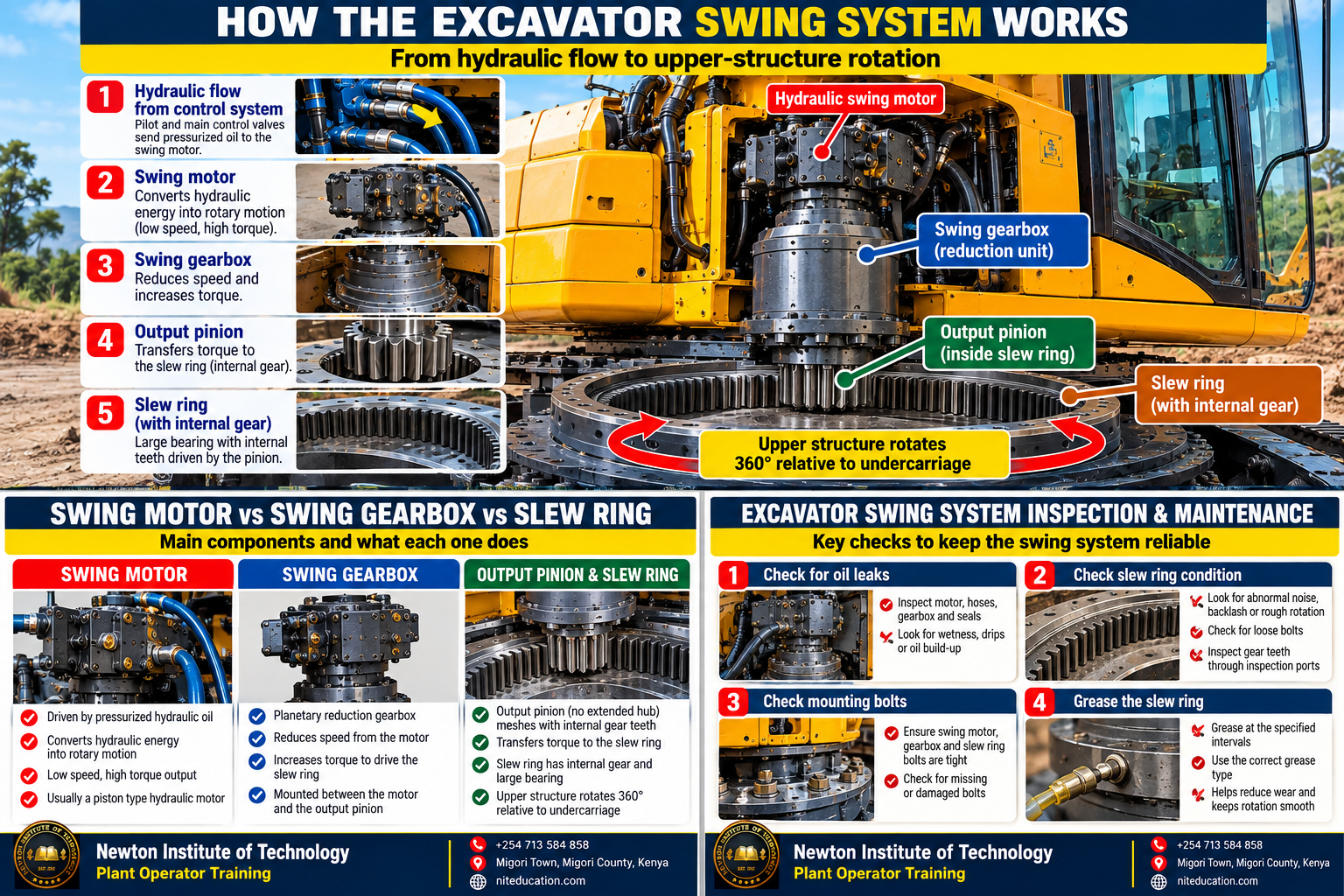
Moving the swing control directs hydraulic power to the swing motor. The motor turns the reduction gearbox. The gearbox reduces speed and increases torque before its output pinion drives the geared section of the slew assembly. The upper structure then rotates relative to the undercarriage.
Caterpillar describes the excavator swing drive as a hydraulic motor and gearbox working together, while its swing-bearing documentation explains that the geared bearing carries axial, radial and tilting loads and meshes with the swing-drive pinion. [1] [3]
Swing motor creates rotation → gearbox multiplies torque → pinion drives the slew gear → slew bearing carries the rotating upper structure.
Know the jobs
Swing motor vs swing gearbox vs slew ring at a glance
| Component | Main job | What a change may feel or sound like |
|---|---|---|
| Swing motor | Converts hydraulic energy into rotation. | Slow, weak, hesitant or uneven swing. |
| Swing gearbox | Reduces motor speed and increases torque. | Rumbling, grinding, knocking or vibration. |
| Output pinion | Transfers gearbox torque to the geared slew ring. | Clicking, backlash or repeated mechanical noise. |
| Slew gear | Receives drive from the pinion. | Noise or roughness associated with a particular rotational position. |
| Slew ring / swing bearing | Carries the upper structure while allowing rotation. | Clunking, increased movement, roughness or bearing-area noise. |
| Swing holding system | Secures the swing drive after controlled deceleration. | Changed stopping or holding behaviour. |
Direction + load + temperature + sound + rotational position. These clues give maintenance personnel a much clearer starting point than a general report that the excavator “does not swing well.”

Follow the energy
How swing power reaches the upper structure
The swing system is a hydraulic-to-mechanical power path:
The hydraulic system supplies controlled oil to the motor. The motor produces rotation. The gearbox lowers speed and raises torque. The pinion transfers that torque into the geared slew assembly while the slew bearing supports the rotating upper structure.
NIT’s Excavator Hydraulic System guide owns the full pump, valve, pressure and oil-flow explanation. Article 161 begins where hydraulic power reaches the swing drive. [5]
Hydraulic side
What the swing motor does
The swing motor converts hydraulic pressure and flow into torque and rotary movement. Caterpillar describes the swing drive as a hydraulic motor coupled with a gearbox, while Komatsu specifies an axial-piston swing motor with a swing holding brake on the PC200-10M0. [1] [4]
Response
Notice how quickly rotation begins after the control is moved.
Direction
Compare left and right swing deliberately.
Warm behaviour
Record whether performance changes once the hydraulic system is warm.
Hydraulic clue
Fresh hydraulic oil or changed hydraulic whine belongs in the report.
Mechanical reduction
What the swing gearbox does
The swing motor creates rotation; the reduction gearbox makes that rotation useful for moving the heavy upper structure. Caterpillar states that the gearbox receives high-speed motor input and uses planetary reduction to produce lower-speed, higher-torque output. Komatsu likewise specifies planetary swing reduction. [2] [4]
A typical planetary swing gearbox uses gears, carriers, shafts, bearings, seals and a lubricated housing arranged to transmit heavy swing torque in a compact assembly.
Listen for new metallic knocking, grinding, rumbling, repeated clicking or vibration through the cab or upper frame. A continuous rumble tells a different story from one knock that returns at the same upper-structure position.
Torque transfer
Output pinion and slew gear
At the output of the gearbox is the pinion. In the internal-geared arrangement illustrated in this guide, the pinion runs inside the slew ring and meshes with its internal gear teeth; it does not need an extended hub below the pinion. The gear mesh transfers gearbox torque into upper-structure rotation. Caterpillar describes the swing bearing as gear-integrated and designed to mesh directly with the swing-drive pinion. [3]
Repeated position
A click or knock that returns once each rotation is valuable evidence.
Backlash
Notice a clear increase in free movement before rotation begins.
Rough sector
Record whether roughness appears only through one part of the swing.
Grease condition
Abnormal grease condition around an approved inspection point is worth recording.
Structural rotating joint
What the slew ring / swing bearing carries
The slew ring sits between the upper structure and undercarriage. Its job is to support the rotating upper structure while allowing full swing movement. Caterpillar identifies three combined load types acting on the bearing during slewing, lifting and digging. [3]
Axial load
Vertical force through the rotating structure.
Radial load
Horizontal force through the bearing.
Moment load
Tilting or overturning force generated by work equipment and load.
Rotation
The bearing maintains the upper-to-lower joint while the house swings.
New clunking, increased upper-to-lower movement, rough rotation, rumbling, unusual vibration or changed grease condition all provide useful operator evidence.
Start · accelerate · decelerate · hold
Swing holding and stopping behaviour
The swing circuit controls acceleration and deceleration, while the holding arrangement secures the swing drive according to the machine design. Komatsu specifies a swing holding brake and planetary swing reduction on the PC200-10M0. [4]
Read the swing from the cab
Swing warning signs: record the pattern, not just the symptom
| What you notice | Pattern to record | System area to examine |
|---|---|---|
| Slow swing | Both directions, one direction, loaded only or hot only. | Hydraulic supply, control circuit, swing motor. |
| Weak swing | Empty bucket versus loaded bucket. | Hydraulic circuit, motor, mechanical resistance. |
| Delayed response | Both directions or one direction. | Hydraulic/control circuit, swing motor. |
| Hydraulic whine | Loaded, unloaded, left or right. | Hydraulic swing circuit. |
| Metallic knock | Continuous, on load change, or once each rotation. | Gearbox, pinion, slew gear, bearing. |
| Grinding | Continuous or only through part of the rotation. | Gearbox, gearing, slew bearing. |
| Rumbling | Changes with speed or load. | Gearbox bearings, slew bearing. |
| Repeated click | Same position every rotation or random. | Pinion / slew gear. |
| Vibration | Starting, steady swing or stopping. | Gearbox, gearing, bearing, mounting. |
| Free movement | Before motion begins or after stopping. | Gear train, bearing, holding system. |
| Hydraulic-oil leak | Cold, warm or while operating. | Swing-motor circuit, hoses, fittings. |
| Gearbox lubricant leak | Seal area, housing or output area. | Swing reduction gearbox. |
| Changed stopping | Abrupt, delayed or inconsistent. | Hydraulic control / holding system. |
| Changed holding | After stopping or while positioned. | Holding system / swing control. |
Machine hours + direction + load + temperature + sound + rotational position. Example: “At 4,216 hours, right swing became slower after warm-up; left swing remained normal; hydraulic whine increased with a loaded bucket.”
Operator value
25 reasons an excavator operator should understand the swing system
The swing system works through most digging and loading cycles. Understanding it improves control, condition awareness, machine care and professional reporting.
Control and productivity
Understand the command
Connect joystick movement with hydraulic flow, motor torque, gear reduction and upper-structure movement.
Know normal response
Establish how the machine normally starts, accelerates, rotates and stops.
Position accurately
Place the bucket over a truck body, trench or spoil point with fewer correction movements.
Smooth the work cycle
Coordinate digging, lifting, swinging, dumping and returning with controlled movement.
Reduce overswing
Use the machine’s response more accurately and waste less movement.
Recognize changes earlier
See slow swing
A speed change stands out quickly when the normal baseline is known.
Compare load response
Separate empty-bucket behaviour from loaded swing behaviour.
Compare left and right
Direction-specific behaviour becomes useful diagnostic evidence.
Notice hesitation
Record the delay between control input and upper-structure movement.
Recognize jerky rotation
A new grab, pause or surge is easy to identify against a known baseline.
Describe the sound
Separate hydraulic whine, continuous rumble and once-per-revolution knock.
Place the vibration
Report whether vibration appears during acceleration, steady swing or stopping.
Protect the machine
Reduce shock loading
Smooth acceleration and deceleration reduce abrupt loading through the swing drivetrain.
Control reversals
Bring the upper structure under control before demanding the opposite swing direction.
Notice backlash
Extra free movement before response becomes a measurable change to report.
Watch the slew bearing
Clunking, roughness, movement and grease condition become everyday observations.
Locate hydraulic leakage
Know where the swing-motor circuit sits and what fresh hydraulic oil means.
Separate gearbox leakage
Distinguish reduction-unit lubricant from hydraulic oil in the same general area.
Inspect and report professionally
Make pre-start purposeful
Know which swing components you are checking and what normal condition looks like.
Monitor while working
Speed, sound, smoothness, vibration and stopping remain part of the shift.
Compare end of shift
Ask what changed between the morning baseline and the final walk-around.
Write specific defects
“Repeated knock at the same swing position” is better evidence than “swing has a noise.”
Know the machine
Professional operation combines controls with basic mechanical awareness.
Use correct terminology
Swing motor, gearbox, pinion and slew ring make handover and maintenance communication clearer.
Build employable judgement
Control, inspect, recognize change and communicate it clearly.

Morning baseline
Swing-system checks during the morning pre-start
This section covers the swing-specific part of the daily inspection. NIT’s full Plant Operator Pre-Start Inspection Checklist owns the whole-machine route. [7]
| Check | What the operator examines |
|---|---|
| Ground beneath the centre | Fresh hydraulic oil, gearbox lubricant, unusual grease or debris. |
| Swing-motor lines and fittings | Fresh wetness, rubbing, cracking or physical damage. |
| Swing gearbox | Fresh lubricant, wet seals, housing damage or oily dirt. |
| Slew-ring area | Grease condition, visible seals, contamination, debris and obvious change. |
| Lubrication lines | Fittings, remote lines and automatic-lubrication lines where fitted. |
| Service record | Any swing-drive oil or lubrication service that is due. |
| Swing clearance | Counterweight, boom, arm and attachment path clear of people and obstacles. |
| Monitor | Any warning, temperature indication or fault message that accompanies changed swing behaviour. |
| Left/right functional check | Response, speed, smoothness, sound, vibration and deceleration in both directions. |
| Morning baseline | How the machine sounds, feels and stops before full production begins. |
NIT’s Excavator Dashboard Warning Lights guide owns detailed monitor-symbol interpretation. [8]
While operating
What to monitor while the excavator is swinging
Speed
Has swing become slower than the morning baseline?
Load response
Does a loaded bucket change swing strength or smoothness?
Direction
Does right swing behave differently from left swing?
Smoothness
Has the movement begun to hesitate, jerk or pulse?
Sound
New knock, grind, rumble, click or hydraulic whine?
Vibration
Anything new through the seat, cab floor or upper frame?
Position
Does the symptom repeat when the upper structure reaches the same point?
Hold
Does deceleration or holding feel different from the morning baseline?
End-of-shift comparison
After work, inspect what changed
The end-of-shift check compares the swing system with its morning condition.
| Recheck | What to record |
|---|---|
| Ground beneath swing area | Fresh fluid that was not present in the morning. |
| Swing-motor area | New wet fittings, oil along a hose or connection leakage. |
| Swing gearbox | Fresh lubricant around the housing, seals or output area. |
| Slew area | New grease movement, contamination, damaged seals or debris. |
| Lubrication lines | Loose fitting, damaged line or leaking connection exposed during the shift. |
| Operating behaviour | Any change in speed, direction, sound, vibration, stopping or holding. |
| Handover | Machine hours + direction + load + temperature + sound + position. |
“At 4,216 hours, right swing became slower after warm-up. Left swing remained normal. Hydraulic whine increased while swinging a loaded bucket.”
Three different service points
Swing bearing, slew gear and swing gearbox are not the same service point
| Component | Main function | Service distinction |
|---|---|---|
| Swing bearing / slew ring | Carries the upper structure and permits rotation. | Uses its specified bearing-lubrication arrangement. |
| Slew gear / swing pinion | Transfers mechanical torque into rotation. | Gear-tooth lubrication is separate from gearbox oil. |
| Swing gearbox | Provides planetary gear reduction. | Uses the specified reduction-unit lubricant and service procedure. |
Komatsu’s PC200-10M0 specification separately lists planetary swing reduction, a grease-bathed swing circle and swing-drive lubricant capacity, demonstrating why these service points must be identified correctly. [4] NIT’s Excavator Greasing Points guide owns the detailed lubrication routine. [6]
Newton Institute of Technology practical
How NIT demonstrates the swing system beside the excavator
NIT’s Excavator Operator Training programme runs for two months and is structured around approximately 70% practical training and 30% theory. Students connect swing-system theory directly with supervised machine observation and operation. [9]
Identify
Separate the undercarriage from the rotating upper structure and locate the slew joint.
Locate
Identify the swing-drive area and distinguish the hydraulic motor from the reduction gearbox.
Trace
Explain the path from hydraulic supply to motor, gearbox, pinion, slew gear and upper-structure rotation.
Operate
Practise progressive start, steady swing, controlled deceleration and accurate stopping.
Listen and feel
Establish normal hydraulic sound, mechanical sound, vibration and stopping behaviour.
Inspect
Follow the swing-specific pre-start route before supervised practical operation.
Report
Describe direction, load, temperature, sound and rotational position precisely.
Compare
Repeat the inspection after operation and identify any change from the morning baseline.
Identify → trace → inspect → operate → listen → compare → report. The objective is to turn component knowledge into practical operator judgement.
Common questions
Excavator swing system FAQs
Is the swing motor the same as the swing gearbox?
No. The swing motor converts hydraulic energy into rotary torque. The gearbox receives that rotation, reduces speed and increases torque before sending power to the output pinion. Caterpillar describes the complete swing drive as a hydraulic motor and gearbox working together. [1]
Is the swing gearbox the same as the slew ring?
No. The gearbox is the reduction unit driven by the hydraulic motor. The slew ring is the large bearing between the upper structure and undercarriage.
Are “slew ring” and “swing bearing” the same thing?
Both terms are commonly used for the large rotational bearing supporting the excavator’s upper structure. Caterpillar uses the term swing bearing and describes it as the rotational joint between the upper structure and undercarriage. [3]
Is the slew gear the same as the slew bearing?
The functions are different. The bearing supports the upper structure and permits rotation; the gear teeth provide the mechanical interface with the swing-drive pinion. Caterpillar describes gear-integrated swing bearings that mesh with the pinion. [3]
What causes an excavator to swing slowly?
Record whether slow swing occurs in both directions or one, loaded or unloaded, cold or warm, and continuously or intermittently. That pattern helps separate hydraulic/control behaviour from mechanical resistance in the swing drive.
Why does an excavator grind while swinging?
Grinding directs inspection toward mechanical areas such as the swing reduction gearbox, pinion/gearing and slew bearing. Also record whether the sound is continuous or appears only at a particular rotational position.
Why does the excavator jerk during swing?
Record when the jerking occurs: starting, steady rotation, direction reversal, deceleration or stopping. That timing gives a clearer picture of the affected part of the swing cycle.
Does the swing gearbox use the same lubricant as the slew bearing?
No. Komatsu separately specifies the swing reduction system, grease-bathed swing-circle lubrication and a dedicated swing-drive lubricant capacity. [4]
Final operator lesson
Know the power path, then read the change
Morning: establish the swing system’s baseline condition.
During work: compare direction, load response, sound, vibration, rotational position and stopping behaviour.
After work: identify what changed and record it clearly.
FLOW → MOTOR → GEARBOX → PINION → SLEW GEAR → ROTATION.
Learn beside the machine
Register for Excavator Operator Training at Newton Institute of Technology
Learn excavator controls, machine systems, pre-start inspection, supervised operation, daily care and practical defect recognition on real training equipment.
Course duration2 months
Training structureApproximately 70% practical · 30% theory
Call / WhatsApp+254 713 584 858
LocationNamba Area, Migori Town · along Migori–Sirare Highway
Websiteniteducation.com
Technical sources
- Caterpillar. 629-6326: Excavator Swing Drive. Describes the excavator swing drive as a hydraulic motor and gearbox and explains torque transfer to the upper structure. Accessed 5 October 2026. parts.cat.com.
- Caterpillar. 467-3079: Swing Drive Transmission Gearbox. Describes planetary reduction from high-speed hydraulic-motor input to lower-speed, higher-torque output. Accessed 5 October 2026. parts.cat.com.
- Caterpillar. 216-8922: Swing Bearing. Describes axial, radial and moment loads, 360-degree upper-structure rotation and gear integration with the swing-drive pinion. Accessed 5 October 2026. parts.cat.com.
- Komatsu. PC200-10M0 Hydraulic Excavator Specification. Specifies an axial-piston swing motor with swing holding brake, planetary swing reduction, grease-bathed swing circle and dedicated swing-drive lubricant capacity. Accessed 5 October 2026. komatsu.jp.
Related Newton Institute of Technology guides
- Newton Institute of Technology. Excavator Hydraulic System: Components, Oil Flow & Checks. Parent guide for pumps, control valves, hydraulic flow and actuator operation. Accessed 5 October 2026. niteducation.com.
- Newton Institute of Technology. Excavator Greasing Points: Boom, Arm, Bucket & Swing Bearing. Detailed lubrication guide for excavator pivots, swing bearing and swing gear. Accessed 5 October 2026. niteducation.com.
- Newton Institute of Technology. Plant Operator Pre-Start Inspection Checklist Kenya. Whole-machine pre-start route and defect-reporting procedure. Accessed 5 October 2026. niteducation.com.
- Newton Institute of Technology. Excavator Warning Lights & Dashboard Symbols: Meanings. Detailed monitor, warning and fault-code interpretation. Accessed 5 October 2026. niteducation.com.
- Newton Institute of Technology. Excavator Operator Training in Kenya. Two-month course with approximately 70% practical training and 30% theory. Accessed 5 October 2026. niteducation.com.
Prepared by: Newton Institute of Technology Editorial Team · Institutional / technical review: Engineer Simon Barongo · Updated: 5 October 2026.