

Excavator Parts and Functions G4 Excavator
Excavator Parts
& Functions
Basic mechanics · every plant operator should know
The practical goal is to know what each system is meant to do, notice when it behaves differently and give a clear defect report before a small problem becomes a serious one.
Operator-level machine knowledge
Stand beside a crawler excavator and the machine can look like one complicated mass of steel, pipes and hoses. From the operator’s seat, however, it becomes easier to read. Most components belong to one of four groups: the working equipment, the upper structure, the undercarriage, or the hydraulic and control system that makes everything move.
That is the useful way to learn excavator parts and functions. An operator does not need to memorise a workshop manual.
In Kenya’s plant-operator classification, the excavator is identified as G4. This guide deals with operator-level machine knowledge. It does not replace supervised practical training, the manual for the particular excavator, site procedures or repairs by authorised maintenance personnel.
What are the main parts of an excavator?
The main parts are the tracks and undercarriage; the revolving upper structure or house; the cab, engine, pumps and counterweight; the boom, arm, bucket and cylinders; and the swing and travel systems. Pressurised hydraulic oil connects their work. The engine turns the pumps, valves direct the oil, and cylinders or motors turn that flow into movement.
| Machine group | Parts you will find there | Main job |
|---|---|---|
| Working equipment | Boom, arm, bucket, linkage, pins and cylinders | Reaches, digs, lifts and places material |
| Upper structure | Cab, engine, pumps, tanks, upper frame and counterweight | Carries the operator and power systems on a rotating platform |
| Swing system | Swing motor, reduction gear, slew ring and centre swivel | Turns the upper structure and carries services across the rotating joint |
| Undercarriage | Track frames, tracks, rollers, idlers, sprockets and final drives | Supports, stabilises and moves the excavator |
| Hydraulic and control system | Reservoir, pumps, valves, hoses, cylinders, motors and controls | Sends and controls power around the machine |
One habit makes this knowledge useful: connect every part to three questions.
Start with a walk around the machine
A beginner often learns the parts as a list. On site, a walk-around sequence is easier to remember.
Begin at the bucket and follow the steelwork back through the arm and boom. Look at the cylinders, hose routing, pins and retainers as you go. Continue around the upper structure, allowing for the full rear-swing area. Then inspect the tracks and visible undercarriage components on both sides. Finish at the access steps, cab and the service points assigned to the operator.
This sequence does two things. It gives each component a physical location, and it makes comparison easier. If the left track looks or feels different from the right, or one boom pin area has fresh metal dust while the others do not, the difference is worth reporting. The operator’s role is to observe accurately—not to invent a diagnosis.
Boom, arm and bucket: the working equipment
These are the excavator parts most people recognise, but their jobs are not interchangeable.
Boom
The boom is the large steel member hinged to the upper frame. It raises and lowers the rest of the front equipment, providing much of the machine’s height and reach. Depending on the design, one or two cylinders move it.
Look along the structure rather than only at the paint. Visible cracking, distortion, a damaged weld area, missing retaining hardware or a new knock at a pivot needs attention. If the boom moves unexpectedly or damage is visible, lower the attachment to a safe position and report it.
Arm, dipper or stick
The section between the boom and the bucket is called the arm, dipper or stick. Moving it in or out changes the bucket’s reach and digging position. The boom mainly changes height; the arm brings the bucket through the material or pushes it away from the machine.
Smooth digging comes from blending boom, arm and bucket movement. Pulling only with the arm can waste effort and produce a rough cycle. During inspection, notice damaged hose supports, loose retainers, side movement at the joints, distortion or a repeated clunk.
Bucket and attachment connection
The bucket enters, carries and releases material. Its shape, capacity and cutting edge must suit the work. A narrow trenching bucket and a wide grading bucket behave differently even when fitted to the same excavator.
Operator-visible bucket parts include the shell, cutting edge, side plates, teeth, wear plates, hinge points and linkage. Where a coupler is fitted, the attachment connection and its locking device are equally important. A missing tooth, cracked shell, loose retainer or insecure attachment is not just a productivity issue; a loose component may fall into the trench, truck or work area.
Confirm the connection using the approved procedure for that machine. Looking at a coupler from the cab is not always enough.
Cylinders, linkage, pins and bushes
Hydraulic cylinders move the boom, arm and bucket. Oil pressure acts on a piston inside the cylinder, extending or retracting the exposed rod. That straight-line movement is then transferred to the connected steelwork.
At the bucket, linkage changes the cylinder’s movement into curl and dump motion. Pins form the moving joints, while bushes provide replaceable bearing surfaces. These apparently small parts carry heavy, repeated loads.
During a walk-around, check for oil around rods, seals and hose connections; scoring, rust or impact damage on exposed rods; loose or missing pin retainers; dry or damaged grease points; and excessive movement at a joint. Fresh metal dust or a change from a quiet pivot to a sharp knock can be an early clue that something has changed.
Never put a finger into a joint to test play. Never use a hand to search for a fine hydraulic leak. Oil escaping under pressure can penetrate skin even when the leak looks small. Keep clear, secure the machine as instructed and report the defect.
Excavator external components: functions and warning signs
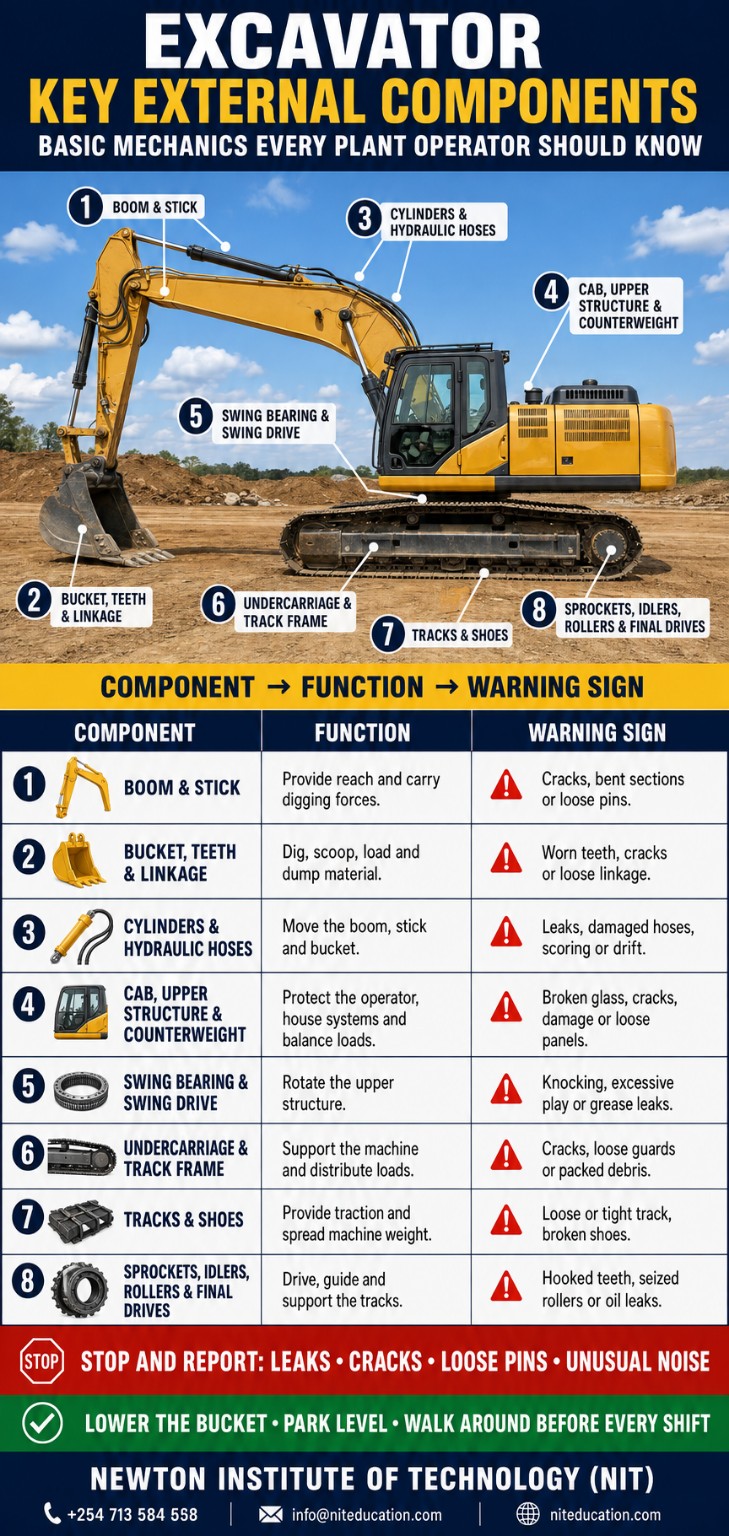
Upper structure, counterweight and swing system
Upper structure and swing
The upper structure—also called the house or revolving frame—sits above the undercarriage. It normally carries the cab, engine, hydraulic pumps, tanks, cooling system, main control valve and counterweight. It can turn while the tracks stay in one position.
That rotation is produced by the swing motor and its reduction gear. They drive the upper structure through the slew ring, a large geared bearing between the upper and lower halves of the machine. A centre swivel, or rotary manifold, lets hydraulic services cross the rotating joint without ordinary hoses winding around it.
From the seat, swing should begin, move and stop in a controlled way. Grinding, repeated knocking, jerky rotation, delayed response, unexpected free movement or leakage around the centre area calls for a safe stop and a clear report. The swing gear, slew ring and centre swivel are not operator repair items.
Counterweight and rear-swing area
The counterweight at the rear offsets part of the load created when the front equipment reaches forward. It improves balance; it does not make the excavator impossible to tip. Stability still changes with the load, attachment, working radius, slope, ground strength and machine position.
The counterweight also creates a rear-swing hazard that is easy to forget when watching the bucket. People and objects must remain outside the full swing area. Never allow anyone to stand between the rear of the machine and a fixed object while the excavator is operating.
Undercarriage: support, stability and travel
The undercarriage carries the entire machine and resists digging forces. On a crawler excavator it includes the track frames, track assemblies, rollers, idlers, sprockets, travel motors and final drives.
Tracks spread the excavator’s weight and provide traction, but they do not make every surface safe. A trench edge, filled excavation, soft shoulder or steep cross-slope can fail beneath a tracked machine. Ground support is a site condition, not a feature the tracks can guarantee.
Track shoes, links and chain
Track shoes are the plates in contact with the ground. They are fastened to linked chains that run around the undercarriage. Check for badly bent or cracked shoes, loose or missing bolts, damaged links, packed material and obvious differences between the two track assemblies.
Mud and stone can build up around the undercarriage, increasing wear or interfering with movement. Cleaning must follow the site’s safe method with the machine secured. No one should work near a moving track.
Rollers and idlers
Lower rollers carry the machine’s weight and guide the track along the bottom of the frame. Carrier rollers, where fitted, support the returning track above. The front idler guides the track and forms part of the tensioning arrangement.
Watch for leakage, obvious damage, unusual heat or noise, and a track that no longer runs correctly. Track tension is machine-specific: too loose may encourage derailment; too tight increases wear and load. Use the stated inspection method instead of judging one excavator by the setting on another.
Sprockets, travel motors and final drives
The sprocket engages the chain and pulls the track around the undercarriage. A hydraulic travel motor turns it through the final drive. Each side has its own drive, so changing the relative speed or direction of the tracks steers the excavator.
Report oil around a final drive, a new travel noise, loss of power on one side, repeated pulling to one side or a clear difference in track response. Describe when the symptom appears rather than guessing which internal component has failed.
The upper structure can face either way over the tracks. After it has turned, the travel controls may move the excavator in a direction a beginner does not expect. Check the undercarriage orientation before travelling.
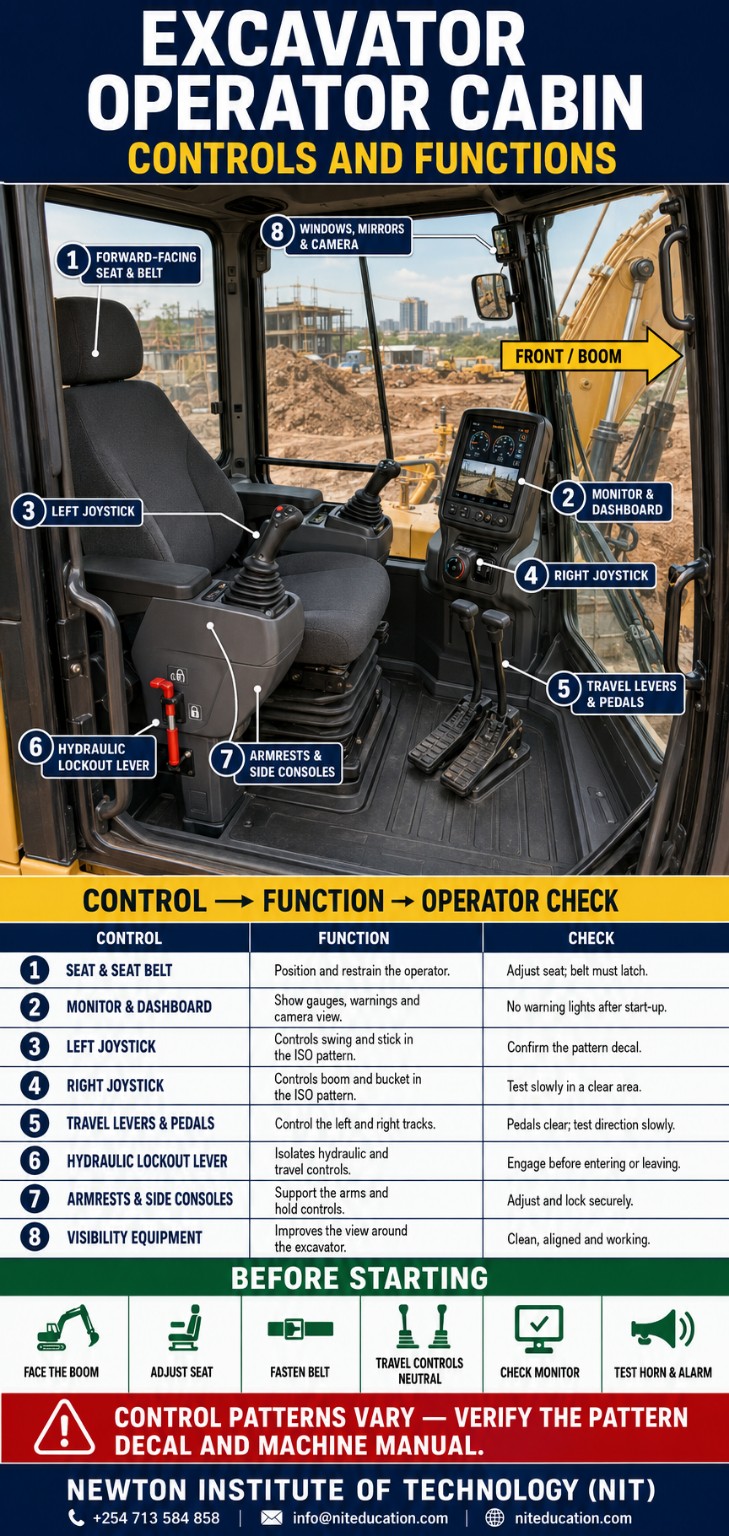
Inside the excavator cab
The cab is where the operator turns intention into machine movement. Layouts vary, and some control patterns are selectable. Before moving an unfamiliar excavator, verify the pattern from its instructions and decals, then test each function slowly in a clear area under the required supervision.
Seat, restraint and access
Adjust the seat so the pedals and joysticks can be reached without leaning or stretching, and use the fitted restraint. Clean steps and handholds matter because a poor entry or exit can cause an injury before the engine even starts.
Joysticks, travel controls and auxiliary controls
The joysticks normally command the boom, arm, bucket and swing. Travel levers or pedals command the left and right tracks. Separate pedals, switches or rollers may control an attachment or auxiliary circuit. Familiar-looking controls are not proof that two machines respond in exactly the same way.
Monitor, gauges and warning indicators
The display may show fuel, coolant temperature, hydraulic temperature, engine speed, working mode, operating hours and fault warnings. Pay attention during start-up. A message that does not clear, a gauge moving outside its normal range or a new alarm should be understood before work continues.
Hydraulic lockout and visibility aids
Many excavators have a lockout or safety lever intended to reduce unintended hydraulic movement while the operator is entering, leaving or not ready to work. Never bypass it. Its exact action varies, so follow the machine instructions.
Windows, mirrors, cameras, the horn and travel alarm support awareness; none removes a blind spot. Keep them clean and usable, then continue scanning the work area, swing area and travel path.
Excavator operator cabin: controls and functions
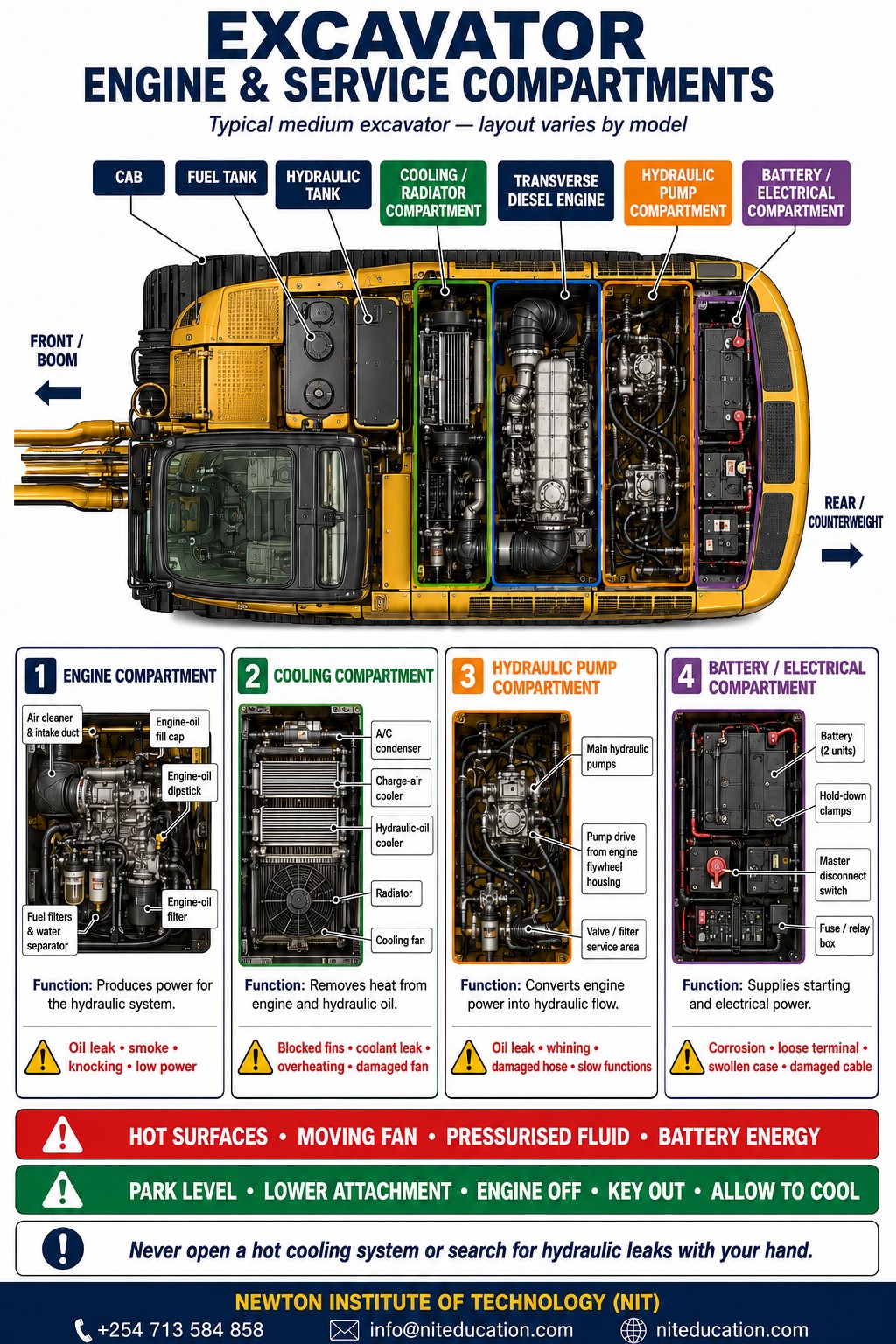
Inside the engine compartment
Open panels only at the approved stage of the inspection, with the machine parked and secured as required. Component positions differ, but the following systems are commonly visible or accessible.
Engine and hydraulic pumps
The diesel engine supplies rotating mechanical power. It drives the hydraulic pumps and supports the electrical and cooling systems. Difficult starting, abnormal knocking, loss of power, heavy smoke or an engine warning deserves a report. Smoke colour by itself is not a complete diagnosis; note whether the engine was cold or warm, what load it was carrying and which warning appeared.
The pumps supply oil flow to the working circuits. They do not simply “send strength” to the boom. Pressure develops as the system meets resistance, while flow has a strong effect on movement speed. Weak or slow response may have several causes, including temperature, working mode, shared flow or a defect. Pump and relief settings are not adjusted by the operator.
Air intake and cooling system
The air cleaner protects the engine from dust. Check the restriction indicator where fitted and inspect accessible hoses or clips by the approved method. Do not run the engine with filtration parts removed.
The cooling pack may include a radiator, hydraulic-oil cooler, charge-air cooler, fan and screens. Blocked fins, coolant loss or damage can lead to overheating. Never open a hot pressurised cooling system. Let it cool and use the specified procedure.
Fuel, lubrication and electrical items
Fuel filters and a water separator help keep contamination away from the engine. The engine-oil dipstick, filter and filling point belong to the lubrication system. Check and service only the items assigned to the operator, at the stated machine position and interval, using the correct fluid.
Batteries, wiring, fuses and control modules support starting, sensors, lights and alarms. Damaged visible wiring, corrosion, loose covers, unusual heat or a sharp smell needs attention. Batteries can release explosive gas and contain corrosive electrolyte, so improvised connections and unauthorised testing are unsafe.
Belts, pulleys and fans may still be exposed behind service panels. Inspect them only with the engine stopped and the required isolation complete. A running compartment is no place for hands, tools or loose clothing.
Excavator engine and service compartments
How the hydraulic system makes the excavator move
The simplest way to understand the hydraulics is to follow the oil path:
Pressure and flow are related, but they are not the same thing. Pressure is associated with the force available against resistance. Flow strongly affects speed. That is why “the hydraulics are weak” is not a useful defect report on its own.
Say what changed. Did only the arm slow down, or did every function? Was the oil cold? Did the problem appear only when two movements were combined? Was there a warning, leak, unusual sound or rise in temperature? Those observations help a technician narrow the fault without asking the operator to diagnose inside the system.
Hoses and pipes carry oil between components. They should be supported, protected from rubbing and free from visible leaks, bulges or crushed sections. Treat any suspected pressurised leak as hazardous.
How the parts work together during one digging cycle
Picture an ordinary bucket cycle. The undercarriage provides the base while the engine drives the pumps. A movement at the joystick directs oil through the control system. The boom and arm position the bucket, the bucket curls through the material, and the front equipment raises the load. The swing motor then turns the upper structure through the slew ring. At the placement point, the bucket opens and the machine returns for the next pass.
Several functions often move together. They share the available hydraulic flow, so a small, predictable change in speed during combined movement may be normal. A sudden new delay, violent movement, loss of one function or response that keeps worsening is different. Stop at a safe point and report it.
From the seat, good machine knowledge becomes a rhythm: listen, feel, watch. Listen for a new knock or grinding sound. Feel for a delay, jerk or weak side. Watch the display, the attachment and the ground supporting the tracks. That is more useful than knowing a part name but missing the change in its behaviour.
Part, function and warning-sign reference
| Part | Function | Operator observation worth reporting |
|---|---|---|
| Boom | Raises and supports the front equipment | Crack, distortion, new knock or leak |
| Arm/dipper | Controls reach and digging position | Excessive side play, damage or repeated clunk |
| Bucket | Enters and carries material | Missing tooth, cracked shell or insecure connection |
| Pins and bushes | Form the moving joints | Missing retainer, fresh metal dust or excessive looseness |
| Hydraulic cylinders | Produce straight-line movement | Oil leak, scored rod or unexpected drift |
| Counterweight | Helps balance the extended front | Impact damage or unsafe rear clearance |
| Swing system | Rotates the upper structure | Grinding, jerky rotation or unexpected movement |
| Tracks | Support and move the excavator | Loose parts, damaged shoe or derailment risk |
| Rollers and idlers | Support and guide each track | Leak, seizure, heat or misalignment |
| Final drives | Turn the tracks | Visible oil, unusual noise or one weak side |
| Engine | Supplies mechanical power | Overheating, warning, abnormal smoke or power loss |
| Cooling system | Removes heat | Rising temperature, blockage or coolant loss |
| Hydraulic system | Transmits controlled power | Jerky or slow movement, heat or pressurised leak |
| Cab controls | Send operator commands | Sticking control or unexpected function |
| Display and alarms | Report machine condition | Warning that remains active or unexplained |
Where the operator’s responsibility stops
Basic mechanics does not mean opening every system. The operator observes, completes authorised daily care and communicates defects. Typical duties include the walk-around, specified fluid checks, inspection of visible hoses and attachments, cleaning visibility aids, greasing assigned points and monitoring sound, smell, smoke, temperature, vibration and response.
Pressurised hydraulic testing, relief-valve adjustment, structural welding, high-pressure hose repair, work beneath unsupported equipment and dismantling of a final drive, swing gear, slew ring or centre swivel belong to trained and authorised personnel. Safety devices and alarms must never be bypassed.
Safety connections an operator should not miss
Knowing the component names helps explain several everyday hazards:
- The counterweight can strike or trap someone even while the bucket is clear.
- The boom and arm can enter the space around overhead services.
- The bucket can contact buried electricity, water, gas or communication services.
- The undercarriage can lose support near trenches, filled ground and soft shoulders.
- The upper structure can turn over stationary tracks, changing the expected travel direction.
- The hydraulic system can retain pressure after the engine stops.
- An attachment can move or fall if it is unsupported or incorrectly connected.
Machine knowledge improves hazard recognition. It does not replace an exclusion zone, service identification, ground assessment, a trained spotter where required, or the approved excavation and lifting plan.
For a fuller inspection sequence, use NIT’s Plant Operator Training Materials Kenya guide. The Plant Operator Course Syllabus in Kenya shows where machine knowledge fits within the wider learning programme.
Frequently asked questions
What are the four main groups of excavator parts?
They are the working equipment, upper structure, undercarriage, and hydraulic/control system. The swing components connect the rotating upper structure to the lower machine.
What is the difference between the boom and the arm?
The boom is hinged to the upper structure and mainly changes the height of the front equipment. The arm—also called the dipper or stick—is hinged to the boom and changes the bucket’s reach and digging position.
What allows an excavator to rotate?
A hydraulic swing motor and reduction gear turn the upper structure through the slew ring. A centre swivel carries hydraulic services between the rotating upper structure and the undercarriage.
What drives the excavator tracks?
Each track is normally driven by a hydraulic travel motor through a final drive and sprocket. Controlling the two tracks independently allows the machine to travel and turn.
Does the counterweight prevent an excavator from tipping?
No. It offsets part of the load created by the extended front equipment, but stability still depends on working radius, load, attachment, slope, ground strength and machine position.
Can an operator repair a hydraulic leak?
Only if that person is trained, authorised and following the correct isolation and repair procedure. Never search for a suspected high-pressure leak with a hand. Secure the machine, keep clear and report it.
Are all excavator control patterns the same?
No. Patterns and auxiliary controls can vary or may be selectable. Check the machine instructions and decals, then test each function slowly in a clear area before work.
Is an excavator the same as a track shovel?
No. A conventional excavator has a boom, arm and bucket on a revolving upper structure and can dig below its standing level. A track shovel is a tracked loader with lift arms and a front loader bucket. Their layouts and work cycles are different.
The lesson to carry into the cab
You do not need to rebuild a pump to operate with mechanical awareness. You need to know which system is working, what normal behaviour feels like and which change means the excavator should be stopped.
Learn the machine in groups. Trace power from the engine to the pumps, then through the valves to a cylinder or motor. Watch how the boom, arm, bucket, swing and tracks work together. Finally, connect each component to an operator check and a clear warning sign.
For practical training, course duration and admissions information, read Excavator Operator Training in Kenya. For current licence eligibility and endorsement guidance, use NIT’s NTSA Category G Plant Operator Licence Kenya guide.