

NIT Excavator Operator Guide G4 track sag · operator checks
How to Check Excavator Track Tension
Track Sag, Loose vs Tight Tracks & Operator Checks
Inspect → clean → measure → compare → monitor → report
A practical operator guide to excavator track sag: how to prepare the track, measure from the correct reference points, recognise loose and tight conditions, and compare the track before, during and after work.
Correct tension is a measured condition, not a visual guess.
How do you check excavator track tension?
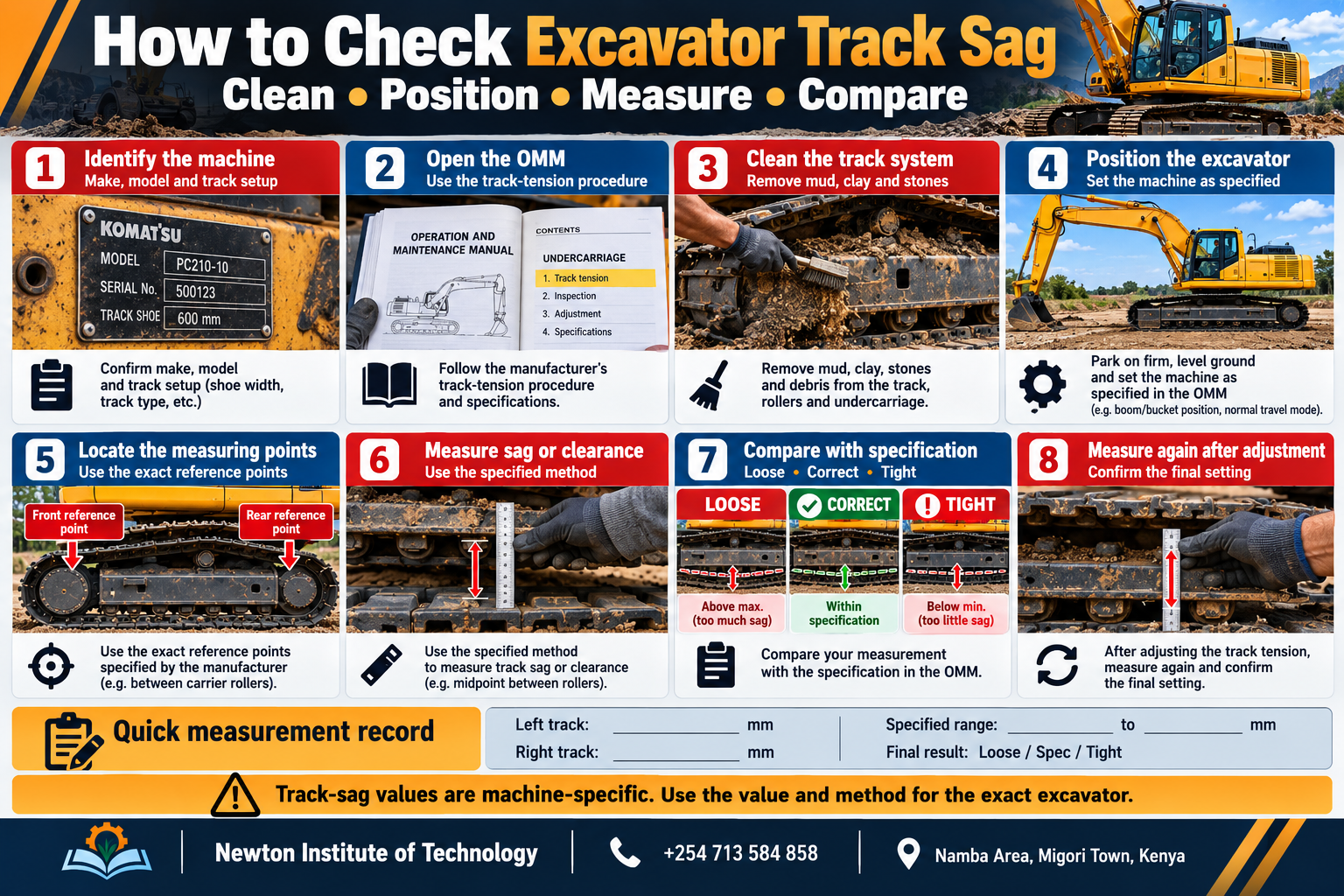
Identify the exact excavator, clean the track system, position the machine as specified in its Operation and Maintenance Manual (OMM), measure sag or clearance from the stated reference points, and compare the reading with the permitted range. Record the left and right tracks separately.
After an authorised adjustment, reposition or settle the track as specified and measure again. Caterpillar’s steel-track guidance uses the same measure, adjust and remeasure principle. [1]
Measurement method + measuring points + permitted range belong together.
Start with the principle
What track tension and track sag mean
Track tension is the controlled tightness of the crawler track around the drive sprocket, front idler, rollers, links and track shoes. The track adjuster changes the position of the front idler, which changes the amount of controlled slack in the track. Hitachi describes the idler and adjuster as part of the system used to guide the track and maintain tension. [3]
Track sag is the measurable slack used to assess that tension. Some machines use a straightedge or string method; others use a raised-track clearance method. Caterpillar and Develon publish different arrangements, so the method and its specification must be used as a pair. [1] [6]
Read the condition
Loose vs correct vs tight excavator tracks
| Track condition | Measurement | What the operator may notice | Practical response |
|---|---|---|---|
| Too loose | Sag or clearance exceeds specification. | Excess movement, slapping, poor engagement or track movement away from its normal path. | Clean, measure and correct according to the machine procedure. |
| Correct | Reading falls within specification. | Controlled slack and normal track behaviour. | Record and continue monitoring. |
| Too tight | Sag or clearance is below specification. | Track appears unusually taut and running-gear loading increases. | Return the track to the specified range. |
| Not confirmed | Only a visual judgement has been made. | Dirt, machine position or ground conditions may affect appearance. | Prepare and measure the track. |
Caterpillar notes that excessive track tension accelerates wear while excessive looseness can allow indexing or jumping. Bobcat likewise emphasizes correct tension rather than running too loose or too tight. [1] [5]

Operator value
25 reasons a plant operator needs this knowledge
The operator sees the excavator before work, feels how it travels during the shift and can compare the track condition again after work. That makes operator observation one of the earliest sources of useful track-condition information.
Protect the running gear
Recognise excessive sag
Notice a loose track early enough to measure it before the condition develops further.
Recognise excessive tightness
A very taut track can increase friction and loading through the crawler system. [2] [4]
Reduce de-tracking risk
Excessive slack increases unwanted track movement and the chance of losing the track. [1] [2]
Protect track links
Correct tension keeps track-chain loading closer to the intended condition.
Protect pins and bushings
These joints articulate continuously as the chain travels around the running gear.
Protect sprocket engagement
Correct position helps the chain engage the sprocket consistently.
Understand the idler
Link front-idler position with the adjuster and the amount of track slack.
Read the machine better
Interpret track slapping
A changed sound has meaning when the operator knows the normal baseline.
Compare left and right
A difference between the two tracks directs attention to a developing change.
Read mud packing
Hitachi notes that packed material can increase effective track tension. [2]
Read site conditions
Track behaviour can change as the machine moves from dry ground into sticky material.
Read travel behaviour
New vibration, resistance or track movement can trigger a targeted inspection.
Spot recurring looseness
A setting that will not hold provides useful maintenance evidence.
Inspect properly
Improve the morning check
Know what track-specific condition to compare before work starts.
Know when to measure
Move from visual observation to measurement when the condition has changed.
Use the OMM
Find the machine-specific track-tension procedure rather than memorising a universal number.
Find the right points
Use the reference points specified for the measurement method.
Match method to range
Keep the checking method and its permitted value together.
Record both tracks
Left and right measurements make the condition easier to compare.
Confirm the adjustment
Caterpillar directs operators to remeasure after track adjustment. [1]
Operate professionally
Improve defect reporting
A measured condition gives maintenance personnel useful evidence.
Reduce avoidable downtime
Volvo links systematic undercarriage inspection with improved machine availability. [4]
Protect costly components
Track care supports the wider undercarriage, a major wear area on tracked machines. [3]
Understand adjuster pressure
Know that the tensioning fitting controls a pressurised mechanism, not normal pin lubrication.
Build operator judgement
Professional operation combines controls, inspection, measurement and clear reporting.
Field procedure
How to check and measure excavator track sag
The exact dimension and machine position come from the OMM. The operator workflow stays consistent.
Identify the machine
Confirm make, model, track configuration and applicable serial-number range where used.
Find the procedure
Note machine position, travel direction where specified, reference points, range and adjustment method.
Clean the track
Remove packed material around the chain, idler, sprocket, rollers and track frame. [2] [6]
Position the excavator
Set the machine exactly as required; machine position forms part of the measurement.
Locate reference points
Use the exact surfaces or points stated by the manufacturer.
Measure and record
Use the specified straightedge, string, ruler, tape or other stated method.
Compare with specification
Above permitted sag = loose; inside range = correct; below permitted sag = tight.
Check the other track
Record left and right independently. Volvo inspection guidance also separates both sides. [4]
Adjust where required
Use the procedure authorised for that machine and worksite.
Measure again
Settle or reposition the track as specified and confirm the finished measurement. [1]
Working conditions
How mud, clay and changing ground conditions affect tension
An excavator may begin the morning with clean tracks and correct sag, then move into sticky clay or shale-like material that packs around the chain and track frame. Hitachi explains that packed material can increase track tension and component loading. [2] [3]
Condition changed → clean the track → reassess the sag → measure where required. This separates material packing from the actual adjuster setting.
Morning baseline
Morning pre-start checks for the track-tension system
This is the track-tension portion of the morning inspection. NIT’s Plant Operator Pre-Start Inspection Checklist owns the whole-machine route. [8]
| Check | What the operator examines |
|---|---|
| Previous shift | Any adjustment, unusual movement, excessive sag, de-tracking, noise or heavy material buildup. |
| Left vs right sag | Notice whether one track appears to carry clearly more or less slack. |
| Material packing | Mud, clay, stones or compacted material around sprocket, idler, rollers, frame and chain. |
| Track seating | Track positioned normally around the sprocket, idler and rollers. |
| Adjuster area | Fresh grease, visible damage or a clear change from the previous inspection. |
| Measurement decision | Measure when the schedule requires it, sag changed, the tracks differ, an adjustment was made or working conditions justify another check. |
| Recorded result | Left reading, right reading, specified range and loose / within spec / tight result. |
While operating
What to monitor while the excavator is travelling
Noise
Listen for a new slap, knock, click or squeal.
Vibration
Notice new roughness or vibration through the machine.
Sag
Watch for a visible change in track slack where the track can be observed safely.
Material buildup
Notice increasing mud, clay or stone packing as site conditions change.
Left-right difference
Compare whether one side begins behaving differently from the other.
Change
If track behaviour changes materially, stop at a suitable location and inspect again.
Caterpillar includes unusual track sound and excessive sag among conditions worth investigating during track maintenance. [1]
End-of-shift comparison
After work, ask one question: what changed?
| Recheck | What to record |
|---|---|
| Track before cleaning | Unusual sag, displacement or material buildup created during the shift. |
| Cleaning | Remove mud, clay, stones and compacted soil from the crawler system. |
| Left vs right after cleaning | Any meaningful difference in clean-track sag or position. |
| Adjuster area | Fresh grease or another visible change. |
| Measurement | Take another reading when sag changed, travel behaviour was abnormal or the track was adjusted. |
| Handover | Side + measured condition + specification + action already taken. |
Hitachi recommends regular cleaning because packed material increases friction and interferes with normal undercarriage operation. [3]

Idler and adjuster
How the track adjuster changes tension
The track adjuster changes the position of the front idler. In practical terms:
Hitachi describes the idler as being connected to the track-adjuster assembly, while Develon documents a hydraulic track adjuster and recoil mechanism in excavators. [3] [6]
The adjuster fitting controls a pressurised track-tensioning mechanism. Develon states that grease in the track-adjustment system is held under high pressure and specifies controlled procedures for releasing it. Follow the procedure for the exact machine, use the specified PPE and keep clear of the grease discharge path. [6]
When the setting will not hold
Recurring looseness is maintenance evidence
If a track is cleaned, measured, adjusted into specification and then returns to excessive sag after operation, the repeated change deserves further inspection. Possible areas include track-chain wear, pins and bushings, the adjuster, grease retention and idler movement.
Develon notes in its excavator documentation that continued looseness after adjustment can indicate excessive pin and bushing wear on the machine covered by that manual. [6]
“Right track was adjusted and confirmed within specification. Excessive sag returned after operation. Track chain and tensioning system require further inspection.”
Common mistakes
Better track-tension practice
| Mistake | Better practice |
|---|---|
| Tightening until the track appears straight | Set the track to the specified measurement. |
| Using one sag figure for different excavators | Use the exact model’s OMM. |
| Measuring through heavy mud buildup | Clean the track first. |
| Measuring from convenient-looking points | Use the specified references. |
| Mixing a method with a figure from another procedure | Keep the method and range together. |
| Checking only one track | Record both sides. |
| Adjusting without measuring again | Confirm the final reading. |
| Repeatedly correcting recurring looseness | Record the pattern and inspect the underlying cause. |
| Ignoring mud and clay effects | Clean and reassess the track. |
| Treating the adjuster as a normal lubrication point | Use the track-tension procedure. |
Newton Institute of Technology practical
How NIT demonstrates track-tension checking beside the excavator
NIT’s Excavator Operator Training programme runs for two months and is structured around approximately 70% practical training and 30% theory. Students connect track-tension theory directly with supervised machine inspection and operation. [9]
Identify
Name the sprocket, front idler, chain, shoes, rollers and track adjuster.
Compare
Observe both tracks and describe the visible condition before diagnosis.
Clean
Remove material around the chain, sprocket, idler and measurement area.
Use the OMM
Find machine position, measurement method, reference points and permitted range.
Position
Set the training excavator exactly as the procedure requires.
Measure
Take and record left and right readings before interpreting the result.
Interpret
Classify each reading as loose, within specification or tight.
Observe the adjuster
Relate idler position to changing track slack and confirm with another measurement.
Travel
Listen for track noise, feel travel response and watch material buildup.
Report
Recheck the machine and complete a clear operator handover.
NIT practical track-tension record
| Item | Left track | Right track |
|---|---|---|
| Measurement method | OMM method | OMM method |
| Initial reading | ___ mm | ___ mm |
| Specified minimum | ___ mm | ___ mm |
| Specified maximum | ___ mm | ___ mm |
| Initial result | Loose / Spec / Tight | Loose / Spec / Tight |
| Reading after cleaning, where changed | ___ mm | ___ mm |
| Reading after adjustment | ___ mm | ___ mm |
| Final result | ___ | ___ |
Identify → compare → clean → use the OMM → position → measure → interpret → operate → recheck → report.
At-a-glance routine
Operator quick-reference
| When | What to check | What to do |
|---|---|---|
| Morning | Left/right sag, buildup, seating, adjuster area. | Clean and measure where required. |
| Before measuring | Machine, OMM method, reference points. | Position correctly. |
| Measurement | Left reading, right reading, specified range. | Compare and record. |
| After adjustment | Final sag or clearance. | Measure again. |
| During work | Slapping, vibration, noise, movement, material packing. | Inspect when behaviour changes. |
| After work | Clean-track sag, left/right difference, adjuster area. | Record and hand over. |
Common questions
Excavator track-tension FAQs
How much sag should an excavator track have?
Should an excavator track be completely tight?
What happens when an excavator track is too loose?
What happens when the track is too tight?
Can mud make an excavator track tighter?
Should both tracks be measured?
Yes. Record left and right independently and compare each with the machine specification. Volvo inspection guidance also records both sides independently. [4]
What does it mean when a track becomes loose again after adjustment?
A recurring loss of tension can indicate wear or another condition in the track or tensioning system. Record the measured change and refer the system for further inspection. [6]
Final operator lesson
Confirm track tension by measurement
Morning: establish the clean track condition and compare both sides.
Measure: use the exact machine method, points and permitted range.
During work: monitor noise, vibration, sag and material buildup.
After work: clean, compare again and report what changed.
INSPECT → CLEAN → MEASURE → COMPARE → MONITOR → REPORT.
Learn beside the machine
Register for Excavator Operator Training at Newton Institute of Technology
Build practical excavator operating skills through supervised machine inspection, controlled operation, track-tension awareness and operator-level machine care.
Course duration2 months
Training structureApproximately 70% practical · 30% theory
Call / WhatsApp+254 713 584 858
LocationNamba Area, Migori Town · along Migori–Sirare Highway
Websiteniteducation.com
Technical references
- Caterpillar. How to Maintain Cat® Steel Tracks. Track cleaning, inspection, sag measurement, loose/tight conditions and remeasurement after adjustment. Accessed 30 September 2026. cat.com.
- Hitachi Construction Machinery. Keeping on Track. Model-specific track-tension measurements, effects of loose/tight settings and changing ground conditions. Accessed 30 September 2026. hitachicm.com.
- Hitachi Construction Machinery. Undercarriage 101: How to Extend the Life of Your Machinery. Idler/adjuster relationship, cleaning, daily inspection and operating-environment effects. Accessed 30 September 2026. hitachicm.com.
- Volvo Construction Equipment. How to Inspect Your Machine’s Undercarriage — and Why It Matters. Left/right track inspection, undercarriage care and operator-manual specifications. Accessed 30 September 2026. volvoce.com.
- Bobcat. Check Compact Excavator Track Tension. Correct track sag and loose-versus-tight track condition. Accessed 30 September 2026. bobcat.com.
- Develon. Excavator track-tension service documentation. Machine-specific measurement, cleaning before measurement, adjuster operation and high-pressure grease procedure. Accessed 30 September 2026. eu.develon-ce.com.
Related Newton Institute of Technology guides
- Newton Institute of Technology. Excavator Undercarriage: Parts, Track Tension, Wear & Checks. Parent guide for undercarriage components, wear and system-wide inspection. Accessed 30 September 2026. niteducation.com.
- Newton Institute of Technology. Plant Operator Pre-Start Inspection Checklist Kenya. Whole-machine pre-start route and defect-reporting procedure. Accessed 30 September 2026. niteducation.com.
- Newton Institute of Technology. Excavator Operator Training in Kenya. Two-month course with approximately 70% practical training and 30% theory. Accessed 30 September 2026. niteducation.com.
Prepared by: Newton Institute of Technology Editorial Team · Institutional / technical review: Engineer Simon Barongo · Updated: 8 October 2026.