

Excavator Engine Guide colour · condition · operator report
Excavator Exhaust Smoke
What Black, White & Blue Smoke Can Tell an Operator
See it → connect it to load → check → report
A practical operator guide to black, white and blue excavator exhaust smoke: what each colour can indicate, what to check before and after work, when to stop, and how to give a useful defect report.
Colour starts the observation. Operating condition makes it useful.
What can black, white and blue excavator smoke tell an operator?
Black smoke directs attention toward air supply, fuel delivery and engine loading. White smoke has to be read against engine temperature: a cold-start haze that clears is different from smoke that remains after warm-up. Blue smoke directs attention toward engine oil entering the combustion or exhaust path.
Perkins links black smoke with conditions including air-cleaner restriction, over-fuelling and loading; blue smoke with turbocharger seals, rings, liners and valve guides; and persistent white smoke with injection or coolant/water-entry problems. [1]
Operator value
24 reasons a plant operator should understand exhaust smoke
The operator spends more working time with the excavator than almost anyone else. That makes the operator well placed to notice when the machine no longer sounds, responds, runs or exhausts the way it normally does. Perkins emphasises early recognition of changing engine behaviour because faults found early can often be addressed before they become major repairs or extended downtime. [1]
Protect the engine
Detect trouble earlier
A change in exhaust can appear before complete engine failure. Early reporting gives the maintenance team a chance to inspect the machine before a developing fault produces major secondary damage.
Recognise air-intake problems
Black smoke accompanied by weak engine response immediately gives the operator a reason to check the approved air-cleaner indicators and visible intake components.
Spot changes in combustion
If the engine begins producing smoke it did not produce before, something about airflow, fuel delivery, temperature, loading or internal engine condition may have changed.
Watch oil consumption intelligently
Blue smoke becomes more useful when it is compared with engine-oil level and recent oil consumption rather than treated as a colour by itself.
Connect white smoke with coolant evidence
Persistent white smoke becomes especially useful when coolant level or operating temperature is changing at the same time.
Protect the turbocharger and engine internals
Persistent blue smoke, abnormal oil use or power loss can expose a developing problem before continued operation causes greater damage.
Make better operating decisions
Separate cold-start smoke from a warm-engine problem
A little white exhaust immediately after starting is one observation; white smoke still present after the engine is properly warm is another.
Connect smoke with workload
An excavator that idles normally but develops black smoke during heavy digging is giving different information from one that smokes continuously.
Recognise power loss sooner
Black smoke together with sluggish response or falling engine speed under load gives maintenance personnel much stronger evidence than smoke colour alone.
Use engine temperature as evidence
Smoke that appears only after the machine becomes hot should be reported differently from smoke seen only during the first moments after starting.
Recognise serious combinations
Smoke plus overheating, low oil pressure, rapid coolant loss, serious oil loss or abnormal knocking deserves prompt attention.
Avoid forcing a struggling engine
When engine response has changed, repeatedly demanding more throttle or hydraulic load does not correct the underlying problem.
Improve inspection and reporting
Make morning checks purposeful
Knowing what exhaust changes mean gives a clear reason to inspect oil, coolant, air intake, leaks and warning indicators before work.
Turn end-of-shift checks into a comparison
The operator can ask one practical question after work: what changed between this morning and now?
Produce useful defect reports
“Black smoke appears only during heavy digging and engine speed falls at the same time” is far more useful than “machine smoking.”
Help the mechanic narrow the investigation
Colour, temperature, operating load, duration, warnings and fluid changes reduce guesswork.
Reduce unplanned downtime
A developing condition found during inspection can be investigated before the machine fails in the middle of productive work.
Build a reliable machine history
Repeated operator records can show whether a symptom is occasional, becoming more frequent or linked to one operating condition.
Build professional machine awareness
Improve fuel and engine awareness
Smoke awareness teaches the operator how engine load, combustion quality and machine performance relate to one another.
Reduce unnecessary diesel-exhaust exposure
Persistent visible exhaust is a machine condition to report and control rather than ordinary background smoke.
Protect productivity
An excavator that is losing power or struggling under load cannot maintain the same productive cycle as a healthy machine.
Protect expensive equipment
Daily attention to fluid levels, airflow, temperature and engine behaviour helps prevent a small fault from being worked into a larger one.
Demonstrate professional competence
Professional machine operation includes recognising when normal machine behaviour has changed, not only moving the controls.
Improve communication across the site
When operator, supervisor and mechanic receive the same facts—colour, temperature, load, duration, warnings and fluid condition—the machine can be assessed more efficiently.
A professional operator does not need to name the failed internal component from the cab. The valuable skill is noticing the change early and reporting the evidence clearly.
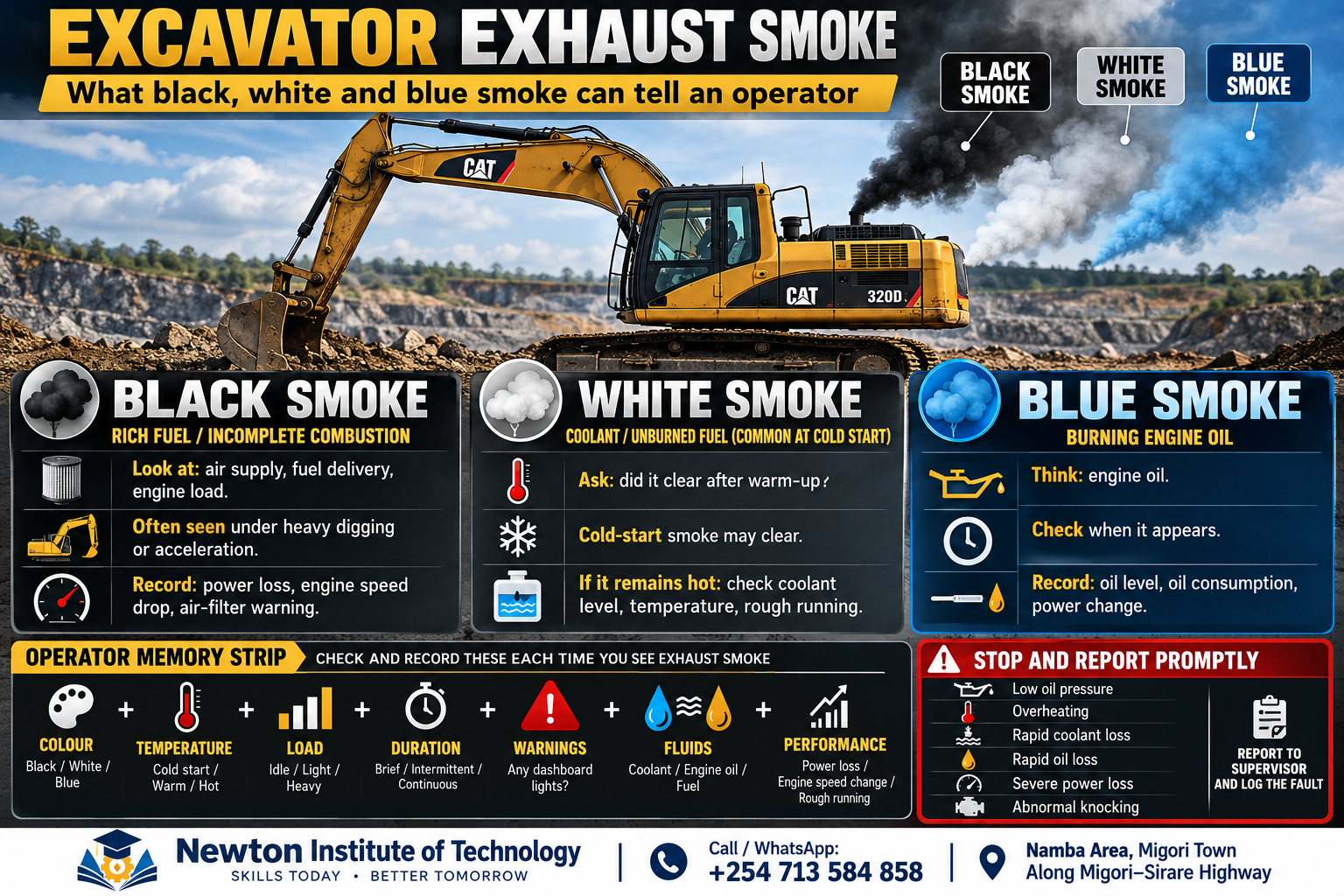
Read the condition, not colour alone
The operator smoke-reading matrix
HSE describes black diesel smoke as containing soot and material from incomplete combustion, blue smoke mainly as oil and unburned fuel, and cold-start white smoke as water droplets and unburned fuel that should normally disappear as the engine warms. [2]
| When smoke appears | Colour | Check at the same time | Useful report |
|---|---|---|---|
| Cold start | White | Starting time, rough running, how quickly it clears | White exhaust appeared at start-up and cleared as the engine warmed. |
| Engine fully warm | White | Coolant level, temperature, rough running | White exhaust remains after normal warm-up. |
| Heavy digging | Black | Engine-speed drop, weak response, air-filter indication | Black smoke increases when bucket load becomes heavy. |
| Acceleration | Black | Engine response and intake/turbo sound | Black smoke appears as engine speed increases. |
| Warm engine | Blue | Engine-oil level and oil use | Blue smoke continues after the engine is warm. |
| Any condition | Any heavy smoke | Temperature or oil-pressure warning | Record the smoke and warning as one event. |
Black smoke
Start with air, fuel and engine load
Black exhaust is strongly associated with soot and incomplete combustion. Perkins includes air-cleaner condition, over-fuelling and excessive loading among causes associated with black smoke at full load. [1]
Check the intake route
Inspect the approved air-filter restriction indicator, dust valve and accessible intake hoses. Caterpillar includes the engine-air-filter indicator and dust valve among routine checks. [3]
Record combustion changes
Injector, pump and electronic fuel diagnosis belong to maintenance personnel. The operator contributes by recording when black smoke appears and whether power changes.
Watch what happens while digging
If the machine idles normally but black smoke appears as digging resistance rises, record engine-speed behaviour and whether the smoke clears when load reduces.
“Black smoke increased under heavy digging load and engine response was weaker than normal. Smoke reduced when hydraulic load was released.”
NIT’s hydraulic-system guide explains why this load observation matters: the engine supplies the mechanical power that drives the hydraulic pump group. [7]
White smoke
First establish whether the engine is cold or fully warm
HSE notes that white diesel smoke can occur during cold starting and should normally disappear as the engine warms. [2] Persistent white smoke after warm-up carries a different meaning.
Record how it clears
Note cranking time, initial idle quality, smoke quantity and how long the white exhaust remains visible.
Persistent smoke needs investigation
Perkins identifies incorrect injection timing, injector faults and water entering the combustion chamber among possible white-smoke causes. [1]
Compare level and temperature
Persistent white exhaust together with falling coolant or abnormal temperature gives the maintenance team a much stronger clue. See NIT’s cooling-system guide for the related checks. [8]
Blue smoke
Compare the smoke with engine-oil behaviour
Blue exhaust directs attention towards engine oil entering the combustion or exhaust path. Perkins identifies turbocharger seals, rings and liners, and valve guides among possible sources. [1]
| When blue smoke appears | What the operator should record |
|---|---|
| Immediately after starting | How long the smoke continues and whether recent oil consumption has changed. |
| After extended idling | Whether smoke clears as engine condition changes. |
| During acceleration | Whether power response changes at the same time. |
| Under load | Whether smoke becomes heavier as work demand increases. |
| Continuously when warm | Engine-oil level, recent oil use and any accompanying power loss. |
“Blue smoke continues after warm-up and engine-oil level has reduced since the previous inspection.”
Add the second symptom
Smoke becomes more useful when another change appears with it
| Observation | Main investigation direction |
|---|---|
| Black smoke + weak response | Air supply, fuelling, boost or engine loading. |
| Black smoke + air-filter warning | Air-intake system. |
| Black smoke only during heavy digging | Engine/load relationship. |
| White smoke at cold start that clears | Cold-start behaviour. |
| White smoke continuing when warm | Fuel, combustion or coolant investigation. |
| White smoke + coolant loss | Cooling/combustion-path investigation. |
| Blue smoke + falling engine oil | Oil consumption or oil-entry path. |
| Blue smoke + power loss | Turbocharger/internal engine investigation. |
| Smoke + overheating | Engine/cooling problem requiring prompt attention. |
| Smoke + low oil-pressure warning | Lubrication problem requiring immediate attention. |
| Smoke + abnormal knocking | Serious engine condition requiring inspection. |
| Smoke + rapid fluid loss | Stop work and report. |

Morning baseline
Exhaust-smoke checks during the morning pre-start
This section covers only the checks that help an operator interpret exhaust behaviour. For the complete machine inspection, use NIT’s dedicated Plant Operator Pre-Start Inspection Checklist. [6] Caterpillar’s daily guidance includes checking beneath the machine for leaks, engine oil, coolant, air-cleaner condition, cooling components, hoses and the fuel-water separator. [3] [4]
| Check | Practical action |
|---|---|
| Previous shift report | Look for smoke, power loss, oil use, coolant loss or engine warnings. |
| Ground beneath machine | Check for fresh oil, coolant or fuel. |
| Engine-oil level | Compare with the normal level using the manufacturer’s specified condition. |
| Coolant | Check using the approved cold/safe procedure. |
| Air-filter indicator | Check for a restriction indication. |
| Air-cleaner dust valve | Check for blockage or heavy contamination. |
| Visible intake hoses | Look for loose, split or damaged sections. |
| Turbo/exhaust area | Look for fresh oil, damaged visible piping, soot marks or loose components. |
| Fuel-water separator | Check the bowl or indicator where applicable. |
| Cooling pack | Look for dust, leaves, grass or debris restricting airflow. |
| Dashboard self-check | Note warnings that fail to clear normally. |
| Start-up exhaust | Record colour, duration, idle quality and whether the smoke clears as the engine warms. |
Ground → oil → coolant → air intake → exhaust area → cooling pack → dashboard → start-up smoke.
Connect smoke to machine demand
What to watch while the excavator is working
Do not allow exhaust watching to distract from machine control, people around the excavator, ground conditions or the work area. When abnormal smoke is visible or reported, connect it to the operating condition.
Idle
Is smoke present without significant working load?
Travel
Does the smoke increase while the excavator travels?
Acceleration
Does it appear as engine speed rises?
Digging
Does it increase as bucket resistance rises?
Combined functions
Does smoke increase when hydraulic demand is high?
Hot operation
Does the symptom appear only after extended work?
What changed immediately before the smoke appeared?
Compare with the morning baseline
What to recheck after a shift when smoke was observed
Finish the cycle normally
Remove unnecessary working load before parking.
Park correctly
Use the designated safe area and lower the attachment.
Follow shutdown procedure
Observe the model-specific cool-down and aftertreatment requirements.
Observe low-load exhaust
Note whether abnormal smoke remains once working demand has reduced.
Check the monitor
Record temperature, oil-pressure or engine warnings seen during the shift.
Look underneath again
Compare the ground with the morning condition for new oil, coolant or fuel.
Inspect intake and exhaust
Look for new damage, soot leakage, loose joints or heavy contamination.
Inspect the cooling pack
Check debris accumulated during the day’s work.
Compare fluid behaviour
Record unusual oil or coolant use using the correct checking procedure.
Hand over the evidence
Make sure the supervisor, mechanic or next operator receives the information.

Turn an observation into evidence
A practical NIT-style defect report
| Machine | Excavator |
|---|---|
| Observation | Black exhaust smoke |
| Engine condition | Fully warm |
| When it occurred | Heavy digging only |
| Engine response | Engine speed falls as digging load increases |
| Dashboard warning | None displayed |
| Fluid change | No abnormal oil/coolant change observed |
| After load reduced | Smoke reduced |
| Operator action | Reported for inspection before continued heavy work |
Colour · temperature · load · duration · warnings · fluids · performance.
When the smoke is part of a bigger problem
When should the operator stop and report the excavator?
Park the machine and report promptly when abnormal smoke appears with evidence that the engine may be losing lubrication, cooling, fuel control or mechanical integrity.
Low oil pressure
Smoke together with a low engine-oil-pressure warning is a lubrication problem requiring immediate attention.
Overheating
Stop loading the engine and follow the machine’s overheating response.
Rapid fluid loss
Rapid coolant or engine-oil loss is more than an exhaust observation.
Severe power loss
A machine that suddenly becomes very weak while producing heavy smoke needs inspection.
Abnormal knocking
New knocking together with smoke can indicate a serious engine condition.
Leak or thermal hazard
Substantial fuel/oil leakage, fire risk or another critical warning requires prompt action.
Clear responsibility
Operator evidence and technician diagnosis work together
| Plant operator | Maintenance technician |
|---|---|
| Observe smoke colour and when it appears | Test injectors and fuel pressure |
| Check approved fluid levels | Measure compression and boost pressure |
| Inspect visible intake condition | Diagnose electronic engine faults |
| Watch gauges and warnings | Inspect internal engine components |
| Record power changes and abnormal sounds | Repair turbocharger and internal engine faults |
| Produce a clear defect report | Confirm the cause and repair it |
Newton Institute of Technology practical
How NIT demonstrates exhaust-smoke awareness beside the excavator
At Newton Institute of Technology, exhaust-smoke knowledge is tied directly to the machine. NIT’s current Excavator Operator Training programme runs for two months and is structured around approximately 70% practical training and 30% theory. [5]
The lesson begins with the excavator parked. Learners identify the air cleaner, intake route, engine, turbocharger area, exhaust route, cooling system, engine-oil check point, coolant check point and dashboard before the engine starts.
Build the morning baseline
Learners perform the relevant pre-start checks themselves and explain what normal looks like and what change should be reported.
Observe the cold start
Watch starting time, engine sound, dashboard indications, initial smoke colour and how long visible smoke remains.
Compare the warm engine
Once warm, compare exhaust, idle quality, gauges and engine response with the cold start.
Apply controlled working load
Under instructor supervision, move from light hydraulic movement to normal digging and observe whether smoke appears as demand changes.
Connect smoke with dashboard and fluids
Compare exhaust behaviour with temperature, oil-pressure indication, air-filter warning, oil level and coolant behaviour.
Finish with a defect report
The learner must explain colour, engine temperature, machine activity, duration, warnings, fluid change and power response.
Inspect → start → warm → load → compare → report. The goal is practical machine awareness that the operator can use on a real shift.
Use observation, not inhalation
Do not deliberately breathe or smell diesel exhaust to identify a fault
HSE describes diesel-engine exhaust as a mixture of gases, vapours, aerosols and soot particles and identifies heavy construction equipment, including excavators, as an important source of exposure. [2] Use visual observation, machine instruments, fluid checks and proper technical testing.
Common questions
Excavator exhaust smoke FAQs
Why does my excavator produce black smoke when digging?
Digging increases engine and hydraulic demand. If black smoke appears mainly under heavy load, note whether engine speed falls, power becomes weak or an air-filter warning appears. Perkins includes excessive loading, air-cleaner restriction and over-fuelling among recognised black-smoke causes. [1]
Can a dirty air filter cause black smoke?
Restricted airflow is an important black-smoke check. Caterpillar recommends checking the engine-air-filter restriction indicator and dust valve during routine inspection. [3]
Is white smoke normal when starting an excavator?
Some white smoke can occur when a diesel engine starts cold. HSE notes that it should normally disappear as the engine warms. White smoke that continues after warm-up needs further investigation. [2]
Does white smoke always mean a damaged head gasket?
No. Perkins also identifies fuel-injection timing and injector faults among white-smoke causes. Coolant entering the combustion chamber is another possible source, so coolant behaviour and engine temperature should be reported with the smoke. [1]
What does blue smoke from an excavator mean?
Blue smoke commonly directs attention towards engine oil entering the combustion or exhaust path. Perkins lists turbocharger seals, rings, liners and valve guides among possible sources. [1]
Does blue smoke mean the piston rings have failed?
Rings and liners are one possible source, but turbocharger seals and valve guides can also allow oil into the combustion or exhaust path. Record oil consumption and the operating condition in which the smoke appears. [1]
What should an operator report?
Report the colour, engine temperature, workload, duration, warning indications, fluid changes and any loss of power or unusual noise.
Final operator lesson
Know normal, notice change, report the evidence
For black smoke, look first at air, fuel and engine load. For white smoke, establish whether the engine is cold or warm and whether the smoke clears. For blue smoke, compare the observation with engine-oil consumption and when the smoke appears.
Colour · temperature · load · duration · warnings · fluids · performance.
Learn beside the machine
Register for Plant Operator Training at Newton Institute of Technology
Build practical excavator skills through supervised machine operation, pre-start inspection, basic mechanical awareness, warning recognition, daily equipment care and clear defect reporting.
Course duration2 months
Training structureApproximately 70% practical · 30% theory
Call / WhatsApp+254 713 584 858
LocationNamba Area, Migori Town · along Migori–Sirare Highway
Websiteniteducation.com
Technical references
- Perkins Engines. Troubleshooting Engine Problems & Preventative Maintenance Tips. Black, blue and white exhaust smoke; air-cleaner restriction; over-fuelling/loading; injectors; turbocharger seals; rings/liners; valve guides; and water entering the combustion chamber. Accessed 1 October 2026. perkins.com.
- Health and Safety Executive (HSE). Diesel Engine Exhaust Emissions. Visible black, blue and white diesel smoke, cold-start white smoke, exhaust composition and construction-site exposure. Accessed 1 October 2026. hse.gov.uk.
- Caterpillar. Guide to Checking Filters & Fluids on Cat Equipment. Air-filter indicators, dust valves, fluid levels, cooler units, hoses and fuel-water separators. Accessed 1 October 2026. cat.com.
- Caterpillar. Operator Tips: Daily Machine Walk Around and Safety Checks. Daily walk-around guidance covering leaks, engine oil, coolant, cooling-pack condition and engine-air-cleaner inspection. Accessed 1 October 2026. cat.com.
- Newton Institute of Technology. Excavator Operator Training in Kenya. Two-month programme, practical/theory structure, inspection and supervised machine operation. Accessed 1 October 2026. niteducation.com.
- Newton Institute of Technology. Plant Operator Pre-Start Inspection Checklist Kenya. Whole-machine pre-start inspection and reporting guidance. Accessed 1 October 2026. niteducation.com.
- Newton Institute of Technology. Excavator Hydraulic System: Components, Oil Flow & Checks. Engine-driven hydraulic pump, flow, working load and operator checks. Accessed 1 October 2026. niteducation.com.
- Newton Institute of Technology. Excavator Cooling System: Parts, Overheating & Daily Checks. Coolant level, leakage, radiator airflow and temperature behaviour. Accessed 1 October 2026. niteducation.com.
- Newton Institute of Technology. Excavator Parts and Functions: Operator Guide Kenya. Whole-machine anatomy and operator-level defect-reporting context. Accessed 1 October 2026. niteducation.com.
Prepared by: Newton Institute of Technology Editorial Team · Institutional / technical review: Engineer Simon Barongo · Updated: 1 October 2026.