

NIT Excavator Operator Guide G4 travel motor · final drive · warning signs
Excavator Travel Motor vs Final Drive
How They Work, Differences & Warning Signs
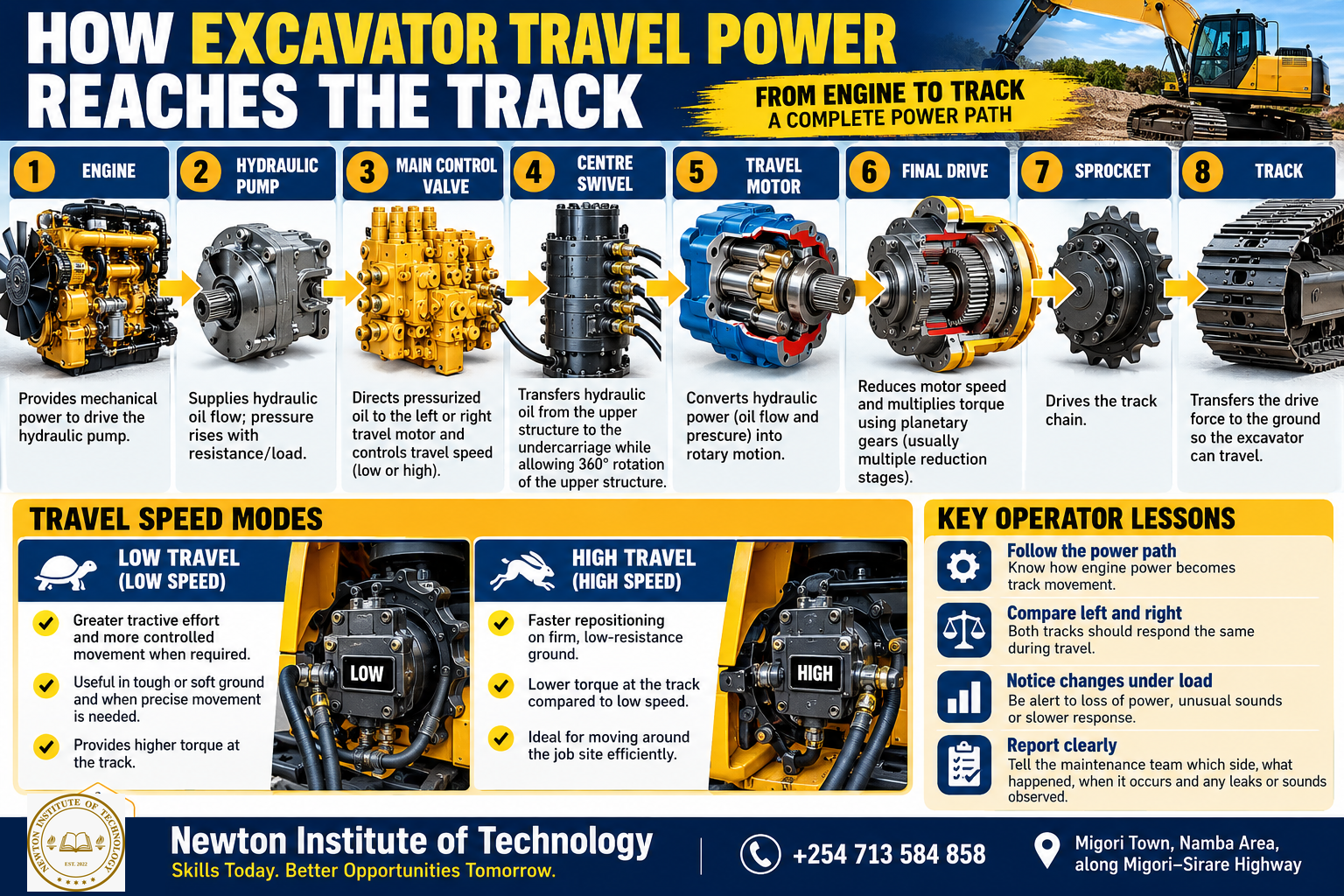
Hydraulic power → rotation → gear reduction → sprocket → track
A practical operator guide to the excavator travel motor and final drive: what each component does, how planetary reduction moves the track, how to read a weak or slow track, and what to inspect before, during and after work.
Two components, one drive path. Know what creates rotation and what multiplies torque.
What is the difference between an excavator travel motor and final drive?
The travel motor is the hydraulic component that converts hydraulic oil flow and pressure into rotary motion. The final drive is the mechanical reduction gearbox that takes that rotation, reduces its speed and increases torque before the sprocket turns the track.
John Deere excavator specifications describe axial-piston travel motors working with planetary gear reduction, which is the same basic relationship this guide explains. [1]
Travel motor creates rotation → final drive reduces speed and multiplies torque → sprocket moves the track.
Know the two jobs
Travel motor vs final drive at a glance
| Feature | Travel motor | Final drive |
|---|---|---|
| Component type | Hydraulic motor | Mechanical reduction gearbox |
| Input | Pressurized hydraulic oil through the travel circuit | Rotary motion from the travel motor |
| Main job | Converts hydraulic energy into rotation | Reduces speed and increases torque |
| Common design | Axial-piston motor on many excavators | Planetary gear reduction |
| Output | Rotary motion to the reduction gearbox | Low-speed, high-torque drive to the sprocket |
| Lubrication | Machine hydraulic oil | Specified final-drive gear lubricant |
| Typical operator clues | Weak or uneven travel, hydraulic leakage, abnormal speed response | Gear-oil leakage, grinding/growling, heat, vibration or loss of drive |
The motor and gearbox are physically close and may be sold as one travel-drive assembly, which is why workshop language sometimes uses travel motor, track motor, final drive or travel device for the complete unit. The functions remain distinct.

Follow the energy
How travel power reaches the track
Excavator travel is a hydraulic-to-mechanical power path:
The hydraulic system supplies controlled oil to the travel motor. The motor creates rotation. The final drive reduces that rotation and raises torque. The sprocket then engages the track chain and moves the machine.
NIT’s dedicated Excavator Hydraulic System guide owns the full pump, main-control-valve, centre-swivel and hydraulic-flow explanation. Article 159 begins at the travel-drive system and follows the power to the track. [8]
Hydraulic side
How the excavator travel motor works
Many excavators use an axial-piston hydraulic motor for travel. John Deere specifications provide examples of axial-piston travel motors paired with planetary gear reduction. [1]
Pressurized oil enters the motor through the main travel ports. The pressure acts on the piston group and the motor geometry produces torque at the output shaft. Reversing the direction of oil flow reverses motor rotation, giving forward and reverse travel.
Main travel ports
The two main ports carry pressure and return flow; their roles reverse when travel direction reverses.
Pistons
Hydraulic pressure acts on the rotating piston group to create torque.
Displacement control
On two-speed or variable-displacement designs, the motor changes operating displacement to alter travel speed and tractive effort.
Case drain
Low-pressure internal leakage oil returns through the case-drain circuit.
Mechanical side
How the planetary final drive works
The final drive receives rotary motion from the travel motor and passes it through planetary reduction gearing. A planetary stage normally includes a sun gear, several planet gears, a planet carrier and an internally toothed ring gear. More than one reduction stage may be used depending on the excavator design. [1]
The result is a practical trade: rotational speed falls while available output torque rises. That lower-speed, higher-torque output turns the sprocket and gives the machine useful tractive force.
| Part | Role in the reduction system |
|---|---|
| Sun gear | Receives rotational input in a typical stage. |
| Planet gears | Mesh with the sun and ring gear and share load around the stage. |
| Planet carrier | Supports the planet gears and can carry reduced-speed output depending on stage arrangement. |
| Ring gear | Surrounds the planet gears with internal teeth and forms part of the reduction path. |
| Output hub | Transfers reduced-speed, high-torque rotation to the sprocket. |
Low and high travel
What changes when travel speed changes?
Two-speed travel motors are common. In practical terms, low travel is used where controlled movement and greater tractive effort are required, while high travel is used for faster repositioning on firm, lower-resistance ground. John Deere specifications document two-speed travel systems on multiple excavator models. [1]
Low travel
Greater tractive effort and more controlled movement when load or resistance rises.
High travel
Faster repositioning when conditions permit and the machine is not demanding maximum drawbar pull.
Compare both sides
Both tracks should respond consistently when the travel mode changes.
Notice change
A machine that no longer changes speed normally has provided useful fault information.
Operator value
24 reasons a plant operator should understand the travel motor and final drive
The operator is beside the machine before work, in the cab during travel and back at the drive assemblies after the shift. That makes operator observation one of the earliest sources of useful condition information.
See problems earlier
Find fresh gear-oil leakage
Know where the final-drive housing sits and what a new wet area looks like.
Recognize hydraulic leakage
Separate oil at travel-motor lines or fittings from gearbox leakage.
Notice one weak track
Compare left and right travel deliberately rather than waiting for complete loss of drive.
Hear a new drive noise
Grinding, growling, clicking or changed hydraulic sound becomes useful evidence.
Feel abnormal vibration
Relate vibration to travel speed, direction and affected side.
Compare heat
A clear left-to-right temperature difference after similar work directs further inspection.
Understand what the machine is telling you
Read straight-travel drift
Know that unequal travel performance can pull the machine toward one side.
Read load-related weakness
A track that weakens on a slope or during steering gives a different clue from a track that is always slow.
Interpret speed-mode changes
Abnormal high/low travel behaviour points toward the travel control or motor side.
Notice warm-machine changes
A symptom that changes after hydraulic oil reaches working temperature helps diagnosis.
Separate fluid clues
Hydraulic oil and final-drive gear oil point to different parts of the assembly.
Follow the whole path
Understand that the fault may start before the motor, inside the motor, in the gearbox or at the track.
Protect the machine
Protect gears and bearings
Final-drive lubrication receives the attention it deserves.
Protect the motor
Hydraulic contamination, leakage and unusual travel response are reported early.
Avoid forcing resistance
Track or running-gear resistance is investigated instead of repeatedly demanding more power.
Use travel modes well
Low and high travel are used with a clear understanding of speed and tractive effort.
Support preventive maintenance
Small changes become maintenance information before they become major failures.
Reduce avoidable downtime
Early reporting gives maintenance time to inspect the machine while it is still serviceable.
Work and report professionally
Name the affected side
“Left travel drive” is far more useful than “the excavator is weak.”
Name the operating condition
Forward, reverse, uphill, turning, high travel and low travel can be reported separately.
Improve handover
The next operator receives a specific machine-condition report.
Give technicians evidence
Power, sound, heat, leakage and direction are reported together.
Build machine awareness
Know what is happening between the hydraulic circuit and the ground.
Develop operator judgement
Inspection and observation become part of operating skill, not an afterthought.
Caterpillar similarly recommends daily visual checks of final drives for leakage, cracks and other abnormalities as part of drivetrain care. [3]
Know the baseline
Learn what normal travel looks, sounds and feels like
Fault recognition becomes much easier when the operator knows the machine’s normal response. Build that baseline during controlled travel on suitable ground.
| Observation | What to establish as normal |
|---|---|
| Forward travel | How quickly both tracks respond. |
| Reverse travel | How both tracks respond in the opposite direction. |
| Straight travel | The machine’s normal tendency to hold its path. |
| Low travel | Sound, control and pulling response. |
| High travel | Normal speed change and response. |
| Steering | How each track responds during turns. |
| Sound | Normal hydraulic and mechanical travel noise. |
| Vibration | Normal vibration transmitted through the machine. |
| Warm operation | How travel behaves after the hydraulic system reaches working temperature. |
Read the symptoms
Travel-motor and final-drive warning signs
| Observation | Hydraulic / travel-motor side | Mechanical / final-drive side |
|---|---|---|
| One track weak | Check hydraulic supply, motor performance, speed control and brake release. | Check for excessive mechanical resistance or internal gearbox condition. |
| One track slow | Compare flow, pressure and motor response left versus right. | Listen for drag, bearing noise or gearbox roughness. |
| Weak mainly under load | Pressure/flow, internal motor leakage and brake release become important checks. | Mechanical resistance can become more obvious as torque demand rises. |
| Changes after warm-up | Hydraulic leakage and efficiency become more relevant. | Compare heat with mechanical noise and drag. |
| Hydraulic oil at motor/lines | Inspect the travel hydraulic side first. | — |
| Gear oil at drive hub | — | Inspect final-drive seals, plugs and housing. |
| Grinding/clicking/growling | Less characteristic of a purely hydraulic fault. | Inspect gears, bearings and mechanical drive components. |
| Abnormal heat | Motor, brake or hydraulic load can contribute. | Gear or bearing friction can contribute. |
| Metal debris in gear oil | — | Investigate internal gearbox wear; trend and quantity matter. |
| Loss of drive | Hydraulic supply, motor or brake fault can stop the track. | Severe gearbox or output failure can stop the track. |
Caterpillar includes final-drive leaks, cracks, fasteners and lines in routine drivetrain inspection, while its hydraulic-analysis procedures compare travel performance in forward/reverse and high/low speed. [3] [4]
Signature diagnostic lesson
One track is weak: follow the fault path
When one side becomes slow or weak, follow the evidence in order rather than jumping directly to a component replacement.
Check track resistance
Look for packed material, incorrect track condition, seized/damaged running gear or another reason one side is harder to move.
Compare travel behaviour
Check forward, reverse, low travel, high travel and behaviour under load.
Identify the fluid clue
Hydraulic oil at motor/lines points toward the hydraulic side; gear oil at the hub points toward the gearbox side.
Listen to the sound
Changed hydraulic whine directs attention to the hydraulic side; grinding or growling at the hub directs attention to the mechanical drive.
Compare temperature
Use a non-contact IR thermometer after similar work and compare left versus right.
Confirm with measurements
Technicians use pressure, flow, case drain, brake release, travel-speed control, centre-swivel checks and final-drive inspection.
Specialist troubleshooting guidance likewise lists track resistance, hydraulic pressure/flow, travel-speed control, motor wear, brake release, centre-swivel leakage and gearbox condition among the causes of one-sided travel weakness. [7]
Side + direction + speed mode + load + sound + leakage + temperature. Example: “Left track is slower in forward high travel and becomes weaker uphill; new growling noise from the left drive hub.”

Morning routine
Travel motor and final drive checks during the morning walk-around
This section is deliberately limited to the travel-drive system. NIT’s general Plant Operator Pre-Start Inspection Checklist owns the whole-machine routine. [10]
| Check | What the operator examines |
|---|---|
| Left final-drive housing | Fresh gear oil, visible cracks, impact damage or displaced hardware. |
| Right final-drive housing | Repeat the same check and compare both sides. |
| Ground below both drives | Fresh oil spots or drips that were not present previously. |
| Visible travel-motor connections | Fresh hydraulic oil, damaged visible lines or wet fittings. |
| Previous shift report | Weakness, noise, heat or travel-speed concerns already recorded. |
| First forward movement | Even response from left and right tracks. |
| First reverse movement | Even response in the opposite direction. |
| Straight travel | Unexpected pull or drift. |
| Low/high travel | Normal mode change and consistent track response. |
| Sound | New hydraulic whine, grinding, clicking or growling. |
Caterpillar recommends checking final drives for leaks, rust and cracks and inspecting drive-related fasteners and lines during daily drivetrain inspection. [3]
While operating
What to monitor while the excavator is travelling
Straight tracking
Notice whether the machine begins pulling more strongly toward one side.
Travel power
Notice whether one track becomes weak as resistance increases.
Speed change
Compare current travel speed with the machine’s established normal response.
Noise
Record the side, direction and operating condition in which a new sound appears.
Temperature
Compare the two sides after similar work if abnormal heat is suspected.
Leakage
A new fluid trace is easier to interpret when the morning condition was already known.
End-of-shift comparison
After work, ask one question: what changed?
The evening check is not a repeat of the whole pre-start. It compares the drive system with its morning condition.
| Compare | Record |
|---|---|
| Left final-drive housing | New leakage, impact marks or other visible change. |
| Right final-drive housing | New leakage or condition change compared with the left. |
| Travel-motor lines | New wetness or hydraulic leakage. |
| Travel strength | Which side became weak and under what condition. |
| Straight travel | Any new drift or pull. |
| Travel-speed response | Any change in high/low travel operation. |
| Sound | Side, direction and type of new noise. |
| Vibration | When it appeared and whether it followed track speed. |
| Temperature | Meaningful left/right difference after comparable work. |
| Handover | Side + symptom + operating condition for the next shift. |
Two fluid systems
Hydraulic oil and final-drive oil do different jobs
The travel motor operates with the excavator’s hydraulic oil. The planetary reduction gearbox uses the final-drive lubricant specified for that machine. Caterpillar treats final-drive oil as a separate service item and provides machine-specific procedures for checking its level and condition. [5]
| System | Fluid | Main job |
|---|---|---|
| Travel motor | Machine hydraulic oil | Transfers hydraulic power through the travel circuit and lubricates the motor’s hydraulic components. |
| Final drive | Specified gear lubricant | Lubricates planetary gears, bearings and loaded mechanical surfaces. |
Use the machine’s Operation and Maintenance Manual for lubricant grade, oil level, quantity, plug position and service interval.
Newton Institute of Technology practical
How NIT demonstrates the travel drive beside the excavator
NIT’s Excavator Operator Training programme combines technical understanding with supervised machine practice. The course runs for two months with approximately 70% practical training and 30% theory. [11]
Identify
Locate the drive sprocket and identify the travel-drive assembly at the drive end of each track.
Trace
Explain the path from hydraulic pump to main control valve, centre swivel, travel motor, final drive, sprocket and track.
Inspect
Compare both drive housings, visible hydraulic connections, leakage and obvious condition changes.
Operate
Carry out supervised forward, reverse, straight travel, steering, low travel and high travel.
Compare
Compare left with right, forward with reverse, low with high and cold with normal working behaviour.
Report
Describe the exact side, operating condition, sound, leakage and performance change.
Identify → trace → inspect → operate → compare → report. The objective is to turn component knowledge into practical operator judgement.
Technical confirmation
How technicians confirm a travel fault
Operator observations establish what the machine is doing. Technical testing establishes why it is doing it.
| Test | What it helps confirm |
|---|---|
| Travel-cycle timing | Compares travel performance in controlled conditions. |
| Hydraulic pressure | Checks whether the travel circuit can develop specified pressure. |
| Hydraulic flow | Checks delivery to the travel circuit and left/right balance. |
| Case-drain measurement | Helps identify excessive internal motor leakage. |
| Brake-release check | Confirms whether the travel brake is releasing correctly. |
| Speed-control check | Confirms high/low travel control operation. |
| Centre-swivel test | Checks for internal leakage affecting one travel circuit. |
| Gearbox inspection | Confirms gears, bearings, lubricant and mechanical output condition. |
Caterpillar’s hydraulic-analysis guidance uses controlled forward/reverse and high/low travel tests as part of travel-system evaluation. [4]
Common questions
Excavator travel motor and final drive FAQs
Is a travel motor the same as a final drive?
No. The travel motor converts hydraulic energy into rotation. The final drive reduces that rotation and raises torque before the sprocket turns. The two are often packaged together, which explains the overlapping terminology.
What type of travel motor does an excavator use?
Axial-piston hydraulic motors are common. John Deere excavator specifications provide examples of axial-piston travel motors paired with planetary reduction. [1]
Why does an excavator need a final drive?
The final drive converts the travel motor’s relatively high-speed rotation into the lower-speed, higher-torque output needed at the sprocket.
Why is one excavator track slower than the other?
Compare running-gear resistance, hydraulic delivery, speed control, centre swivel, travel motor, brake release and final-drive condition. One-sided weakness can originate in several parts of the travel system. [7]
What does a leaking final drive look like?
Fresh gear oil may appear around the final-drive housing, plug or seal area and can collect dirt around the wet surface. Caterpillar includes final-drive leakage in routine drivetrain inspection. [3]
What does grinding or growling from the drive area indicate?
Grinding, clicking or growling at the drive hub directs inspection toward gears, bearings, lubrication and other mechanical drive components.
Does the travel motor use the same oil as the final-drive gearbox?
No. The travel motor uses the machine’s hydraulic fluid. The reduction gearbox uses its specified final-drive gear lubricant. [5]
What should an operator report about a weak track?
Report the affected side, forward or reverse, high or low travel, load condition, sound, leakage, temperature difference and when the change began.
Final operator lesson
Know the power path, then read the change
Before work: establish the condition of both travel-drive assemblies.
While working: compare travel strength, straight tracking, speed, sound, vibration, heat and leakage.
After work: identify what changed and record it clearly.
Hydraulic pump → travel motor → final drive → sprocket → track.
Learn beside the machine
Register for Excavator Operator Training at Newton Institute of Technology
Build practical excavator operating skills through supervised machine practice, inspection, control, basic mechanical awareness and accurate defect reporting.
Course duration2 months
Training structureApproximately 70% practical · 30% theory
Call / WhatsApp+254 713 584 858
LocationNamba Area, Migori Town · along Migori–Sirare Highway
Websiteniteducation.com
Technical references
- John Deere. Hydraulic Excavator specifications. Axial-piston travel motors, two-speed travel systems and planetary gear reduction. Accessed 3 October 2026. deere.com.
- John Deere. 750LC Production Excavator specifications. Variable-displacement axial-piston travel motors and planetary final drives. Accessed 3 October 2026. deere.com.
- Caterpillar. Essential Tips for Inspecting Your Cat Drive Train. Daily checks covering final-drive leakage, cracks, fasteners, lines and abnormal condition. Accessed 3 October 2026. cat.com.
- Caterpillar. Hydraulics Technical Analysis Guide. Controlled travel evaluation using forward/reverse and high/low travel testing. Accessed 3 October 2026. cat.com.
- Caterpillar. Healthy Equipment Fluids / final-drive fluid guidance. Final-drive lubricant checking and machine-specific maintenance procedures. Accessed 3 October 2026. cat.com.
- Caterpillar. Excavator Undercarriage Maintenance. Sprocket, track and planetary final-drive inspection context. Accessed 3 October 2026. cat.com.
- Final Drive Centre. Excavator Final Drive Problems. Diagnostic factors for one-sided weak travel, including hydraulic pressure/flow, track resistance, speed control, swivel leakage, brakes, motor wear and gearbox condition. Accessed 3 October 2026. finaldrive.eu.
- Newton Institute of Technology. Excavator Hydraulic System: Components, Oil Flow & Checks. Parent guide for pump flow, main control valve, centre swivel, travel motors and final drives. Accessed 3 October 2026. niteducation.com.
- Newton Institute of Technology. Excavator Undercarriage: Parts, Track Tension, Wear & Checks. Parent guide for track-chain resistance, sprockets, rollers, idlers and track tension. Accessed 3 October 2026. niteducation.com.
- Newton Institute of Technology. Plant Operator Pre-Start Inspection Checklist Kenya. Parent resource for the complete machine pre-start routine and defect reporting. Accessed 3 October 2026. niteducation.com.
- Newton Institute of Technology. Excavator Operator Training in Kenya. Two-month programme, practical/theory structure and supervised machine operation. Accessed 3 October 2026. niteducation.com.
Prepared by: Newton Institute of Technology Editorial Team · Institutional / technical review: Engineer Simon Barongo · Updated: 3 October 2026.