

NIT Future Skills Guide Kenya · to 2030
Future-Proof Skills in Kenya
Skills Likely to Stay Valuable to 2030
Useful work · digital ability · judgement · continuous learning
A practical Kenya-focused guide to skills with strong reasons to remain useful as technology, machines, workplaces and customer needs change towards 2030.
Build the foundation that can absorb the next tool
Quick answer
Which skills are likely to stay valuable in Kenya to 2030?
Future-facing skill areas include AI and digital literacy, data analysis, cybersecurity, software development, electrical and energy systems, plant operation, construction trades, logistics, agribusiness, healthcare and business capability. Their long-term value becomes stronger when technical ability is combined with analytical thinking, communication and continuous learning.
OECD analysis projects that 32.7 million jobs in Kenya will require digital skills by 2030: 21.4 million at basic level, 9.6 million at intermediate level and 1.7 million at advanced level. [1]
Visual guide · 11 skill areas
Future-proof skills in Kenya to 2030
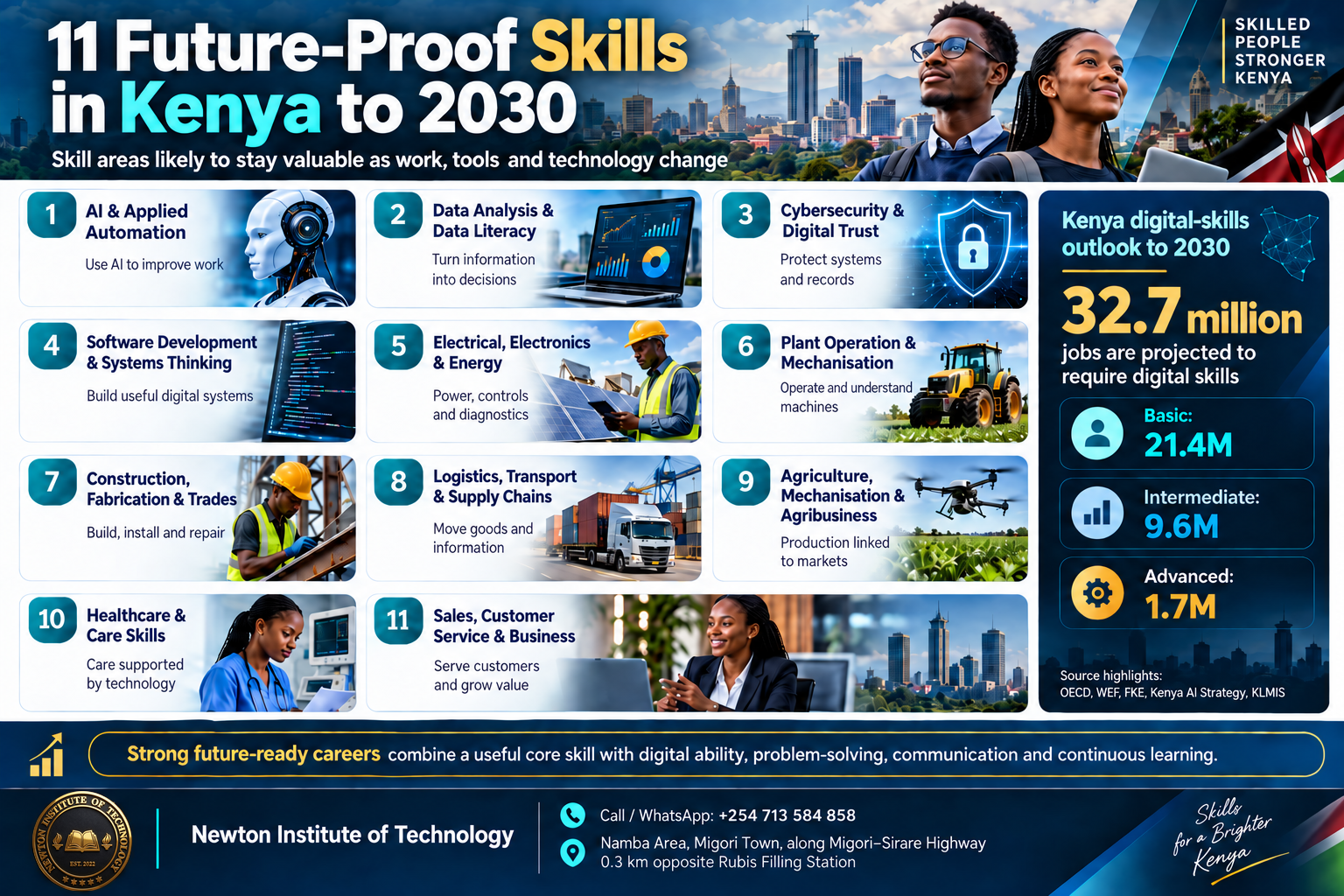
A future-proof skill is one that keeps solving useful problems while the tools around it change. The worker does not depend on one software version, one machine dashboard or one platform; the worker understands the underlying work well enough to adopt what comes next.
The World Economic Forum reports that nearly 40% of skills required on the job are expected to change by 2030. AI and big data, networks and cybersecurity, and technological literacy lead its fastest-rising skill categories, while analytical thinking, creativity, resilience and lifelong learning remain important human capabilities. [2]
Kenya + global evidence
Three signals that matter before 2030
Projected to require some level of digital skill by 2030. [1]
Expected to change by 2030 across surveyed employers. [2]
National plans include digital literacy, AI exposure, internships and real-world projects. [4]
Kenya-specific employer evidence adds an important practical layer. In the Federation of Kenya Employers’ 2023 Skills Needs Survey, employers reported demand across engineering, information technology, building and construction, finance and business management, and transport and logistics. Effective communication, critical thinking, teamwork and time management were also among the most demanded social skills. [3]
Choose a skill connected to a durable need, learn the underlying work, then add the technology that is improving that occupation. That approach is stronger than chasing a new tool without a foundation.
NIT 2030 Skill Durability Test
Six questions to test a skill before you invest in it
Use these six checks before choosing training, changing careers or adding a new skill.
Persistent need
Will people and organisations still need the result this skill produces?
Technology fit
Can technology make a skilled worker faster, safer, more accurate or more productive?
Transferability
Can the skill work across more than one industry, employer or work setting?
Practical proof
Can you demonstrate competence through a finished task, project, installation, report or operating record?
Skill stacking
Can it combine with another useful ability to produce a stronger capability?
Growth path
Can you keep improving as tools, standards, machines and customer expectations change?
Visual decision tool · six checks
The NIT 2030 Skill Durability Test

Eleven durable skill families
Where to build capability for the years to 2030
These are skill families rather than a ranking. Each becomes stronger when the learner understands the work deeply enough to adopt new tools without starting again.
AI literacy & applied automation
Learn to define a task, use AI appropriately, check the output and integrate it into real work. Kenya’s AI roadmap explicitly links talent development with digital literacy, AI exposure, internships and real-world projects. [4]
Data analysis & data literacy
Build from spreadsheets and data cleaning to SQL, visualisation and analytical reasoning. The durable ability is turning information into a clear decision, not memorising one dashboard tool. [1]
Cybersecurity & digital trust
Understand systems, networks, Linux, access control, secure configuration, monitoring and incident response. Networks and cybersecurity are among the fastest-rising global skill categories towards 2030. [2]
Software development & systems thinking
Learn the full chain from requirements and logic to data, testing, security, deployment and maintenance. AI-assisted coding raises the value of system understanding and verification. [2]
Electrical, electronics, automation & energy
Combine electrical fundamentals with testing, fault diagnosis, controls, solar and automation. FKE’s employer survey identified electrical and electronics engineering among important technical demand areas. [3]
Plant operation & mechanisation
Build machine control together with pre-start inspection, safety, machine-condition awareness, fault reporting and electronic monitoring. ILO’s 2026 fodder-sector assessment in Nakuru, Narok and Kajiado identified mechanisation and digital skills gaps. [5]
Construction, fabrication & technical trades
Strengthen hands-on work with measurement, technical drawings, diagnostics and digital tools. Building, construction and engineering appear in FKE’s employer demand and hard-to-fill TVET evidence. [3]
Logistics, transport & supply chains
Combine physical movement with inventory systems, route planning, documentation, tracking and customer coordination. Transport, distribution and logistics feature prominently in Kenyan employer demand. [3]
Agriculture, mechanisation & agribusiness
Combine production with machinery, records, quality, logistics and market understanding. The ILO’s 2026 assessment identified gaps across mechanisation, logistics, digital skills and green technologies in the three counties studied. [5]
Healthcare & care skills
Care work is strengthened by digital records, accurate documentation, communication and technology use. WEF expects care-related roles to be among significant global growth areas through 2030. [2]
Sales, customer service & business capability
Learn to understand a customer’s need, explain a solution, price correctly, record the transaction and follow through. FKE’s survey reinforces the importance of communication and critical thinking across work settings. [3]
Three abilities that strengthen every skill
Technical depth works better with judgement, communication and learning
Observe, gather evidence, test possible causes, correct the problem and verify the result. WEF and FKE both identify analytical or critical thinking as important. [2] [3]
Receive instructions accurately, ask precise questions, explain completed work and report faults clearly. Effective communication was a leading social-skill signal in FKE’s survey. [3]
Add the next useful tool without rebuilding your entire career from zero. Curiosity and lifelong learning are among the skills WEF expects to rise in importance. [2]
Build a stack, not a pile
Combine one strong core skill with neighbouring abilities
| Core skill | Add | Stronger capability |
|---|---|---|
| Software development | AI + cybersecurity | Build and protect modern systems |
| Data analysis | AI + business understanding | Turn information into useful decisions |
| Cybersecurity | Networking + communication | Protect systems and explain risk |
| Electrical | Solar + automation | Work across modern energy and control systems |
| Plant operation | Inspection + diagnostics | Operate while understanding machine condition |
| Logistics | Data + inventory systems | Manage movement and information together |
| Agriculture | Mechanisation + agribusiness | Connect production to operations and markets |
| Sales | Digital tools + analytics | Serve customers and measure what works |
Depth first. Then add capabilities that directly improve the work you already understand.
A practical route from now to 2030
Seven steps for building future-ready capability
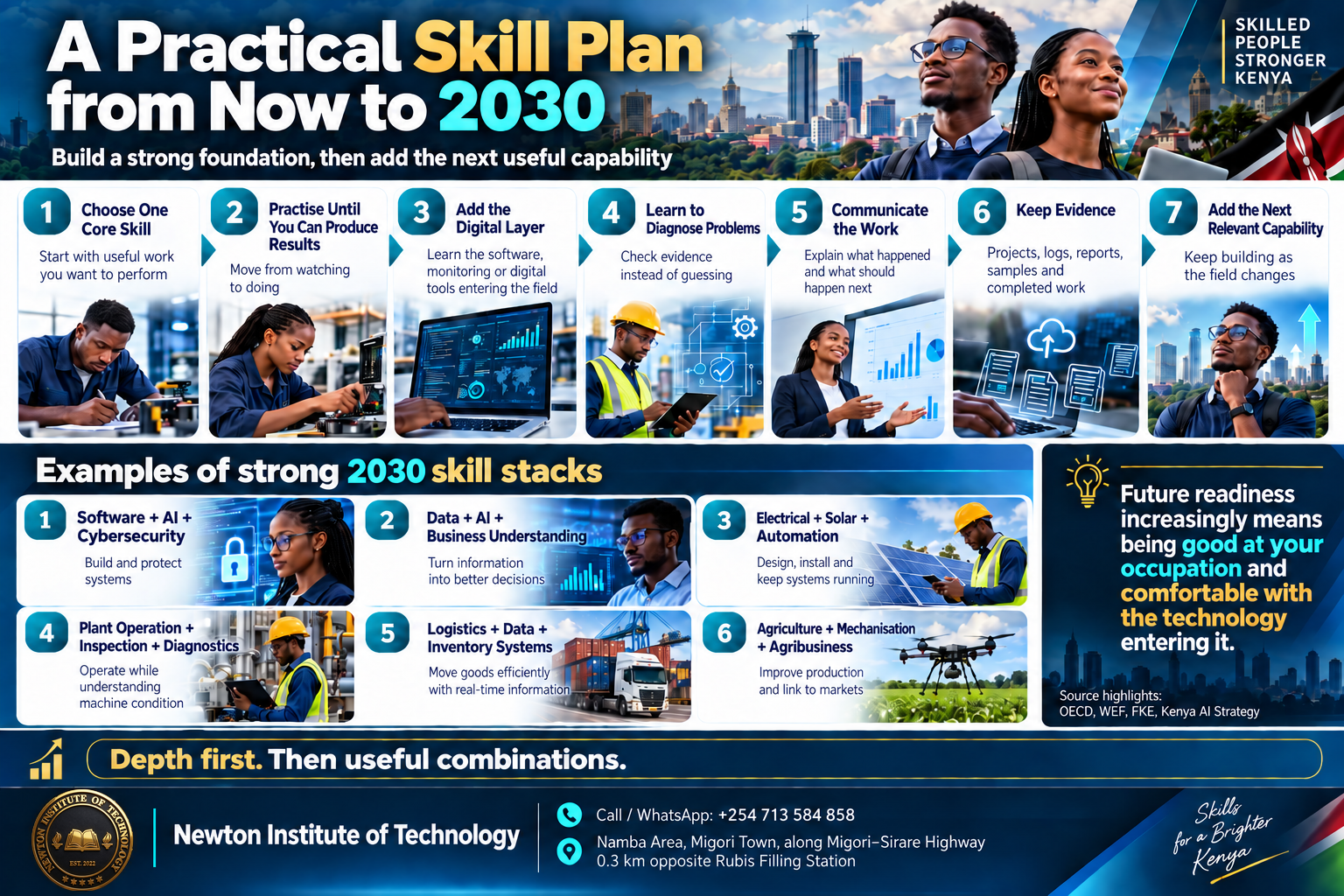
Choose one useful core skill
Name the work you want to perform: build software, analyse data, secure systems, operate machinery, install electrical systems, repair equipment, move goods or serve customers.
Practise until you can produce a result
Move from watching to doing. Build it, analyse it, install it, operate it, repair it or configure it.
Add the digital layer
Learn the software, monitoring systems or digital tools entering your occupation. OECD’s Kenya projection shows that digital capability will spread well beyond specialist ICT jobs. [1]
Learn to diagnose problems
Check evidence instead of guessing. Understand what normal looks like so you can recognise what has changed.
Communicate the work
Explain what happened, what you did, what you verified and what should happen next.
Keep evidence
Save projects, reports, practical logs, attachment records, installations, operating records and other proof of completed work.
Add the next relevant capability
Review your field regularly and add the technology, method or standard that improves the work you already know.
Visual action plan · seven steps
A practical skill plan from now to 2030
2030 reality
Digital skills will spread far beyond ICT jobs
The OECD projection of 32.7 million Kenyan jobs requiring digital skills by 2030 is mostly about basic and intermediate capability, not only advanced programming. [1] A plant operator may use electronic monitoring, a logistics worker may use tracking systems, an electrician may work with intelligent controls, a farmer may keep digital production records, and a salesperson may use CRM and analytics.
Become good at your occupation and comfortable with the technology entering it.
Choose your starting point
Ask four questions before you enrol
The course name matters less than the capability you leave with.
- What useful result will I be able to produce? Identify the actual work, not only the course title.
- Can I practise it properly? Look for repeated practical work, not observation alone.
- Can I prove the skill? Make sure the training produces visible evidence of competence.
- Can the foundation grow? Choose a starting skill that can absorb new tools and responsibilities.
For a deeper personal-choice framework, use NIT’s How to Choose the Right Skill to Learn in Kenya. [10] For immediate employment, freelance and business routes, continue to Most Employable Skills in Kenya. [6]
Newton Institute of Technology
Build a practical foundation you can keep developing
NIT’s ICT pathways include Full-Stack Software Development, Cybersecurity, Data Science & Analytics, Artificial Intelligence and Mobile App Development. [11] Plant Operator training develops practical machine operation together with inspection, safe working habits and equipment understanding. [12]
The training principle is consistent: learn the foundation → practise the work → understand the system → prove the skill → keep developing.
built to keep growingDirect answers
Future-proof skills in Kenya: FAQs
What are the main future-proof skills in Kenya?
Strong future-facing areas include AI and digital literacy, data analysis, cybersecurity, software development, electrical and energy systems, plant operation, construction trades, logistics, agribusiness, healthcare and business capability. Their durability improves when technical skill is combined with analytical thinking, communication and continuous learning.
Why are digital skills important towards 2030?
OECD analysis projects 32.7 million jobs in Kenya will require digital skills by 2030, with most demand at basic and intermediate levels. [1]
Is plant operation a future-ready skill?
Will software development remain useful with AI?
Yes. AI-assisted coding changes the workflow, while organisations still need correctly designed, tested, secured, deployed and maintained systems. WEF continues to identify programming and broader technological capabilities as relevant towards 2030. [2]
Which abilities strengthen almost every career?
Should I learn many skills at once?
Build one useful core skill first, then add neighbouring abilities that directly strengthen it. Depth makes the next tool easier to learn and gives your skill stack a clear purpose.
The principle to carry to 2030
Build the foundation that lets you learn the next tool
Choose useful work. Learn the fundamentals. Practise until you can produce a real result. Add digital capability, develop judgement, communicate clearly and keep improving as your field changes.
Useful skill + technology + judgement + communication + continuous learning = stronger future readiness.
Related NIT career guides
Build a practical skill for the future
Register at Newton Institute of Technology
Choose practical training that gives you a useful foundation now and room to keep developing towards 2030. Speak with Admissions about Full-Stack Software Development, Cybersecurity, Data Science & Analytics, Artificial Intelligence, Mobile App Development, Plant Operation, Forklift, Driving and other practical programmes.
Call / WhatsApp+254 713 584 858
LocationNamba Area, Migori Town · along Migori–Sirare Highway
LandmarkAbout 0.3 km opposite Rubis Filling Station
Websiteniteducation.com
References and further reading
- Organisation for Economic Co-operation and Development (OECD). Digital skills in East Africa — Africa’s Development Dynamics 2024. Kenya projection of 32.7 million jobs requiring digital skills by 2030, including basic, intermediate and advanced levels. Accessed 3 October 2026. oecd.org.
- World Economic Forum. The Future of Jobs Report 2025. Global employer evidence on skills changing through 2030, including AI and big data, networks and cybersecurity, technological literacy, analytical thinking, creativity, resilience and lifelong learning. Published January 2025; accessed 3 October 2026. weforum.org.
- Federation of Kenya Employers (FKE). Skills Needs Survey Report 2023. Employer demand across engineering, IT, construction, finance/business management, transport/logistics and social skills including communication and critical thinking. Published November 2023; accessed 3 October 2026. fke-kenya.org.
- Ministry of Information, Communications and the Digital Economy. Kenya National AI Strategy 2025–2030 Implementation Roadmap. Talent development, digital literacy, AI exposure, internships, mentorships and real-world projects. Accessed 3 October 2026. ict.go.ke.
- International Labour Organization. Skills gap assessment in the fodder sector that promotes inclusive decent employment and productive livelihood in Nakuru, Narok and Kajiado counties. Mechanisation, logistics, digital and green-skill gaps in the assessed value chains. Published 17 August 2026; accessed 3 October 2026. ilo.org.
- Newton Institute of Technology. Most Employable Skills in Kenya. Current employment, freelance, contract and business routes. Accessed 3 October 2026. niteducation.com.
- Newton Institute of Technology. Kenya Job Market Trends 2026. Current labour-market structure and hiring context. Accessed 3 October 2026. niteducation.com.
- Newton Institute of Technology. ICT Skills Employers Want in Kenya. Present employer expectations, practical ICT foundations and proof of ability. Accessed 3 October 2026. niteducation.com.
- Newton Institute of Technology. AI, Data & Cybersecurity Skills in Kenya. Applied technical pathways in AI, data and cybersecurity. Accessed 3 October 2026. niteducation.com.
- Newton Institute of Technology. How to Choose the Right Skill to Learn in Kenya. Personal skill-selection framework. Accessed 3 October 2026. niteducation.com.
- Newton Institute of Technology. ICT Courses. Current ICT programme pathways. Accessed 3 October 2026. niteducation.com/courses/ict.
- Newton Institute of Technology. Plant Operator Training. Current plant-operator training pathway and practical machine training. Accessed 3 October 2026. niteducation.com/courses/plant-operator.
Prepared by: Newton Institute of Technology Editorial Team · Institutional / technical review: Engineer Simon Barongo · Updated: 3 October 2026.