

NIT Career Decision Guide Kenya · 2026
Choose the Right
Skill to Learn
Work fit · practice access · proof
A practical way to choose a skill before you choose a course: test the work, practice access, total cost, proof of ability, entry rules and realistic career direction.
Your decision tool
How do you choose the right skill to learn in Kenya?
Look at the actual work, your access to practice, the complete training cost, how you will prove your ability, entry or licensing requirements, a realistic route to work and whether the skill can grow with you. A good course choice begins with the work—not the advert, the college name or a salary claim.
Start in the right place
Work → Skill → Training → College
Many poor course choices begin in the reverse order. This visual shows the safer sequence: understand the work, identify the skill, find the training that develops it, then compare institutions.
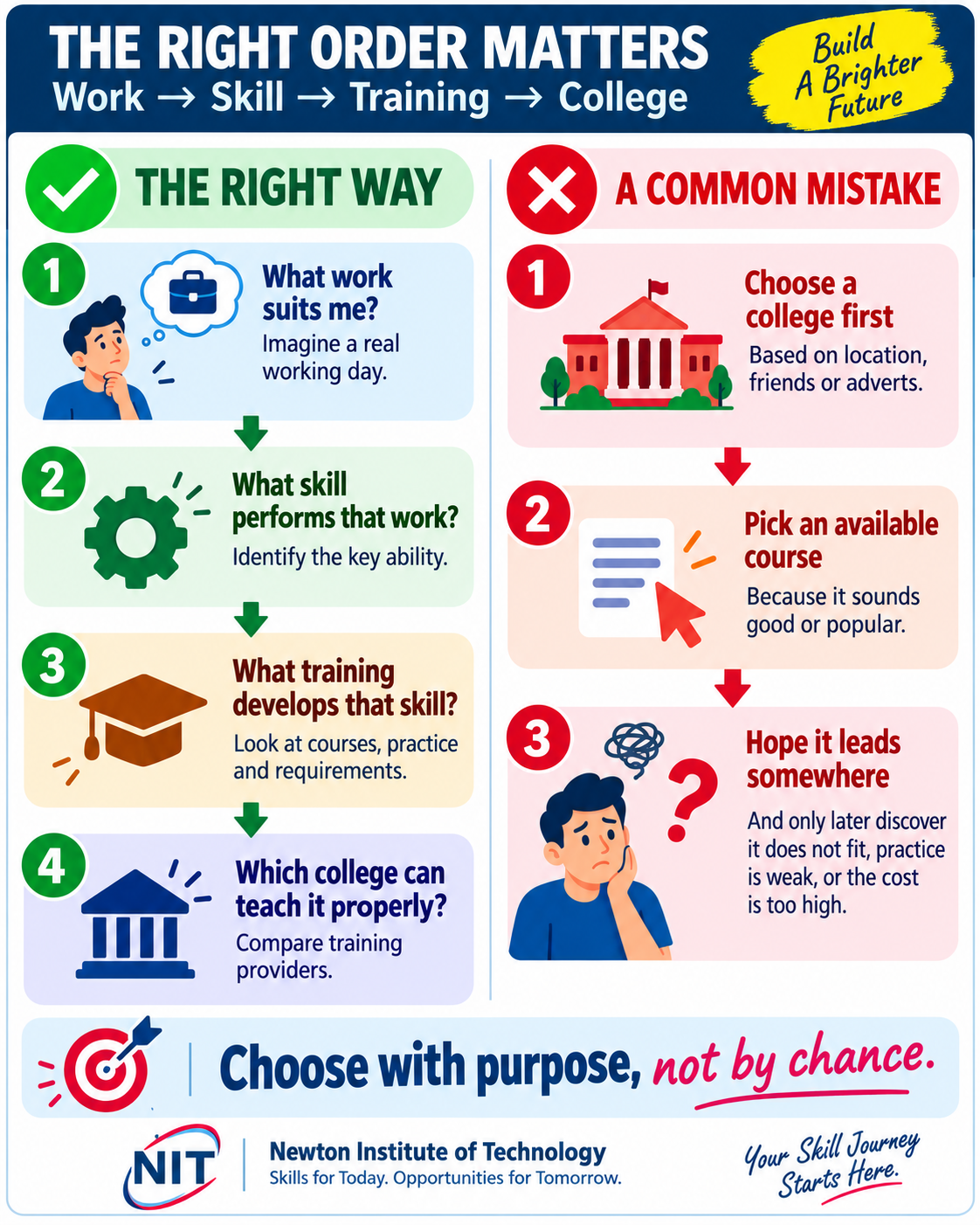
NIT visual guide: choose with purpose, not by chance. The infographic is reproduced without alteration.
A course advert can make almost anything sound like the right choice. The harder part is knowing whether you will still want the work once the advert disappears.
Picture an ordinary Tuesday after training. You may be tracing why a piece of software refuses to work, carrying out a pre-start inspection on a machine, helping a client explain the service they want, checking a faulty device or reconciling business records.
Those ordinary details tell you more about career fit than the course title does.
Before the course name
Picture the work you could actually live with
Interest helps, but broad labels such as “I like computers” or “I like machines” are only a starting point. Break the interest down into the work itself.
Do you enjoy building, analysing, troubleshooting or protecting systems?
Are you comfortable with inspection, control, safety routines and physical working environments?
Do you enjoy listening, explaining, serving clients and handling different expectations?
Do you like finding faults, using tools, building or correcting physical problems?
The aim is to stop comparing careers that lead to completely different working days.
The centrepiece
Use the NIT 100-Point Skill-Fit Test
The test is a practical decision aid, not a psychological or psychometric assessment. A high score cannot predict career success. It helps you expose weak assumptions before you commit time and money.
The weighting deliberately gives the most points to work fit and practice access. If you dislike the work or rarely get to practise it, the rest of the plan can look good on paper and still fall apart.
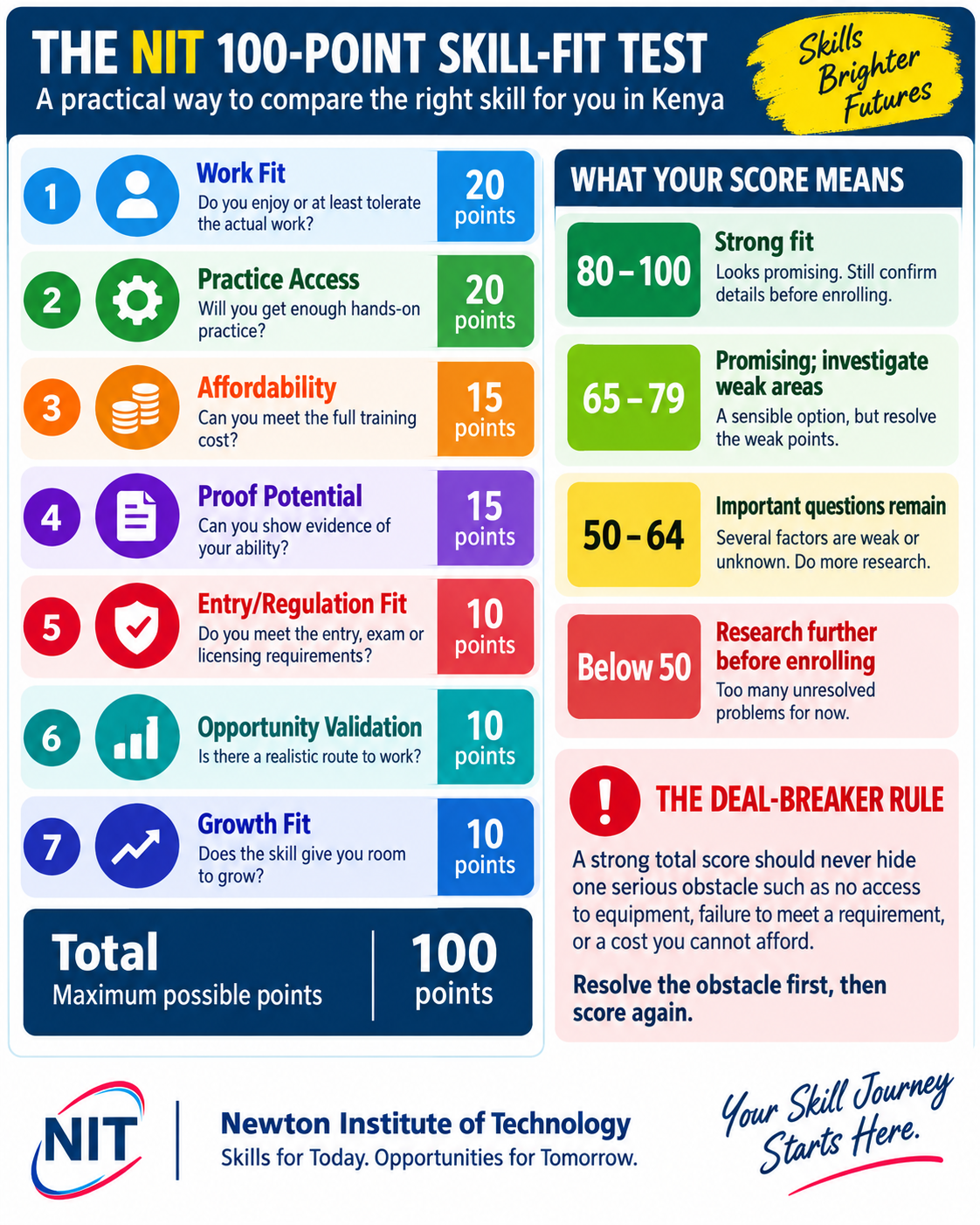
NIT visual guide: seven factors, four score bands and the Deal-Breaker Rule. The infographic is reproduced without alteration.
| Factor | Maximum points | What you are checking |
|---|---|---|
| Work fit | 20 | Would you tolerate and eventually enjoy the ordinary daily work? |
| Practice access | 20 | Can you repeatedly access the computer, machine, tools, clients or environment needed? |
| Affordability | 15 | Can you meet the complete training pathway cost, not only advertised tuition? |
| Proof potential | 15 | Will you leave with convincing evidence that you can perform the work? |
| Entry / regulation fit | 10 | Can you meet any academic, licence, examination or regulatory requirement? |
| Opportunity validation | 10 | Can you identify a realistic employer, customer or project route? |
| Growth fit | 10 | Can the skill deepen, combine with another skill or lead to more advanced work? |
Read the result carefully
A strong total is useful—but one serious obstacle can still stop you
What the total should prompt you to do
- 80–100: strong fit worth investigating seriously.
- 65–79: promising; resolve the weak areas.
- 50–64: important questions remain.
- Below 50: research further before enrolling.
Do not let the total hide one serious problem
- No meaningful access to essential equipment.
- A mandatory entry or licensing requirement you cannot meet.
- A complete training cost you cannot realistically finish paying.
- Any obstacle that prevents you from practising enough to become competent.
The score bands are prompts for further investigation, not predictions of career success.
The factor learners often underestimate
Practice access can make or break a good course choice
A student can choose a sensible field and still progress slowly because the equipment or practice environment is rarely available.
Before you enrol
Find out where the learning becomes hands-on
At NIT, plant-operator training is weighted heavily towards practical work, while ICT learners are expected to build actual projects rather than finish with theory alone.
- How often will I personally use the equipment or tools?
- Can I practise outside the trainer’s demonstration?
- What happens when I make a mistake or get stuck?
- Is attachment or supervised workplace exposure part of the route?
- Can I eventually perform a realistic task without step-by-step guidance?
NIT ICT learners have worked on projects including the NIT website, a school-management system, a hospital clocking system and an ERP project for water production and distribution. The value is not the project name itself; it is having something substantial enough to explain, test and improve.
Before tuition
Try the 7-Day Reality Test
You are not trying to teach yourself the skill in seven days. You are replacing assumptions with evidence before you commit.
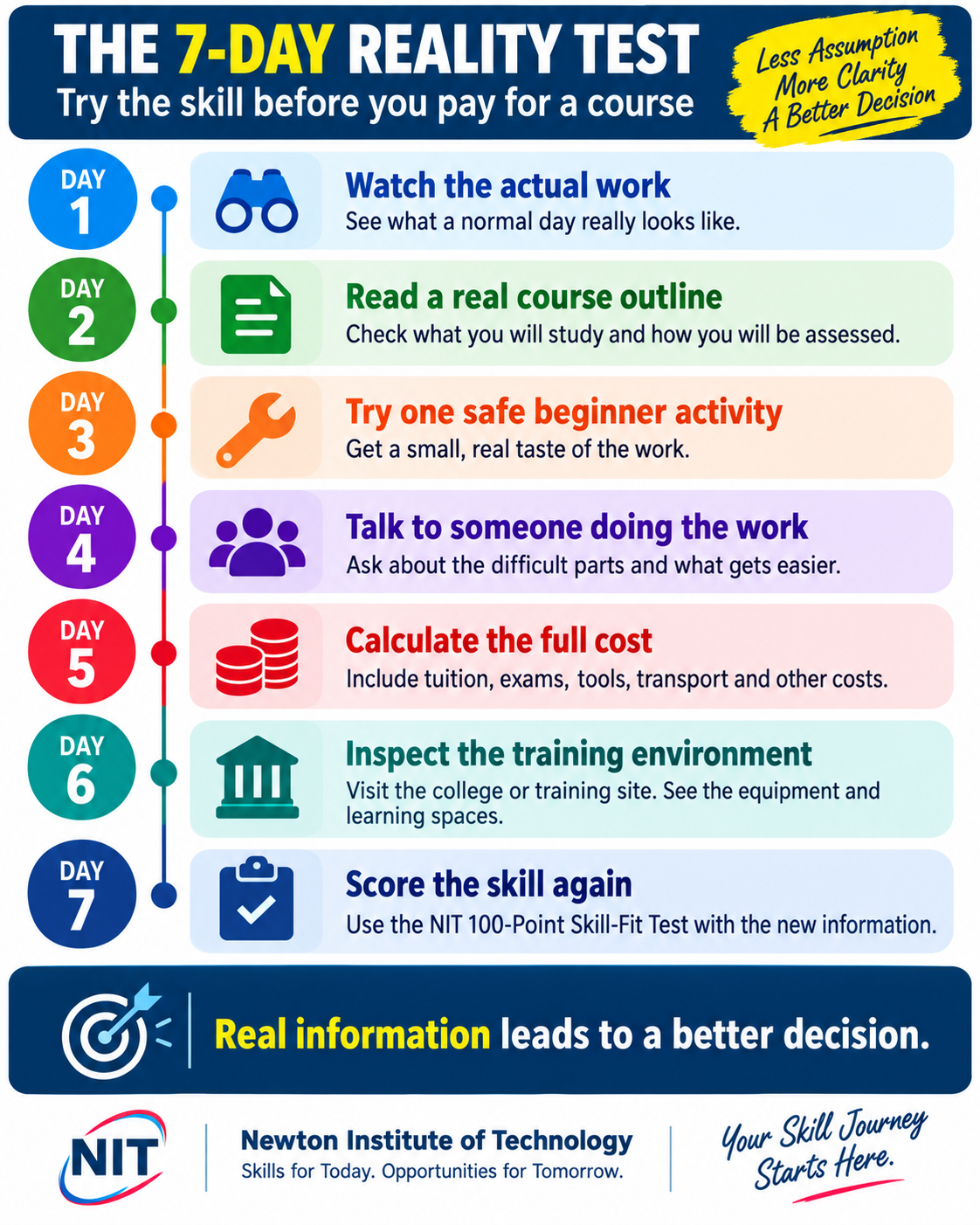
NIT visual guide: watch, read, try safely, ask, calculate, inspect and then score the skill again. The infographic is reproduced without alteration.
Observe before you imagine
Watch the actual work and read a real course outline. Notice the repetitive, difficult and ordinary parts as closely as the exciting ones.
Try one safe beginner activity
A small coding exercise, a basic data task or a supervised practical taste can reveal whether curiosity grows once the work becomes real.
Talk to somebody doing the job
Ask what beginners misunderstand, what gets tiring, what customers notice and what becomes easier with experience.
Verify the practical route
Calculate the whole cost, inspect the training environment and score the skill again using better information.
When two options both look reasonable
Put the two skills side by side
Comparing two specific options is more useful than repeatedly searching for the “best course.” Fill this table after you have seen enough of both fields to answer honestly.
| Decision factor | Option A | Option B |
|---|---|---|
| I understand the normal working day | /5 | /5 |
| I can access enough practical training | /5 | /5 |
| I can afford the complete training path | /5 | /5 |
| I meet the main entry requirements | /5 | /5 |
| I can build clear evidence of ability | /5 | /5 |
| I am willing to practise consistently | /5 | /5 |
| I value where the skill can take me later | /5 | /5 |
Which option can you test more easily? Where will you get better practical access? Which ordinary working day would you rather repeat?
Job demand matters—but it is not the whole test
Validate the route to work without turning this into another employability ranking
Kenya’s 2026 Economic Survey reports that about 822,100 new jobs were generated in 2025 and 87.2% were in the informal sector. That is useful context because work can take several forms; it does not tell one learner which skill to choose.
If your question has become “Which skills currently offer stronger employment potential?”, continue to Most Employable Skills in Kenya 2026. For the wider economic picture, use Kenya Job Market Trends 2026.
Source: Kenya National Bureau of Statistics, Economic Survey 2026.
Technology will change the work
AI should affect how you prepare—not automatically choose your career
Build something substantial underneath the tools
- A developer can use AI-assisted coding.
- A data analyst will encounter AI-supported analysis.
- A marketer can automate parts of research and production.
- A technician may increasingly use computerised diagnostics.
Keep learning after the first course
- AI and big data are among the fastest-growing skill areas.
- Networks and cybersecurity continue to rise in importance.
- Technological literacy increasingly supports many occupations.
- Human judgement, communication and adaptability still matter.
The World Economic Forum estimates that about 39% of workers’ existing skill sets will change or become outdated between 2025 and 2030. The safer habit is to build one useful core skill and keep updating it as the work changes.
Practical review note
Seeing the work changes the quality of the decision
During technical review, Engineer Simon Barongo’s emphasis was straightforward: learners get a clearer understanding of a course when they see what the work actually demands, rather than judging it from the course name alone.
A learner can understand something in class and still struggle once the instructor steps away. The difference between “I understand it” and “I can do it myself” is where practice matters most.
Know when another source should take over
When this guide is not the right tool
This guide is for choosing a practical skill or training direction
Official placement, pathway and regulatory decisions should be verified through the responsible official source.
- CBC Senior School pathway: use KEMI’s Career Interest Inventory and pathway guidance.
- KUCCPS placement or programme requirements: use KUCCPS official systems and career guidance.
- Regulated work: confirm current licensing or professional requirements with the relevant regulator.
Official resources: KEMI Career Guidance · KUCCPS Career Guidance.
Once your question becomes specific
Move to the NIT guide that owns that next decision
Employment, self-employment or ICT?
Duration, grade or college choice?
- Best Short Courses After KCSE
- 6-Month Courses in Kenya
- Use the relevant NIT KCSE grade guide when eligibility is the main issue.
- How to Choose a TVET College in Kenya once the course is settled.
One article does not need to answer every career question. This page owns the decision method; the specialist pages own their specific comparisons.
Two decisions people often confuse
Training length and certificates matter—but neither should choose the skill for you
How long should training take?
Shorter is not automatically better, and longer is not automatically stronger. Find out how much useful practice fits into the period and whether attachment, examination or licensing comes afterwards.
Certificate or competence?
Where a credential or licence is required, you need it. Practical fields also reward proof that you can perform. Aim for the relevant credential, practical competence and evidence.
Research has an end point
Know when it is time to stop searching and choose
You probably have enough information once you can explain the normal work, practice access, total cost, entry requirements, proof of ability, licensing and at least one realistic route to work.
Choose three possible directions and understand the ordinary work behind each.
Observe, try safe beginner activities and speak to people already doing it.
Check cost, equipment, practice access, assessment and entry requirements.
Use the Skill-Fit Test, resolve any deal-breaker, then commit to one main direction.
Avoid the easy traps
Common mistakes when choosing a skill or course
A good decision is usually quieter than a sales pitch
Be especially careful when one exciting claim is doing all the work in your decision.
- Choosing mainly from salary claims.
- Following friends whose interests and circumstances are different.
- Choosing the college before deciding what you need to learn.
- Ignoring how often you will actually practise.
- Mistaking a popular tool for a complete profession.
- Collecting certificates without building practical ability.
Direct answers
Choosing the right skill in Kenya: FAQs
How do I choose the right skill to learn in Kenya?
Begin with the work itself. Then compare practice access, full training costs, entry requirements, proof of competence, realistic work opportunities and future progression. The NIT Skill-Fit Test brings those factors into one 100-point comparison.
What if I have no idea what I want to learn?
Start with activities rather than course names. Decide whether you are more interested in computers, machinery, repairs, numbers, customers, selling, building or organising, then investigate two or three directions.
What is a good NIT Skill-Fit score?
80–100 suggests a strong option worth investigating seriously; 65–79 is promising but has weaknesses to resolve; 50–64 means important questions remain; below 50 suggests more investigation before enrolling. These bands are decision prompts, not predictions of career success.
Can a high Skill-Fit score still be a bad choice?
Yes. Use the Deal-Breaker Rule. No access to essential equipment, an unmet mandatory requirement or unaffordable full costs can matter even when the total looks strong.
Should employability be the main factor?
It should matter, but it should not dominate the whole decision. You also need enough interest in the work and enough practice to become competent. Use the dedicated employability guide once you are ready to compare demand.
How can I test a career before paying for a course?
Observe the real work, read an actual course outline, attempt a safe beginner activity, speak to someone already in the field, calculate the full cost and inspect the learning environment. The 7-Day Reality Test in this guide puts those checks in sequence.
Does AI change which skill I should learn?
AI is changing many occupations, but it should not automatically choose your career. Build a useful core skill and learn how AI and other technology are changing that particular field.
Should I choose the college or the course first?
Neither should be first. Start with the work, identify the skill, choose the appropriate training pathway and then compare institutions.
Final answer
Choose something you can learn properly, practise often and prove you can perform
The right skill is not necessarily the one making the most noise online. Understand the work first. Check your practice access. Know the full cost. Confirm the requirements. Decide what evidence you should leave with. Validate that a realistic opportunity exists.
Work → Skill → Training → College.
Need help narrowing the direction?
Talk to NIT Admissions after you have identified the kind of work you want
Newton Institute of Technology provides practical training across ICT, plant and driving, and hair and beauty programmes. Admissions can explain the current entry requirements, duration, fees, practical timetable, equipment arrangements, assessment, licensing where applicable, attachment and next intake.
LocationNamba Area, Migori Town
Along Migori–Sirare Highway
Call / WhatsApp+254 713 584 858