

Plant Operator Career Guide G4 Excavator
Excavator Operator
Career in Kenya
Jobs · Demand · Skills employers need
A realistic Kenyan career guide to where excavator operators work, what employers look for, why experience matters and how practical competence becomes employability.
Career decision · not course duplication
Is excavator operation a good career in Kenya?
Excavator operation can be a good career in Kenya for someone targeting construction, roads, drainage, quarrying and earthmoving. The skill can be useful across several types of projects, but training alone does not guarantee employment. Employers also look for safe machine control, practical experience, inspections, basic mechanical awareness and reliable behaviour on site.
For someone considering plant operation as a career, the excavator is difficult to ignore. You see it opening trenches, digging foundations, clearing sites, working on drainage, loading material and handling earthworks on road projects.
That range of work is one reason excavator operation attracts so much interest among people entering plant operation in Kenya.
The machine may be needed. The person in the seat still has to prove that they can operate it safely, smoothly and responsibly.
A learner may be asking, Which machine should I learn? An employer is usually asking something different: Can this person actually do the work?
Demand needs context
Why excavator skills remain relevant in Kenya
Excavators are useful because excavation and earthmoving appear in many different kinds of projects. A building contractor may need one for foundations. A road contractor may use one during drainage and earthworks. A water project may need trenches opened. A quarry may use an excavator to handle material.
Kenya’s wider construction figures provide useful context. The Kenya National Bureau of Statistics reported that the construction sector grew by 6.8% in 2025, recovering from a 0.7% contraction in 2024. KNBS linked the recovery to increased civil works, including road construction and maintenance, together with increased residential construction. Cement consumption also rose during the year.
Excavators support foundations, site preparation and general earthworks.
Earthworks and drainage keep excavators relevant to road projects.
Trenches, channels and related civil works need controlled excavation.
Sector growth is not the same thing as a guaranteed excavator vacancy.
The 6.8% figure does not mean excavator vacancies grew by 6.8%. It shows increased activity in industries where excavation, earthworks, foundations and drainage are routinely needed.
For a machine-by-machine comparison, use NIT’s separate Most Marketable Plant Operator Machines in Kenya guide. This article stays with the excavator career itself.
The machine moves between industries
Where can excavator operators work in Kenya?
There is no single “excavator industry.” That is part of the machine’s appeal. The employment arrangement can vary too: some operators work for contractors that own equipment, while others work for plant-hire businesses and move with the machine from client to client.
Building construction
Foundations, site clearance, trenches and general earthworks can all bring excavators onto a building site.
Roads and drainage
Road construction and maintenance may require excavation for drainage, culverts, shoulders and earthworks.
Quarries and earthmoving
Excavators can remove material, load, reshape ground and support heavier earthmoving activities.
Plant hire and civil works
A hired machine may travel from one client project to the next, and the operator may travel with it.
A road project can end. The next suitable job may be somewhere else.
More than joystick movement
What does an excavator operator actually do?
Operating the controls is only the most visible part of the job. A working day may begin before the engine starts. The operator needs to look around the machine, check for obvious problems, understand the work area and know what the site team expects before anything moves.
Understand the machine and the work area
- Look for obvious defects and leaks.
- Understand the task before moving.
- Check the surrounding work area.
- Know where people, trucks and structures are.
Control, judgement and accuracy
- Dig trenches and prepare foundations.
- Load trucks without striking them.
- Work around ground crews safely.
- Use accuracy where speed would create risk.
Take a trench near an existing service line. Digging quickly does not make someone a good operator there. Loading a truck is similar: filling the body is only part of the job. The operator also has to avoid striking the truck, spilling material unnecessarily or creating danger around people on the ground.
This is where the difference between knowing the controls and knowing the job becomes obvious.
2026 job-market snapshot
What Kenyan employers are actually asking for
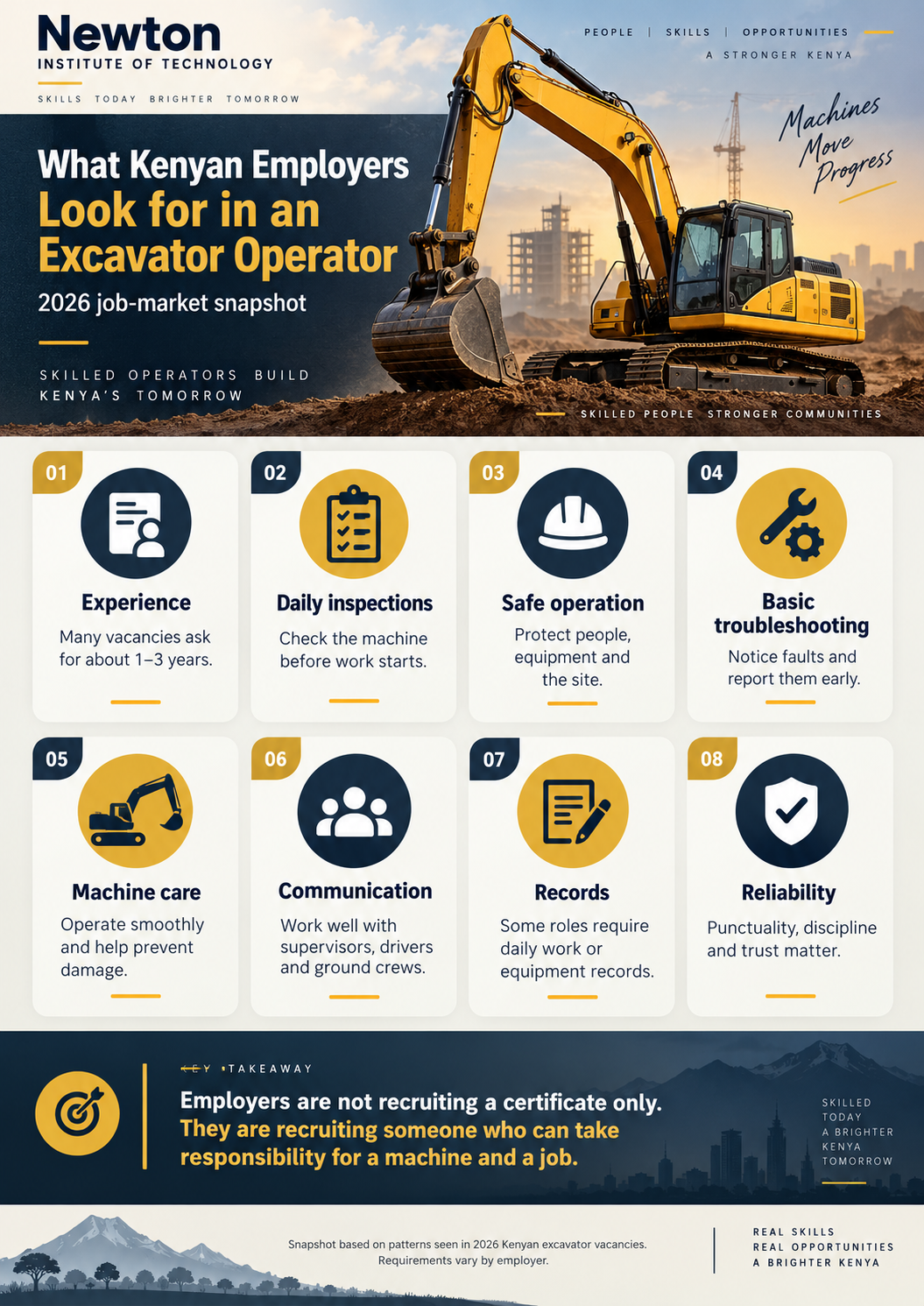
Course brochures tell you what you can study. Vacancies tell you what employers expect after training. A review of Kenyan excavator vacancies advertised during 2026 found recurring emphasis on previous operating experience, machine inspections, safe operation, basic maintenance or fault recognition, reliability and the ability to work with other people on site.
The employer is recruiting somebody to take responsibility for a machine and a job.
Approved Article 77 infographic
What Kenyan employers look for in an excavator operator
The beginner’s hardest question
Why do employers ask for experience?
You finish training, start looking for work and discover an advertisement asking for an experienced excavator operator. Then comes the obvious question: How do I become experienced when employers are already asking for experience?
There is no clever shortcut. You build it.
Learn the movement
- Supervised practice builds coordination.
- Correction helps remove poor habits early.
- Repetition turns awkward movements into controlled ones.
Learn the site
- Soft ground changes decisions.
- Trucks and workers move unpredictably.
- Real tasks teach judgement under pressure.
This is why seat time matters, but all seat time is not equal. Moving the boom for a few minutes is not the same as repeatedly positioning, digging, loading, correcting mistakes and developing enough coordination for the machine to become controlled.
Speed is not the first benchmark
A beginner does not need to pretend to be experienced
One of the easiest mistakes for a new operator to make is trying too hard to look experienced. That often appears as speed: fast swinging, abrupt movements and sudden stops meant to impress people standing nearby.
Slow and deliberate is a better foundation than fast and rough.
A beginner who listens can improve quickly.
Coordination matters before production speed.
Speed becomes useful after control is dependable.
Career decision reality check
What excavator work is really like
Heavy equipment can look impressive from outside a construction site. The working conditions are usually less glamorous. There can be dust, mud, heat, noise and long periods where concentration matters much more than excitement.
Some days may involve repetitive loading. Another task may require very careful excavation in a confined area. At times the excavator can sit idle because another part of the project is not ready; then, when work resumes, several trucks or workers may suddenly be waiting on the operator.
You are sitting in an expensive piece of equipment on a live worksite. That comes with responsibility.
Employability is built from several habits
What skills make an excavator operator more employable?
Smooth machine movement
Useful operators coordinate movements without making every action abrupt. Smooth does not mean permanently slow; it means controlled.
See beyond the bucket
The rear swings, workers approach, trucks reposition and ground conditions change. Good operators monitor the wider work area.
Look after the machine
Do not wait for a breakdown before paying attention. Detailed pre-start procedure belongs in NIT’s dedicated inspection guide.
Be someone the site can depend on
Showing up, following instructions, communicating and admitting when you do not know something all affect employability.
— Engineer Simon Barongo
For the detailed inspection sequence, use the Plant Operator Pre-Start Inspection Checklist.
The central career distinction
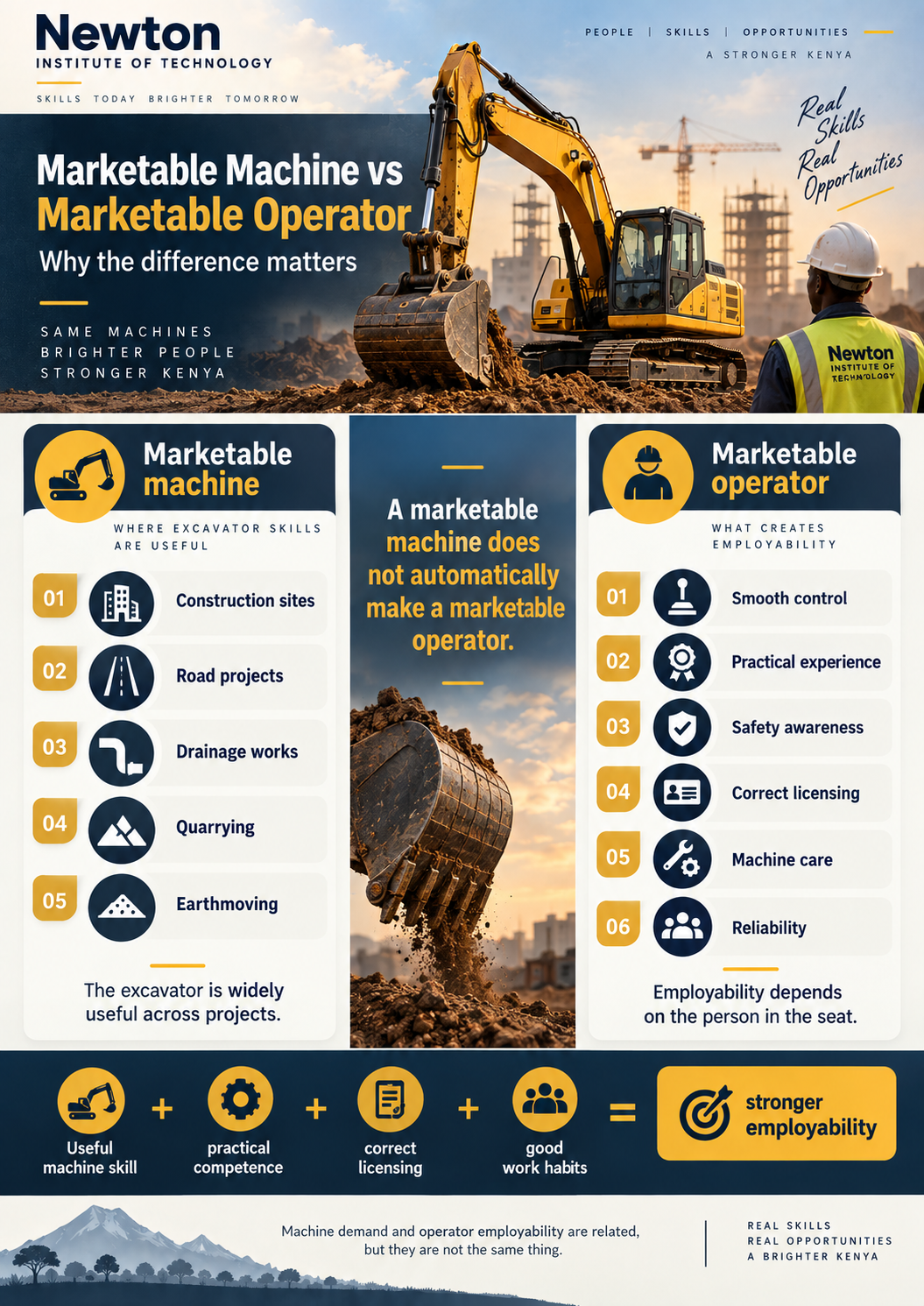
A marketable machine is not necessarily a marketable operator
An excavator may be widely used. That makes the machine skill attractive. But two people can complete excavator training and leave with very different employment prospects.
Where excavator skills are useful
- Construction sites
- Road projects
- Drainage works
- Quarrying and earthmoving
What the person in the seat adds
- Smooth control and practical experience
- Safety awareness and correct licensing
- Machine care and reliability
- Credible workplace references
A realistic equation is:
There will still be competition and project cycles. Marketability improves possibilities; it does not remove the employment market around you.
Approved Article 77 infographic
Marketable machine vs marketable operator
Choose the workplace before the machine
Is excavator a good first machine to learn?
For somebody interested in construction and earthmoving, it can be. Its main advantage is the range of places where excavation is needed. But there is no single best first machine for everybody.
Forklift may fit the intended workplace better.
Excavator can pair naturally with grader or roller skills later.
Excavator and loader skills can complement one another.
Look at the machines employers actually use around your target area.
Start with the workplace, then choose the machine. NIT’s marketability comparison guide handles that wider decision.
You cannot manufacture years of experience overnight
What can make a new operator easier to employ?
Practical exposure and references
- Choose training with meaningful operating time.
- Take attachment as workplace learning, not a signature exercise.
- Build references from supervisors who have actually watched you work.
Licensing and work habits
- Keep licensing records in order.
- Do not exaggerate experience.
- Show up, follow instructions and report machine problems honestly.
For the licensing pathway, use NIT’s NTSA Category G Plant Operator Licence in Kenya guide. For broader vacancy-search and application strategy, use Plant Operator Jobs in Kenya.
Career growth is usually task-based
How does an excavator career develop?
Progression in plant operation is rarely as tidy as moving through office job titles. An operator normally becomes more valuable by handling increasingly difficult work well.
Build dependable control on straightforward tasks.
Take on trenching, confined work and difficult ground.
Handle larger production targets and sensitive worksites.
Add skills that make sense for the kind of work you actually want.
National marketability is not identical local demand
Is excavator demand the same everywhere in Kenya?
No. Project activity changes from place to place and over time. Before choosing any machine, look closely at the places where you are realistically prepared to seek employment.
Are active road projects nearby?
Road upgrading, drainage and maintenance can change the local mix of machines in use.
Is construction active?
Large building sites can create different plant needs from areas dominated by small projects.
Is material extraction common?
Quarrying and earthmoving can make excavator and loader skills more relevant.
Which machines keep appearing?
Local plant-hire businesses can reveal which machines clients regularly request.
Training is the starting point
How does excavator training fit into the career?
Formal training should give a beginner supervised practice, safety awareness and enough familiarity with the machine to begin developing proper control. It is the starting point, not the entire career.
Learners who want NIT’s course duration, practical-training structure, admissions information and assessment pathway should use the dedicated Excavator Operator Training in Kenya guide.
The neat version is rarely the real version
What usually happens after excavator training?
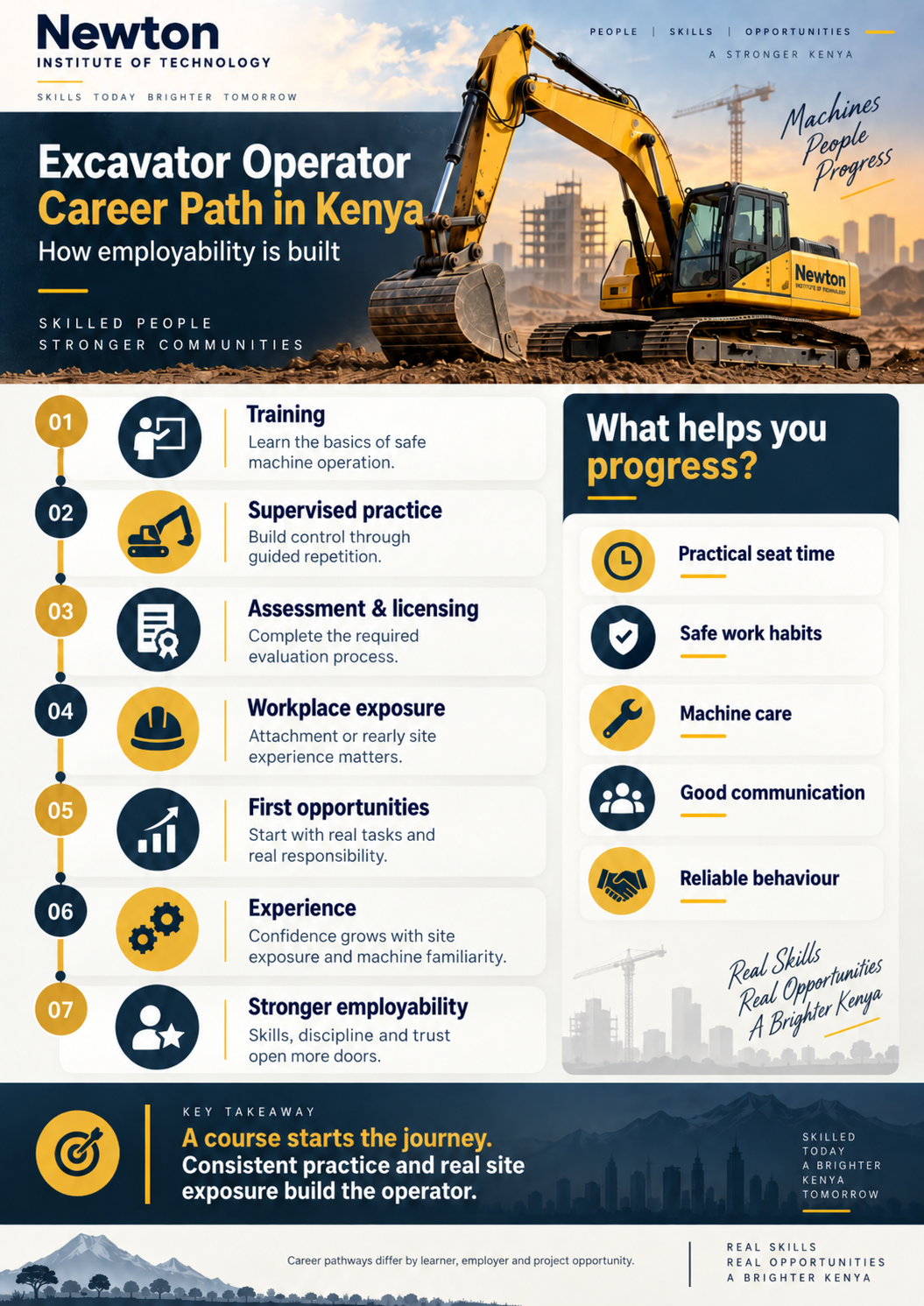
The neat version is course → certificate → job. Real careers do not always work that way. A more realistic route is training, supervised practice, assessment and licensing, workplace exposure, first opportunities, experience and stronger employability.
Training should give you a better starting point. What you build from there matters just as much.
Approved Article 77 infographic
Excavator operator career path in Kenya
Before you commit
Before choosing excavator as a career
Ask yourself
- Do I genuinely want construction or earthmoving work?
- Am I comfortable working outdoors in dust, mud, heat or rain?
- Can I concentrate for long periods?
- Could I travel for suitable project work?
Be prepared to
- Begin as a beginner.
- Care for the machine, not just operate it.
- Accept correction from more experienced people.
- Keep learning long after the course ends.
Common career questions
Frequently asked questions
Is excavator operation a good career in Kenya?
It can be a good career for someone interested in construction, roadworks, drainage, quarrying and earthmoving. Excavator skills can be applied across several types of projects. Employment still depends on competence, licensing, practical experience and available work.
Is excavator operation marketable in Kenya?
Yes. Excavators are used in several types of construction and earthmoving work. But a marketable machine does not guarantee employment. Employers also assess the operator’s experience, safety awareness, control, machine care and reliability.
Where do excavator operators work in Kenya?
They may work on building sites, road projects, drainage and water works, quarries, earthmoving projects, plant-hire operations and other civil works.
What skills do employers look for in excavator operators?
Requirements vary, but vacancies reviewed for this guide commonly emphasised operating experience, safe equipment use, routine inspections, mechanical awareness, maintenance, communication and reliability.
Can I get an excavator job immediately after training?
It is possible, but training does not guarantee immediate employment. Many vacancies prefer previous experience. Attachment, supervised practice, credible references and genuine operating competence can strengthen a beginner’s position.
How can a beginner gain excavator experience?
Begin with meaningful supervised practice and take attachment or legitimate junior workplace opportunities seriously. The aim is to develop real control and learn how machine operation fits into a working site.
Do excavator operators need a licence in Kenya?
Excavator operation falls within Kenya’s plant-operator licensing framework. NIT’s NTSA Category G Plant Operator Licence in Kenya guide explains the licensing process separately.
Career verdict
So, is an excavator career worth it?
For the right person, yes. The excavator’s strength is not that it guarantees employment. Its strength is that excavation and earthmoving are needed in different kinds of work—from foundations and drainage to roads, quarries and general construction.
Someone who develops good control, respects safety, understands basic machine care, gains meaningful workplace exposure and builds a reputation for reliability will be in a stronger position than somebody who simply collected a certificate.
Choose the excavator because the work suits you and because the industries you want to enter actually use it. Then work on becoming the kind of operator an employer is comfortable putting in the seat.
Turn career interest into practical machine skill
Train for excavator operation at Newton Institute of Technology
Use the dedicated training guide for course details, then speak to NIT about supervised practical learning, the next intake and the plant-operator pathway that fits your career goal.
MachineG4 Excavator
Career directionConstruction · roads · earthmoving
InstitutionNewton Institute of Technology