

NIT Certificate Course Guide Kenya · 2026/2027
Certificate Courses
in Kenya 2026/2027
Requirements · fees · duration · career paths
A practical guide to understanding certificate routes in Kenya, comparing entry requirements and costs, and choosing training that leads to a clear skill, career or progression pathway.
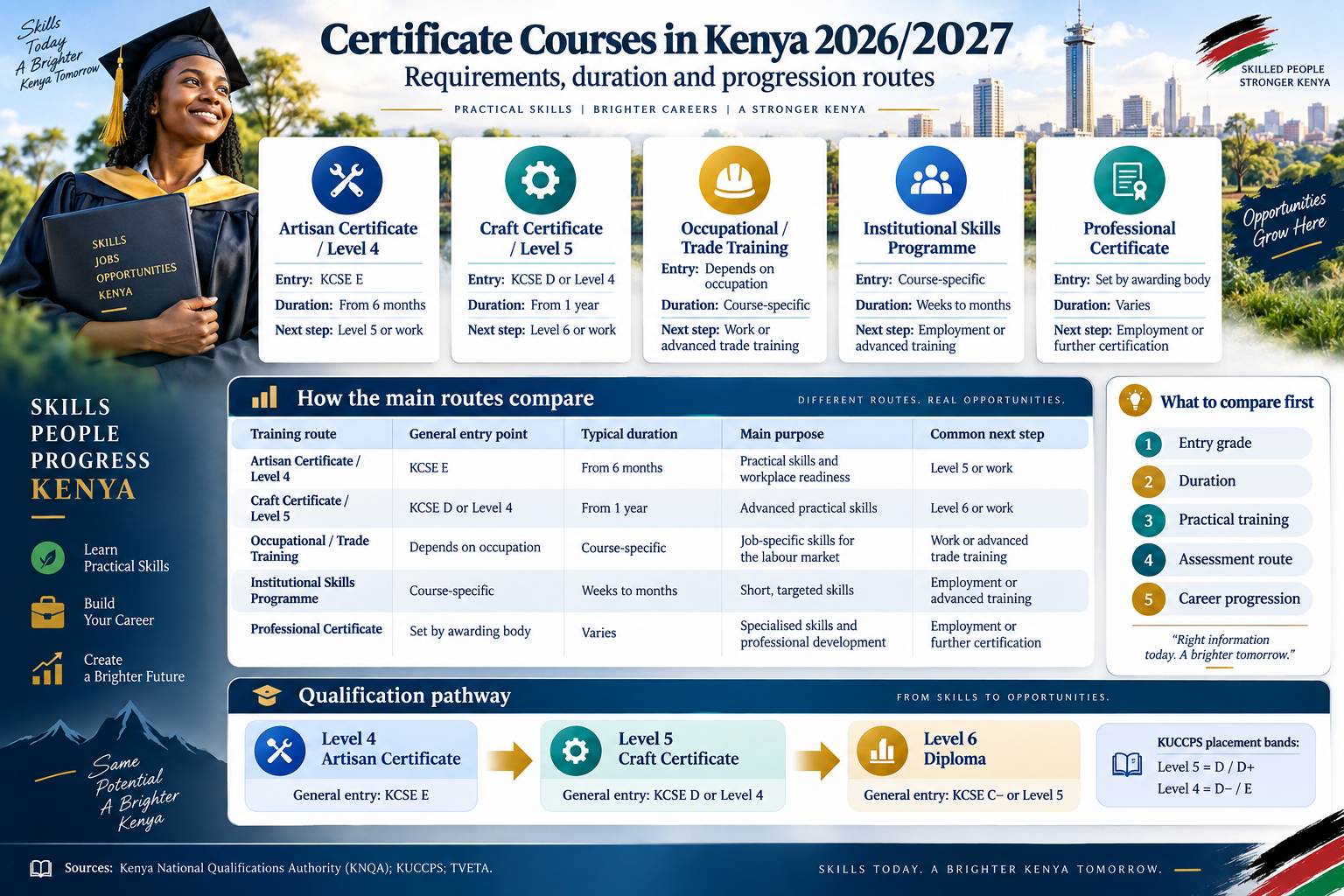
Qualification pathway
What should you check before choosing a certificate course in Kenya?
Start by identifying the training route. A formal Craft Certificate sits at KNQF Level 5, while Kenya also has Artisan qualifications, occupational and trade training, professional certificates and shorter institutional skills programmes. Once the route is clear, compare the entry grade, duration, full cost, practical training and next career or study step. [1] [2]
Start with the training route
What counts as a certificate course in Kenya?
The word certificate appears across several parts of Kenya’s education and training system. The course becomes much easier to understand once you know which route it follows.
Artisan Certificate
Level 4 builds practical occupational foundations and can lead into a relevant Level 5 qualification.
Minimum duration- From 6 months
- Occupational foundation
Craft Certificate
This is the main formal certificate level in the KNQF and develops technical and occupational competence.
Minimum duration- From 1 year
- 120–239 credits
National Diploma
Level 6 provides the next formal progression step after a relevant Level 5 qualification.
Minimum duration- From 2 years
- Advanced technical study
KNQA publishes the qualification levels, general entry routes, minimum learning volume and progression structure. [1]
Occupational and trade training
Hairdressing, Beauty Therapy, mechanical trades and other practical careers can follow occupational assessment routes. The course is organised around competence in the work, with assessment through the relevant examining or occupational body.
Institutional and professional certificates
Institutions and professional bodies also offer focused programmes in fields such as software development, cybersecurity, graphic design, accounting, networking and project management. Compare these through curriculum depth, practice, assessment and career outcome.
Entry requirements
What grade do you need for a certificate course in Kenya?
For a formal KNQF Level 5 Craft Certificate, the general entry point is KCSE D or an appropriate Level 4 qualification. KUCCPS currently places D and D+ within its Certificate/Level 5 placement band, while D− and E fall within Artisan/Level 4. [1] [2]
| Qualification | General KNQF entry route | KUCCPS placement context |
|---|---|---|
| Artisan / Level 4 | KCSE E or Level 3 | D− and E are in the Level 4 placement band. |
| Craft Certificate / Level 5 | KCSE D or Level 4 | D and D+ are in the Level 5 placement band. |
| National Diploma / Level 6 | KCSE C− or Level 5 | C and C− are in the Level 6 placement band. |
For detailed D Plain programme choices and subject requirements, use NIT’s dedicated Courses for D Plain in Kenya and KUCCPS Courses for D Plain Students guides rather than duplicating those programme lists here.
Students starting from D− can use the Level 4 route and then progress upward. NIT’s Courses for D− in Kenya guide handles those options in detail.
Training time
How long does a certificate course take in Kenya?
A formal Level 5 Craft Certificate has a national minimum duration of one year. Level 4 starts from six months, while Level 6 starts from about two years. [1]
Foundation occupational training before work or Level 5 progression.
The main formal certificate level in the KNQF.
The next formal qualification level after a relevant Level 5 route.
Short skills programmes, occupational courses and professional certificates can use different training periods. Duration tells you how long you train; qualification level tells you where the qualification sits in the framework.
Course fields
Which certificate course fields are available in Kenya?
TVET and skills training covers most major occupational areas. TVETA maintains searchable registers for institutions and courses, including course levels and examining bodies. [3] [4]
ICT
Software, ICT, networking, cybersecurity, computer systems and digital services.
Business
Management, HR, marketing, supply chain, administration and operations.
Technical trades
Electrical, automotive, plumbing, masonry, carpentry and related workshop skills.
Hair & Beauty
Hairdressing, Beauty Therapy, Cosmetology, barbering and specialised beauty skills.
Hospitality & community
Food production, catering, front office, community and social-service programmes.
Agriculture & enterprise
Agriculture, agribusiness, production, fashion and self-employment pathways.
Compare the complete cost
How much do certificate courses cost in Kenya?
There is no single fee covering every certificate route. Cost changes with the institution, duration, facilities, practical equipment and assessment structure.
| Cost item | What it covers | Question to ask |
|---|---|---|
| Tuition | Institutional training | Is the quotation for the full programme, term, module or year? |
| Examination | Internal or external assessment | Is the examination charge included or paid separately? |
| Equipment | Laptop, tools, PPE, salon kit or specialist materials | What must the student provide personally? |
| Practical work | Lab, workshop, salon or machine access | How much supervised practical time is included? |
| Attachment | Workplace learning costs | How long is attachment and what expenses should the learner plan for? |
| Licensing | Government or professional payments where applicable | Which fees go directly to the licensing or examining body? |
For the full national fee discussion, use NIT’s dedicated TVET Course Fees in Kenya guide. This article keeps the fee discussion focused on course comparison.
Newton Institute of Technology example
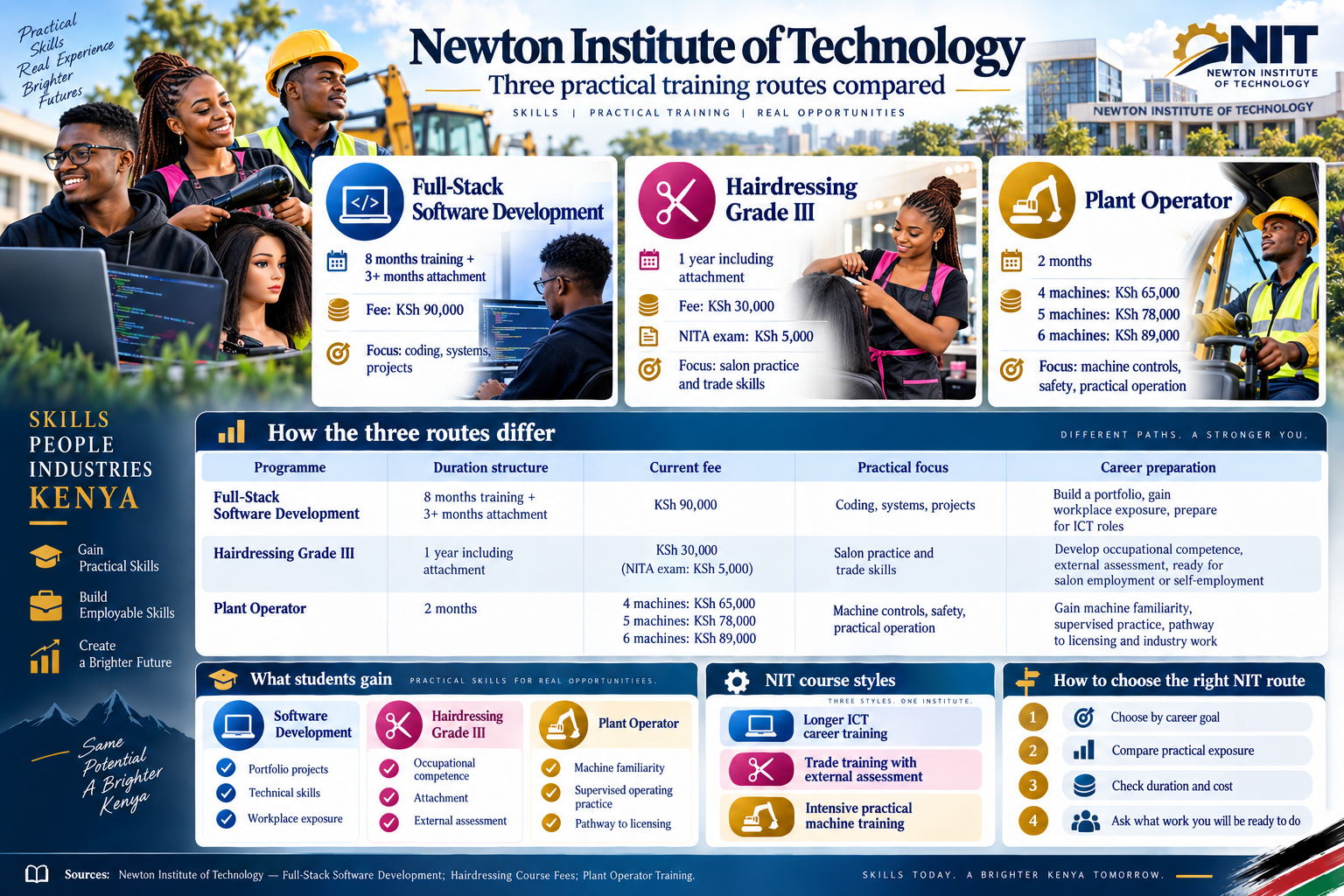
Three real training routes at Newton Institute of Technology
Newton Institute of Technology in Migori provides a useful demonstration because learners can choose between programmes with very different training methods, durations and career outcomes.
Full-Stack Software Development
8 months training + 3+ months attachment
Current NIT fee: KSh 90,000. Training covers front-end development, back-end systems, databases, APIs, testing, deployment and project work. Previous coding experience is not required. [6]
Focus: coding · systems · projects · attachmentHairdressing Grade III
1 year including attachment
Current NIT fee: KSh 30,000, with a separate KSh 5,000 NITA examination fee. The programme develops broader occupational hairdressing competence through training, practical work and attachment. [8]
Focus: salon practice · trade skills · external assessmentPlant Operator
2 months · approximately 70% practical
Current NIT fees are KSh 65,000 for 4 machines, KSh 78,000 for 5 and KSh 89,000 for 6. Training concentrates on machine controls, inspection, safety and supervised operation. [9]
Focus: machine controls · safety · practical operation| NIT route | Training structure | Practical career preparation |
|---|---|---|
| Software Development | 8 months + 3+ months attachment | Working projects, portfolio development and workplace exposure. |
| Hairdressing Grade III | 1 year including attachment | Salon practice, occupational competence and external assessment. |
| Plant Operator | 2 months | Machine familiarity, supervised operation and licensing pathway. |
NIT’s Cybersecurity, Data Science & Analytics, Artificial Intelligence and Mobile App Development programmes each run for six months followed by a compulsory three-month attachment, with a current institutional training fee of KSh 60,000. [7]
Different goals, different routes
Certificate course or short course?
Formal Level 5 route
Choose a Craft Certificate when you want a formal qualification level, broader occupational training and a route towards Level 6.
Focused short course
Choose a short course when you want a defined skill over a shorter period—for example Computer Packages, Nail Technology, Barbering or another focused practical service.
For a full short-course comparison, use NIT’s Best Short Courses After KCSE in Kenya guide.
Progression
Can you progress from a certificate to a diploma?
Yes. KNQA places the National Diploma at Level 6, with KCSE C− or an appropriate Level 5 qualification as the general entry route. [1]
KCSE C− → Level 6 Diploma or Level 5 Certificate → related Level 6 Diploma.
A learner who begins at certificate level can therefore build the qualification step by step.
Before you enrol
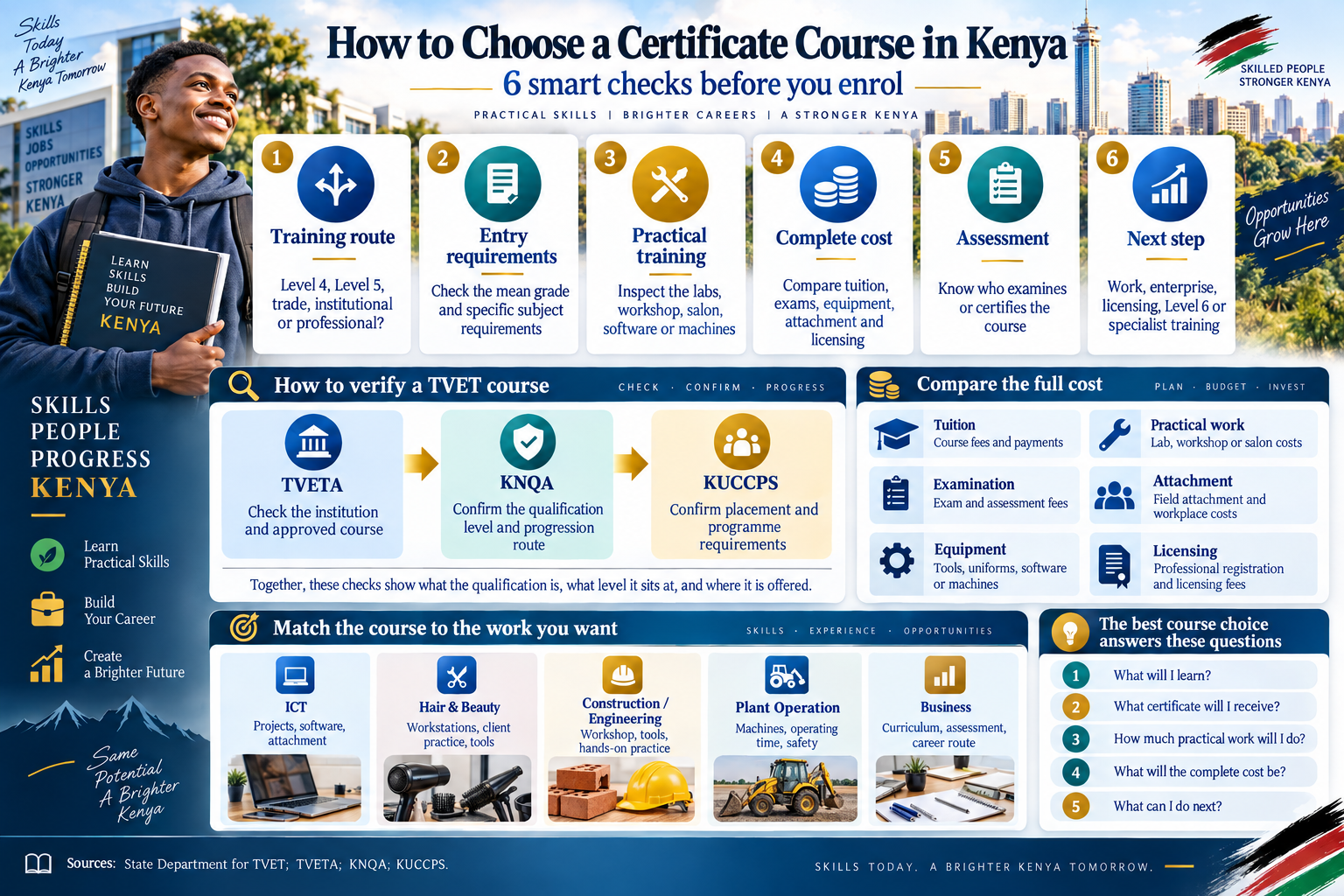
Six checks for choosing a certificate course
Start with the work you want to learn, then judge the course through the training itself.
- Training route: identify whether it is Level 4, Level 5, occupational/trade training, a professional certificate or an institutional skills programme.
- Entry requirements: check the mean grade and the exact subjects required by the programme.
- Practical training: inspect the labs, workshops, salon workstations, machines, software or projects used during training.
- Complete cost: combine tuition with examinations, equipment, practical materials, attachment and licensing where applicable.
- Assessment: know who examines or certifies the programme and what must be completed before certification.
- Next step: identify whether the course leads towards employment, self-employment, licensing, Level 6 progression or specialist training.
Use the official registers
How to verify a TVET course in Kenya
The State Department for TVET directs prospective learners to TVETA’s public registers to check institutions and programmes. TVETA’s course register can show the course name, level, examining body and institutions offering it. [3] [4] [5]
TVETA
Check the institution and the course information in the public TVET registers.
KNQA
Confirm where the qualification sits in the national qualifications framework.
KUCCPS
For placement programmes, confirm the current placement band and exact programme requirements.
Assessment body
Know who examines, assesses, licenses or awards the certificate attached to the programme.
Career direction
What career can a certificate lead to?
The career path depends on the field and on what the student can actually do after training.
ICT
Technical support, networking, software development, data work and other digital roles.
Technical trades
Installation, repair, maintenance, construction, workshop work and independent contracting.
Hair & beauty
Salon employment, mobile client services and personal-care enterprise.
Business & services
Administration, customer service, sales, operations and business-support roles.
For the separate question of labour-market demand, use NIT’s Most Marketable Courses in Kenya guide. This page remains focused on understanding and choosing certificate training.
Frequently asked questions
Certificate courses in Kenya: quick answers
What is the minimum grade for a certificate course in Kenya?
For a formal KNQF Level 5 Craft Certificate, the general entry requirement is KCSE D or a relevant Level 4 qualification. [1]
Can I study a certificate course with D Plain?
Yes. KCSE D meets the general Level 5 entry requirement. The exact programme may also specify subject requirements. [1]
Can I study a certificate course with D−?
KUCCPS places D− in the Artisan/Level 4 route. A relevant Level 4 qualification can then provide progression into Level 5. [2]
How long does a certificate course take in Kenya?
A formal Level 5 Craft Certificate has a minimum duration of one year. Occupational, professional and institutional skills programmes can use different training periods. [1]
How much does a certificate course cost in Kenya?
Fees depend on the institution and training route. Compare tuition together with examinations, equipment, practical materials, attachment and any licensing costs attached to the programme.
Is a short course the same as a Level 5 certificate?
No. Level 5 is a defined qualification level within Kenya’s National Qualifications Framework. A short course normally concentrates on a narrower skill over a shorter training period. [1]
Can I join a diploma after completing a certificate?
Yes. An appropriate Level 5 qualification is a general entry route into Level 6. [1]
The main point
Choose the training route before you compare the certificate title
Know what you will learn, what qualification or certificate you will receive, how much practical work you will do, what the complete training will cost and what you can do next.
A useful certificate should leave you with a skill you can demonstrate and a clear direction for the next stage of your career.
Practical training in Migori
Register at Newton Institute of Technology
Newton Institute of Technology offers practical training across ICT, Hairdressing and Beauty, Plant Operation, Driving and other skills-focused areas.
Tell the NIT Admissions team the career you want to pursue. We will help you identify the training route, course duration and practical programme that fits that goal.
Sources and references
- Kenya National Qualifications Authority — FAQ: KNQF Levels 4–6, general entry routes, credits, minimum duration and progression.
- KUCCPS — Placement: current general placement bands for Certificate/Level 5, Artisan/Level 4 and Diploma/Level 6.
- TVETA — Accredited TVET Institutions: public register for TVET institutions.
- TVETA — TVET Courses: public course register showing programme, level, examining body and provider information.
- State Department for TVET — Frequently Asked Questions: official guidance on checking institutions and programmes through the TVETA registers.
- Newton Institute of Technology — Full-Stack Software Development Course: duration, attachment, fee, beginner entry and practical curriculum.
- Newton Institute of Technology — TVET Course Fees in Kenya: current NIT ICT programme duration, attachment and fee examples.
- Newton Institute of Technology — Hairdressing Course Fees in Kenya: Grade III duration, NIT fee, NITA examination fee and short-course options.
- Newton Institute of Technology — How to Become a Plant Operator in Kenya: two-month training structure, practical/theory balance and current machine-package fees.
Prepared by: Newton Institute of Technology Editorial Team · Institutional / Technical review: Engineer Simon Barongo · Reviewed: 23 September 2026