

NITA Trade Test Guide Kenya · 2026
NITA Trade Test
in Kenya 2026
Grade III → Grade II → Grade I
A practical guide to NITA Trade Test grades, current fees, registration, assessment centres, exam periods, results, certification and the route for experienced artisans.
Three traditional grades
What is the NITA Trade Test?
A NITA Trade Test assesses whether a candidate can perform the practical work required in a specific occupation. NITA conducts the assessment and issues Government Trade Test certificates to successful candidates. The traditional progression is Grade III → Grade II → Grade I. [1] [3]
Understand the progression
NITA Grade III, Grade II and Grade I
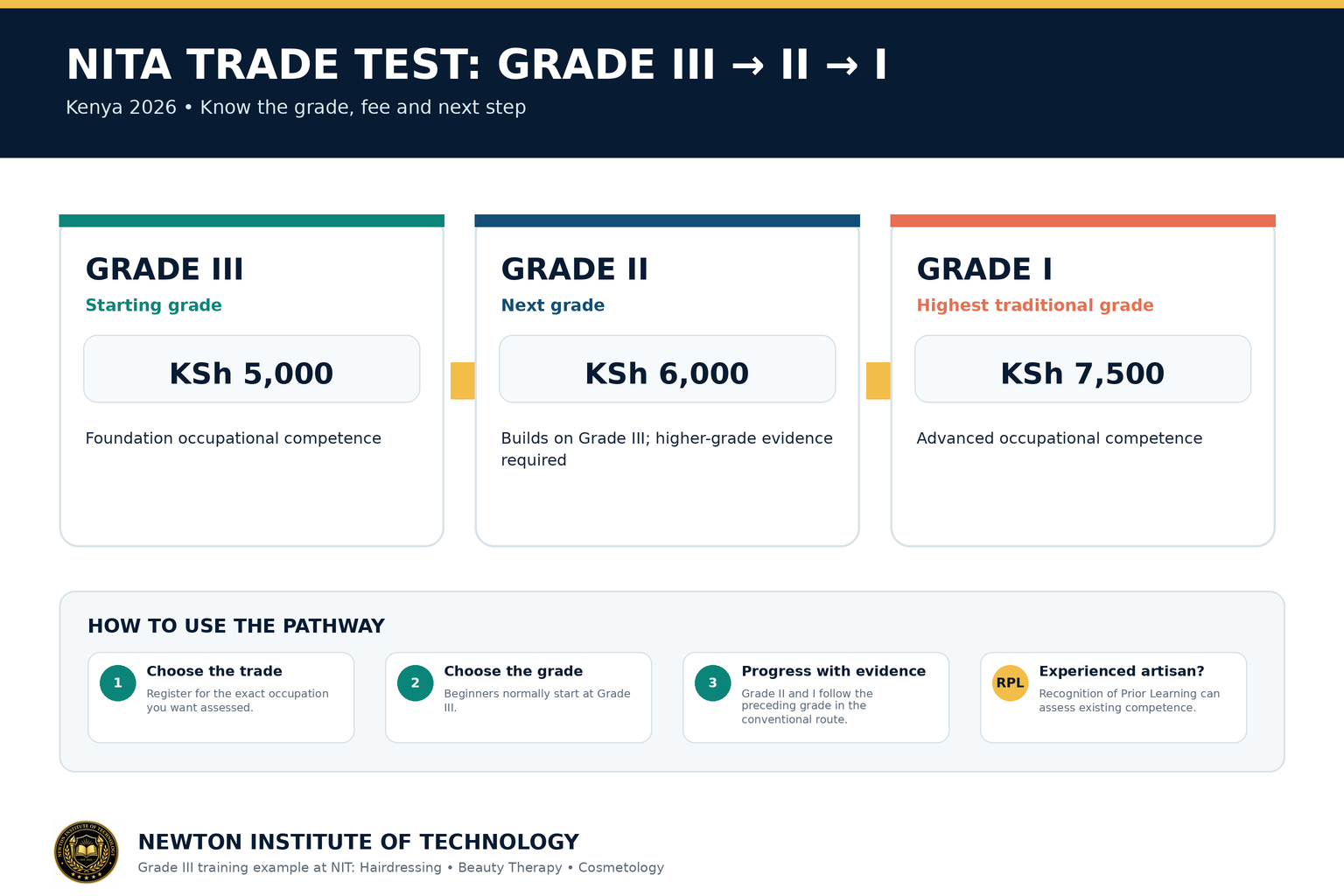
NITA’s traditional artisan pathway moves from Grade III to Grade II and then Grade I. Grade III is the normal starting point; higher grades build on the competence demonstrated at the preceding level. [3] The 2026 Trade Test circular requires higher-grade applicants in the conventional route to provide evidence of passing the immediately preceding grade. [7]
Starting grade for the conventional route. Focus: foundation occupational competence. Exam fee: KSh 5,000.
Follows Grade III in the normal progression. Exam fee: KSh 6,000.
Highest of the three traditional artisan grades. Exam fee: KSh 7,500.
Recognition of Prior Learning can assess competence acquired through work, apprenticeship or informal learning.
Budget the assessment correctly
NITA Trade Test fees in Kenya in 2026
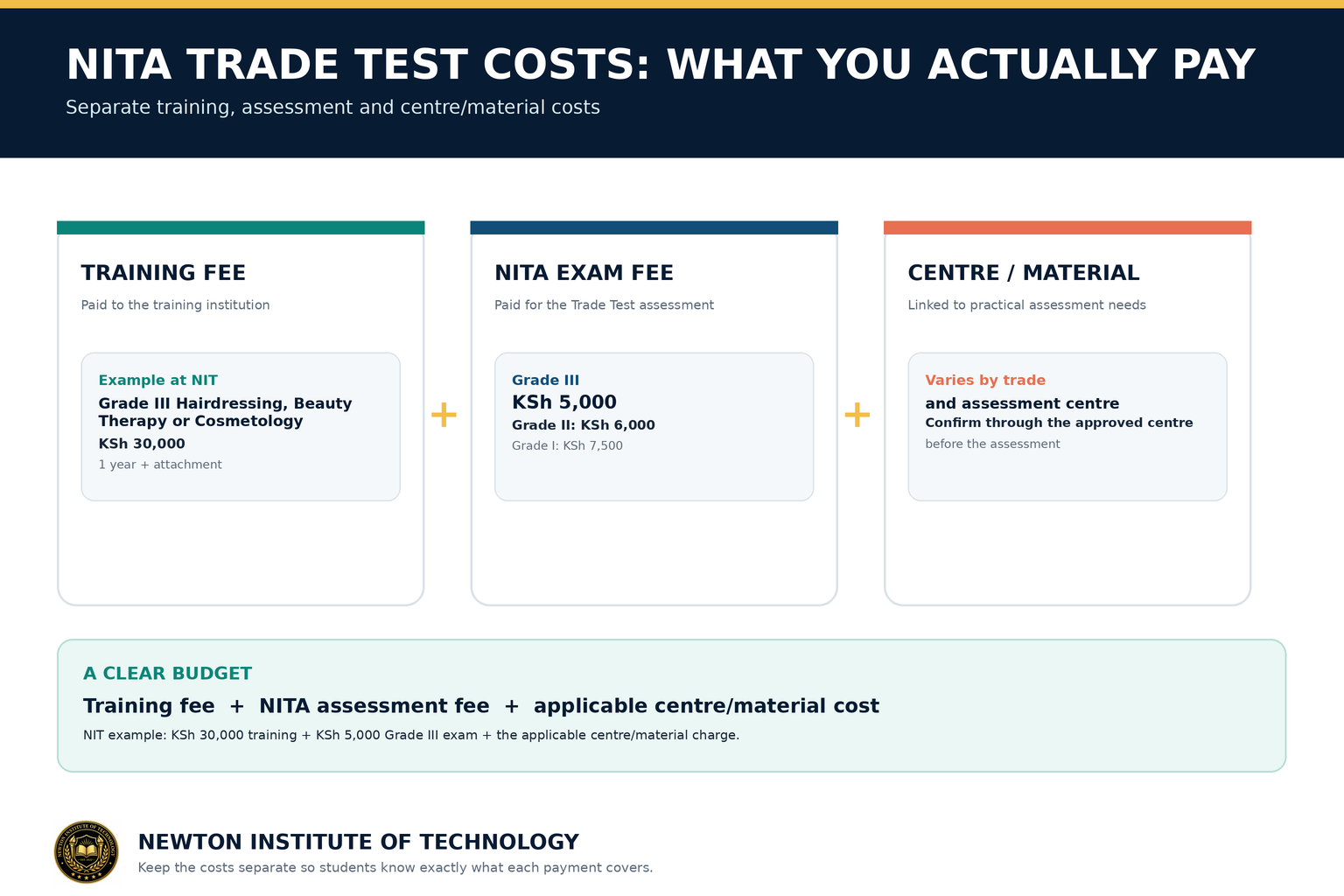
NITA currently publishes the following examination fees for the three traditional grades. [2]
| Grade | 2026 examination fee | Progression point |
|---|---|---|
| Grade III | KSh 5,000 | Normal starting grade |
| Grade II | KSh 6,000 | Follows Grade III in the conventional route |
| Grade I | KSh 7,500 | Follows Grade II in the conventional route |
Training tuition and centre/material charges are separate from the Trade Test examination fee. NITA notes that centre and material costs depend on the trade and assessment arrangements. [1]
Training
Learn and practise the trade
The training institution provides demonstrations, supervised practice, correction, tools, equipment and workplace preparation.
Trade Test
Demonstrate competence
NITA assesses whether the candidate can perform the occupational tasks required for the registered trade and grade. [1]
Registration route
How to register for a NITA Trade Test in 2026
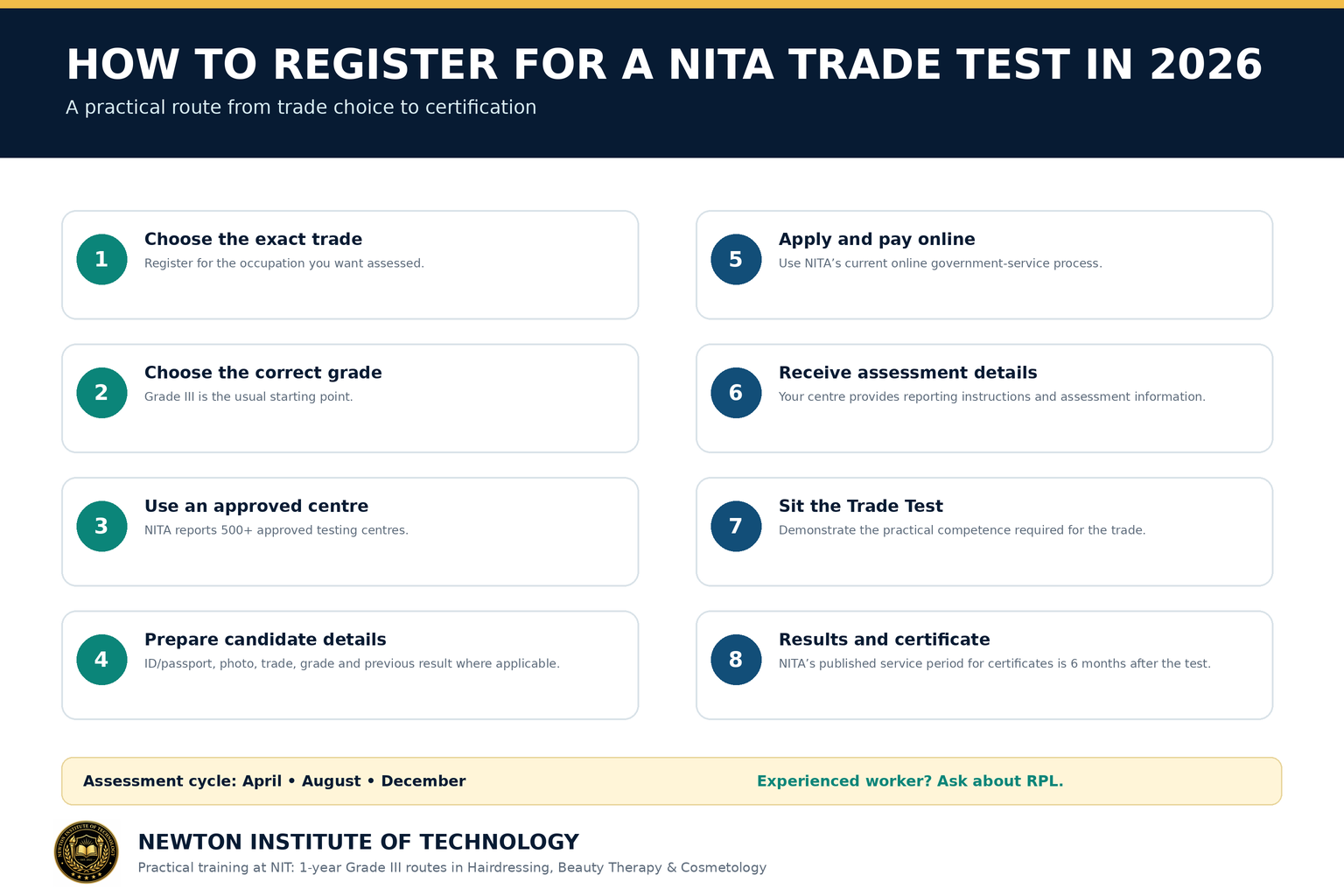
Choose the exact trade
Register for the occupation in which you want to be assessed.
Choose the correct grade
Grade III is the usual starting point in the conventional route; Grade II and I follow the preceding grade. [7]
Use an approved assessment centre
NITA reports more than 500 approved testing institutions and workplaces across Kenya. [1]
Prepare candidate details
Have your correct name, ID or passport details, trade, grade, photograph and previous result where applicable.
Apply through the current online service
NITA’s eCitizen service supports online applications and payments. [4]
Pay the assessment fee
Use the current Grade III, II or I examination fee and the applicable centre/material arrangement.
Receive assessment details
Your centre provides the reporting information for the scheduled Trade Test series.
Sit the Trade Test
Demonstrate the practical and supporting technical competence required in your trade. [1]
2026 assessment calendar
When are NITA Trade Tests held?
NITA’s standing Trade Testing information identifies three main testing periods each year: April, August and December. [1] The August 2026 national series ran from 10–22 August 2026, covering 21,801 candidates in 46 trades at 512 accredited centres across all 47 counties. [6]
The January 2026 Trade Test circular schedules the December 2026 assessment period for 1–18 December 2026. [7]
What happens on assessment
What the NITA Trade Test actually tests
NITA describes Trade Testing as a systematic way of evaluating the competence an artisan or apprentice has in a trade. Assessment guidelines can involve practical instructions, technical drawings and a defined piece of work that the candidate must complete. [1]
Preparation
Practise the work, not only the notes
Competency-based assessment rewards correct practical performance.
- Know the tasks covered in your trade.
- Use tools and equipment correctly.
- Follow the right work sequence.
- Maintain safety throughout the task.
- Work accurately and manage the available time.
- Finish to the standard required for the occupation.
For experienced artisans
Recognition of Prior Learning can be the better route
An experienced worker may already have substantial competence acquired through employment, apprenticeship, self-employment or informal learning. NITA explains that Recognition of Prior Learning can assess existing competence at an appropriate level rather than forcing every skilled worker to begin again as a beginner. [3]
This is particularly relevant to experienced jua kali artisans, self-employed tradespeople, long-serving employees and workers whose practical ability is stronger than their formal paper qualifications.
After the assessment
Results, progression and certificates
After assessment, results are submitted to NITA for verification and processing. NITA’s published FAQ gives a six-month service period for Trade Test certificates. The same FAQ states that a result slip can be used to book a Trade Test. [5]
NITA’s Trade Testing page also provides for replacement of lost or defaced certificates; the current listed charge for newer certificates is KSh 5,000. [1]
Full demonstrative example
How the pathway works at Newton Institute of Technology
A beginner who wants to train in Hairdressing, Beauty Therapy or Cosmetology can start with a one-year Grade III programme at Newton Institute of Technology in Migori Town. The programme consists of two teaching terms followed by attachment, and the NIT institutional course fee is KSh 30,000. Entry is open to KCPE or KCSE applicants, including KCSE D− and below. [8]
The learner develops practical competence at NIT, completes attachment, then follows the external NITA assessment route for the registered trade. The current Grade III NITA examination fee is KSh 5,000. [2]
This keeps the responsibilities clear: Newton Institute of Technology provides the practical training and attachment; NITA conducts the external Trade Test assessment and certification.
Related NIT guides
Continue with the specialist guide you need
Quick answers
NITA Trade Test FAQs
How much is NITA Grade III in 2026?
KSh 5,000 is the current Grade III examination fee. Training tuition and applicable centre/material charges are separate. [2]
How much is NITA Grade II?
KSh 6,000. [2]
How much is NITA Grade I?
KSh 7,500. [2]
Which NITA grade comes first?
Grade III is the normal starting point in the traditional Grade III → II → I pathway. [3]
Where can I sit a Trade Test?
NITA reports more than 500 approved testing institutions and workplaces around Kenya. [1]
How long does the certificate take?
NITA’s published service period is six months after the Trade Test. [5]
Can an experienced artisan get certified?
Yes. Recognition of Prior Learning provides an assessment route for competence acquired through work, apprenticeship and informal learning. [3]
Start with practical training
Register at Newton Institute of Technology
Join a one-year Grade III programme in Hairdressing, Beauty Therapy or Cosmetology and build the practical competence required before the external Trade Test assessment.
Duration1 year
NIT course feeKSh 30,000
LocationNamba Area, Migori Town, along the Migori–Sirare Highway
Sources
[1] NITA — Trade Testing.
[2] NITA Textile Training Institute — Trade Test examination fees.
[3] NITA — Recognition of Prior Learning.
[4] NITA eCitizen — online services and payments.
[5] NITA FAQs — result-slip booking and certificate service period.
[6] NITA Kenya — August 2026 National Trade Test update.
[7] NITA 2026 Trade Test Circular — public copy.
[8] Newton Institute of Technology — NITA Hairdressing & Beauty Therapy grades guide.
Factual review: 23 September 2026.