

NIT Career Pathways Guide Kenya · 2026
Jobs for D Plain
Students in Kenya
Job requirement · practical skill · evidence · work
A practical guide to documented D Plain job pathways in Kenya, what employers require beyond KCSE, and how to build the skill, licence, Trade Test, experience or portfolio needed for work.
Start with the work you want
Can you get a job with D Plain in Kenya?
Yes. Kenyan public-service records include D Plain pathways in artisan work, plant operation, driving, cooking, housekeeping and office-support roles. Skilled jobs normally add a practical requirement such as a Trade Test, driving licence, machine assessment, vocational certificate or work experience. [1] [2] [3] [4]
Start with documented requirements
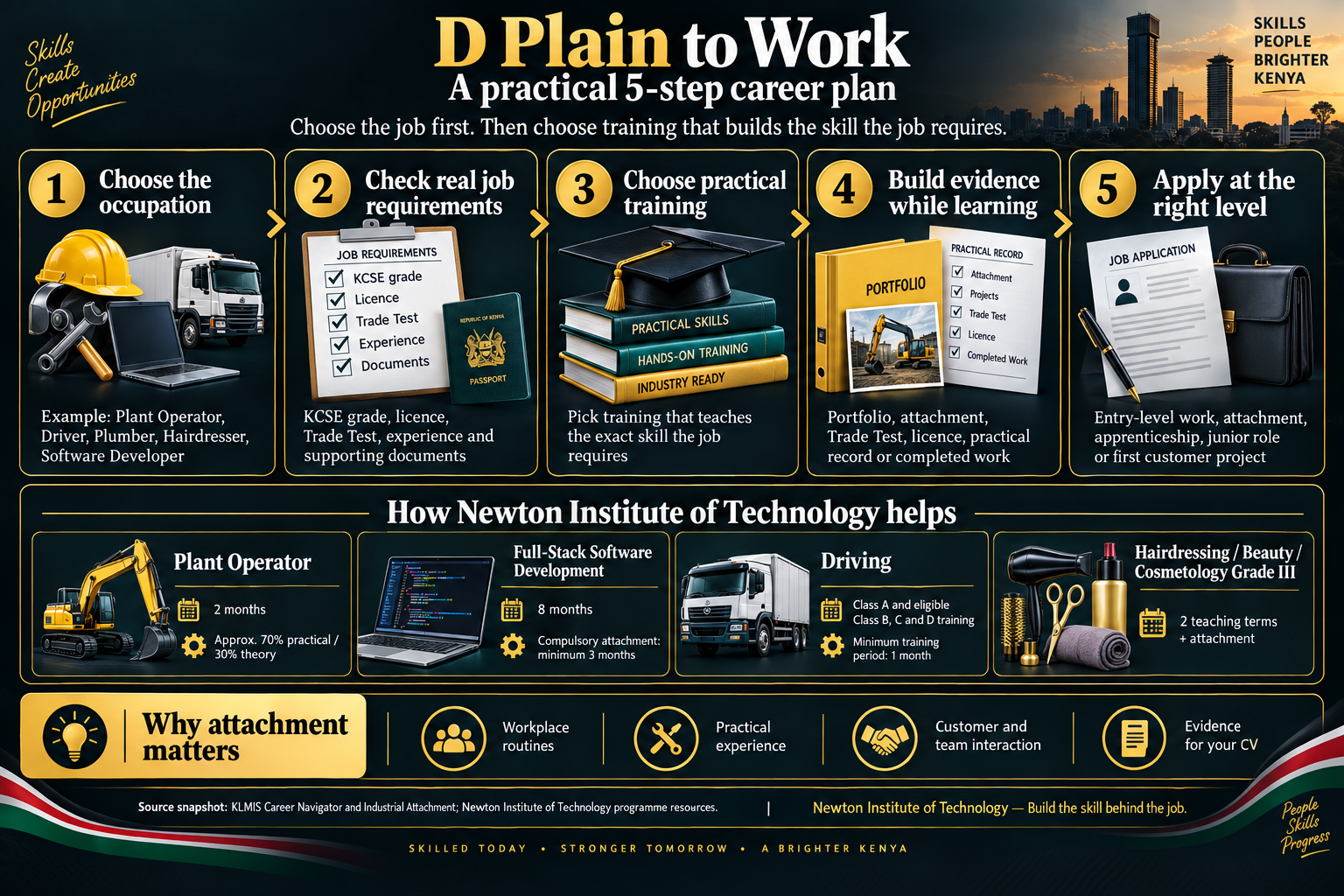
Jobs that accept D Plain in Kenya
These examples show where D Plain appears in Kenyan government and Public Service Commission requirements, and what additional qualification or competence completes the employment profile.
| Job | Academic starting point | What completes the job profile |
|---|---|---|
| Artisan III | KCSE D Plain | Government Trade Test Grade III in the relevant trade. [1] |
| Plant Operator III | KCSE D Plain | Plant suitability test, relevant licence, machine competence and first aid. [4] |
| Driver III | KCSE D | Correct driving licence, first aid, suitability/practical testing, good conduct and experience. [4] [8] |
| Cook III | KCSE D Plain | Food-production qualification or recognised formal training. [3] |
| Housekeeping Assistant III | KCSE D Plain | Formal housekeeping or laundry training. [2] |
| Office support | D Plain appears in public-service entry pathways | Workplace, communication and office-support competence. |
The table separates the KCSE entry point from the occupational requirement. That second column is where practical training, assessment, licensing and experience become important.
Read the complete specification
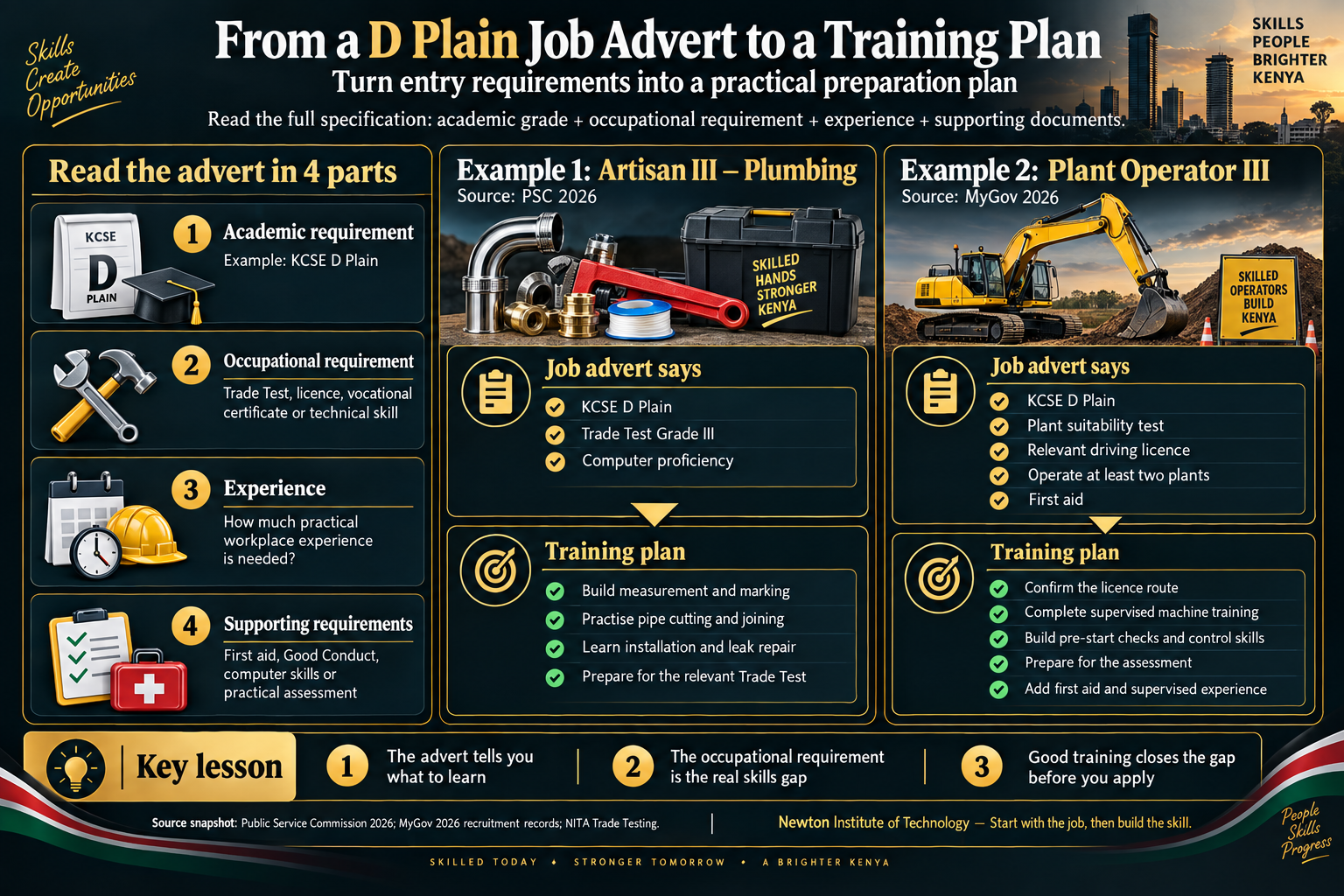
How to read a D Plain job advert
Academic requirement
Check the stated KCSE grade first. If the advert says D Plain and you meet it, move to the occupational requirement.
Occupational qualification
Look for the Trade Test, driving licence, plant assessment, vocational training, computer competence or other job-specific requirement.
Experience
Note whether the position is an entry grade, requires supervised practice, or specifies a number of years in the occupation.
Supporting requirements
First aid, Certificate of Good Conduct, practical testing and other documents can form part of the complete job profile. [4]
Read the KCSE grade, occupational qualification, experience and supporting requirements together.
Trade skills with a documented entry route
Artisan jobs: plumbing, welding, carpentry, masonry and painting
PSC’s Artisan III specification requires KCSE D Plain, Government Trade Test Grade III in the relevant trade and computer-application proficiency. The listed trades include carpentry, masonry, welding, painting and plumbing. The position is an entry grade carrying out basic repair and maintenance under supervision. [1]
For a plumbing learner, the job requirement points directly to the practical abilities to build: measuring, cutting, fitting, joining, fixture installation, leak identification, repair and correct use of tools. A welding learner needs material preparation, measurement, cutting, joining, fabrication, equipment handling and inspection of completed work.
NITA describes Trade Testing as a systematic assessment of the competence an artisan or apprentice has acquired in a trade and issues certificates to successful candidates. [5]
Machines, assessment and licensing
Plant Operator III
A 2026 government Plant Operator III recruitment required D Plain, Plant Operator Grade III suitability testing, a relevant driving licence, ability to operate at least two specified plants, first-aid training and demonstrated ability. Duties included operating plant, identifying possible breakdowns, coordinating servicing, making routine oil checks and keeping machines clean. [4]
Inspect
Build a reliable pre-start walk-around routine and understand the checks taught for the machine.
Control
Become familiar with starting, stopping, positioning, movement and attachment control.
Observe
Maintain awareness of people, structures, terrain and activity around the machine.
Care for the machine
Understand routine checks and operating habits that support reliability and safe use.
For the detailed D Plain-to-Category G route, use NIT’s dedicated D Plain Plant Operator in Kenya guide.
Licence class and experience matter
Driver III
A 2026 government Driver III recruitment required KCSE grade D, the relevant driving licence, first-aid training, Driver Grade III suitability testing, a practical driving test, a Certificate of Good Conduct and at least two years of driving experience. [4] Another official public-sector specification similarly combines D Plain with the appropriate licence, Driver Trade Test Grade III, first aid and work performance. [8]
The work goes beyond steering a vehicle. Official duties include routine checks, recognising and reporting faults, maintaining work tickets, and protecting passengers, goods and the vehicle. [4]
Identify the kind of vehicle you want to drive professionally, then establish the correct licence category, eligibility conditions, practical training and experience expected for that work.
Newton Institute of Technology provides Class A and eligible Class B, C and D driving training in Migori. [12]
Service work with specific practical training
Cook III and Housekeeping Assistant III
PSC’s Cook III specification combines D Plain with a Craft Certificate in Food and Beverage Production, Sales and Service, or at least two months of recognised formal food-production training. Duties include preparing food, maintaining kitchen hygiene, handling equipment and reporting defects. [3]
For Housekeeping Assistant III, PSC requires D Plain plus at least two months of formal housekeeping or laundry training. The work includes cleaning rooms and corridors, bed preparation, handling cleaning materials, washing linen, ironing and storing equipment correctly. [2]
Client-facing practical work
Hairdressing, barbering and beauty work
Hair and beauty careers are heavily skills-based. Possible directions include hairdresser, barber, beauty therapist, nail technician, makeup artist, salon assistant, independent practitioner and salon owner.
Useful competence includes client consultation, hygiene, preparation, styling, treatment, safe tool handling, product use and consistent service quality. At NIT, Grade III Hairdressing, Beauty Therapy and Cosmetology each run for one year, made up of two teaching terms followed by attachment. [11]
Show what you can build, analyse or support
ICT and digital work
ICT employers and clients evaluate practical output. Depending on the skill developed, a learner can build towards web development, software support, IT support, networking, graphic design, digital marketing, mobile applications, junior data work and freelance digital services.
Useful evidence includes websites, applications, source code, dashboards, technical reports, databases, project portfolios and workplace attachment. NIT’s Full-Stack Software Development programme uses eight months of institutional training followed by at least three months of compulsory attachment, with work across front-end development, back-end systems, databases, APIs, testing, Git/GitHub and deployment. [10]
For course selection, use the dedicated ICT Courses for D Plain Students in Kenya guide. This article stays focused on employment readiness.
Turn the advert into a preparation plan
From a D Plain job advert to a training plan
Plant Operator III
Advert: D Plain + suitability test + relevant licence + machine competence + first aid. Training response: confirm the licence route, complete supervised machine training, prepare for assessment and build operating experience. [4]
Use its requirements as a skills-gap checklist instead of choosing training blindly.
A career-first training model
How practical training builds job readiness: the NIT example
At Newton Institute of Technology, the useful admissions conversation starts with the work the learner wants to do. A learner interested in plant operation needs a different plan from someone interested in software development, professional driving or beauty services.
| Career goal | What the learner must demonstrate | Evidence carried towards work |
|---|---|---|
| Plant operation | Safe machine control, inspection and operating judgement | Machine competence plus applicable assessment/licensing. [9] |
| Driving | Safe vehicle control and road judgement | Correct licence and driving experience. [12] |
| Software development | Ability to build working systems | Working portfolio plus attachment. [10] |
| Hair and beauty | Ability to deliver a professional client service | Completed services plus attachment. [11] |
Worked institutional example
D Plain to plant-operator work
The government Plant Operator III specification expects an applicant who can meet the academic requirement, pass the applicable suitability test, hold the relevant driving licence, operate specified machines, understand routine machine care and work safely. [4]
At Newton Institute of Technology, the main Plant Operator programme takes 2 months and is structured at approximately 70% practical training and 30% theory. Learners select four-, five- or six-machine packages according to their training route. [9]
Inspect
Walk around the machine, observe its condition and learn the checks carried out before operation.
Control
Become familiar with controls, starting, stopping, positioning and movement.
Operate
Practise machine-specific tasks under supervision and improve coordination.
Connect training to the job
Follow the applicable licensing and assessment route, then build supervised operating experience.
Move from practice to workplace evidence
Where industrial attachment fits
KLMIS describes industrial attachment as a link between training institutions and workplaces through which learners gain practical skills and appropriate work ethics before entering the labour market. [6]
A useful attachment develops reporting habits, communication, teamwork, technical procedures, customer interaction, safety, problem solving and responsibility for completed work. NIT’s Full-Stack Software Development programme, for example, moves from eight months of institutional training into at least three months of compulsory attachment. [10]
Five steps from KCSE to work
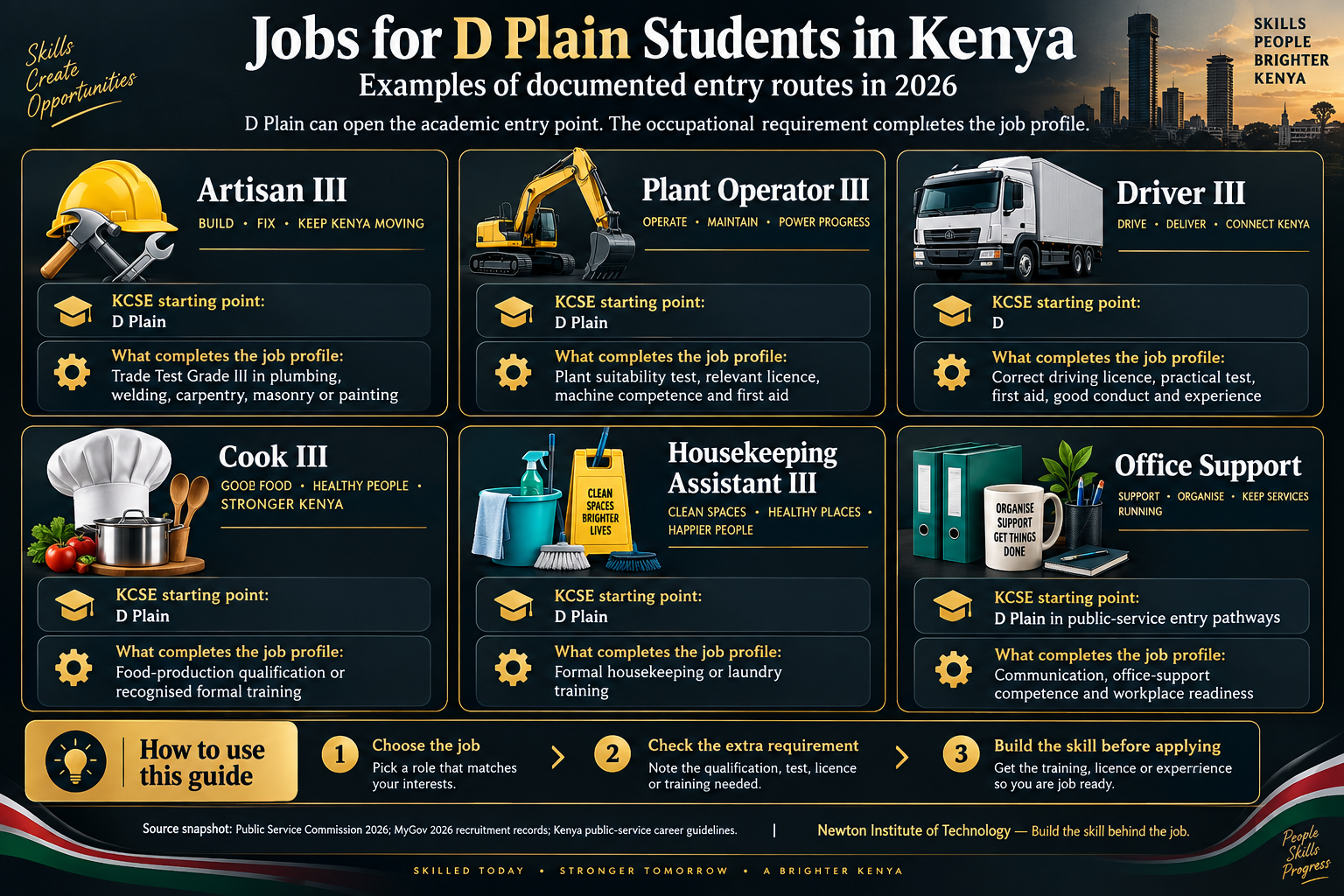
A practical D Plain-to-work plan
KLMIS’s Career Navigator is designed to help learners and job seekers explore occupations, required skills, entry requirements and training routes. [7]
- Choose the occupation. Start with a clear target such as Plant Operator, Driver, Plumber, Welder, Hairdresser, Software Developer or IT Support Technician.
- Read real job specifications. Record the KCSE requirement, occupational qualification, licence, experience, practical test and supporting documents.
- Choose training that closes the skills gap. Ask what you will practise, which tools or software you will use, what projects you will complete and which external assessment follows.
- Build evidence while learning. Collect a Trade Test certificate, licence, practical logbook, attachment report, portfolio, website, application, photos or client references as appropriate.
- Apply at the right level. Target entry employment, supervised artisan work, attachment, apprenticeship, junior technical work, first customer projects or self-employment that matches your competence.
Another route into work
Using a practical skill for self-employment
Practical skills such as plumbing, welding, carpentry, hairdressing, barbering, beauty services, graphic design, website development and computer support can also be offered directly to customers.
Keep the business preparation simple: define the service, build evidence of quality, assemble the tools you need, price the work properly and keep customer records. Each completed job should strengthen both your competence and your reputation.
Before you apply
What to get right
Match training to the job
Choose the occupation first and use its requirements to guide your training decision.
Complete the occupational requirement
That may be a Trade Test, the correct driving licence, machine assessment, vocational certificate or a strong technical portfolio.
Build evidence throughout training
A portfolio, licence, Trade Test, attachment report or completed client job gives substance to the qualification on your CV.
Read the whole specification
Match your academic grade, occupational qualification, experience and supporting documents against the complete job requirement.
Frequently asked questions
D Plain jobs in Kenya: FAQs
Can I get a job with D Plain in Kenya?
Can I get a government job with D Plain?
Can I become a plant operator with D Plain?
Yes. D Plain appears in documented Plant Operator III requirements. The complete profile also includes the relevant licence, suitability assessment, machine competence and first aid. [4]
Can I become a driver with D Plain?
Can I get an artisan job with D Plain?
Yes. PSC requires D Plain plus Government Trade Test Grade III for Artisan III in trades such as carpentry, masonry, welding, painting and plumbing. [1]
Can a D Plain student study software development?
Yes. At Newton Institute of Technology, the Full-Stack Software Development programme accepts beginners and uses eight months of institutional training followed by at least three months of compulsory attachment. [10]
Why is industrial attachment useful?
KLMIS describes attachment as work-integrated learning that links institutions and workplaces so learners acquire practical skills and appropriate work ethics before entering the labour market. [6]
A practical final rule
Start with the job, then build the skill
When you know the occupation you want, its requirements become a training plan. Identify the KCSE threshold, occupational qualification, licence, practical evidence and experience expected—then build them deliberately.
Sources and references
- Public Service Commission — Artisan III. Official source. KCSE D Plain plus Government Trade Test Grade III in carpentry, masonry, welding, painting or plumbing. Accessed 22 September 2026.
- Public Service Commission — Housekeeping Assistant III. Official source. KCSE D Plain plus formal housekeeping or laundry training. Accessed 22 September 2026.
- Public Service Commission — Cook III. Official source. KCSE D Plain plus food-production qualification or recognised formal training. Accessed 22 September 2026.
- State Department for Livestock Development — 2026 Recruitment. Official source. Driver III and Plant Operator III entry and occupational requirements. Accessed 22 September 2026.
- National Industrial Training Authority — Trade Testing. Official source. Assessment and certification of artisan competence. Accessed 22 September 2026.
- Kenya Labour Market Information System — Industrial Attachment. Official source. Work-integrated learning, practical skills and work ethics. Accessed 22 September 2026.
- Kenya Labour Market Information System — Career Navigator. Official source. Occupations, skills, entry requirements and training pathways. Accessed 22 September 2026.
- Warehouse Receipt System Council — Careers. Official source. Official public-sector driver requirements. Accessed 22 September 2026.
- Newton Institute of Technology — Plant Operator Course Duration. Official source. Two-month plant-operator programme with practical-first training. Accessed 22 September 2026.
- Newton Institute of Technology — Full-Stack Software Development. Official source. Eight months institutional training plus compulsory attachment of at least three months. Accessed 22 September 2026.
- Newton Institute of Technology — Hairdressing and Beauty Grade III. Official source. Grade III training structure and attachment. Accessed 22 September 2026.
- Newton Institute of Technology — Driving School Fees and Classes. Official source. Class A and eligible Class B, C and D training information. Accessed 22 September 2026.
Prepared by: Newton Institute of Technology Editorial Team
Institutional / Technical review: Engineer Simon Barongo
Evidence checked: 22 September 2026
Build the skill behind the job
Register at Newton Institute of Technology
If you scored D Plain, start with the career you want and choose practical training that develops the skills that career requires. NIT offers training pathways in Plant Operation, Driving, Full-Stack Software Development, Cybersecurity, Data Science & Analytics, Artificial Intelligence, Mobile App Development, Hairdressing, Beauty Therapy, Cosmetology and other practical skills.
CampusNamba Area, Migori Town
ApproachPractical, career-focused training
AdmissionsContinuous for applicable programmes