

NIT Post-KCSE Guide Kenya · 2026
What Next After
KCSE Results?
Results · entry level · career direction · course · next step
A practical Kenya guide to reading your KCSE results, identifying the right qualification level, comparing university and TVET routes, planning funding and choosing training that leads somewhere clear.
Turn results into a route
What should you do after getting your KCSE results?
Start with your mean grade and the subjects that matter for the career you are considering. Use the mean grade to identify your broad KUCCPS entry level, check the exact course requirements, choose a career direction, compare institutions, work out the full cost and then make the application and funding plan. [1] [2]

Start with the official framework
KUCCPS entry bands and KNQF progression answer different questions
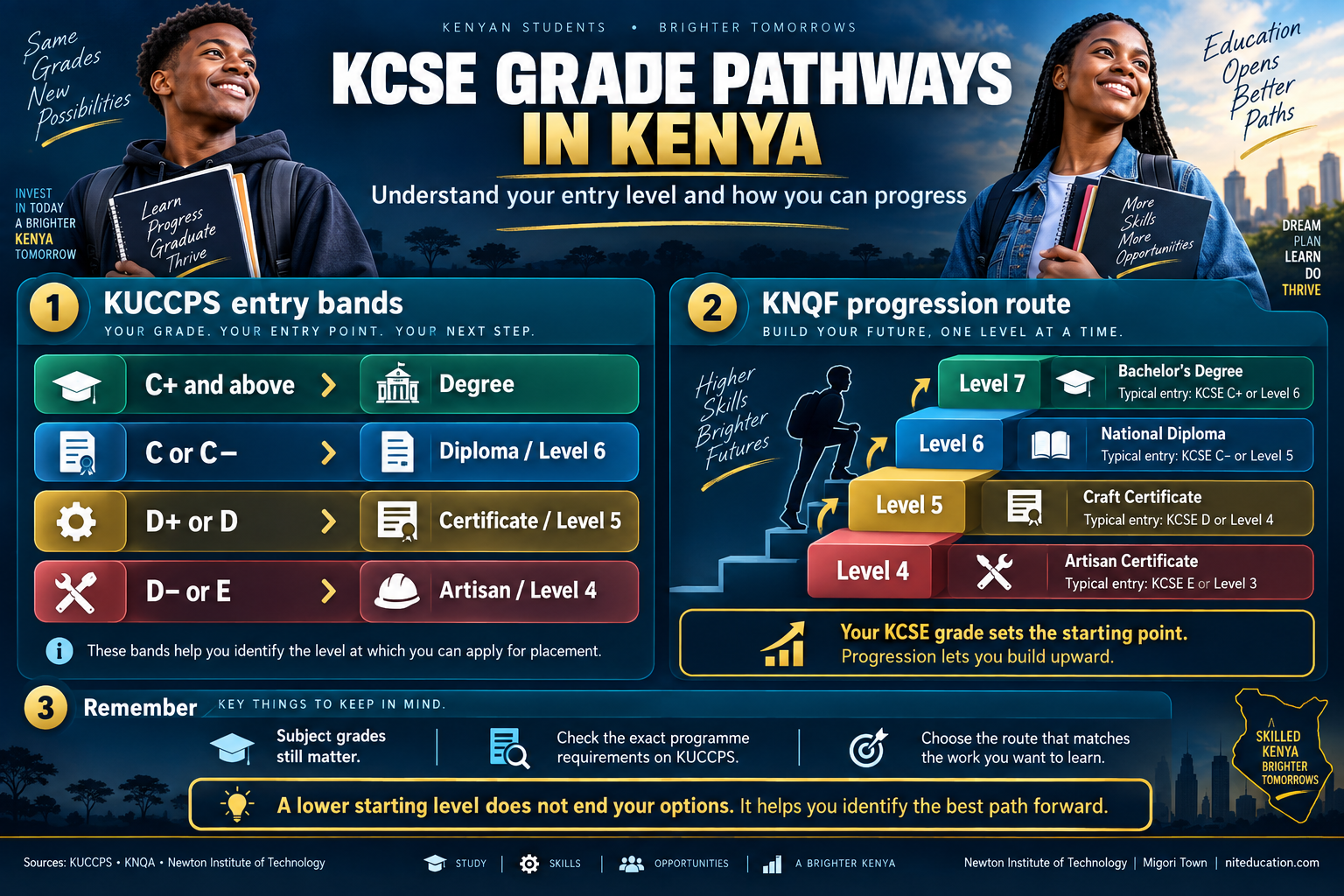
KUCCPS shows the broad level at which a KCSE candidate can seek placement. KNQA shows how recognised qualifications relate and progress from one level to another. Keeping the two frameworks separate makes the route easier to understand. [1] [3]
| KCSE mean grade | General KUCCPS route | What to do next |
|---|---|---|
| C+ and above | Degree | Check course-specific subject requirements and compare degree options with your career direction. |
| C or C− | Diploma / Level 6 | Compare Level 6 programmes and their specific subject requirements. |
| D+ or D | Certificate / Level 5 | Choose a suitable Level 5 route and plan progression where appropriate. |
| D− or E | Artisan / Level 4 | Build a Level 4 route and identify the next qualification level. |
KUCCPS publishes programme-specific requirements through its programme information and Student’s Portal resources. [2]
| KNQF level | Qualification example | Standard entry route |
|---|---|---|
| Level 4 | Artisan Certificate | KCSE E or Level 3 |
| Level 5 | Craft Certificate | KCSE D or Level 4 |
| Level 6 | National Diploma | KCSE C− or Level 5 |
| Level 7 | Bachelor’s Degree | KCSE C+ or Level 6 |
KNQA’s framework shows progression between qualification levels, including Level 4 → Level 5 and Level 5 → Level 6. [3] [4]
Turn the result into a plan
Your first seven days after KCSE results
You do not need to settle your entire career on results day. Use the first week to reduce the decision into a small number of clear choices.
Record the results that matter
Write down your mean grade and the subjects connected to the fields you are considering.
Establish the entry level
Use the KUCCPS bands to identify degree, Level 6, Level 5 or Level 4 as the broad starting point.
Choose three career directions
Pick areas of work rather than a long list of unrelated course names.
Check exact course requirements
Compare your mean grade and subjects with the programme information published through KUCCPS.
Compare colleges
Look at facilities, practical work, attachment, student output, duration and training structure.
Build the full budget
Add tuition, examinations, equipment, transport, accommodation and personal costs.
Make the shortlist
Finish with a first choice, a strong second choice and a progression route.
Choose by the work
Choose the kind of work before the course name
A course is much easier to judge when you understand the work behind it. Use these fields as starting directions, then move into the specialist guide for detailed course comparisons.
Technology
Software development, mobile development, cybersecurity, networking and ICT.
Data & business
Data analytics, accounting, statistics, business management and entrepreneurship.
Machines & technical work
Plant operation, automotive, electrical, fabrication and construction trades.
Health & care
Eligible health and caring-profession programmes where the required grades are met.
Beauty & creative work
Hairdressing, Beauty Therapy, Cosmetology, graphic design, fashion and digital media.
Agriculture & hospitality
Agriculture, agribusiness, hospitality, catering and food-production routes.
TVETA’s national course register includes training areas across ICT, electrical and electronics, motor vehicle technology, building technology, agriculture, fashion, food processing, hairdressing and beauty therapy, and other technical fields. [5]
Use the level, then go deeper
What each KCSE band means for the next step
C+ and above
Compare eligible degree programmes with your subject grades, career direction, practical content and total cost. A diploma or specialist route can still be considered when it fits the career better. See the C+ degree guide.
C or C−
Start with Level 6/diploma programmes and check the exact subject requirements. For a deeper C− comparison, use the dedicated C− course guide.
D+ or D
Start with Level 5/certificate routes and plan the next qualification level. D Plain students can use the detailed D Plain course guide and KUCCPS Level 5 guide.
D− or E
Explore Level 4/artisan training and identify the Level 5 progression route that follows successful completion. [1] [3]
Skills can be a first route too
Practical training should leave evidence of what you can do
Some learners want to develop a focused skill before or alongside a longer qualification. That can include software development, cybersecurity, graphic design, digital marketing, hardware repair, plant operation, driving, hairdressing, barbering, nail technology and other practical fields.
Software
Working applications, source code and a portfolio.
Design
A portfolio showing completed visual work.
Plant operation
Supervised machine competence and the applicable assessment route.
Beauty
Repeated practical work, client service and attachment experience.
Before you enrol
Five things to compare between colleges
Compare the training itself, not only the advertisement or tuition figure.
- Facilities: inspect the actual labs, workshops, machines, equipment or practical workstations used for the course.
- Practical training time: establish how much of the course is spent performing the skill yourself.
- Student work: look at projects, repairs, designs, practical records or other evidence produced by current learners.
- Attachment: understand the workplace component, duration and what students are expected to practise.
- Complete cost: combine tuition with examinations, tools, transport, accommodation and other course costs.
Use official registers
Check TVET institutions and courses on TVETA
TVETA maintains public registers for accredited TVET institutions and TVET courses in Kenya. Use them while comparing institutions and programmes. [5] [6]
Application and financing
Where KUCCPS and HEF fit into the plan
KUCCPS coordinates placement to participating universities, TVET institutions, national polytechnics, KMTC, teacher-training institutions and other higher-learning institutions. Applications are submitted through its Student’s Portal during the relevant application windows. [1]
A useful shortlist contains a preferred route, a strong alternative and a progression option.
For students using government higher-education financing, the current HEF process covers eligible undergraduate and TVET applicants. The official portal sets out the funding application and the information required from the applicant. [7]
Newton Institute of Technology example
Three practical routes after KCSE at NIT
The same KCSE result can lead students in completely different directions. At Newton Institute of Technology in Migori Town, the starting conversation is about the work the learner wants to build competence in.
Technology & ICT
NIT offers Full-Stack Software Development, Cybersecurity, Data Science & Analytics, Artificial Intelligence and Mobile App Development. [8]
Full-Stack Software Development runs for eight months followed by at least three months of compulsory industrial attachment. The published training fee is KSh 90,000, beginner entry is supported and the maximum class size is 25. [9]
Learn → build → debug → attachment → portfolioMachines & practical work
NIT Plant Operator training takes two months and is structured around approximately 70% practical work and 30% theory, with 4-, 5- or 6-machine packages. [12]
The learner moves from machine choice to supervised practice, operating competence and the applicable assessment/licensing route.
Choose → practise → assess → build experienceBeauty & client service
NIT offers Grade III Hairdressing, Beauty Therapy and Cosmetology. Each runs for one year, with two teaching terms followed by attachment. The published institutional fee is KSh 30,000 and the separate NITA Grade III examination fee is KSh 5,000. [13]
Training → practice → attachment → clients / workNIT’s ICT learners have worked on practical systems including institutional web work, a school-management system, a hospital staff-clocking system and an ERP platform for water-production and distribution businesses. [10] Industrial attachment then adds workplace tasks, supervision, feedback and evidence of what the learner personally practised. [11]

Reduce the choice
Still unsure what to study?
What work can you practise repeatedly?
Coding, analysing data, operating machines, repairing things, serving clients and caring for people feel very different in daily life.
What evidence will the course leave you with?
Look for projects, portfolios, practical assessments, client work, repaired systems or supervised machine competence.
What happens after training?
Identify the next step: attachment, employment, self-employment, licensing or the next qualification level.
A planned year still moves forward
What about a gap year?
A useful gap year has dates, activities and a clear next intake. It can be used for driving, computer skills, a focused short course, supervised work exposure, portfolio building, career research or financial preparation.
January–March: research and shortlist · April–June: build a practical skill · July–August: organise applications and finances · next intake: begin the selected course.
At a glance
Your post-KCSE decision map
| Your position | Next action |
|---|---|
| C+ and above | Compare eligible degree and other training routes with the career you want. |
| C or C− | Explore Level 6/diploma programmes and their subject requirements. |
| D+ or D | Start with Level 5 options and plan the next qualification level. |
| D− or E | Explore Level 4/artisan training and progression to Level 5. |
| Interested in ICT | Compare the actual work in software, cybersecurity, data, AI and mobile development. See NIT’s ICT guide. |
| Need a shorter route | Choose training that develops a practical skill you can demonstrate. |
| Unsure about the field | Narrow the choice to three career directions before selecting programmes. |
| Need government funding | Secure admission and follow the current HEF application process. |
Frequently asked questions
What next after KCSE results: quick answers
What should I do immediately after KCSE results?
What can I do with C+ after KCSE?
C+ and above falls within the KUCCPS degree-entry band. Compare programmes for which you meet the subject requirements, alongside other training routes that fit your career plans. [1]
What can I do with C or C−?
KUCCPS places C and C− within Diploma/Level 6. Choose the field first and then compare the programmes and subject requirements within that field. [1]
What can I do with D+ or D?
What can I do with D− or E?
Can I study ICT after KCSE without previous coding experience?
Yes. NIT’s Full-Stack Software Development programme accepts beginners and starts from the foundations before progressing into complete software projects and industrial attachment. [9]
How do I check a TVET institution?
Should I simply choose the most marketable course?
Employment demand is useful, but combine it with your interests, practical ability, training quality, cost and the next step after the course. Use NIT’s dedicated marketability guides for deeper comparisons.
The main point
Your KCSE result tells you where to begin
Find your entry level, check the subjects that matter, choose the type of work you want to learn, compare the programmes that fit and make a clear application and funding plan.
Different grades create different starting points. The goal is to choose a route that keeps moving forward.
Practical training in Migori
Register at Newton Institute of Technology
If you have completed KCSE and want to turn your results into a practical training plan, speak with the NIT Admissions team about the work you want to learn, the course that fits that direction, fees, timetable and practical-training arrangements.
NIT offers training across ICT, Plant Operation, Driving, Hairdressing, Beauty Therapy, Cosmetology and other practical skills. Admissions are open throughout the year.
Sources and references
- KUCCPS — Placement: general degree, Level 6, Level 5 and Level 4 placement bands; applicant eligibility and placement process.
- KUCCPS — Frequently Asked Questions: programme subject requirements and Student’s Portal guidance.
- Kenya National Qualifications Authority — FAQ: KNQF levels, qualification examples, minimum entry routes and progression.
- KNQA — Kenya National Qualifications Classification Standard: qualification-level descriptions and progression structure.
- TVETA — TVET Courses Register: national course register and training areas.
- TVETA — Accredited TVET Institutions: public institution register and current status information.
- Higher Education Financing — HEF: current undergraduate and TVET funding information and application process.
- Newton Institute of Technology — Best ICT Courses After KCSE in Kenya: NIT specialist ICT pathways.
- Newton Institute of Technology — Full-Stack Software Development Course: duration, attachment, fee, beginner entry, class size and practical training structure.
- Newton Institute of Technology — ICT Skills Employers Want in Kenya: examples of practical student project exposure.
- Newton Institute of Technology — ICT Industrial Attachment in Kenya: workplace tasks, supervision, logbooks and evidence of learning.
- Newton Institute of Technology — Plant Operator Course Duration in Kenya: two-month programme, practical/theory balance and machine packages.
- Newton Institute of Technology — Hairdressing Course Fees in Kenya: Grade III duration, fee, NITA examination fee, attachment and short-course options.
Prepared by: Newton Institute of Technology Editorial Team · Institutional / Technical review: Engineer Simon Barongo · Reviewed: 22 September 2026