

NIT Progression Guide Kenya · 2026
D Plain to Diploma
in Kenya
KCSE D Plain → Level 5 → Level 6
A practical guide to choosing the right Level 5 qualification, progressing to an appropriate Level 6 diploma and understanding when credit transfer does—or does not—apply.
Your qualification starting point
Can you do a diploma with D Plain in Kenya?
Yes—through the correct progression route. D Plain normally starts at Level 5 rather than direct Level 6 entry. KNQA lists KCSE D or Level 4 as an entry route to Level 5, while Level 6 can be entered through KCSE C− or Level 5. The Level 5 qualification still has to satisfy the requirements of the diploma you eventually want.[1]
Plan backwards
Choose the diploma first, then choose the Level 5 route
The safest plan is not “find any certificate that accepts D Plain.” Start with the Level 6 qualification you ultimately want and work backwards to the Level 5 qualification that it accepts.
Choose the destination
Identify the Level 6 diploma and career field you actually want.
Confirm the Level 5 route
Check which recognised Level 5 qualification the diploma accepts.
Complete Level 5
Finish the training and assessment successfully and keep the official award records.
Apply for Level 6
Use the completed Level 5 qualification under the receiving programme’s current admission rules.
Choose the diploma first. Then confirm the exact Level 5 qualification that leads to it.
If you are still deciding what to study rather than how to progress, use NIT’s separate guide to courses available with D Plain. For a general explanation of qualification levels, use the TVET Levels 4–6 guide. This page stays focused on the progression decision.
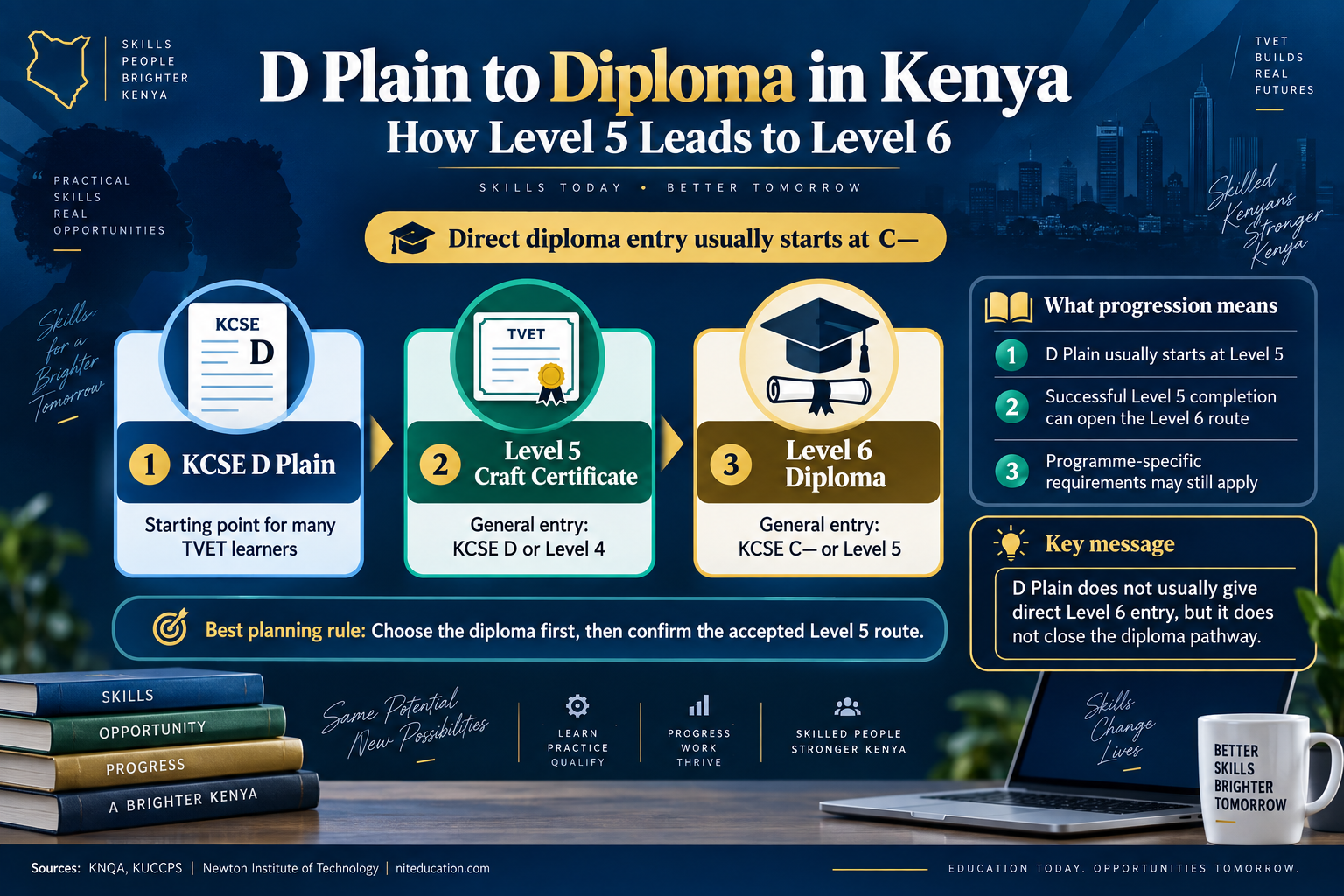
Infographic 1: the D Plain → Level 5 → Level 6 progression route. Sources: KNQA and KUCCPS framework guidance.[1][2]
Use the exact qualification when planning progression
Confirm the qualification that will carry you from Level 5 to Level 6
When planning a diploma pathway, work with the exact qualification name and level. Confirm its KNQF level, awarding or assessment body, and the Level 6 programme that accepts it. This gives the learner a clear progression map from the beginning.[1]
Confirm your Level 5 qualification
Record the exact qualification name, KNQF level and awarding or assessment body.
Confirm the Level 6 destination
Identify the diploma that accepts the completed Level 5 qualification.
Build practical competence
Choose training that develops the actual skills, projects and workplace ability needed in your career.
A registered Kenyan example
What the progression rule looks like in a real qualification
KNQA’s registered qualification information provides a clear Human Resource Management example. The Craft Certificate in Human Resource Management is listed at KNQF Level 5 with entry through KCSE D or Level 4. The Diploma in Human Resource Management is listed at Level 6 with entry through KCSE C− or Level 5.[3]
KCSE D Plain
Meets the stated mean-grade entry route to this Level 5 example, subject to the qualification’s current requirements.
Craft Certificate in HRM
Complete the registered Level 5 qualification successfully.
Diploma in HRM
Level 5 is listed as an entry route to the corresponding Level 6 diploma.
This example proves that Level 5-to-Level 6 progression is a real qualification pathway; it does not mean every Level 5 qualification opens every diploma.[3]
Full worked example · ICT
D Plain student who wants to become a software developer
Assume a learner has KCSE D Plain and wants two things: a clear route to diploma level and enough practical software-development ability to build real projects. The formal qualification route and the practical-skills route should be planned separately, then allowed to support each other.
Start with D Plain and a clear career goal
The learner decides that software development is the target field. D Plain does not normally provide direct Level 6 entry, so the learner plans to progress through Level 5.[1]
Identify the intended Level 6 ICT diploma
Before enrolling for any certificate, the learner finds an appropriate Level 6 ICT or software-related diploma and reads its current entry requirements.
Work backwards to the accepted Level 5 qualification
The learner asks which recognised Level 5 ICT qualification the intended diploma accepts. That exact qualification—not simply any course called a certificate—becomes the formal next step.
Complete the recognised Level 5 qualification
The learner completes the required training and assessment successfully. This creates the qualification route that can be used when applying for the intended Level 6 programme.[1]
Build practical software skills and proof of ability
Separately, the learner can take practical Full-Stack Software Development training at NIT, build front-end and back-end projects, work with databases and APIs, use Git/GitHub, test and deploy software, and complete the programme’s compulsory industrial attachment.[7]
Apply for Level 6 and keep building the portfolio
After the accepted Level 5 qualification is complete, the learner applies for Level 6 under the receiving institution’s rules. The practical projects and attachment experience remain useful career evidence alongside the formal qualification.
D Plain → accepted Level 5 ICT qualification → successful completion → Level 6 diploma application, while practical Full-Stack training, projects and attachment build the learner’s software-development competence.
In this pathway, the recognised Level 5 qualification provides the academic progression route, while NIT’s Full-Stack Software Development training strengthens the learner’s practical ability through software projects, modern development tools and industrial attachment. Together, the two parts support both qualification progression and career preparation.
Practical ICT skill-building at NIT
How formal progression and practical training can work together
A strong ICT pathway combines qualification progression with practical competence. The recognised Level 5 qualification opens the route toward Level 6, while NIT’s ICT programmes help learners build the hands-on skills, projects and workplace exposure needed in the career itself.
Full-Stack Software Development
Eight months of practical training followed by at least three months of compulsory industrial attachment. Training includes front-end, back-end, databases, APIs, Git/GitHub, testing, deployment and projects.[7]
Practical skills routeCybersecurity
Six months of practical training plus a compulsory three-month attachment, with hands-on work around Linux, networking, systems, monitoring and authorised security exercises.[8]
Practical skills routeData Science & Analytics
Six months of practical training plus a compulsory three-month attachment, covering Excel, SQL, Python, statistics, data cleaning, visualisation and introductory machine learning.[9]
Practical skills routeWhich recognised Level 5 qualification gets me to the Level 6 diploma I want? And which training gives me the practical ability I need for the career?
Do not confuse the two
Progression and credit transfer are different decisions
Progression
Asks whether your completed Level 5 qualification gives you an acceptable route to apply for the intended Level 6 programme.
Credit transfer
Asks whether eligible prior learning can count toward credits required for the new qualification under KCATS and the applicable regulations.
The regulations also exclude credit transfer for industrial attachment, project work, teaching practice and thesis/dissertation work. A Level 5 qualification can therefore help you progress to Level 6 without automatically meaning you will skip a full year of the diploma.[5]
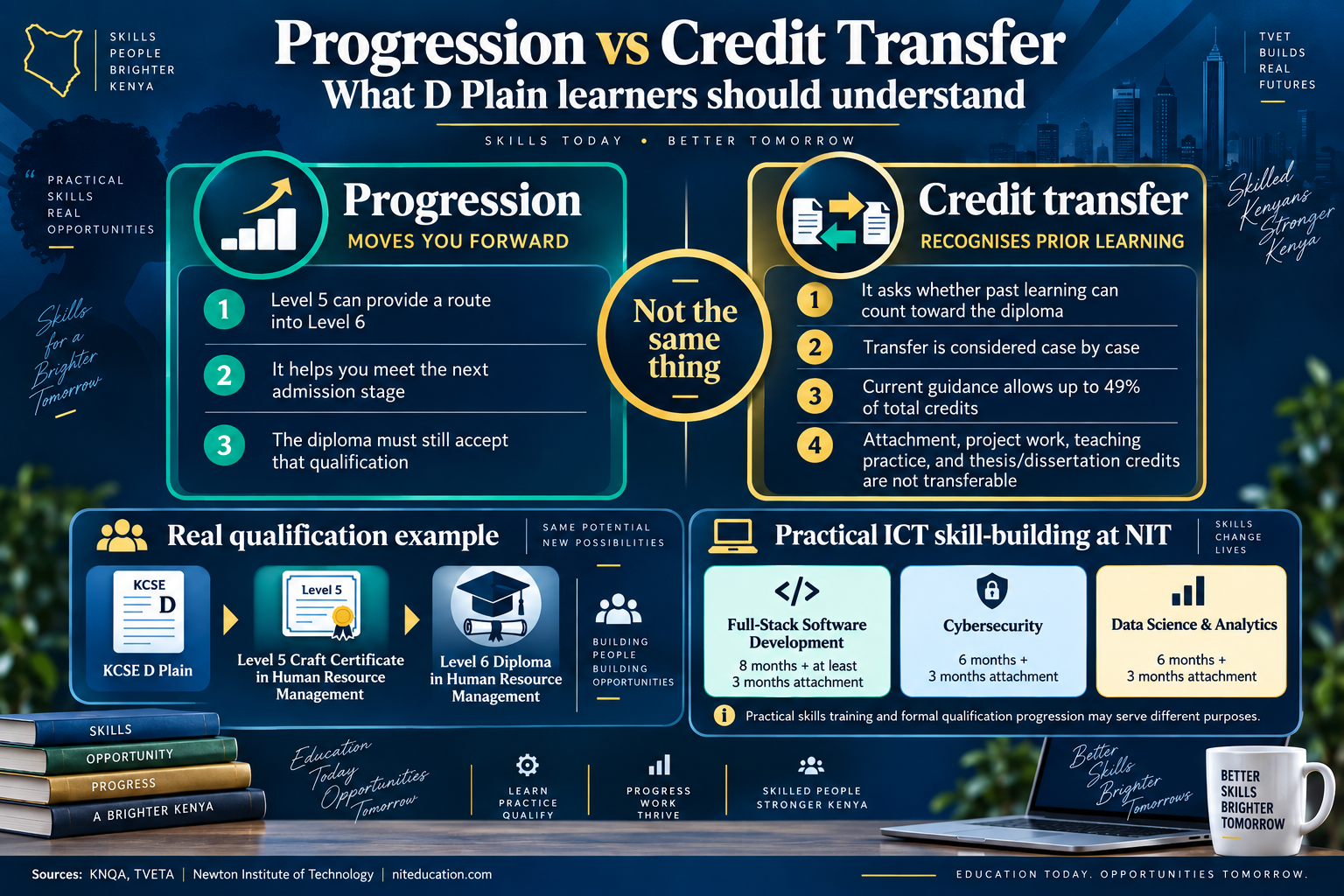
Infographic 2: progression gets you to the next admission stage; credit transfer is a separate recognition process under KCATS and the KNQF regulations.[4][5]
Before you enrol
Five checks before paying for Level 5
These checks protect the diploma pathway you are trying to build.
- Exact qualification name: ask for the official qualification, not only the marketing course name.
- KNQF level: confirm that it is actually Level 5 if Level 5 progression is your goal.
- Awarding or assessment body: know who assesses or awards the qualification.
- Accepted Level 6 route: ask which exact diploma accepts it after successful completion.
- Credit transfer: ask separately whether eligible credits may transfer and how the receiving institution applies KCATS.
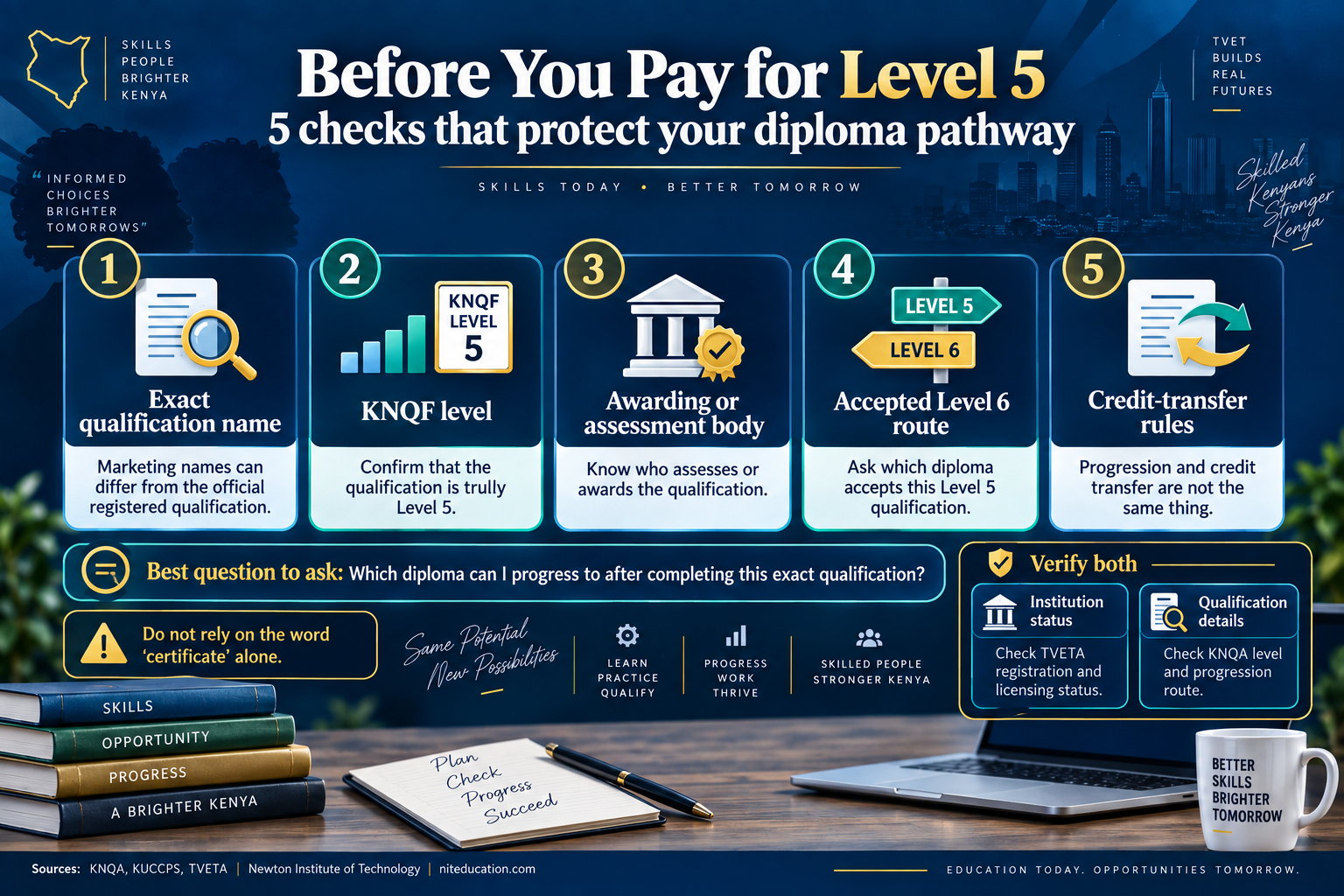
Infographic 3: verify both the institution and the exact qualification before paying.
Verify both sides
Check the institution and the qualification separately
Before paying fees, confirm the institution’s current regulatory status through the appropriate official register. Then verify the specific qualification separately, including its exact name, KNQF level, awarding or assessment body and the Level 6 programme it can lead to.[6]
For the clearest decision, verify both pieces of information: the institution’s current regulatory status and the exact qualification details for the programme you intend to take.
Plan the whole journey
How long can D Plain to diploma take?
KNQA’s framework gives Level 5 a minimum learning volume equivalent to about one year, while Level 6 qualifications are generally longer and can vary by qualification design. Actual time can also be affected by assessment schedules, industrial attachment and any approved credit transfer.[1]
Level 5 training + assessment + attachment where required + Level 6 training + Level 6 project or attachment requirements.
Nearby KCSE grades
What about D+ or D−?
D Plus
D+ can also sit within Level 5 entry territory for many TVET pathways, but programme-specific and subject requirements still matter.
D Minus or E
The national framework generally places Artisan Certificate study at Level 4, with progression possible after the relevant requirements are met.[1]
When unsure
Ask the institution to show you the exact qualification, its level and the next qualification it leads to before you pay.
Frequently asked questions
D Plain to diploma: common questions
Can you do a diploma with D Plain in Kenya?
Yes, through an appropriate progression route. D Plain normally starts at Level 5 rather than direct Level 6 entry. A completed Level 5 qualification can provide an entry route to Level 6 where the receiving programme accepts it.[1]
Do I have to repeat KCSE before reaching diploma level?
Not necessarily. KNQA recognises Level 5 as an entry route to Level 6, so a learner can build a new qualification and use it for progression without changing the original KCSE grade.[1]
Does every certificate lead to a diploma?
No. Verify the exact qualification, its KNQF level and the Level 6 programme that accepts it. The word “certificate” alone is not enough.
Does Level 5 automatically shorten the diploma?
What is the best question to ask before enrolling?
Ask: “If I successfully complete this exact qualification, which Level 6 diploma can I apply for?” Then verify the answer against the receiving programme’s current admission requirements.
The practical rule
With D Plain, plan backwards from the diploma
D Plain does not normally provide direct Level 6 entry, but it does not close the diploma pathway. Choose the Level 6 destination, identify the Level 5 qualification it accepts, verify that qualification before paying, complete it successfully and then apply under the current diploma rules. Treat credit transfer as a separate question.
Practical ICT training in Migori
Build practical skills at Newton Institute of Technology
NIT offers practical ICT training in Full-Stack Software Development, Cybersecurity, Data Science & Analytics, Artificial Intelligence and Mobile App Development. Give Admissions your KCSE grade and career goal, and the team can guide you on the most suitable NIT programme, its duration, fees, study mode, practical training and attachment arrangements.
CampusNamba Area, Migori Town · along Migori–Sirare Highway
Call / WhatsApp+254 713 584 858