

NIT ICT Pathway Guide Kenya · D Plain
ICT Courses for D Plain Students in Kenya
Level 5 · practical options · progression
A practical guide to ICT Technician Level 5, other D Plain digital routes, computer foundations and specialist ICT training in Kenya.
Your ICT starting point
Can you study ICT with D Plain in Kenya?
Start at the right level
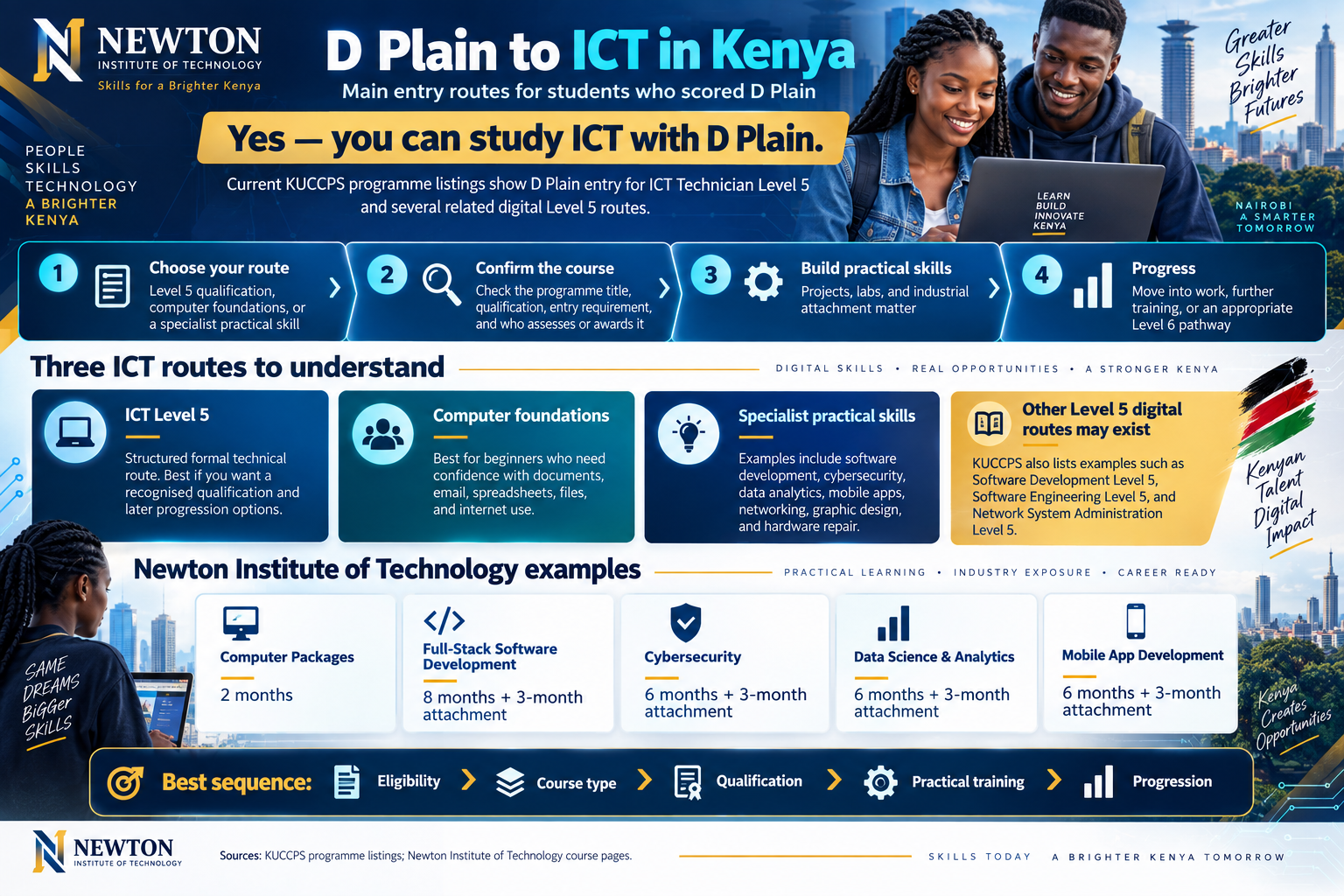
Three practical ICT starting routes
A D Plain learner can enter ICT in different ways depending on the goal and current computer confidence.
| Route | Best fit | What it gives you |
|---|---|---|
| ICT Level 5 | A student seeking a structured formal ICT qualification | A recognised technical route with a clear base for later progression |
| Computer foundations | A learner who still needs confidence with everyday computer use | Stronger control of files, documents, spreadsheets, email and common digital tools |
| Specialist practical programme | A learner who already knows the technical field they want | Focused practical training in software, cybersecurity, data, mobile, networking or another ICT area |
Formal route
ICT Technician Level 5
For a D Plain student looking for a structured ICT qualification, ICT Technician Level 5 is one of the clearest formal entry routes. KUCCPS currently shows D as the minimum mean grade and no additional minimum subject requirement on the cited programme record. [1]
Choose Level 5 when your priority is a structured technical qualification and a formal route that can support later progression.
More than one digital route
Other Level 5 digital options
D Plain students can also find more specialised Level 5 digital programmes. Current KUCCPS programme records include Software Development Level 5 and Software Engineering Level 5, both showing D as the minimum mean grade and no minimum subject requirement on the cited records. [2] [3]
ICT Technician Level 5
Broad technical ICT route for learners who want structured training across core computing areas.
D Plain · KUCCPSSoftware Development Level 5
A more specialised Level 5 route for learners interested in building software systems.
D Plain · KUCCPSSoftware Engineering Level 5
Another current digital Level 5 option listed by KUCCPS at D Plain entry.
D Plain · KUCCPSFoundation before specialisation
What if your basic computer skills are still developing?
Students do not all leave secondary school with the same level of computer experience. At Newton Institute of Technology, a learner who still needs confidence with documents, spreadsheets, email, files and everyday computer use can begin with Computer Packages before moving into more technical training. NIT’s Computer Packages course runs for two months. [6]
The purpose is simple: become comfortable enough with the computer that you can focus on the technical subject itself.
Newton Institute of Technology example
How we guide a D Plain learner at NIT
At NIT, we start with two practical questions: What can you already do on a computer? and what kind of digital work do you want to learn?
If basic computer use still needs strengthening, Computer Packages can provide the foundation. If the learner is already comfortable with everyday computer work, the discussion moves to the technical area they want to develop.
Full-Stack Software Development
Eight months of institutional training followed by a compulsory industrial attachment of at least three months. Published fee: KSh 90,000. Previous coding experience is not required. [7]
Cybersecurity
Six months of institutional training followed by a compulsory three-month attachment. Published fee: KSh 60,000. [8]
Data Science & Analytics
Six months of training followed by a compulsory three-month attachment. Published fee: KSh 60,000. D and D+ applicants are accepted. [9]
Mobile App Development
Six months of institutional training followed by a compulsory three-month attachment. Published fee: KSh 60,000. Previous programming experience is not required. [10]
Computer Packages
A two-month foundation route for learners building confidence in everyday computer use before technical specialisation. [6]
Other ICT options
NIT also offers Artificial Intelligence, Networking, Database Administration, Graphic Design, Digital Marketing and Computer Hardware Repair. [11]
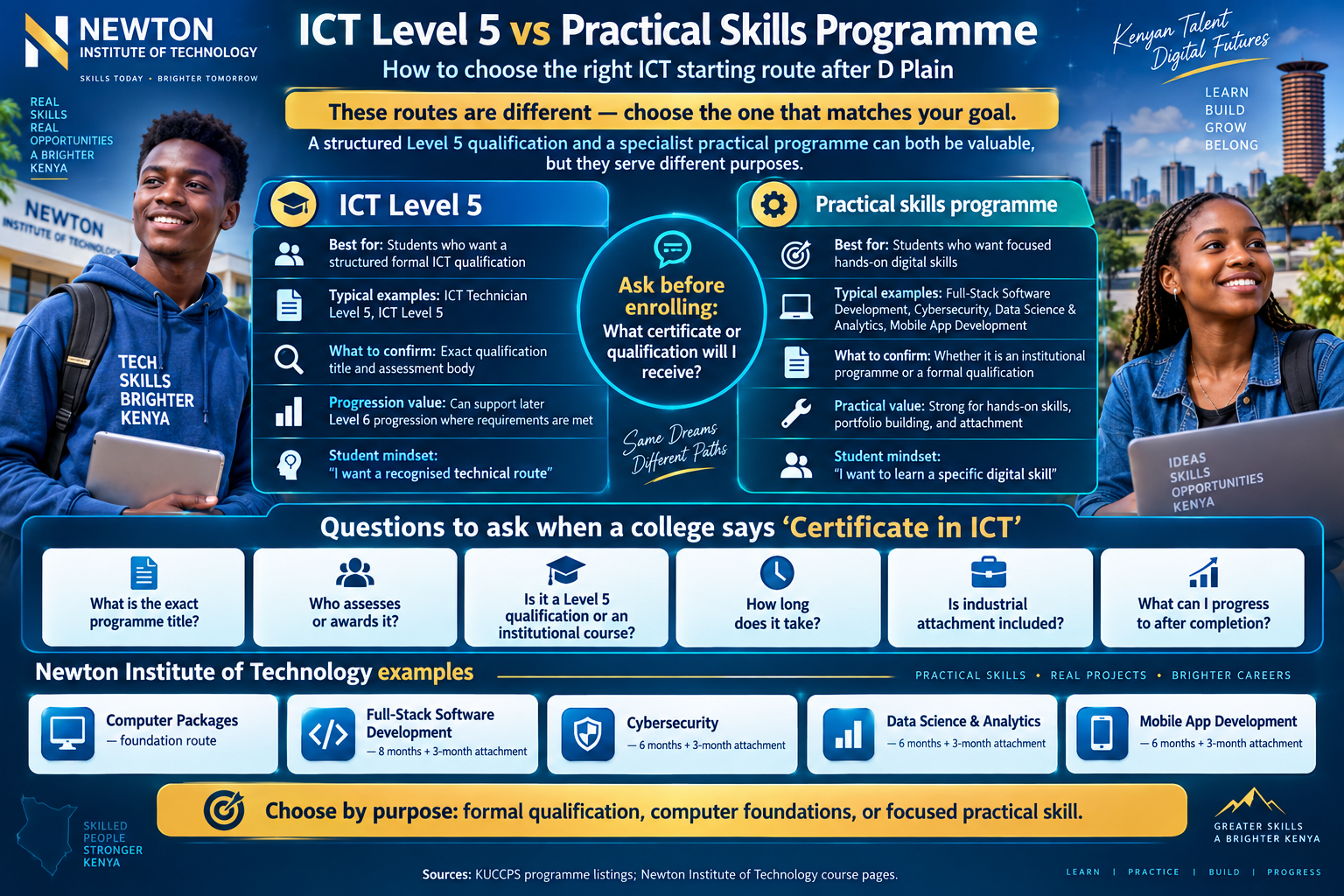
Choose by purpose
Level 5 qualification or specialised practical skills?
| Question | Level 5 qualification | Specialist practical programme |
|---|---|---|
| Main purpose | Structured formal technical qualification | Focused practical competence in a particular field |
| Typical learner goal | Build a recognised technical route and possible formal progression | Learn a specific practical skill such as software, cybersecurity, data or mobile development |
| What to identify | Exact qualification title, assessment body and progression route | Programme title, certificate, practical work, projects and attachment arrangement |
Next qualification level
Can a D Plain student progress to Level 6?
Yes, through an appropriate progression route. For direct KCSE entry, KUCCPS currently lists ICT Level 6 at a minimum mean grade of C−, with no minimum subject requirement shown on the cited programme record. [5]
KCSE D Plain → relevant Level 5 qualification → appropriate Level 6 progression. Students planning for diploma-level ICT study should choose a Level 5 programme aligned with the higher qualification they want to pursue.
Before you enrol
Seven details that should be clear
These details make it easier for students and parents to compare ICT programmes on substance rather than the course title alone.
- Programme name: the exact course or qualification title.
- Entry requirement: the KCSE requirement for that specific programme.
- Qualification or certificate: what you receive after successful completion.
- Assessment: who assesses or awards the formal qualification where applicable.
- Practical training: projects, labs, equipment and hands-on work.
- Attachment and complete cost: the training structure and full programme cost.
- Progression: what the programme prepares you to do next.
Equipment
Do you need a laptop?
For practical ICT training, regular access to a suitable computer becomes more important as the course becomes more technical.
NIT’s current Full-Stack Software Development programme specifies at least an Intel Core i5 processor and 256 GB SSD. [7] Data Science and Analytics recommends an Intel Core i5 or equivalent AMD Ryzen processor, 8 GB RAM and 256 GB SSD. [9]
The ICT department can help a learner confirm whether an existing laptop is suitable for the programme they want to study.
Keep the decision simple
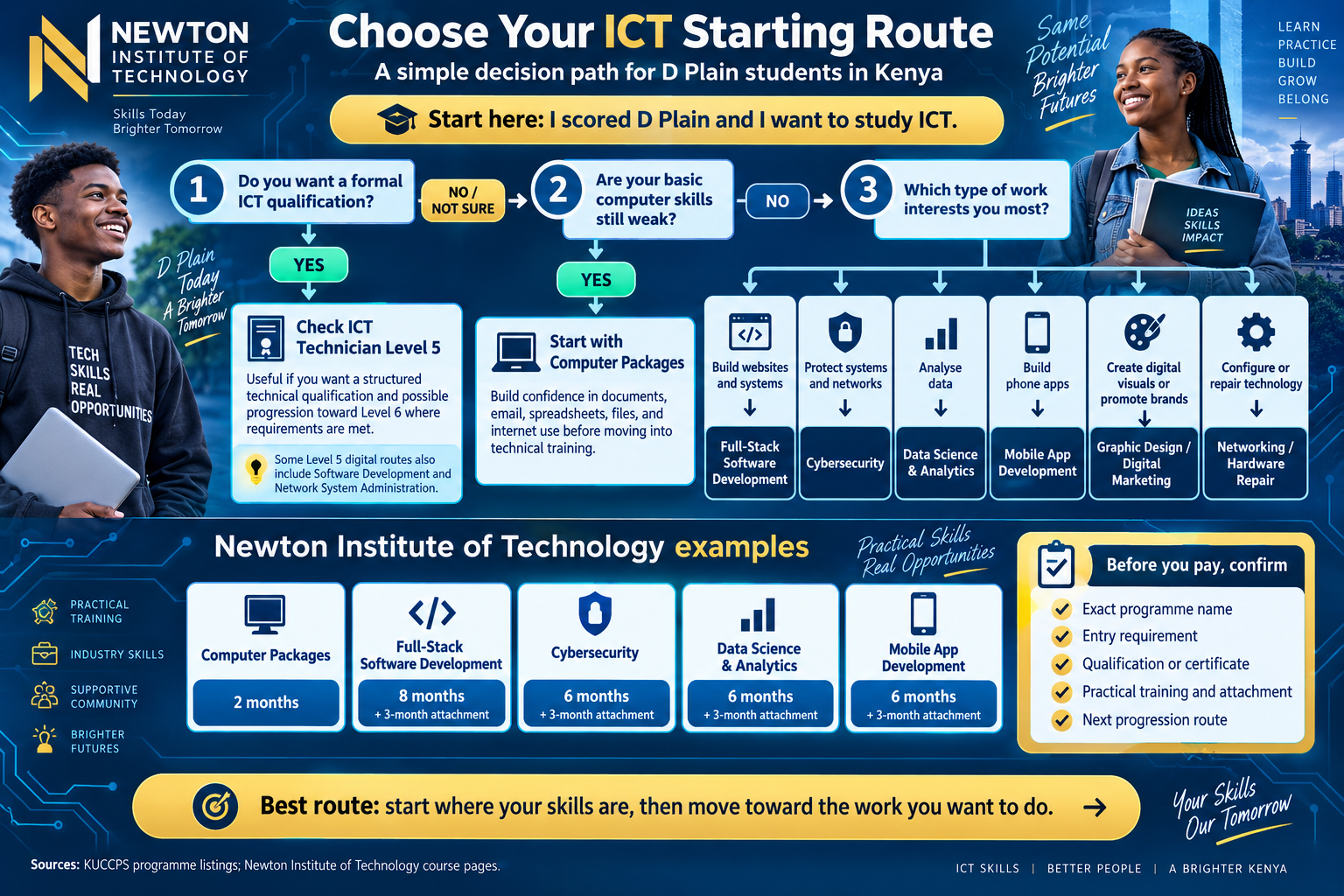
A D Plain to ICT pathway
Need a formal qualification?
Start by checking ICT Technician Level 5 or another suitable Level 5 digital route.
Need computer confidence?
Build the foundation first with Computer Packages or another suitable beginner programme.
Know your technical field?
Move into the specialist route that matches the work you want to learn.
Frequently asked questions
ICT courses for D Plain students: quick answers
Can I study ICT with D Plain in Kenya?
Yes. KUCCPS currently lists ICT Technician Level 5 with D as the minimum mean grade and no minimum subject requirement shown. [1]
Does ICT Level 5 require Mathematics?
The cited KUCCPS ICT Technician Level 5 record currently shows no additional minimum subject requirement. [1]
Can I study Software Development Level 5 with D Plain?
Yes. The current KUCCPS Software Development Level 5 record shows D as the minimum mean grade and no minimum subject requirement. [2]
Is Computer Packages the same as ICT Level 5?
No. Computer Packages develops everyday computer competence, while ICT Level 5 is a structured technical qualification.
Can I study cybersecurity with D Plain?
NIT’s current Cybersecurity programme accepts D and D+ applicants and is designed to begin from computing, networking and Linux foundations. [8]
Can I progress from D Plain to Level 6 ICT?
Yes, through an appropriate Level 5 progression route. KUCCPS currently shows C− as the minimum mean grade for direct KCSE entry to the cited ICT Level 6 record. [5]
The main point
D Plain gives you a real entry route into ICT
Start with the route that matches your present skills and your goal: a formal Level 5 qualification, stronger computer foundations, or focused practical ICT training.
D Plain → choose the right starting route → build practical competence → progress.
Practical ICT training in Migori
Register at Newton Institute of Technology
If you scored D Plain and want practical ICT training, speak with the ICT Department about the route that matches your current computer skills and the work you want to learn.
NIT offers Computer Packages, Full-Stack Software Development, Cybersecurity, Data Science & Analytics, Artificial Intelligence, Mobile App Development, Networking, Database Administration, Graphic Design, Digital Marketing and Computer Hardware Repair. [11]
Sources and references
- KUCCPS — ICT Technician Level 5 (CDACC): minimum mean grade D; no minimum subject requirement shown on the cited record.
- KUCCPS — Software Development Level 5: minimum mean grade D; no minimum subject requirement shown.
- KUCCPS — Software Engineering Level 5: minimum mean grade D; no minimum subject requirement shown.
- KUCCPS — ICT Level 6: minimum mean grade C−; no minimum subject requirement shown.
- Newton Institute of Technology — Courses for D Plain in Kenya: NIT computer-foundation route and Computer Packages duration.
- Newton Institute of Technology — Full-Stack Software Development Course: duration, attachment, fee, beginner entry and laptop baseline.
- Newton Institute of Technology — Cybersecurity Course: duration, attachment, fee and admission information.
- Newton Institute of Technology — Data Science and Analytics Course: duration, attachment, fee, entry and laptop baseline.
- Newton Institute of Technology — Mobile App Development Course: duration, attachment, fee and beginner entry.
- Newton Institute of Technology — Best ICT Courses After KCSE in Kenya: NIT specialist ICT pathways.
Prepared by: Newton Institute of Technology Editorial Team · Institutional / Technical review: Engineer Simon Barongo · Reviewed: 22 September 2026