

NIT KCSE Grade Guide Kenya · 2026/2027
Courses for
KCSE E Students
Level 4 · artisan routes · practical skills · progression
A practical guide to the courses a KCSE Grade E student can start in Kenya, the official Level 4 entry route, current KUCCPS examples, progression to higher levels and practical training options at Newton Institute of Technology.
Your recognised starting point
What can you study with KCSE E in Kenya?
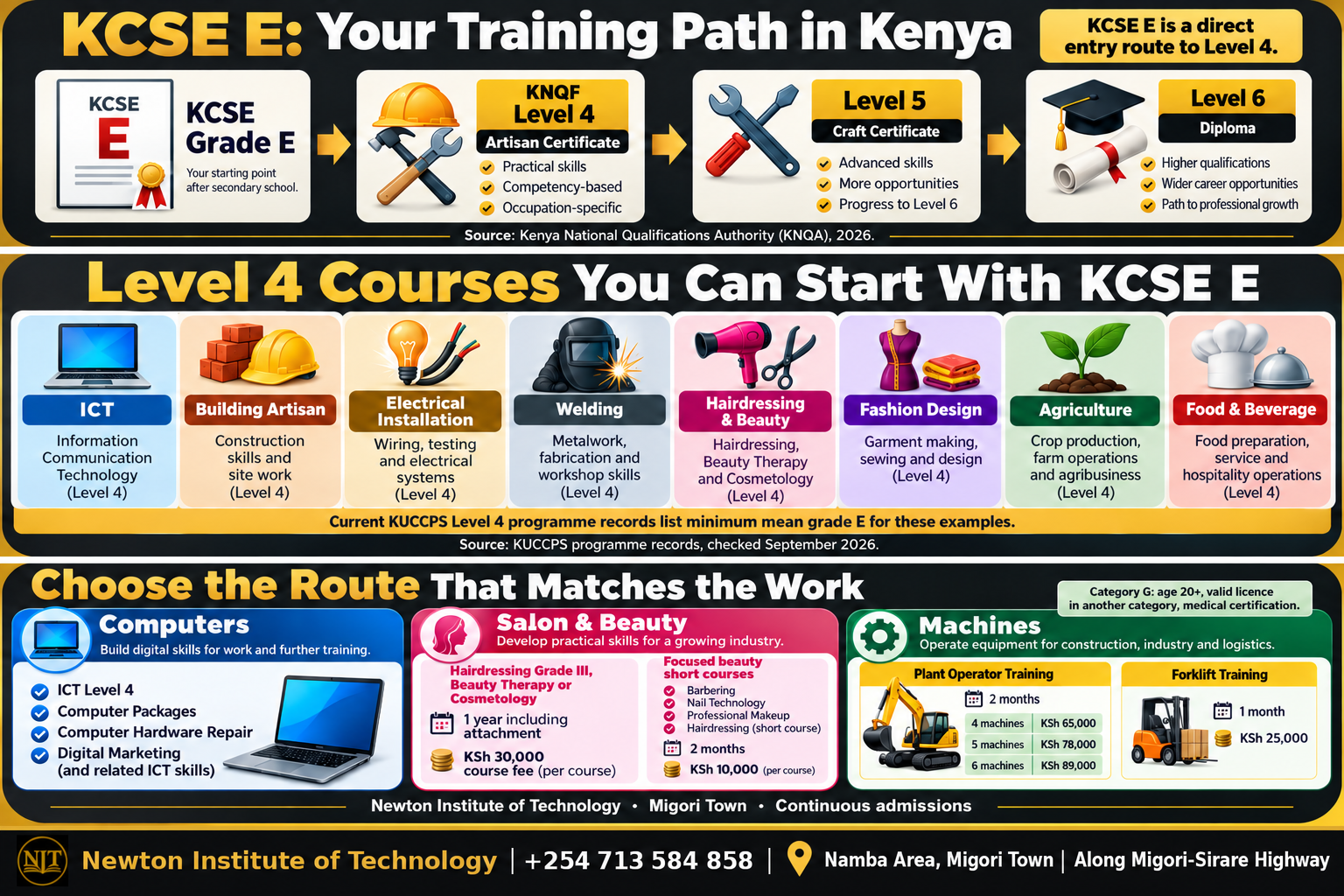
KCSE Grade E is a direct entry route to KNQF Level 4. KNQA lists the Level 4 minimum as KCSE E or successful completion of Level 3. Current KUCCPS programme records show Grade E entry for Level 4 options in ICT, building, electrical installation, welding, hairdressing, fashion, agriculture and food-service training. [1] [2]
Start with the official level
KCSE E is a recognised Level 4 entry point
KNQA’s current qualification framework lists KCSE Grade E or Level 3 as the minimum entry route to KNQF Level 4. Level 4 includes the Artisan Certificate and comparable vocational qualifications. Successful completion of Level 4 provides a progression route to Level 5. [1]
| Starting point | Qualification level | Next step |
|---|---|---|
| KCSE E | KNQF Level 4 — Artisan Certificate / equivalent vocational qualification | Complete the Level 4 qualification. |
| Completed Level 4 | KNQF Level 5 — Craft Certificate / equivalent | Progress in the related field. |
| Completed Level 5 | KNQF Level 6 — National Diploma / equivalent | Continue to specialised technical training. |
For the full Level 4–6 framework, use NIT’s separate TVET Courses and Requirements in Kenya guide. This page stays focused on Grade E choices so it complements rather than duplicates the broader TVET article.
Current KUCCPS examples
Level 4 course options that list KCSE E
Current KUCCPS programme records show minimum mean grade E for the examples below. These records give a practical picture of the fields a Grade E learner can explore. [2] [3] [4] [5] [6] [7] [8] [9]
ICT Level 4
For learners interested in computers, digital systems and technical support. KUCCPS lists Level 4 ICT records with minimum mean grade E and no additional minimum subject requirement on the cited records. [2]
Computers · digital tools · technical supportBuilding Artisan
A practical construction route covering building work, measurements, materials, tools and site processes. The cited KUCCPS record lists minimum mean grade E. [3]
Construction · tools · site workElectrical Installation
A Level 4 route for learners interested in wiring, installations, testing, tools and electrical systems. The cited programme record lists minimum mean grade E. [4]
Wiring · installation · testingWelding
Workshop-centred training in metal preparation, joining, fabrication and equipment use. KUCCPS lists Level 4 welding programmes at minimum mean grade E. [5]
Metalwork · fabrication · workshop skillsHairdressing & Beauty
Level 4 hairdressing and beauty routes are available at minimum mean grade E, alongside NITA trade pathways. [6] [10]
Hair · beauty · client servicesFashion Design
For learners interested in garment production, sewing, measurement and design. Current KUCCPS Fashion Design Level 4 records list Grade E as the minimum mean grade. [7]
Garments · sewing · designAgriculture Extension
A Level 4 entry route for learners interested in crop production, farm operations, agricultural services and agribusiness. [8]
Farming · production · agribusinessFood & Beverage
Hospitality-oriented Level 4 programmes cover food preparation, service and related operations. Current KUCCPS records list minimum mean grade E. [9]
Food · service · hospitality
A second route: focused skills
Short courses can build one practical skill first
A formal Level 4 qualification and a short institutional skills course are not the same product. Level 4 sits within the national qualifications framework; a short course is designed to teach a narrower practical skill over a shorter period.
If you want a formal artisan qualification, follow the Level 4 route. If you want a focused skill first, a short practical programme can be the better starting point.
At Newton Institute of Technology, examples of focused short courses include Computer Packages, Computer Hardware Repair, Digital Marketing, Barbering, Nail Technology, Professional Makeup, Massage, Hairdressing and Salon Management. NIT’s separate 2-Month Courses in Kenya guide explains these focused routes in detail. [13]
Machine training follows licensing rules
Plant Operator and Forklift training are Category G routes
Kenya’s Category G rules set a separate enrolment pathway for industrial, construction and agricultural machine drivers. The learner must hold a valid driving licence in another category, be at least 20 years old and have medical test certification. [11]
Check Category G eligibility
Confirm the existing driving licence, age and medical requirements before machine-driver training. [11]
Choose the machine route
Plant Operator training at NIT takes two months; the current 4-, 5- and 6-machine packages are KSh 65,000, KSh 78,000 and KSh 89,000. [14]
Forklift is a focused option
NIT Forklift Training takes one month, costs KSh 25,000, runs five days per week and is approximately 70% practical. [15]
Train for the work
Machine training is built around supervised practice, safety, inspection, controls and the applicable assessment and endorsement route.
Your KCSE grade is the starting point
Can a KCSE E student progress to diploma level?
Yes. KNQA provides progression from Level 4 to Level 5 and from Level 5 to Level 6. The route is built through successful completion of the relevant qualifications rather than by repeating KCSE. [1]
Start at Level 4
Choose the artisan field that matches the occupation you want to learn.
Complete the qualification
Build practical competence and pass the required assessment for the Level 4 award.
Move to Level 5
Use the completed Level 4 qualification as the progression route into the related Level 5 programme.
Continue to Level 6
After successful Level 5 completion, progress to the relevant diploma-level pathway.
Newton Institute of Technology example
Three practical ways NIT can guide a KCSE E learner
NIT in Migori Town uses the learner’s intended work to identify a sensible starting point. Three students with the same KCSE E grade can need completely different training routes.
Computers
A complete beginner can start with the two-month Computer Packages programme, then move into Computer Hardware Repair, Digital Marketing or a deeper ICT route. [13]
Build confidence → specialiseHair & Beauty
NIT Grade III Hairdressing, Beauty Therapy and Cosmetology each run for one year including attachment and cost KSh 30,000, with the Grade III NITA examination fee paid separately. Entry includes KCPE or KCSE D− and below, which includes KCSE E. [12]
Training → attachment → trade assessmentMachines
An eligible learner can take NIT’s two-month Plant Operator route or one-month Forklift Training, with the applicable Category G licensing pathway. [11] [14] [15]
Eligibility → supervised practice → assessment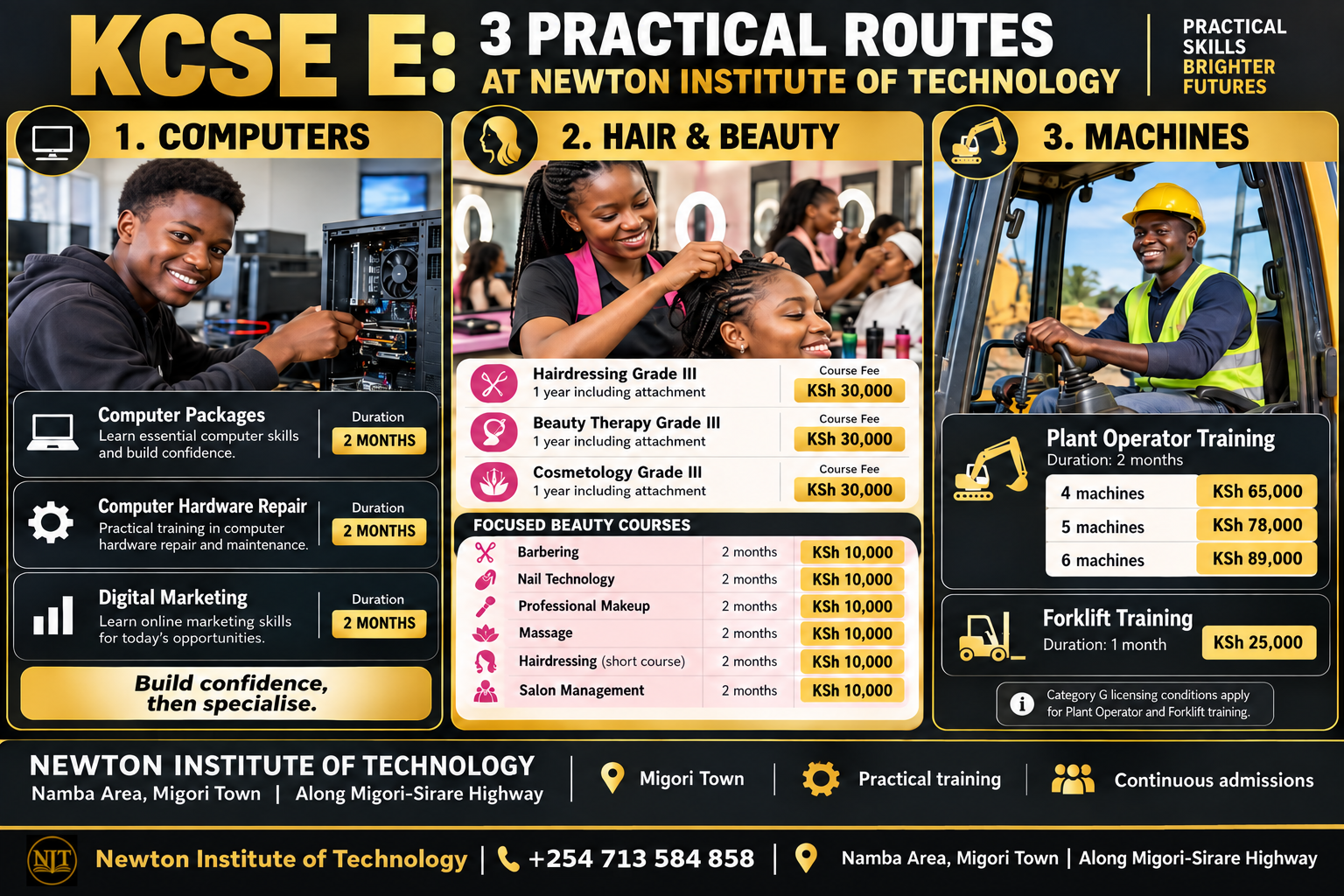
Choose by the work
How to choose your course after KCSE E
The strongest starting point is the occupation you want to practise, not a long list of course names.
- Computers: compare ICT Level 4 or a focused computer foundation depending on your current experience.
- Construction: compare Building Artisan, Electrical Installation and Welding according to the tasks you want to perform.
- Hair and beauty: compare formal Level 4, NITA trade routes and focused salon skills according to the qualification you want.
- Agriculture and hospitality: use the relevant Level 4 programme record to identify the exact course and institutions offering it.
- Machines: meet the Category G requirements first, then select the machine training route that fits your intended work.
Use the specialist guides for deeper questions
This guide answers the Grade E question; the supporting pages go deeper
For D− entry, use NIT’s Courses for D− in Kenya guide. For the full Level 4–6 system, use TVET Courses and Requirements in Kenya. For short skills programmes, use the 2-Month Courses in Kenya guide. This keeps each page centred on one search intent rather than repeating the same article under different titles.
Frequently asked questions
KCSE E courses in Kenya: quick answers
Can I join college with KCSE E?
Yes. KNQA lists KCSE Grade E as a direct minimum entry route to KNQF Level 4. [1]
Which courses can I do with E in KCSE?
Can I study ICT with KCSE E?
Yes. KUCCPS currently lists ICT Level 4 programmes with minimum mean grade E. [2]
Can I study Hairdressing with KCSE E?
Can I study electrical installation or welding with E?
Can I become a plant operator with KCSE E?
KCSE E does not block the Category G route. The Category G enrolment rules require a valid driving licence in another category, minimum age 20 and medical test certification. [11]
Can a KCSE E student reach diploma level?
Yes. The KNQF progression route allows successful Level 4 completion to lead to Level 5, and successful Level 5 completion to lead to Level 6 in the appropriate pathway. [1]
Is a two-month course the same as a Level 4 artisan qualification?
No. Level 4 is a national qualification level. A two-month institutional programme is a focused skills course unless it is specifically registered and awarded as a national qualification. [13]
The main point
KCSE E gives you a recognised place to start
Use Level 4 for the formal artisan route, or choose a focused practical programme when you want to develop one skill first. Then build the next step through practice, assessment, work exposure and progression.
Choose the work you want to learn. Start at the level you qualify for. Build from there.
Practical training in Migori
Register at Newton Institute of Technology
If you scored KCSE E and want a practical training route, speak with NIT Admissions about the work you want to learn. The team can match that direction to the appropriate NIT programme, explain the course structure and show you the next intake.
NIT offers practical training in Computer Packages, Computer Hardware Repair, Digital Marketing, Hairdressing, Beauty Therapy, Cosmetology, Barbering, Nail Technology, Professional Makeup, Plant Operation, Forklift Training and other skills programmes. Admissions are continuous.
Sources and references
- Kenya National Qualifications Authority — Frequently Asked Questions: KNQF Level 4, Level 5 and Level 6 qualification names, minimum entry routes and progression.
- KUCCPS — ICT Level 4: minimum mean grade E and no additional minimum subject requirement on the cited record.
- KUCCPS — Building Artisan Level 4: minimum mean grade E and no additional minimum subject requirement.
- KUCCPS — Electrical Installation Level 4: minimum mean grade E and no additional minimum subject requirement.
- KUCCPS — Welding Level 4 (TVET-CDACC): minimum mean grade E and no additional minimum subject requirement.
- KUCCPS — Hairdressing Level 4 (CDACC): minimum mean grade E and no additional minimum subject requirement.
- KUCCPS — Fashion Design Level 4: minimum mean grade E and no additional minimum subject requirement.
- KUCCPS — Level 4 Agriculture Extension: minimum mean grade E and no additional minimum subject requirement.
- KUCCPS — Food and Beverage Sales and Service Management Level 4: minimum mean grade E and no additional minimum subject requirement.
- National Industrial Training Authority — NITA Textile Training Institute: Hairdressing and Beauty Therapy Grade III open-entry route and Grade progression.
- Kenya Law — Traffic (Driving Schools, Driving Instructors and Driving Licences) Rules: Category G course accreditation and minimum enrolment requirements.
- Newton Institute of Technology — Hairdressing Course Fees in Kenya: NIT Grade III duration, institutional fee, NITA exam fee, entry route and focused beauty courses.
- Newton Institute of Technology — 2-Month Courses in Kenya: focused practical short-course examples and the distinction between course duration and qualification level.
- Newton Institute of Technology — Plant Operator Course Fees in Kenya: current NIT 4-, 5- and 6-machine tuition packages.
- Newton Institute of Technology — Forklift Training Fees in Kenya: one-month duration, KSh 25,000 training fee, five-day schedule, practical share and attachment.
Prepared by: Newton Institute of Technology Editorial Team · Institutional / Technical review: Engineer Simon Barongo · Reviewed: 23 September 2026