

NIT Career Guide Kenya · 2026/2027
Most Marketable Courses in Kenya in 2026/2027
Evidence first · practical fit · career proof
A practical national guide to course fields with credible demand signals in Kenya, how to judge marketability before enrolling, and what evidence of competence should come out of your training.
Broad national guide
Which course fields are most marketable in Kenya in 2026/2027?
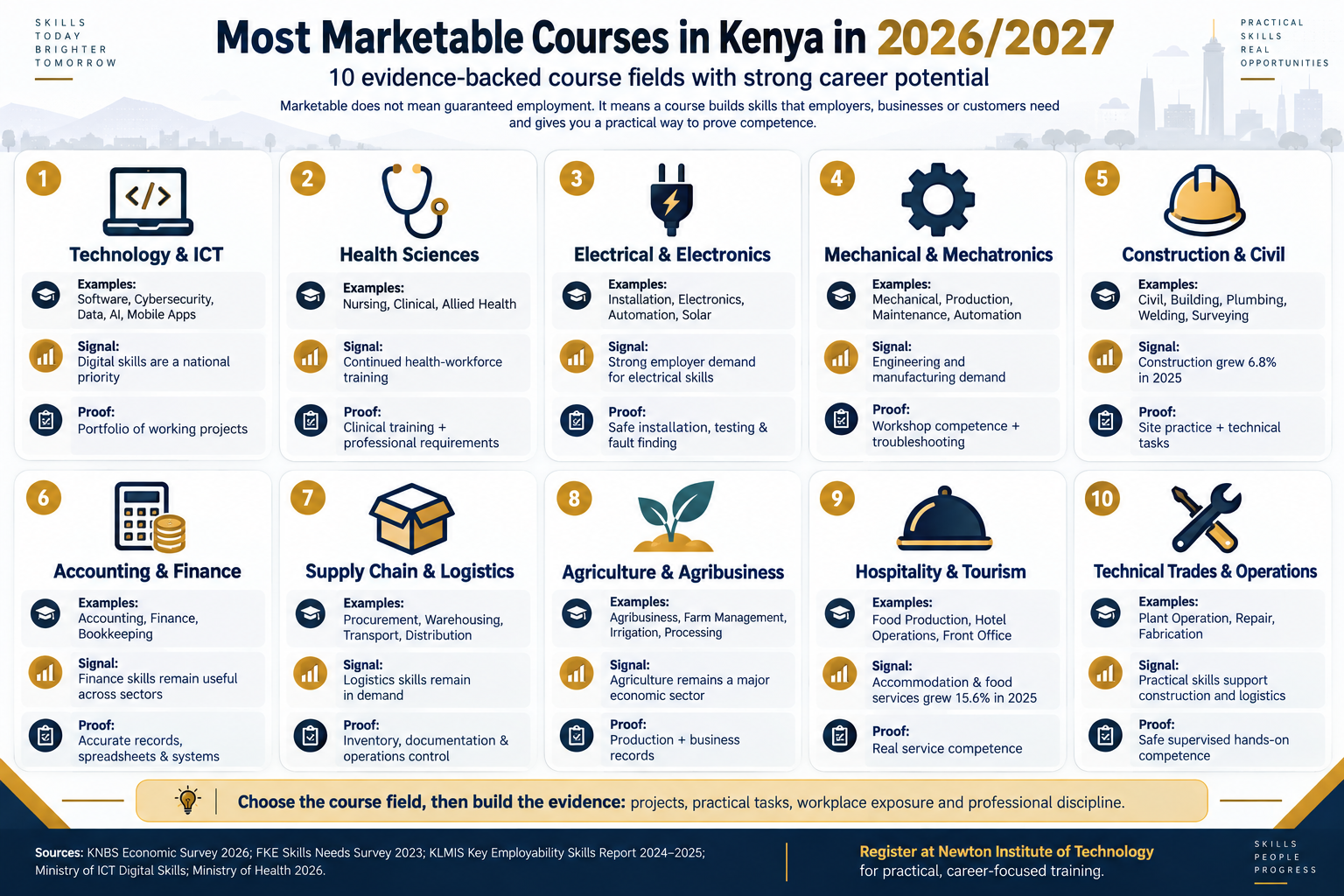
Strong fields to investigate include technology and ICT, health sciences, electrical and electronics, mechanical and mechatronics, construction and civil engineering, accounting and finance, supply chain and logistics, agriculture and agribusiness, hospitality and tourism, and practical technical trades. This is not an official government ranking and none of these fields guarantees a job. The useful question is whether the course builds skills that employers, businesses or customers need—and whether you can prove that competence when training ends.
Start broad, then investigate deeply
Marketable course fields at a glance
The table is deliberately not ranked from first to tenth. Different fields lead to different kinds of work, and marketability depends on your route, location, practical training and ability.
| Course field | Examples | What should prove competence |
|---|---|---|
| Technology & ICT | Software, cybersecurity, data, AI, mobile development | Working projects and a technical portfolio |
| Health Sciences | Nursing, clinical and other recognised health programmes | Approved clinical training and professional requirements |
| Electrical & Electronics | Installation, electronics, automation, energy | Safe installation, testing and fault diagnosis |
| Mechanical & Mechatronics | Mechanical, production, maintenance, automation | Workshop competence and troubleshooting |
| Construction & Civil | Civil, building, plumbing, welding, surveying | Site or workshop practice |
| Accounting & Finance | Accounting, finance, bookkeeping | Accurate records, spreadsheets and systems |
| Supply Chain & Logistics | Procurement, warehousing, transport, distribution | Inventory, documentation and operations control |
| Agriculture & Agribusiness | Agribusiness, production, irrigation, processing | Production plus commercial records |
| Hospitality & Tourism | Food production, hotel operations, tourism | Real service and operational practice |
| Technical Trades & Operations | Plant operation, repair, fabrication and related trades | Safe supervised hands-on competence |
Economic activity and employer-demand signals used in this guide come from KNBS, FKE and KLMIS. [1] [2] [3]
Our method
How we assessed whether a course is marketable
A useful marketability test starts with evidence, not advertising. We used five practical tests.
Are employers asking for the underlying skill or occupation?
Is the field connected to active parts of Kenya’s economy?
Does the training prepare you to perform identifiable tasks?
Can the skill support employment, contracts, enterprise or progression?
A strong course should leave you with something more convincing than the course title: a portfolio, installation, report, practical log, supervised workplace task, repaired item or assessed operational competence.
FKE’s employer survey identifies demand across IT, finance and business management, engineering, building and construction, and transport and logistics. It also identifies communication, critical thinking, teamwork and time management as important complementary skills. [2]
KLMIS’s 2024–2025 vacancy analysis similarly shows employers combining technical expertise with business management, Engineering/IT and sales or commercial competencies. [3]
Keep the concepts separate
A marketable course is not the same as an employable skill
What you study
- A structured programme or pathway
- May lead to a degree, diploma, certificate or focused skill award
- Its title alone does not prove competence
What you can actually do
- Can be demonstrated to an employer or customer
- Improves through repeated practice and workplace exposure
- Often needs evidence: work samples, tests, logs or supervised tasks
If your main question is specifically which abilities can create employment, freelance or business opportunities, use NIT’s separate Most Employable Skills in Kenya guide. Keeping the two questions separate prevents a broad course guide from duplicating the employability guide.
Ten course families to investigate
Most marketable course fields in Kenya in 2026/2027
1. Technology & ICT
Software development, cybersecurity, data analytics, AI, mobile development, networking and databases. Kenya’s Ministry of ICT lists programming, AI, big data, coding, cybersecurity, IoT and mobile app development among advanced digital skills. [4]
Proof: projects + portfolio2. Health Sciences
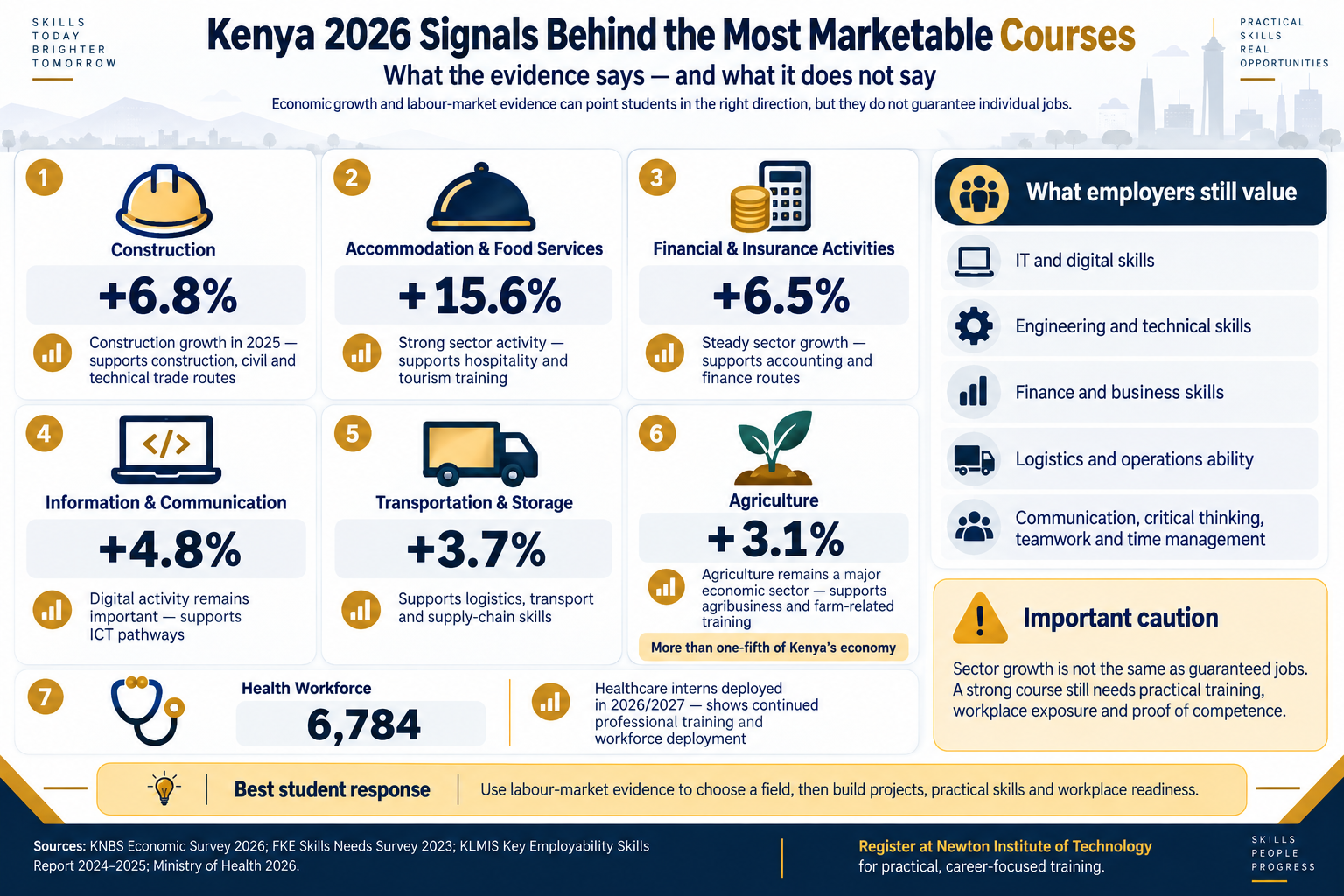
Health training remains a substantial professional route, but recognition matters. Kenya deployed 6,784 healthcare interns in the 2026/27 programme, while the Ministry of Health is also tightening alignment between training capacity, regulation and workforce needs. [5] [6]
Check regulator + clinical route3. Electrical & Electronics
Electrical installation, electronics, automation and energy systems have applications across buildings, industry and maintenance. FKE identifies electrical skills and electrical/electronics engineering among strong employer-demand areas. [2]
Proof: safe testing + fault finding4. Mechanical & Mechatronics
Mechanical, production, maintenance and automation routes support manufacturing and equipment-based work. FKE reports demand for mechanical and production engineering, while KLMIS shows manufacturing vacancies increasingly combining technical and commercial abilities. [2] [3]
Proof: workshop competence5. Construction & Civil
Construction grew by 6.8% in 2025 after contracting in 2024. Employer evidence also identifies building and construction among important TVET skill-demand areas. [1] [2]
Proof: site + technical practice6. Accounting & Finance
Finance and business management appear in employer-demand evidence, while financial and insurance activities grew by 6.5% in 2025. Practical spreadsheet, accounting-system and reporting ability strengthens the qualification. [1] [2]
Proof: accurate records + systems7. Supply Chain & Logistics
Procurement, warehousing, transport and distribution remain important operational functions. FKE identifies transport and logistics among leading TVET demand areas, while transportation and storage grew by 3.7% in 2025. [1] [2]
Proof: inventory + operations8. Agriculture & Agribusiness
Agriculture, forestry and fishing remain a major part of Kenya’s economy and grew by 3.1% in 2025. KLMIS also shows agricultural vacancies combining core sector knowledge with business, sales, finance and Engineering/IT skills. [1] [3]
Proof: production + business records9. Hospitality & Tourism
Accommodation and food services grew by 15.6% in 2025. That is a sector-activity signal—not a job guarantee. Strong training should include real kitchen, service, front-office or hotel-operations practice. [1]
Proof: real service competence10. Technical Trades & Operations
Plant operation, repair, fabrication and related trades can support construction, logistics and industrial work. Marketability depends heavily on equipment access, supervised practice, licensing where applicable and local demand. [1] [2]
Proof: safe hands-on competenceArticle 129 deliberately keeps ICT as one course family so it does not compete with NIT’s dedicated Best ICT Courses After KCSE in Kenya guide.
Match the qualification to the work
Degree, diploma, TVET or focused skills course?
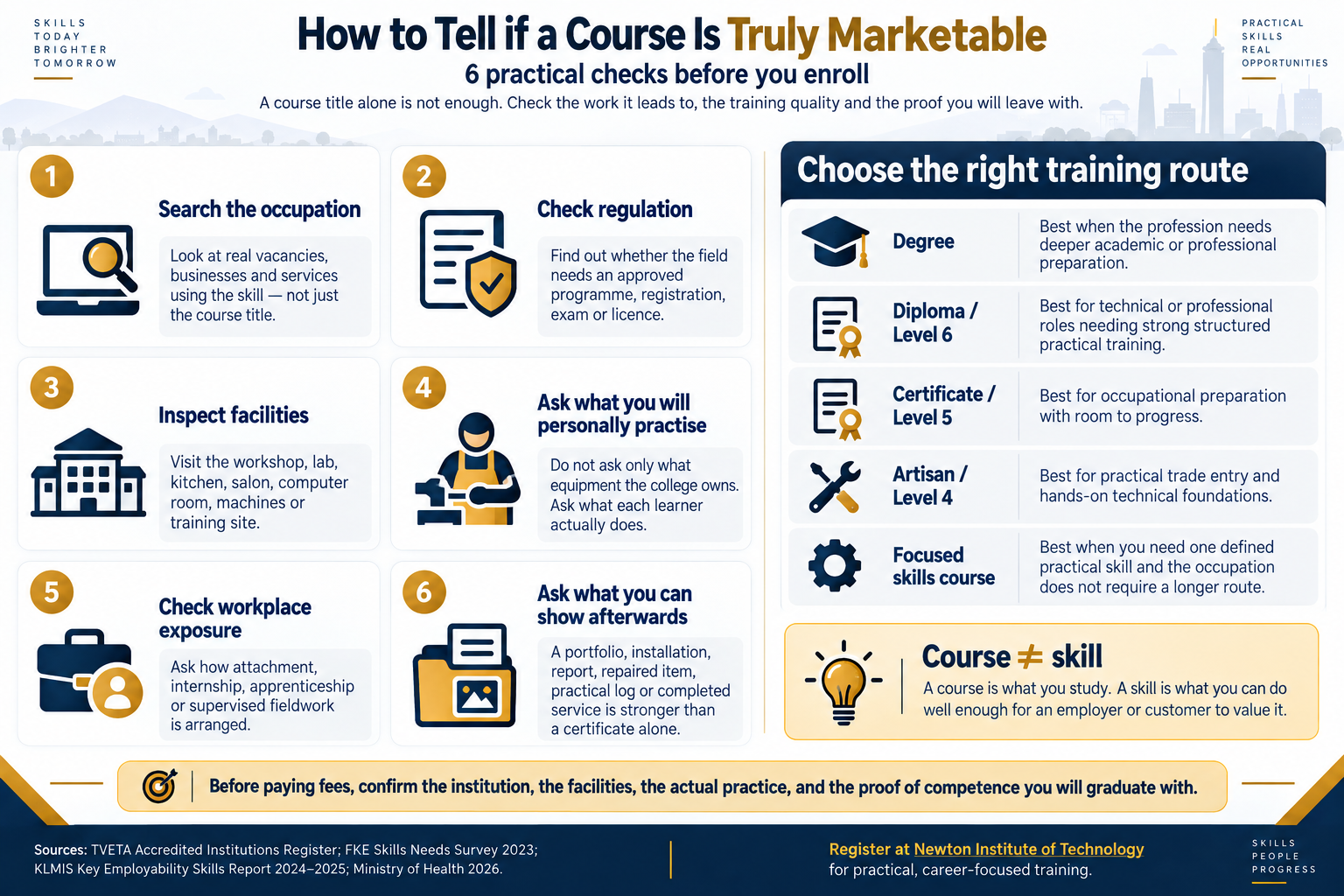
| Training route | Usually makes sense when |
|---|---|
| Degree | The profession needs deeper academic or professional preparation. |
| Diploma / Level 6 | The occupation benefits from strong structured technical and practical training. |
| Certificate / Level 5 | You need occupational preparation at certificate level with room to progress. |
| Artisan / Level 4 | You are entering through a practical trade route or building towards higher TVET levels. |
| Focused skills course | You need one defined practical skill and the occupation does not require a longer regulated qualification. |
Longer does not automatically mean more marketable. At the same time, a short introductory course cannot replace the depth required for regulated health work, complex engineering or other professions with formal qualification requirements.
Before paying fees
Before you call a course marketable, check these six things
Search the occupation
Look at real vacancies, businesses and services using the skill—not only the course title.
Check regulation
Find out whether the field needs an approved programme, registration, examination or licence.
Inspect facilities
Visit the workshop, laboratory, computer room, kitchen, salon, machines or practical training site.
Ask what you practise
Do not ask only what equipment the college owns. Ask what each learner actually does.
Check workplace exposure
Ask how attachment, internship, apprenticeship or supervised fieldwork is arranged.
Ask what you can show
A portfolio, installation, report, repaired item, practical log or completed service is stronger evidence than a certificate alone.
For TVET programmes, TVETA provides a public register that prospective students can use to check registered and licensed institutions. [7]
After choosing the course
What makes a graduate more employable after the course?
Course choice is only the starting point. Employer evidence shows that technical competence is strengthened by communication, critical thinking, teamwork and time management. [2] KLMIS also points towards combinations of technical, digital, management and commercial ability. [3]
Projects, installations, reports, logs or assessed work make competence visible.
Attachment, internship and supervised practice help bridge training and real work.
Technical workers increasingly benefit from systems, data, documentation and business understanding.
Employers still need people who can explain, coordinate, solve problems and work reliably with others.
The work you can perform shows what you learned.
Latest complete evidence available in 2026
What Kenya’s current economic signals do—and do not—tell you
KNBS reports that Kenya’s economy grew by 4.6% in 2025. Relevant sector movements included construction at +6.8%, accommodation and food services at +15.6%, financial and insurance activities at +6.5%, information and communication at +4.8%, transportation and storage at +3.7%, and agriculture at +3.1%. [1]
Your grade affects the route—not your entire future
How your KCSE grade affects the training route
Do not use a national “most marketable courses” guide as a substitute for checking actual entry requirements. Your mean grade and individual subject grades can affect whether the direct route is a degree, diploma, certificate or artisan programme.
Use the grade-specific guide
Choose the route that matches your entry level
- Courses for D+ students
- Marketable courses for D Plain students
- Always confirm the current requirement for the exact programme.
Two related questions—kept separate
What about short courses and self-employment?
A short course can be useful when it teaches one clearly defined service or technical skill deeply enough for the intended task. For a detailed comparison, use NIT’s Best Short Courses After KCSE in Kenya guide rather than stretching this national marketability guide into a second short-course article.
Some marketable fields can also support self-employment, but startup cost, local customers, licences, equipment and business ability all matter. If running a business is the primary goal, use the separate Best Courses for Self-Employment in Kenya guide.
Questions students ask
Frequently asked questions
What are the most marketable courses in Kenya in 2026/2027?
Strong fields to investigate include technology and ICT, health sciences, electrical and electronics, mechanical and mechatronics, construction, finance, logistics, agriculture, hospitality and practical technical trades. This is not an official ranking, and employment is not guaranteed.
What makes a course marketable in Kenya?
A marketable course develops skills that employers, businesses or customers need and gives the learner a realistic way to demonstrate competence. Employer demand, sector activity, regulation, training quality and practical application all matter.
Are TVET courses marketable in Kenya?
Several TVET skill areas show measurable employer demand. FKE’s survey identifies transport and logistics, electrical skills, and building and construction among important demand areas and reports hard-to-fill positions in construction, engineering and logistics. [2]
Which technology courses are in demand in Kenya?
Useful directions include software development, cybersecurity, data analytics, AI, mobile development, networking and related ICT skills. Kenya’s Ministry of ICT identifies programming, AI, big data, coding, cybersecurity, IoT and mobile application development among advanced digital skills. [4]
Is a diploma better than a degree for getting a job?
Not automatically. The correct qualification depends on the occupation. Some professions require degree-level preparation; many technical roles are well served by diploma or TVET training. Compare the actual work and qualification requirements rather than assuming the longest course is always better.
Does studying a marketable course guarantee employment?
No. Practical competence, experience, licensing where required, location, employer demand, communication, portfolio or work evidence and the wider economy can all affect the outcome.
How can I tell whether a course will be useful before enrolling?
Inspect the facilities, confirm the institution and qualification, ask what learners personally practise, check workplace exposure and ask what evidence of competence you will leave with. For TVET institutions, verify registration through TVETA. [7]
A practical final rule
Do not choose a course because someone says it is “hot”
Ask three questions instead: What work will I be able to perform? Who needs that work? How will I prove I can do it? A genuinely marketable course gives you a credible answer to all three.
Ready to build a practical career skill?
Register at Newton Institute of Technology
Newton Institute of Technology offers practical, career-focused training across ICT, plant operation, driving and other skills-based areas. Ask the Admissions team for the current entry requirement, course duration, full fee, practical timetable, assessment route and attachment arrangement before enrolment. [8]
CampusMigori Town, Kenya
ApproachPractical, skills-focused training
Next stepConfirm the current intake and course requirements
Sources and evidence
- Kenya National Bureau of Statistics (KNBS). 2026 Economic Survey. Accessed 21 September 2026.
- Federation of Kenya Employers (FKE). Skills Needs Survey Report 2023. Accessed 21 September 2026.
- Kenya Labour Market Information System (KLMIS). Key Employability Skills Report 2024–2025. Accessed 21 September 2026.
- Ministry of Information, Communications and the Digital Economy. Digital Skills. Accessed 21 September 2026.
- Ministry of Health. Ministry Deploys 6,784 Healthcare Interns to Strengthen Kenya’s Health Workforce. Accessed 21 September 2026.
- Ministry of Health. Kenya Launches Multi-Sectoral Reforms to Strengthen Health Workforce Training. Accessed 21 September 2026.
- Technical and Vocational Education and Training Authority (TVETA). Accredited TVET Institutions Register. Accessed 21 September 2026.
- Newton Institute of Technology. Official website and current course information. Accessed 21 September 2026.
Prepared by: Newton Institute of Technology Editorial Team
Institutional / Technical review: Engineer Simon Barongo
Evidence checked: 21 September 2026