

NIT Technical Course Guide Kenya · 2026/2027
Best Technical Courses
in Kenya
Choose the field · inspect the practice · verify the pathway
A practical Kenya-focused comparison of technical course families, the work each field teaches and the training environment you should inspect before paying.
Start with the work
Which technical courses are worth comparing in Kenya?
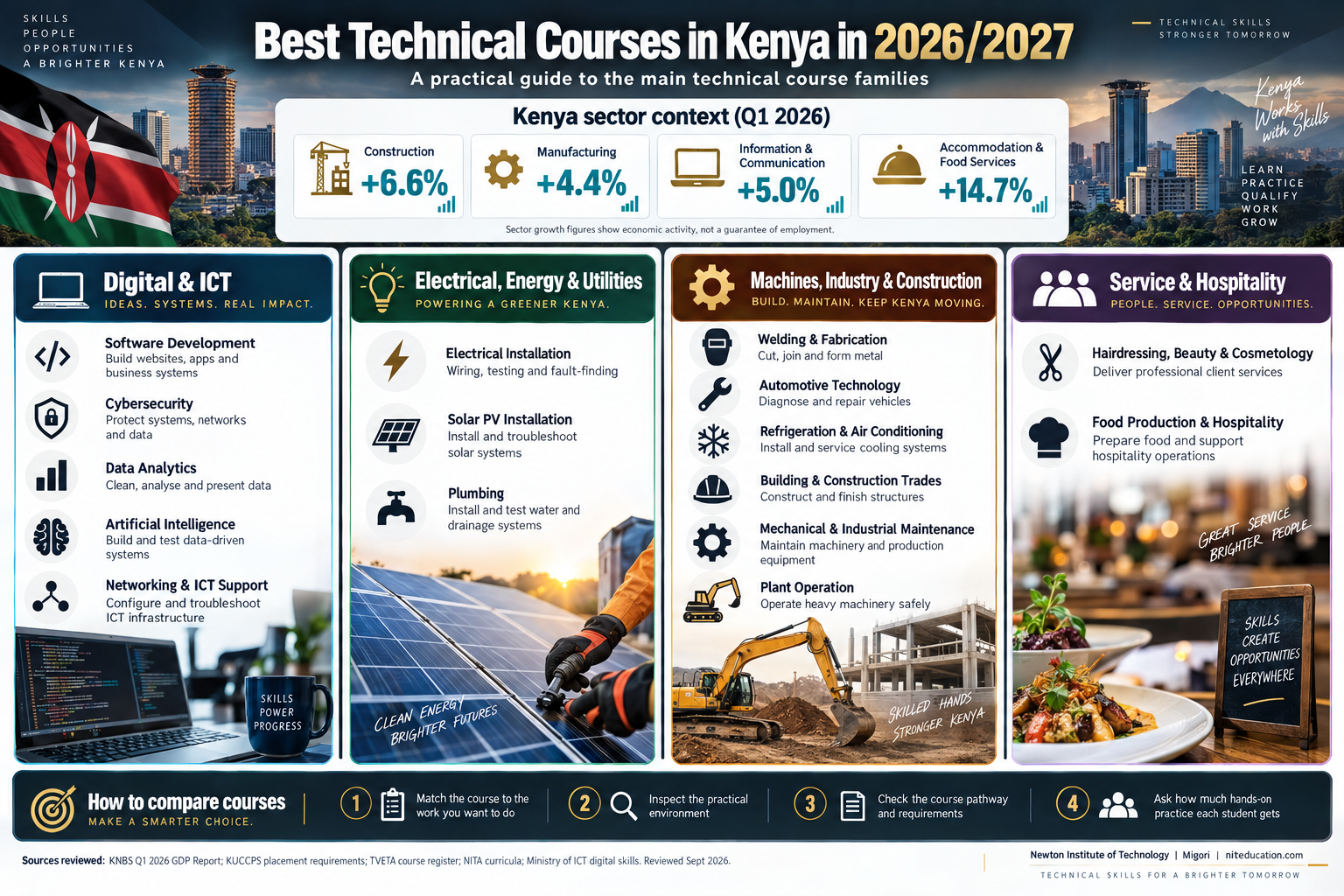
Strong technical pathways to compare in 2026/2027 include ICT and software, electrical installation, solar PV, plumbing, welding, automotive technology, refrigeration and air conditioning, building trades, industrial maintenance, plant operation, hairdressing and beauty, and food production or hospitality.
The right choice is the field that matches the work you want to learn and gives you enough supervised practice to become competent.
Compare the work, not just the title
Technical course families at a glance
| Technical field | What the work involves | What to inspect before enrolling |
|---|---|---|
| Software Development | Building websites, applications and business systems | Recent student projects and working computer labs |
| Cybersecurity | Protecting systems and networks | A practical cyber and networking lab |
| Data Analytics | Cleaning, analysing and presenting data | Realistic datasets, analysis tools and projects |
| Artificial Intelligence | Building and testing data-driven systems | Programming and data foundations before advanced tools |
| Electrical Installation | Wiring, testing and fault-finding | Wiring boards, instruments and individual practical time |
| Solar PV | Installing and troubleshooting solar systems | Complete working solar training systems |
| Plumbing | Installing and testing water and drainage systems | Pipework bays and individual installation tasks |
| Welding & Fabrication | Cutting, joining and forming metal | Functioning welding bays and sufficient arc time |
| Automotive Technology | Diagnosing, servicing and repairing vehicles | Vehicles, tools and diagnostic equipment |
| Refrigeration & AC | Installing and servicing cooling systems | Working systems that can be tested and diagnosed |
| Plant Operation | Inspecting and operating heavy machinery | Actual machines and a clear seat-time rota |
| Hair & Beauty | Delivering professional client services | Salon workstations and supervised client practice |
| Food Production | Preparing food and hospitality services | A functioning training kitchen and service environment |
This is a comparison, not a ranking from best to worst. TVETA’s current register includes many of these technical and vocational programme families. [4]
Keep the level question separate
A short note on TVET entry levels
For KUCCPS placement, the current general bands are Diploma/Level 6 for C and C−, Certificate/Level 5 for D+ and D, and Artisan/Level 4 for D− and E. Individual programmes can still have additional requirements. [2]
For the full qualification-level and progression explanation, use NIT’s separate TVET Courses and Requirements in Kenya: Levels 4–6.
Course family 01 · Digital & ICT
ICT technical courses: choose the problem you want to solve
Kenya’s Ministry of Information, Communications and the Digital Economy identifies advanced digital skills including computer programming, network management, AI, big data, coding, cybersecurity, IoT and mobile application development. [3]
Software Development
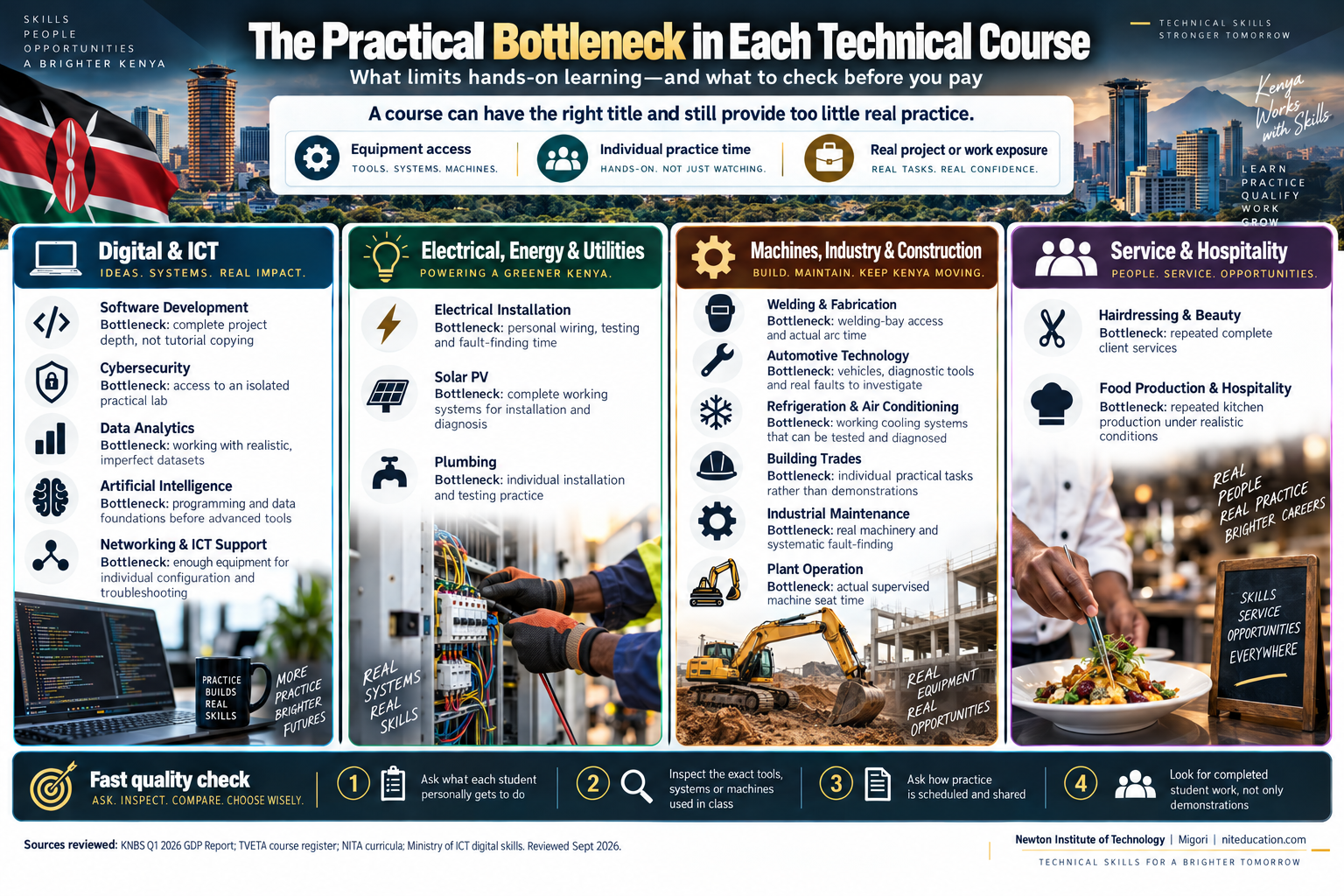
The bottleneck is project depth. Ask for recent working student systems, not screenshots or tutorial copies.
Cybersecurity
Look for an isolated lab where students configure, inspect and secure systems after learning networking and operating-system foundations.
Data Analytics
Good training uses imperfect datasets that need cleaning, querying, interpretation and clear presentation.
Artificial Intelligence
Programming and data foundations should come before advanced tools; students should evaluate outputs, not only generate them.
Networking & ICT Support
Students need enough devices and network equipment for individual configuration, troubleshooting and support practice.
TVETA also lists ICT-related technical programmes in its current course register. [4]
For a detailed comparison of NIT’s Full-Stack Software Development, Cybersecurity, Data Science, Artificial Intelligence and Mobile App Development routes, use Best ICT Courses After KCSE in Kenya.
Course family 02 · Electrical, energy & utilities
Electrical, solar and plumbing: inspect the workstations
Electrical Installation
Look for wiring boards, protective devices, measuring instruments and enough supervised time for each learner to wire, test, find faults and correct them.
Solar PV Installation
A serious setup should let learners work through a complete system: sizing, panels, controllers, inverters, cabling, protection, testing and troubleshooting.
Plumbing
Students should personally measure, cut, join, install and test pipe systems rather than mainly watching demonstrations.
TVETA lists Electrical Installation, Plumbing and Solar PV routes; NITA’s curricula include Solar Photovoltaic and electrical trades. [4] [5]
Course family 03 · Machines, industry & construction
Hands-on trades: the limiting factor is access to real equipment
Welding & Fabrication
Ask how many learners share each welding bay and how actual arc time is scheduled. Preparation, inspection and finishing matter as much as the weld itself.
Automotive Technology
Look for vehicles, tools and diagnostic equipment. The key question is how students learn to identify the cause of a fault before replacing parts.
Refrigeration & Air Conditioning
Students need working systems that can be switched on, tested, serviced and diagnosed—not only dismantled display components.
Building Trades
Masonry, carpentry, steel fixing, tiling and related trades are easiest to judge through completed practical tasks to specification.
Industrial Maintenance
Ask whether students diagnose faults on real machinery and production equipment rather than learning mainly from diagrams.
Plant Operation
Machine ownership is not enough. Ask for the practical timetable, machine rotation and actual supervised seat time per learner.
KNBS reported Q1 2026 growth of 6.6% in construction and 4.4% in manufacturing. These are sector-performance figures, not employment guarantees. [1]
NITA’s current catalogue includes welding, refrigeration and air-conditioning, electrical and related mechanical trades. [5]
For detailed heavy-equipment training content, use NIT’s Plant Operator Course Syllabus in Kenya rather than repeating the plant-operator cluster here.
Course family 04 · Service & hospitality
Client-facing technical skills still need repeated practice
Hairdressing, Beauty & Cosmetology
Look beyond mirrors and salon chairs. Ask how students progress to complete supervised client services from consultation to finishing.
Food Production & Hospitality
Training should happen through repeated kitchen or service cycles: preparation, hygiene, timing, portioning, presentation and safe cleanup.
KNBS reported 14.7% growth in accommodation and food services in Q1 2026. Again, that is economic context rather than a promise that every graduate will find a job. [1]
TVETA’s current register includes Hairdressing and Beauty Therapy, Food and Beverage and related vocational programmes. [4]
The comparison most adverts leave out
The practical bottleneck in each technical course
A course can have the right title and still provide too little real practice. Identify the resource or experience that limits how much each learner personally gets to do.
| Course | Main practical bottleneck to check | What a useful answer sounds like |
|---|---|---|
| Software | Complete-project depth | Students build, debug and deploy working systems. |
| Cybersecurity | Safe practical lab access | Students configure and test systems in an isolated environment. |
| Data Analytics | Realistic datasets | Students clean imperfect data before analysing it. |
| Electrical | Personal wiring and testing time | Each learner completes and troubleshoots installations. |
| Solar PV | Complete systems | Students install, test and diagnose working systems. |
| Welding | Arc time | There is a clear bay rotation and individual welding schedule. |
| Automotive | Vehicles and real faults | Diagnosis is taught before component replacement. |
| Plant Operation | Machine seat time | The machine rotation and supervised hours are clear. |
| Hair & Beauty | Complete client services | Students repeatedly perform full supervised services. |
| Hospitality | Repeated production cycles | Students prepare and deliver work under realistic conditions. |
Visit before you pay
What to inspect before enrolling in a technical course
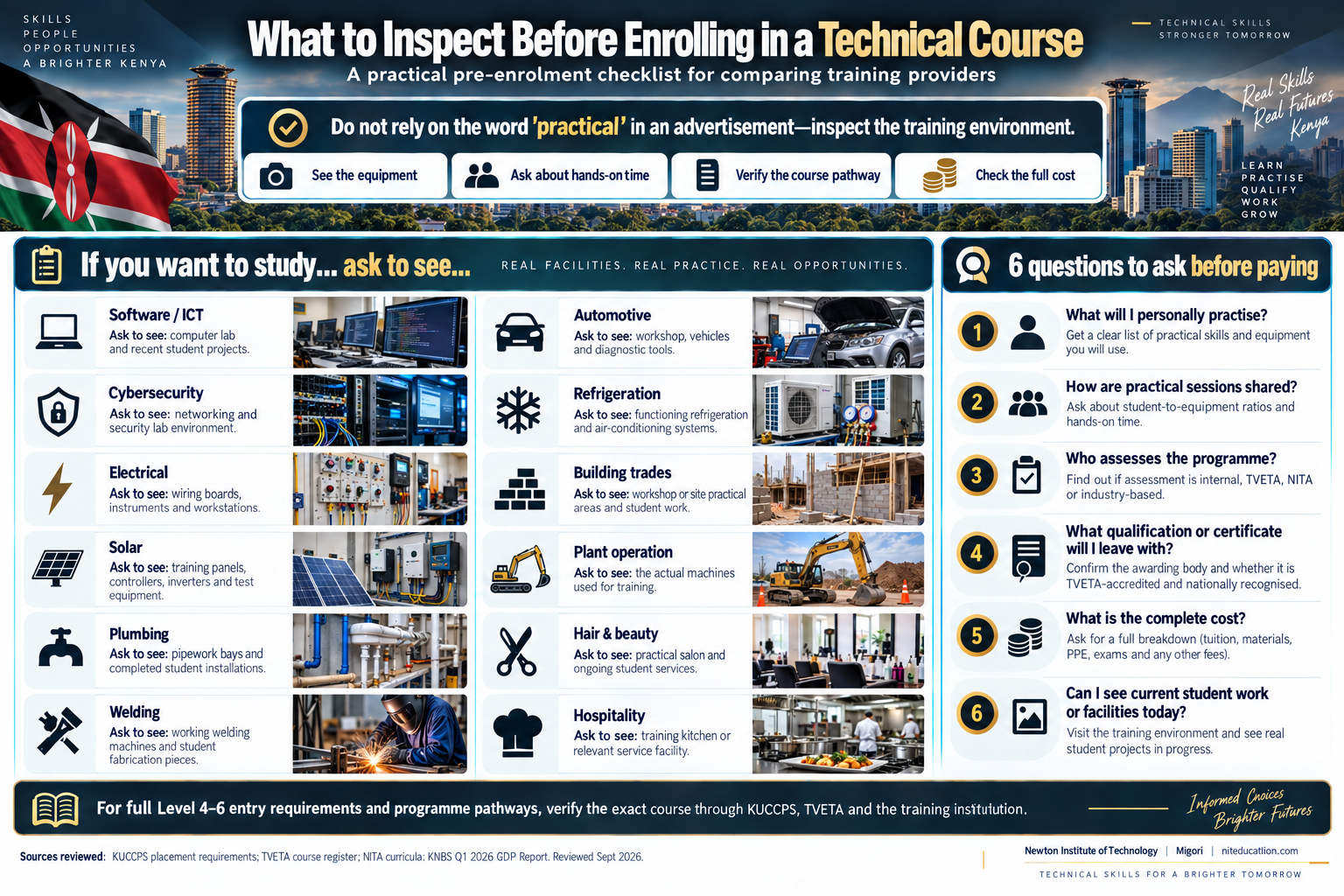
You do not need to conduct a formal college audit. Inspect the place where the skill is actually practised.
| If you want to study… | Ask to see… | Then ask… |
|---|---|---|
| Software / ICT | Computer lab and recent student projects | Which complete projects did the current class build? |
| Cybersecurity | Networking and security lab | What practical exercises does each learner perform? |
| Electrical | Wiring boards and test instruments | How many students share each workstation? |
| Solar | Panels, controllers, inverters and test equipment | Do students work through a complete system? |
| Plumbing | Pipework bays and student installations | Does each learner personally test an installation? |
| Welding | Working machines and student pieces | How is welding time allocated? |
| Automotive | Workshop, vehicles and diagnostics | How are real faults introduced and diagnosed? |
| Refrigeration | Functioning AC/refrigeration systems | Can learners test live systems safely? |
| Plant Operation | The actual machines | What is the supervised seat-time rota? |
| Hair & Beauty | Practical salon and current student work | When do learners begin complete client services? |
| Hospitality | Training kitchen or service facility | How often does each learner complete a production cycle? |
TVETA maintains registers for recognised courses and registered/licensed institutions. Check the exact institution and programme before paying. [4] [6]
For the broader questions of registration, trainers, attachment and full fees, use NIT’s dedicated How to Choose the Best TVET College in Kenya After KCSE.
Use the right guide for the right decision
Technical course, employable skill or short course?
This guide
Which technical fields should I compare, and what should good practical training in each field look like?
Employability guide
For employment, freelance and business routes, read Most Employable Skills in Kenya 2026.
Short-course guide
If duration is your main constraint, read Best Short Courses After KCSE in Kenya.
Frequently asked questions
Best technical courses in Kenya: FAQs
What are the best technical courses in Kenya in 2026/2027?
Strong fields to compare include ICT and software, electrical installation, solar PV, plumbing, welding and fabrication, automotive technology, refrigeration and air conditioning, building trades, industrial maintenance, plant operation, hairdressing and beauty, and food production or hospitality. The best choice depends on the work you want to learn and the amount of genuine practice available.
Which technical courses are available after KCSE?
Kenya’s TVET system offers programmes at several levels, while other skills use occupational, trade-test, licensing or institutional pathways. KUCCPS currently places Diploma/Level 6, Certificate/Level 5 and Artisan/Level 4 within different KCSE entry bands. [2]
Which technical courses involve computers?
Software Development, Cybersecurity, Data Analytics, Artificial Intelligence, Networking and ICT Support are major options. The Ministry responsible for ICT identifies programming, network management, AI, big data, cybersecurity, IoT and mobile-app development among advanced digital skills. [3]
Which technical courses involve construction?
Electrical Installation, Plumbing, Welding and Fabrication, Masonry, Carpentry, Building Technology, Solar Installation, Refrigeration and Plant Operation can all connect to construction activity.
Which technical course suits someone who likes machines?
Automotive Technology, Plant Operation, Mechanical or Industrial Maintenance and some refrigeration or fabrication pathways are worth comparing. The work differs: plant operators control equipment, automotive technicians diagnose vehicles and industrial maintenance focuses on production machinery.
How can I tell whether a technical course is genuinely practical?
Inspect the training environment and identify the course’s main practical bottleneck. Ask how much machine time, workshop time, project depth, lab access or client practice each student receives. Do not rely on the word “practical” in an advert.
Final takeaway
The course title matters less than the practice behind it
There is no single technical course that is best for every learner. Start with the kind of work you want to become good at, then inspect the resource that matters most in that field.
For software, look at project depth. For welding, welding time. For electrical, repeated installation and testing. For automotive, diagnosis on real vehicles. For plant operation, supervised machine seat time. For beauty, repeated client work.
That is where technical training becomes real.
Authoritative sources & verification
Sources checked: 21 September 2026
- Kenya National Bureau of Statistics — Quarterly Gross Domestic Product, First Quarter 2026. Used for construction, manufacturing, information & communication, and accommodation & food-service growth figures.
- Kenya Universities and Colleges Central Placement Service — Placement. Used for current general Diploma/Level 6, Certificate/Level 5 and Artisan/Level 4 entry bands.
- Ministry of Information, Communications and the Digital Economy — Digital Skills. Used for advanced digital-skill areas including programming, networking, AI, big data, cybersecurity, IoT and mobile applications.
- Technical and Vocational Education and Training Authority — TVET Courses Register. Used to verify technical and vocational course families.
- National Industrial Training Authority — Catalogue of NITA Curricula. Used for competency-based trade routes including welding, refrigeration, electrical and solar training.
- Technical and Vocational Education and Training Authority — Accredited TVET Institutions Register. Used for institution-registration and licensing verification guidance.
Programme approvals, entry requirements, licensing arrangements and course availability can change. Confirm the exact programme with the responsible institution and regulator before paying.
Practical training in Migori
Register at Newton Institute of Technology
Newton Institute of Technology offers practical training across ICT, Plant Operation, Driving, Hairdressing, Beauty Therapy, Cosmetology and other vocational areas. ICT options include Full-Stack Software Development, Cybersecurity, Data Science & Analytics, Artificial Intelligence and Mobile App Development.
Before registering, ask Admissions to confirm the current entry requirement, intake date, course duration, complete fee, timetable, practical-training arrangement, assessment route and attachment arrangement where applicable.
Prepared by: Newton Institute of Technology Editorial Team · Institutional / Technical review: Engineer Simon Barongo · Reviewed: 21 September 2026