

NIT Qualifications Guide Kenya · 2026
Artisan vs Craft Certificate
vs Diploma in Kenya
Level 4 · Level 5 · Level 6 · progression
A practical comparison of the three formal qualification levels: what each one means, the general KCSE entry point, how the training depth changes and how to progress to the next stage.
Three qualification stages
What is the difference between Artisan, Craft Certificate and Diploma?
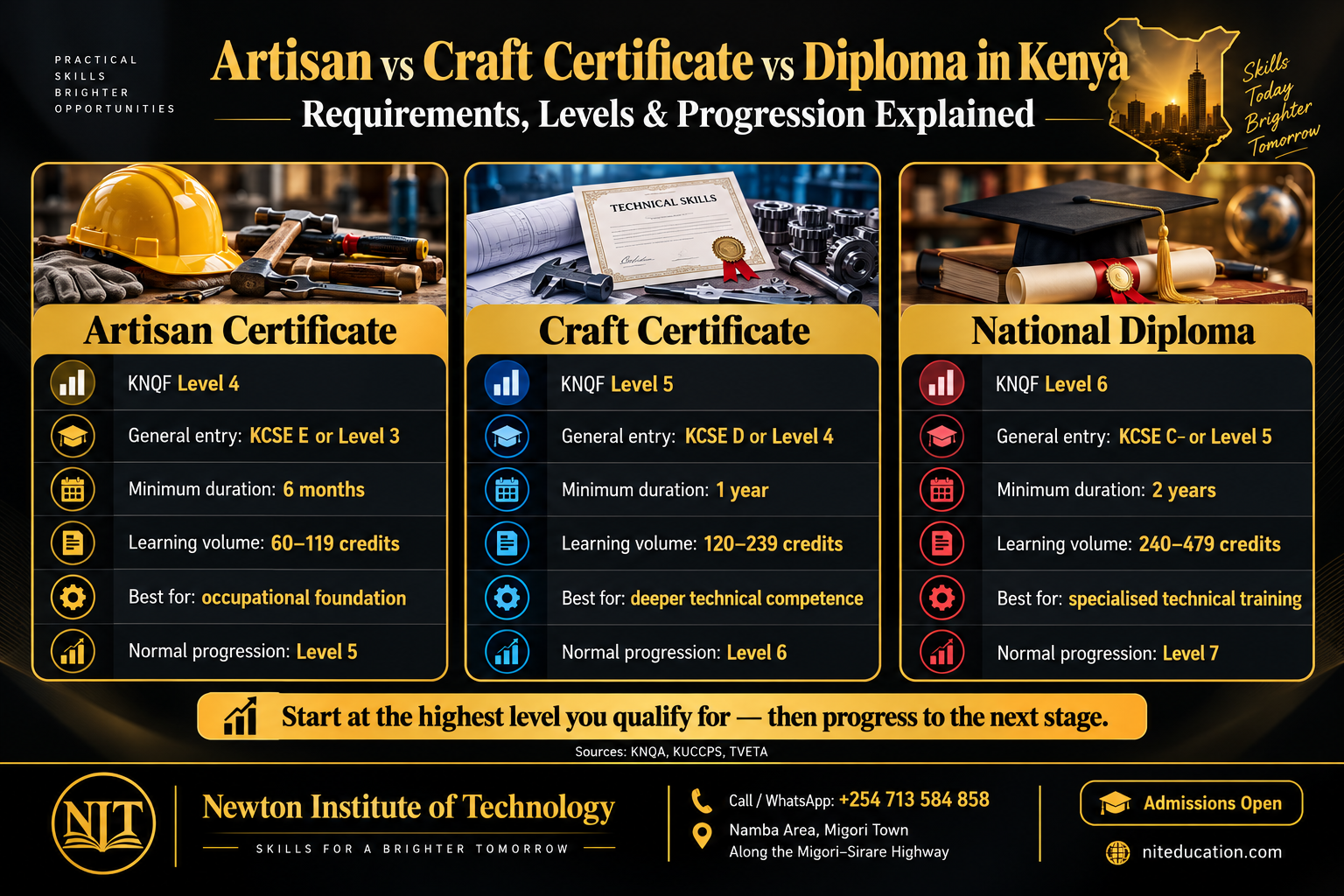
Artisan Certificate is KNQF Level 4, Craft Certificate is Level 5, and National Diploma is Level 6. KNQA gives KCSE E as the general entry point for Level 4, KCSE D for Level 5 and KCSE C− for Level 6. A relevant qualification from the level below can also provide entry to the next stage. [1]
Choose the level that matches your current qualification, then check where that qualification leads next.
The three qualifications sit on the same progression ladder, but they are not interchangeable. Artisan builds the occupational foundation, Craft develops deeper technical competence, and Diploma moves into more advanced and specialised technical training. [2]
Qualification levels, entry routes and learning volumes: [1]
Compare the three qualifications
Entry, level, duration and progression at a glance
| Feature | Artisan Certificate | Craft Certificate | National Diploma |
|---|---|---|---|
| KNQF level | Level 4 | Level 5 | Level 6 |
| General KCSE entry | E | D | C− |
| Alternative entry | Level 3 | Level 4 | Level 5 |
| Minimum duration | 6 months | 1 year | 2 years |
| Learning volume | 60–119 credits | 120–239 credits | 240–479 credits |
| Training position | Occupational foundation | Deeper technical competence | Specialised technical competence |
| Normal next level | Level 5 | Level 6 | Level 7 |
References: [1][2] KNQA entry requirements, learning volumes, minimum durations and level descriptors.
A learner who already meets the requirements for Level 5 or Level 6 can start there. The lower levels remain progression routes for learners who enter earlier in the qualification ladder.
Artisan vs Craft Certificate vs National Diploma
Level 4
What is an Artisan Certificate?
An Artisan Certificate is a KNQF Level 4 qualification. It provides a practical occupational foundation and can prepare a learner for skilled work or further training at Level 5.
KNQA gives KCSE Grade E or successful completion of a Level 3 qualification as the general entry route. Level 4 carries a minimum learning volume of 60–119 credits and a minimum duration starting from about six months. [1]
If your goal is to continue studying, identify the Level 5 qualification that follows the Artisan course before enrolment.
Level 5
What is a Craft Certificate?
A Craft Certificate is KNQF Level 5. It is the formal certificate level in the Artisan–Craft–Diploma progression explained in this guide.
The general KNQA entry route is KCSE Grade D or successful completion of a relevant Level 4 qualification. Level 5 has a minimum learning volume of 120–239 credits and a minimum duration starting from about one year. [1]
Compared with Level 4, Craft training develops greater technical depth, practical competence and responsibility within the occupation. A learner with KCSE D Plain can therefore normally start at the appropriate Level 5 programme rather than first completing Level 4.
Level 6
What is a National Diploma?
A National Diploma is KNQF Level 6. It develops greater technical depth, specialised knowledge and the ability to handle more advanced technical responsibilities.
The general KNQA entry route is KCSE Grade C− or a relevant Level 5 qualification. Level 6 starts from 240 credits and has a minimum duration of about two years under the national framework. [1]
This gives learners two main entry routes: direct entry using the required KCSE grade, or progression using an accepted Level 5 qualification.
Plan from the destination backwards
How progression works from Artisan to Diploma
Progression is easiest to plan when you first identify the qualification you eventually want, then work backwards to the qualification accepted for entry.
Start with the exact Diploma or higher qualification you eventually want.
Find the Level 5 qualification the receiving Diploma accepts.
Your KCSE grade or existing qualification shows whether you begin at Level 4, 5 or 6.
Choose related qualifications so that each stage supports the next one.
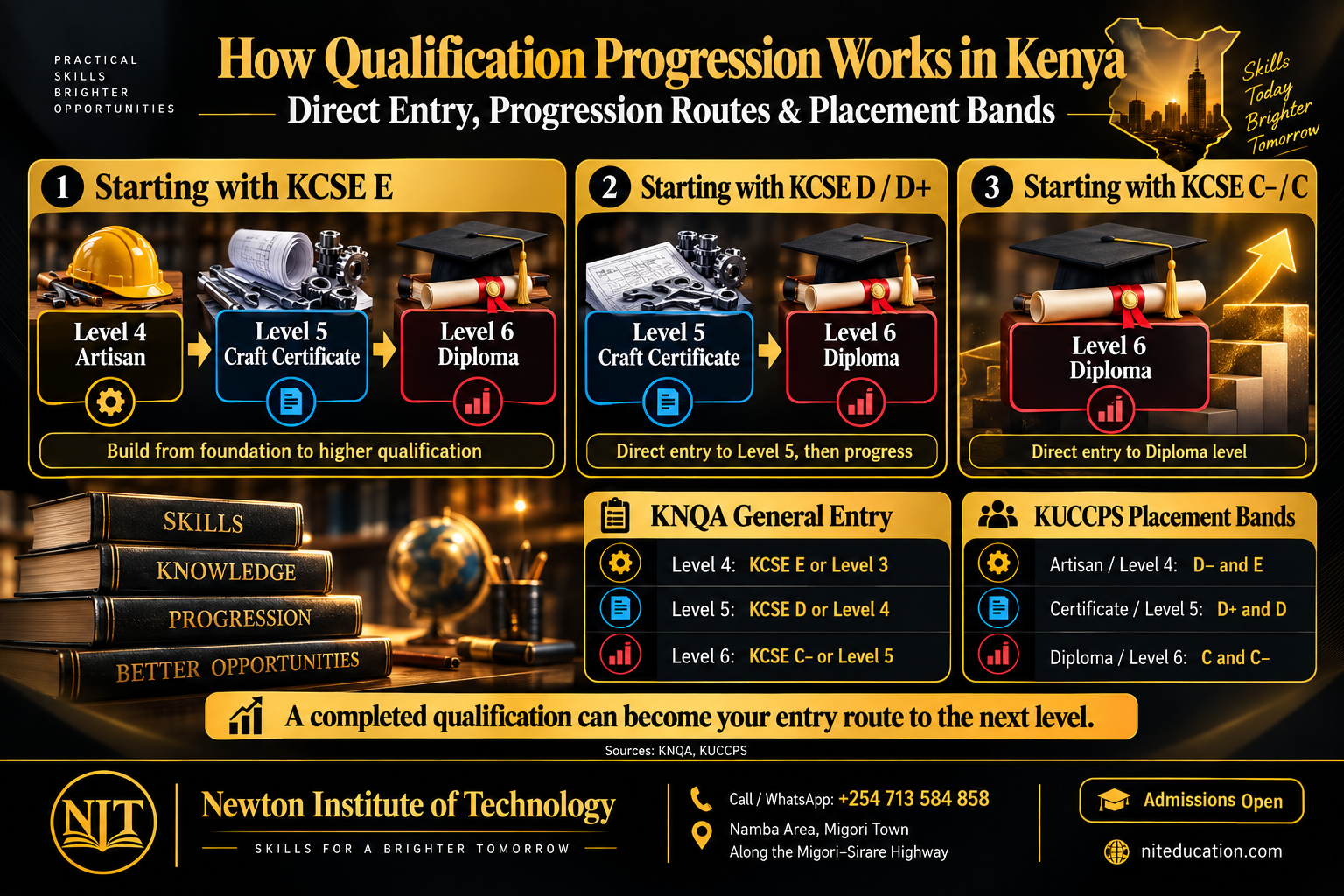
KNQA recognises Level 4 as an entry route into Level 5 and Level 5 as an entry route into Level 6. [1][2] [1] For the D Plain route specifically, see NIT’s D Plain to Diploma guide.
How Qualification Progression Works in Kenya
Two tables, one system
KNQA requirements vs KUCCPS placement bands
KNQA gives the general national qualification entry point, while KUCCPS groups applicants into placement bands for its application process.
| Qualification level | KNQA general entry | KUCCPS placement band |
|---|---|---|
| Level 4 / Artisan | KCSE E or Level 3 | D− and E |
| Level 5 / Certificate | KCSE D or Level 4 | D+ and D |
| Level 6 / Diploma | KCSE C− or Level 5 | C and C− |
A D− learner exceeds the Level 4 minimum of E; D+ exceeds the Level 5 minimum of D; and C exceeds the Level 6 minimum of C−. KUCCPS also requires applicants to meet the exact requirements of the programme selected. [1][3]
Use the exact qualification name
Craft Certificate means a formal Level 5 qualification
The word certificate appears across many different training routes. A Craft Certificate, however, has a specific place in this progression system: KNQF Level 5.
Kenya’s training landscape also includes Artisan qualifications, professional certificates, occupational qualifications, trade grades, institutional skills programmes, short courses and licensing-related training. TVETA’s course register separately identifies programme levels and examining bodies. [4]
Five details to confirm
Classify the course from its qualification—not its name alone
These five details make course comparison much more precise.
- Exact course name
- Qualification or credential awarded
- KNQF level, where applicable
- Assessment or examination body
- Next recognised progression step
Duration is one part of the picture
Use the qualification level to classify the course
Duration tells you how long you train. The qualification tells you what level you are studying.
KNQA publishes minimum durations and credit volumes for formal qualification levels, while qualification placement is based on learning outcomes and level descriptors. Two programmes can therefore have the same calendar length while following different qualification, professional or skills-training routes. [1][2] [1]
Course name → qualification or credential → level or assessment route → duration → progression.
Newton Institute of Technology demonstration
Three NIT programmes show why the training route matters
NIT offers practical programmes that follow different training, assessment and licensing structures. These examples show why a student should identify the exact route instead of assigning an Artisan, Craft or Diploma label from duration alone.
Then compare duration and practical training| NIT example | Training route | Current structure | What it demonstrates |
|---|---|---|---|
| Full-Stack Software Development | Practical ICT skills programme | 8 months + compulsory 3+ month attachment | Duration and KNQF qualification level are separate questions. |
| Hairdressing / Beauty Therapy / Cosmetology Grade III | NITA trade-grade route | 1 year including teaching terms and attachment | Trade grades use their own Grade III → Grade II → Grade I progression. |
| Plant Operator | Practical training linked to Category G licensing | 2 months; approximately 70% practical | Some vocational routes are organised around occupational competence and licensing. |
How to Choose the Right Training Route

Turn the comparison into a decision
How to choose the right level or training route
Start with the occupation or practical ability you want to learn.
For the formal ladder, compare your KCSE grade or existing qualification with Levels 4–6.
Check the exact qualification, level, assessment body, duration and practical component.
Where progression matters, know the qualification or occupational step that comes next.
| Question to ask | What the answer tells you |
|---|---|
| What is the exact course name? | The programme you are actually joining. |
| What qualification or credential will I receive? | The final training outcome. |
| What KNQF level is it? | Its formal position in the national framework, where applicable. |
| Who examines or assesses it? | The assessment route and awarding structure. |
| How much practical training is included? | How occupational competence will be built. |
| Is attachment included? | The workplace-experience component. |
| What can I progress to next? | How the course connects to a longer-term plan. |
Earlier starting point
Where KCPE fits into the qualification ladder
KNQA’s current framework places KCPE as an entry route to Level 3. Level 4 then accepts KCSE Grade E or Level 3. The formal pathway can therefore continue from Level 3 into Levels 4, 5 and 6. [1]
This article stays focused on the Level 4–6 comparison. Learners starting from KCSE E can use NIT’s Courses for KCSE E Students in Kenya guide for Level 4 options and progression.
Common questions
Artisan, Craft Certificate and Diploma: FAQs
Is Artisan lower than Craft Certificate?
Yes. Artisan Certificate is KNQF Level 4, while Craft Certificate is Level 5. [1]
Is Craft Certificate lower than Diploma?
Yes. Craft Certificate is Level 5 and National Diploma is Level 6. [1]
What KCSE grade is required for Artisan?
What KCSE grade is required for a Craft Certificate?
What KCSE grade is required for a Diploma?
Can a D Plain student progress to Diploma?
Yes. A relevant completed Level 5 qualification provides a recognised entry route to Level 6, subject to the receiving programme’s requirements. [1] See NIT’s D Plain to Diploma guide for the full route.
Is every certificate course a Craft Certificate?
No. Craft Certificate is specifically a Level 5 qualification. Kenya also has professional, occupational, trade, institutional and licensing-related training routes. [4]
The key difference to remember
Level 4 builds the foundation, Level 5 deepens technical competence, and Level 6 advances the specialisation
Your KCSE grade helps determine where you can enter directly. A completed relevant qualification can then become the entry route to the next level. [1]
Choose the work you want to learn → identify your correct entry point → confirm the exact qualification → understand where it leads next.
Build practical skills at NIT
Register at Newton Institute of Technology
Newton Institute of Technology offers practical training in ICT, Plant Operation, Driving, Hairdressing, Beauty Therapy, Cosmetology and related vocational skills. Admissions can explain the entry requirement, duration, fees, practical component, assessment route and attachment arrangements for the programme you choose.
Call / WhatsApp+254 713 584 858
LocationNamba Area, Migori Town · along Migori–Sirare Highway
Websiteniteducation.com
References
- Kenya National Qualifications Authority (KNQA). Frequently Asked Questions — KNQF Levels, Minimum Entry Requirements, Minimum Duration and Volume. Accessed 24 September 2026. knqa.go.ke/faq/
- Kenya National Qualifications Authority (KNQA). Kenya National Qualifications Framework — Level Descriptors. Accessed 24 September 2026. knqa.go.ke/qualifications-framework/
- Kenya Universities and Colleges Central Placement Service (KUCCPS). Placement — Minimum Requirements for Artisan, Certificate and Diploma Programmes. Accessed 24 September 2026. kuccps.net/placem
- Technical and Vocational Education and Training Authority (TVETA). TVET Courses Register — Course Levels and Examining Bodies. Accessed 24 September 2026. tveta.go.ke/tvet-courses/
- Newton Institute of Technology. Full-Stack Software Development Course. Current programme structure: 8 months institutional training plus compulsory industrial attachment of at least 3 months. Accessed 24 September 2026. niteducation.com/resources/full-stack-software-development-course/
- Newton Institute of Technology. NITA Hairdressing and Beauty Therapy Grades Explained. Grade III–II–I progression and NIT Grade III training structure. Accessed 24 September 2026. niteducation.com/resources/nita-hairdressing-and-beauty-therapy-grades-explained/
- Newton Institute of Technology. How Long Does a Plant Operator Course Take in Kenya? Current NIT duration, practical/theory balance and machine-package structure. Accessed 24 September 2026. niteducation.com/resources/plant-operator-course-duration-kenya/
Editorial review: Institutional / technical review by Engineer Simon Barongo, Newton Institute of Technology.