

NIT Progression Guide Kenya · 2026/2027
Artisan to Certificate
to Diploma in Kenya
Level 4 → Level 5 → Level 6
A practical guide to moving from an Artisan Certificate to a Craft Certificate and then a National Diploma through Kenya’s formal qualification progression route.
One connected qualification ladder
Can you progress from Artisan to Certificate to Diploma in Kenya?
Yes. The formal progression route is Artisan Certificate at KNQF Level 4 → National Craft Certificate at Level 5 → National Diploma at Level 6. Kenya’s current qualifications framework recognises completion of Level 4 as an entry route to Level 5 and KNQF Level 5 as an entry route to Level 6. [1]
Your KCSE result helps determine where you enter the ladder. The qualification you complete can open the next stage.
This matters for learners who do not qualify for direct Diploma entry after KCSE. Instead of treating the first qualification as the finishing point, you can build a connected route upwards—one recognised level at a time.
National qualification levels and general entry routes: [1]
Entry point vs progression
KUCCPS placement and KNQF progression answer different questions
KUCCPS placement bands show the broad TVET level a KCSE applicant can target through the placement system. KNQF progression rules show how a completed qualification can provide entry into the next level.
| KCSE / qualification | Starting or progression point | What comes next |
|---|---|---|
| D− or E | KUCCPS Artisan / Level 4 band | Complete an appropriate Level 4 qualification, then progress to Level 5. |
| D or D+ | KUCCPS Certificate / Level 5 band | Complete an appropriate Level 5 qualification, then progress to Level 6. |
| C− or C | KUCCPS Diploma / Level 6 band | Direct Level 6 placement route, subject to the programme’s published requirements. |
| Completed Level 4 | KNQF progression route | Can provide entry to Level 5. |
| Completed Level 5 | KNQF progression route | Can provide entry to Level 6. |
KUCCPS minimum placement bands: [3] KNQF qualification entry routes: [1]
Your KCSE grade helps establish where you can start. A completed recognised qualification can then become the entry route for the next stage.
Artisan to Certificate to Diploma: the full progression ladder
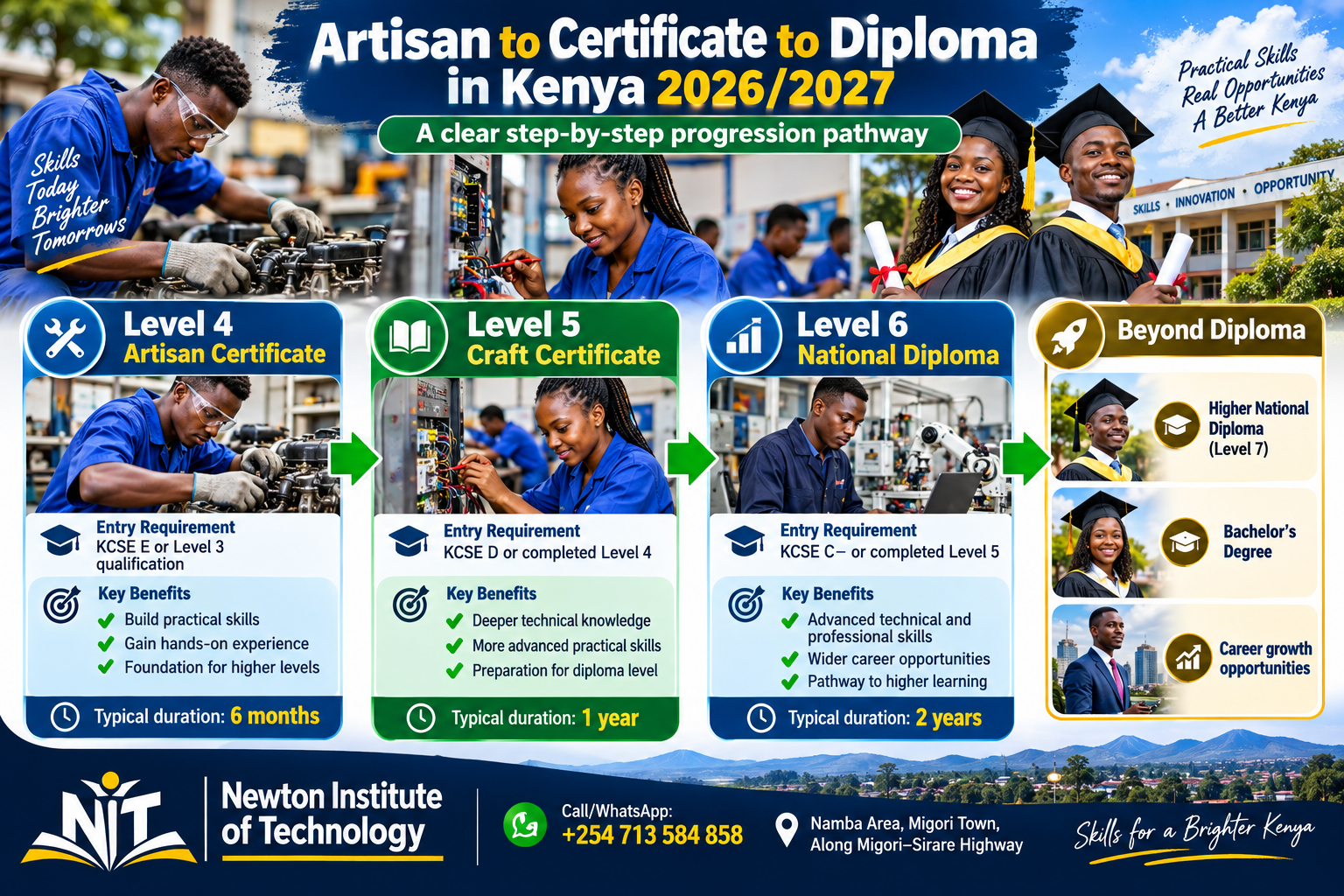
The connected qualification route
How Artisan → Certificate → Diploma progression works
The route is easiest to understand as three connected decisions rather than three unrelated courses.
An appropriate Level 4 qualification can provide entry into Level 5.
An appropriate Level 5 qualification can provide entry into Level 6.
Choose qualifications that fit the field and the intended next programme.
Identify the Diploma you want, then work backwards to the Certificate and Artisan entry route.
The 2025 KNQF General Regulations set out the Level 4, 5 and 6 admission routes, while KNEC lists Artisan, Craft Certificate, Diploma and Higher Diploma examinations and notes that successful candidates can proceed to the next stage or enter the job market. [1][4]
Three common starting positions
What the progression route looks like from different entry points
Starting with KCSE E or D−
Begin in the appropriate Level 4 route, complete it, then move into the connected Level 5 qualification and later the intended Diploma.
E / D− → Level 4 → Level 5 → Level 6Starting with KCSE D or D+
Begin at the appropriate Level 5 Certificate route, then progress to the accepted Level 6 Diploma after completing the qualification.
D / D+ → Level 5 → Level 6Already holding Level 4
Use the qualification you have already completed to identify the appropriate Level 5 route, then trace the intended Level 6 destination.
Level 4 → appropriate Level 5 → Level 6The national qualifications register shows this progression pattern in registered qualifications: Level 5 programmes can list completion of Level 4 among their entry routes, while Level 6 programmes can list KNQF Level 5. [6]
Where you can start—and how to move up
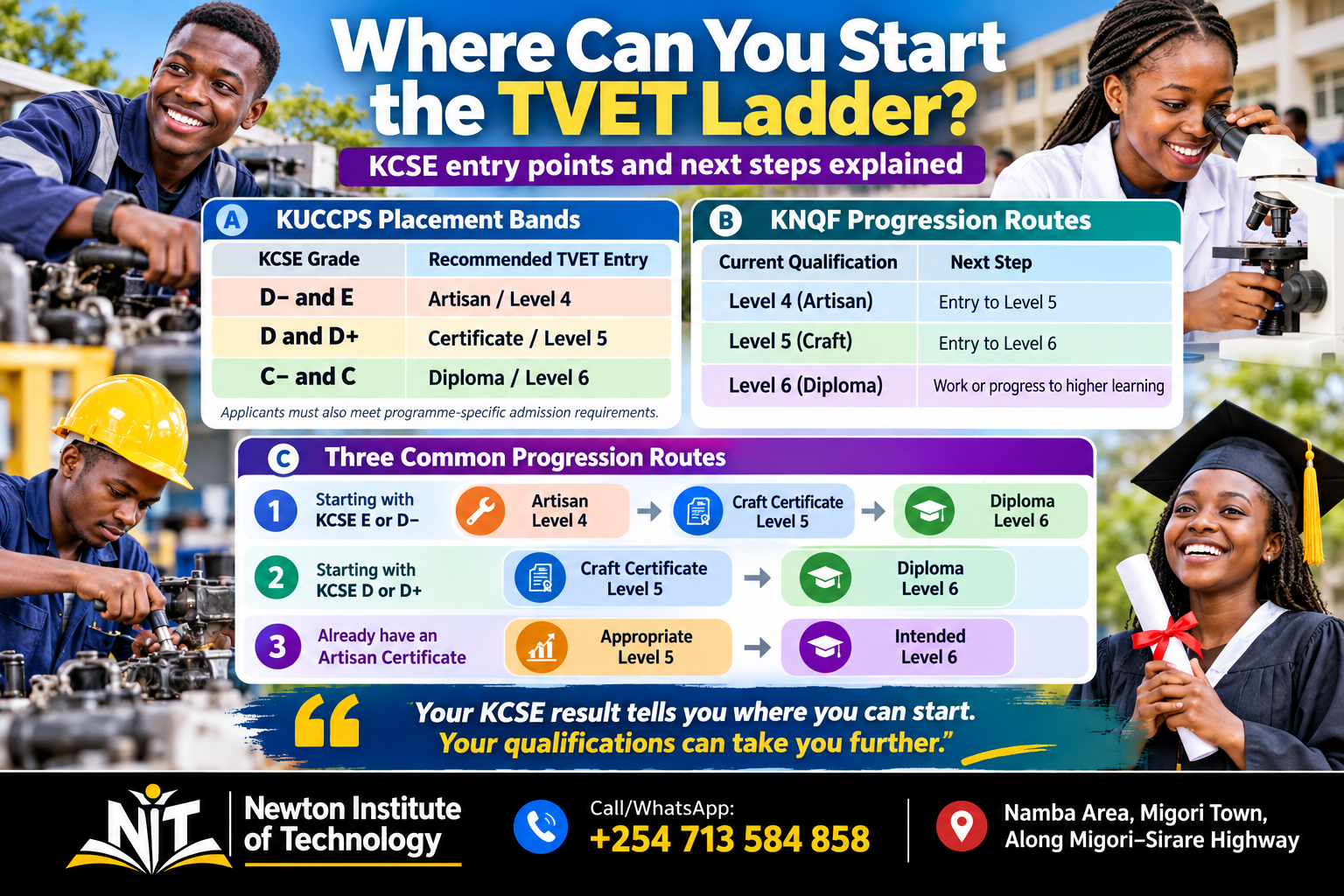
The bridge between Level 4 and Level 6
Can you move straight from Artisan to Diploma?
For the standard qualification-progression route, Level 5 is the bridge between Level 4 and Level 6. The national framework provides Level 4 as an entry route to Level 5 and Level 5 as an entry route to Level 6. [1]
Artisan builds the Level 4 qualification. Craft Certificate builds the Level 5 qualification. The completed Level 5 qualification then creates the progression route into the appropriate Level 6 Diploma.
Build the next qualification
Do you need to repeat KCSE before progressing?
The qualification route allows progression without repeating KCSE simply to improve the original mean grade. Once you successfully complete the appropriate Level 4 qualification, that qualification can provide entry into Level 5. After completing the appropriate Level 5 qualification, Level 5 can provide entry into Level 6. [1]
This is why a learner who starts lower on the qualification ladder can still build towards Diploma level.
Keep the route connected
Can you change fields or colleges while progressing?
For the smoothest progression, choose a Level 5 qualification that aligns with the Level 6 programme you intend to pursue. The receiving programme’s published entry requirements show which prior qualifications it accepts.
Kenya’s Credit Accumulation and Transfer System also supports inter-institutional, programme-to-programme and level-to-level mobility. This means learners can move between institutions and qualification routes within the national framework while preserving a clear progression plan. [5]
Two related processes
Progression is different from credit transfer
Can I enter the next qualification?
- Your completed qualification provides an accepted route into the next level.
- Level 4 can provide entry to Level 5.
- Level 5 can provide entry to Level 6.
Can previous learning count towards the new award?
- Eligible credits may be recognised towards another qualification.
- KCATS governs accumulation, transfer and learner mobility.
- The credit decision is separate from the basic entry route.
KNQA describes KCATS as the framework for accumulating and transferring credits and for progression between courses, institutions and qualification levels. [5] For the detailed Level 5-to-Level 6 credit discussion, see NIT’s D Plain to Diploma guide.
Minimum national benchmarks
How long can the Level 4 → Level 5 → Level 6 route take?
| Qualification | KNQF level | Minimum duration benchmark | Progression position |
|---|---|---|---|
| Artisan Certificate | Level 4 | 6 months | Can progress to Level 5 |
| Craft Certificate | Level 5 | 1 year | Can progress to Level 6 |
| National Diploma | Level 6 | 2 years | Work or progress to higher learning |
KNQA minimum-duration framework: [2]
Actual programme structures can extend beyond these national minimums. The useful planning idea is to treat each stage as a qualification milestone with its own work and progression value.
Progress at your pace
Can you work before moving to the next level?
Yes. KNEC states that successful candidates in its business and technical qualifications can proceed to the next stage or join the job market. [4]
The ladder can continue
What comes after the National Diploma?
KNQF Level 6 can lead into higher qualifications. The 2025 regulations identify KNQF Level 6 among the entry routes to Level 7 qualifications, which include bachelor’s degrees and other qualifications classified at that level. [1]
The longer pathway can therefore extend beyond Diploma level when that fits your career and education plan.
Work backwards from the destination
Four questions to answer before you enrol
Define the occupational or career direction first.
Choose the Diploma destination before choosing the earlier stage.
Identify the Certificate qualification accepted for entry.
If yes, choose the Artisan qualification that connects to the Level 5 route.
Current qualification → next recognised qualification → intended Diploma.
Choose the destination first, then trace the qualifications backwards

Newton Institute of Technology
Start with the skill and the destination
At Newton Institute of Technology, course planning starts with the work a learner wants to do and the practical skills required to do it well. For a learner following the formal TVET progression ladder, the same principle applies: know the intended qualification and the next step before enrolling in the current one.
NIT’s practical training areas include ICT and technology, Plant Operation, Driving, Hairdressing, Beauty Therapy, Cosmetology and other skills routes. The institute’s Full-Stack Software Development programme, for example, combines institutional training with compulsory industrial attachment and project work. [7]
and where you want it to take you nextProgression checklist
Before you start the first level
A five-point check keeps the pathway connected from the beginning.
- Write down the exact qualification you want to reach.
- Confirm the qualification level you currently qualify to enter.
- Identify the next recognised qualification before enrolling.
- Keep your certificates, results and academic records organised.
- Ask the receiving institution how your completed qualification is used for admission or credit recognition.
Common questions
Artisan to Certificate to Diploma: FAQs
Can I progress from an Artisan Certificate to a Diploma in Kenya?
Yes. The standard qualification route is Artisan Level 4 → Craft Certificate Level 5 → National Diploma Level 6. [1]
Can someone with KCSE E eventually get a Diploma?
Yes. KCSE E is a general entry route to Level 4. After completing the appropriate Level 4 qualification, the learner can progress to Level 5 and then use the appropriate Level 5 qualification to enter Level 6. [1]
Can a D Plain student progress to Diploma level?
Can I skip the Certificate stage after Artisan?
For the standard qualification-progression route, Level 5 is the bridge between Level 4 and Level 6. [1]
Do I need to repeat KCSE to move from Artisan to Certificate?
No. Completion of an appropriate Level 4 qualification can itself provide an entry route to Level 5. [1]
Can I change colleges while progressing?
Yes. KNQA’s KCATS framework supports inter-institutional and level-to-level mobility. [5]
Does completing a Certificate automatically shorten the Diploma?
Progression and credit transfer are separate. Level 5 can provide the entry route to Level 6, while eligible credit recognition is handled through KCATS. [5]
Can I work after Artisan or Certificate before continuing?
Yes. KNEC states that successful candidates can proceed to the next stage or join the job market. [4]
The progression principle
Your starting grade is not your finishing point
KCSE establishes an initial entry point. Completed qualifications can then move you up the formal ladder: Level 4 into Level 5, and Level 5 into Level 6. [1]
Choose the destination first → trace the qualifications backwards → begin from the level you qualify for today.
Plan your next practical training step
Speak with Newton Institute of Technology
Tell Admissions the work you want to learn and the training route you are considering. The team can explain the current NIT programme structure, practical component, duration, fees and attachment arrangements for the course you choose.
Call / WhatsApp+254 713 584 858
LocationNamba Area, Migori Town · along Migori–Sirare Highway
Websiteniteducation.com
References
- Kenya National Qualifications Authority (KNQA). The Kenya National Qualifications Framework (General) Regulations, 2025. Level 4, Level 5, Level 6 and Level 7 qualification types and minimum admission routes. Accessed 24 September 2026. KNQF General Regulations 2025.
- Kenya National Qualifications Authority (KNQA). Frequently Asked Questions. KNQF levels, minimum entry requirements, duration benchmarks and KCATS guidance. Accessed 24 September 2026. knqa.go.ke/faq/.
- Kenya Universities and Colleges Central Placement Service (KUCCPS). Placement — Applicant Eligibility and Minimum Requirements. Diploma/Level 6: C and C−; Certificate/Level 5: D+ and D; Artisan/Level 4: D− and E. Accessed 24 September 2026. kuccps.net/placem.
- Kenya National Examinations Council (KNEC). Business & Technical Examinations. Artisan, Craft Certificate, Diploma and Higher Diploma examination levels and progression to the next stage or job market. Accessed 24 September 2026. knec.ac.ke/services/business-exams/.
- Kenya National Qualifications Authority (KNQA). Kenya Credit Accumulation and Transfer System (KCATS). Credit accumulation, inter-institutional transfer and vertical, horizontal and diagonal mobility. Accessed 24 September 2026. KNQA KCATS.
- Kenya National Qualifications Authority (KNQA). National Qualifications Register — registered Level 4, Level 5 and Level 6 qualification examples. The register includes Level 5 qualifications accepting completed KNQF Level 4 and Level 6 qualifications accepting KNQF Level 5. Accessed 24 September 2026. KNQA qualification-register example.
- Newton Institute of Technology. Full-Stack Software Development Course. Current institutional training, compulsory industrial attachment and project-based learning structure. Accessed 24 September 2026. niteducation.com/resources/full-stack-software-development-course/.
Editorial review: Institutional / technical review by Engineer Simon Barongo, Newton Institute of Technology.