

NIT Career Guide Kenya · 2026/2027
Skills for Local, Remote
and International Jobs
Kenya · remote · overseas
A practical guide to choosing a skill that can create opportunities in Kenya, online from Kenya and in international employment markets.
One practical skill · three markets
Which skills for international jobs from Kenya also work locally and remotely?
Strong options include software development, data analysis and AI applications, cybersecurity and networking, digital marketing and design, finance and business operations, electrical and construction trades, transport and logistics, plant operation, care work, hospitality and personal services. Match the skill to where the work is done, the evidence an employer can inspect and any licence or qualification required by the destination.
Be able to produce a result another person needs.
Work clearly with people, systems and information.
Show projects, records, practical tests or verified experience.
Choose a course by matching the skill to a real job market: where the work is done, what employers inspect and what must be added before the skill crosses a border.
A Kenyan software developer can deliver a web application to a client abroad without leaving home. A plant operator, electrician, nurse or chef takes the skill to the worksite. Both routes are international; only one is remote.
This guide compares those routes side by side. For employment, freelance and business opportunities inside Kenya, use NIT’s Most Employable Skills in Kenya guide. [9] Here, the focus is how skills move between Kenyan jobs, remote work from Kenya and employment abroad.
Start with the route
Local, remote and international jobs are three different markets
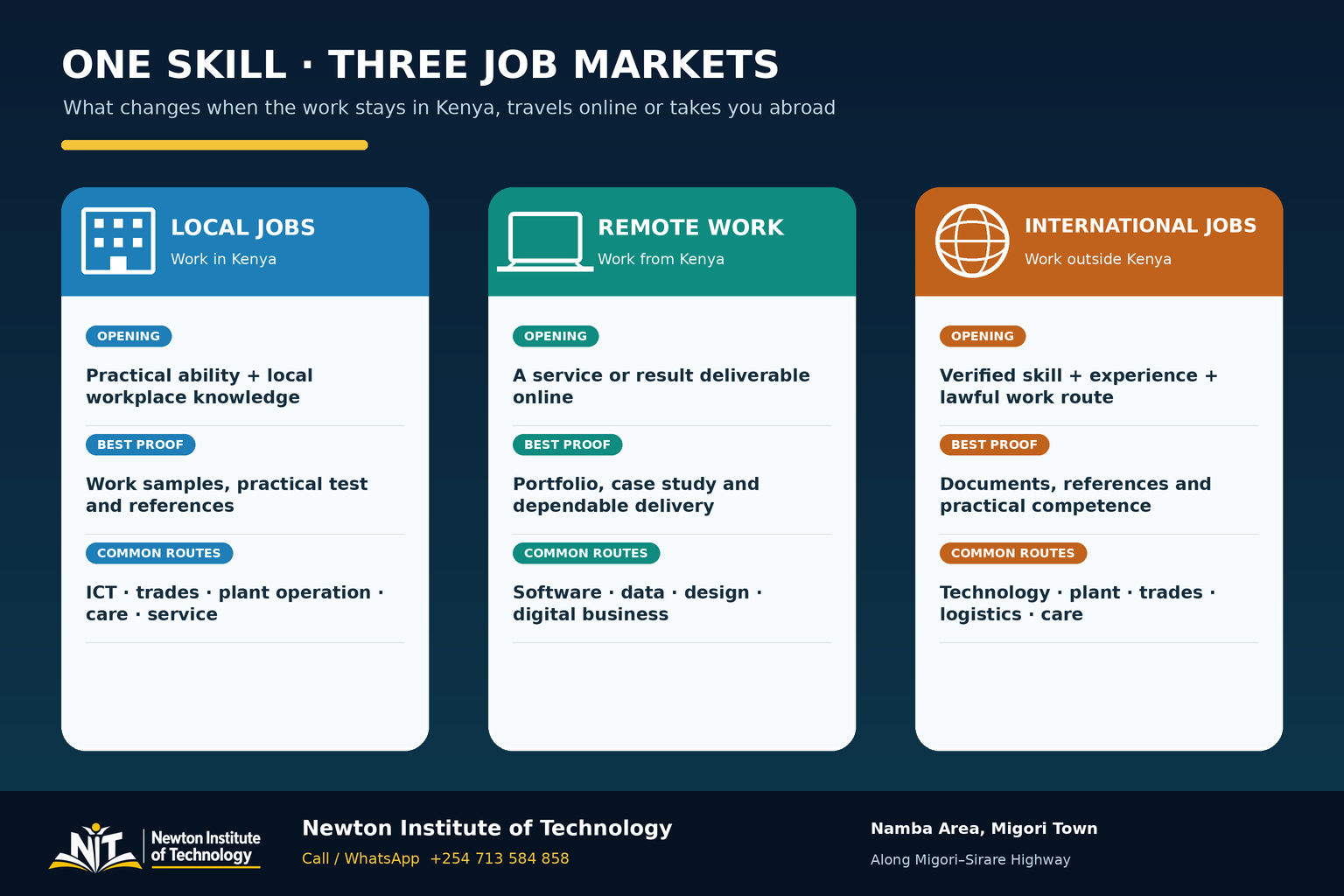
One core skill can reach more than one market. What changes is the work setting, the evidence requested and the entry process.
Employers and customers look for practical ability, reliability, local workplace knowledge and the qualifications or licences attached to the occupation.
The work must be deliverable online. A portfolio, written communication, self-management, secure digital practice and dependable delivery become central.
Practical skill must be combined with verified experience, recognised documents, destination requirements and lawful permission to work.
For remote work, choose a digitally deliverable service. For overseas relocation, choose an on-site occupation with documented competence and a recognised entry route. For a skill that serves more than one market, build proof that every employer can inspect.
Visual guide · three routes
One skill, three job markets
Kenyan and global evidence
What current labour-market evidence says about useful skills
Kenyan employer evidence and global forecasts point in the same direction: technical ability matters, but it becomes stronger when combined with communication, judgement and continuous learning.
Highest career-field demand in the FKE survey.
Average share of current skills expected to change by 2030.
Identified as essential by 7 in 10 surveyed employers.
The Federation of Kenya Employers survey covered 521 enterprises. Information technology led reported career-field demand at 28.4%, followed by finance and business management at 27.4%, engineering at 19.2%, and transport, distribution and logistics at 18.6%. Employers also highlighted effective communication, critical thinking, teamwork and time management. [1]
Kenya’s Labour Market Information System shows that trade and repair, manufacturing and food services are important sources of opportunity in the informal economy, while employers in that market value financial, record-keeping, marketing and managerial ability. [2]
Globally, the World Economic Forum identifies AI and big data, networks and cybersecurity, and technological literacy as the three fastest-growing skill areas. It also expects significant growth in frontline, construction, care, education, software and green-transition roles. [3]
The OECD’s 2026 skills-first report explains why demonstrable competence is becoming more important alongside qualifications: employers need clearer evidence of what a person can do, while workers need practical ways to make their skills visible and portable. [4]
For NIT’s broader interpretation of employment structure, sector demand and labour-market evidence, continue to Kenya Job Market Trends 2026. [10]
Side-by-side career map
Skills and the markets they can serve
| Skill area | Local route | Remote route | International route | Useful proof |
|---|---|---|---|---|
| Software development | Business systems, websites, applications and ICT teams | Web, application and maintenance projects delivered online | Developer and application-support roles | Deployed systems, source control and project explanations |
| Data analysis and AI applications | Reporting, dashboards, operations and decision support | Data cleaning, analysis, dashboards and automation | Analyst, data and AI-enabled business roles | Accurate datasets, dashboards, notebooks and case studies |
| Cybersecurity, networking and cloud | ICT support, networks, systems and security operations | Selected monitoring, support, audit and cloud tasks | Infrastructure, support and security roles | Labs, network diagrams, secure configurations and incident write-ups |
| Digital marketing, design and media | Campaigns, content, brand support and customer acquisition | Design, content, advertising and analytics projects | Marketing and creative roles where portfolio quality transfers | Campaign results, design portfolio and analytics reports |
| Finance and business operations | Bookkeeping, records, stock, administration and customer operations | Selected bookkeeping, reporting and virtual operations work | Business-support roles matched to accepted qualifications | Reconciliations, reports, process records and verified experience |
| Electrical, solar and construction trades | Installation, maintenance, repair and site work | On-site work supported by digital design, quoting and reporting | Technical and construction roles after skills recognition | Trade tests, safe completed work and employment records |
| Transport and logistics | Driving, warehousing, dispatch, fleet support and supply-chain operations | Selected planning, coordination, tracking and documentation roles | Driving, warehousing and logistics roles after meeting destination requirements | Licences where required, dispatch records, stock accuracy and experience |
| Plant operation and heavy equipment | Construction, roadworks, agriculture, quarrying and material handling | On-site operation supported by digital planning, inspection and reporting | Operator roles reached through relocation, verified experience and destination assessment | Machine-specific practical assessment, licence, inspection logs and safe operating evidence |
| Care, hospitality and personal services | Health support, care, hotels, food service, salons and spas | On-site service with selected planning, booking and support tasks online | On-site care, hospitality and personal-service opportunities | Recognised training, hygiene and safety practice, client work and experience |
On a phone, swipe the table sideways to view every column.
Digital work crosses borders through online delivery. Physical work crosses borders with the worker, supported by verified competence, recognised documents and destination approval.
Work that can travel online
1. Digital skills with local, remote and international reach
Software development
Learn to build working websites, applications and business systems. A strong portfolio shows working code, clear project decisions and maintainable systems.
Data analysis and AI
Start with clean data, spreadsheets, SQL, visualisation and problem definition. Use AI to strengthen a defined workflow, analysis or product, supported by clean data and sound judgement.
Cybersecurity and infrastructure
Build foundations in operating systems, networking, secure configuration and troubleshooting. Labs and documented problem-solving make security knowledge easier to assess.
Digital marketing and design
Connect creative work to an outcome: a clear message, qualified enquiries, bookings, sales or useful audience growth. Show the brief, the work, the measurement and what you improved.
The International Labour Organization’s study of digital labour platforms in Kenya documents online, location-based and hybrid platform work across multiple sectors. Remote opportunity is therefore wider than one occupation, but each role still needs a specific deliverable and credible proof. [5]
For a remote application, show one complete piece of work and explain it in plain language: the brief, the tools, the decisions, the result and how you handled feedback. State your working hours, response time and the collaboration tools you can use.
For a deeper technical breakdown, continue to NIT’s ICT Skills Employers Want in Kenya guide. [11]
Skills that travel with the worker
2. Technical and service skills for local and overseas work
Many globally useful skills travel with the worker. Infrastructure, machines, goods and people need competent professionals on location.
Electrical, solar and construction trades
Electricians, solar technicians, welders, plumbers, carpenters and other artisans create, install and maintain physical systems. Safe practical work, measurements, testing and trade evidence matter.
Strong proof: completed work, trade competence and safe procedures.
Transport and logistics
Drivers, warehouse teams, dispatch staff and fleet-support workers keep people, goods and records moving. Some planning and coordination tasks can be digital, but most operations remain site based.
Strong proof: the correct licence where required, accurate records and reliable experience.
Plant operation and heavy equipment
Plant operators work with excavators, graders, loaders, rollers, forklifts and other machines in construction, roadworks, agriculture, quarrying, manufacturing and material handling. The work is on site, so international opportunity follows a relocation route.
Strong proof: machine-specific practical ability, inspection routines, safe operation, licences and documented experience.
Care, hospitality and personal services
Care workers, hospitality staff, cooks, hairdressers and beauty professionals work directly with people. Consistency, hygiene, communication and recognised occupational preparation strengthen mobility.
Strong proof: client work, practical experience and recognised preparation.
Plant operation deserves its own pathway because operating heavy equipment is different from coordinating transport or warehouse work. NIT’s current Heavy Equipment Operator Programme is listed as two months full-time, while its plant operator training guide describes a learning balance of approximately 70% practical and 30% theory. Learners build inspection, control, communication and safety habits before taking those skills into attachment and work. [13]
Global forecasts expect large absolute growth in construction, delivery, food processing and care roles, alongside growth in technology occupations. International opportunity spans both technology and work performed on sites, in facilities and with clients. [3]
Visual comparison · nine skill groups
Which job routes fit each skill?

Make ability visible
What employers need to see before they trust the skill
A qualification starts the conversation. Work samples, tests, logs and verified experience help the employer judge readiness. Match the proof to the occupation.
Digital portfolio
Deployed software, dashboards, designs, campaign reports, lab work or written case studies.
Practical demonstration
A supervised task, skills test, equipment operation, installation, repair or client service.
Workplace evidence
Attachment records, references, job descriptions, completed assignments and responsibility logs.
Clear explanation
Describe the problem, your decisions, the standard followed, the result and what you learned.
The OECD describes skills signalling as a central part of a skills-first labour market. For a learner, the useful habit is to organise evidence during training, while the tasks and feedback are still fresh. [4]
Industrial attachment is especially useful because it gives a learner real situations to discuss: receiving instructions, meeting deadlines, handling feedback, solving problems and following workplace procedures. See NIT’s guide to ICT industrial attachment in Kenya. [12]
The multiplier skills
Communication, judgement and reliability make technical skill usable
Technical skill becomes more valuable when the worker communicates clearly, meets deadlines and can explain the work. These abilities travel across nearly every occupation:
- Communication: understand instructions, ask useful questions and report progress or problems clearly.
- Analytical thinking: separate symptoms from causes, check evidence and choose a sensible next action.
- Reliability: arrive or connect on time, complete agreed work and keep accurate records.
- Teamwork: coordinate with colleagues, clients, supervisors and specialists without losing responsibility for your part.
- Digital working: use documents, spreadsheets, email, collaboration tools and secure file practices appropriate to the role.
- Learning ability: update tools and methods as technology, standards and employer needs change.
Together, these abilities make occupational skill usable in a real organisation. FKE’s employer evidence and the World Economic Forum’s global findings both place communication, analytical thinking, resilience and adaptability alongside technical competence. [1][3]
When the job crosses a border
Add recognition, documents and a lawful employment route
An overseas application has two parts: proof that you can do the job and proof that you can take it up legally. Build both at the same time.
Career evidence an employer can verify
Career evidence
- Relevant training and assessment records
- Portfolio or practical work evidence
- Employment letters and references
- Clear CV matched to the occupation
- Language ability required for the workplace
A ready and lawful employment route
Employment route
- Verified employer or licensed recruitment channel
- Written contract and official attestation process
- Destination qualification recognition where applicable
- Correct passport, visa and work authorisation
- Pre-departure preparation and documented terms
Kenya’s Department of Labour states that a foreign job contract must be authenticated by a Labour Officer before a Kenyan travels to take up the appointment. The State Department for Diaspora Affairs also provides an official register for checking whether a recruitment agency is licensed by the National Employment Authority. [6][7]
Recognition is occupation- and destination-specific. For example, the European Commission explains that a third-country national who wants to work in a regulated profession must follow the recognition procedure in the country of destination. [8] Build this check into the plan early, especially for health, engineering, electrical, driving and other licensed work.
Choose for the work
Five questions that reveal whether a skill fits you
Name the system, report, installation, repair, operation or service you should perform.
Decide whether the role is local, digitally deliverable, based overseas or available through more than one route.
Identify the portfolio, practical test, licence, attachment or experience record expected.
Map foundation skills, specialist training, supervised practice and the first realistic role.
List the tools, standards, licences or methods that will need continuing development.
If you are still comparing fields, use NIT’s guide to choosing the right skill to learn in Kenya. It focuses on personal fit and training decisions; this article focuses on the markets the skill can serve.
A route you can act on
Six steps from learning to job-ready evidence
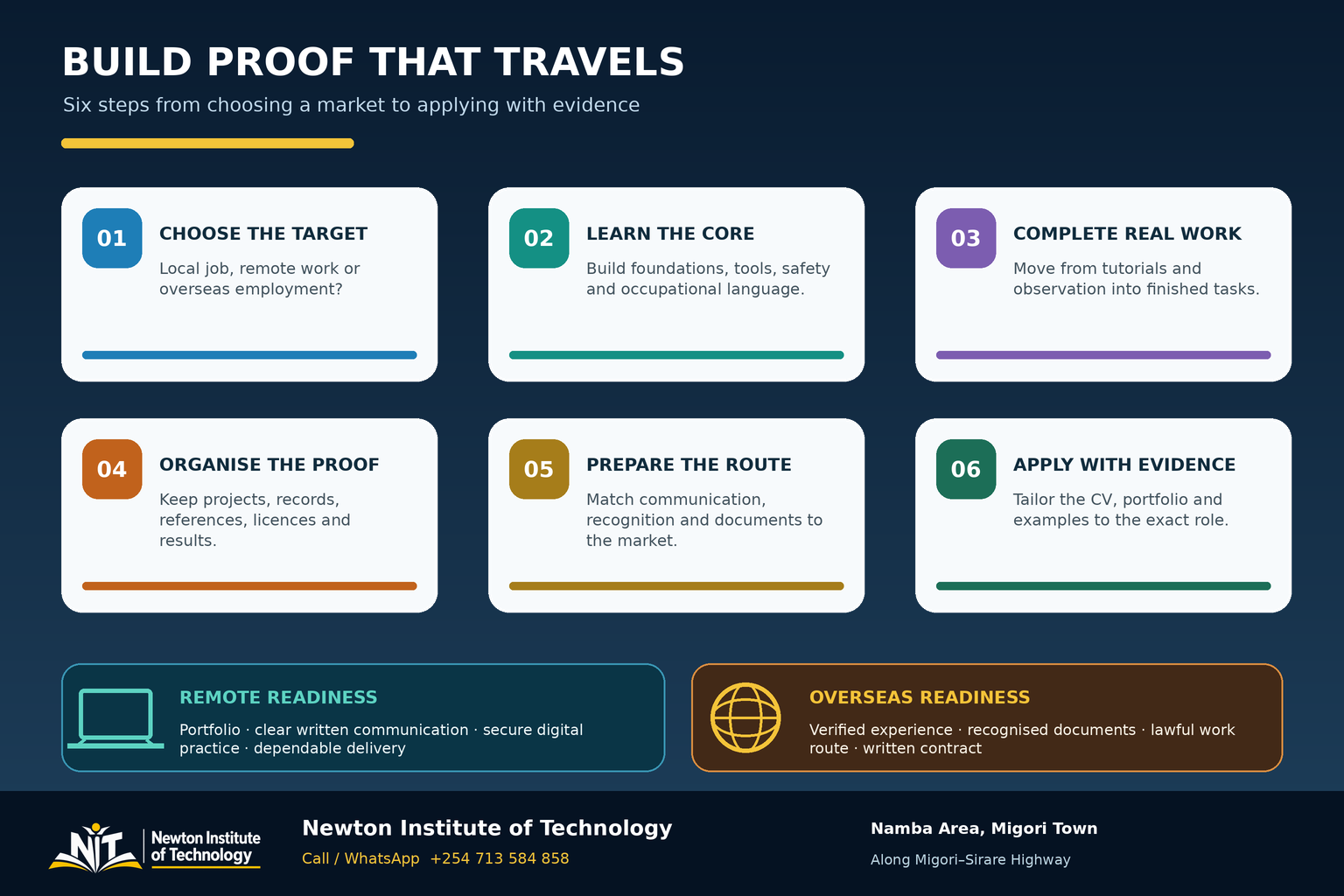
- Choose the market: define whether your first target is Kenyan employment, remote work from Kenya or overseas employment.
- Build the foundation: learn the core concepts, tools, safety practices and language of the occupation.
- Complete real tasks: move beyond tutorials and observation into supervised practice and finished work.
- Package the proof: organise projects, practical records, references, licences and clear explanations.
- Prepare for the route: strengthen communication, match destination requirements and arrange the correct documents.
- Apply with evidence: tailor the CV, portfolio and examples to the specific role so every application speaks directly to the employer’s need.
Set a goal beyond course completion: finish with a body of work that another person can inspect, test and trust.
Visual action plan · six steps
Build proof that travels
Newton Institute of Technology
Build a skill around work you can demonstrate
Newton Institute of Technology approaches practical training through visible performance: build the system, analyse the data, configure the network, operate the machine, complete the service or demonstrate the procedure correctly.
NIT training areas include Full-Stack Software Development, Cybersecurity, Data Science and Analytics, Artificial Intelligence, Mobile App Development, networking and other ICT routes; Plant Operation, Forklift and Driving; and Hairdressing, Beauty Therapy, Cosmetology and focused personal-service courses. Plant Operation is a distinct hands-on route built around machine inspection, coordinated control, safe working habits and practical evidence. The useful starting point is the work you want to perform and the market you want that work to serve.
then show what you can doBefore enrolment
Ask what you will be able to show
A useful course should lead to visible competence.
- Which practical tasks will I perform myself?
- Which finished projects or work records will I keep?
- How is competence assessed?
- Does the route include attachment, supervised practice or client work?
- Which local, remote or international roles match the training?
Direct answers
Skills for local and international jobs: FAQs
Which skill is best for both local and international jobs?
Software development, data analysis, cybersecurity, technical trades, logistics, care and hospitality can all serve more than one market. The best choice is the one you can perform well, prove clearly and match to the requirements of the target role.
Which skills can I use for remote work from Kenya?
Common digitally deliverable routes include software and web development, data analysis, selected cybersecurity and cloud tasks, digital marketing, design, content work, bookkeeping and virtual business operations. Each requires a specific service, reliable delivery and verifiable work samples.
Can plant operation lead to international work?
Yes. Plant operation is an on-site skill that can support overseas employment when the operator has practical competence, documented experience and the licence or assessment required by the destination.
Do international employers accept Kenyan certificates?
Acceptance follows the occupation, employer and destination rules. Employers can assess non-regulated roles through skills and experience; regulated professions follow the destination authority’s recognition process.
Do I need experience before applying for an overseas job?
Verified experience strengthens an application because it shows that the skill has been used in a real workplace. Keep employment letters, attachment records, task descriptions, references and practical evidence organised from the beginning.
Is a certificate enough for a remote job?
A certificate supports the application, but remote employers and clients also need evidence that you can deliver independently. A focused portfolio, clear communication and completed work are especially important.
How can I verify an overseas recruitment agency in Kenya?
What should a beginner learn alongside the main skill?
Add communication, basic digital working, problem-solving, record keeping, time management and the ability to explain completed work. These multiplier skills make occupational competence easier to use and trust.
The principle to carry forward
Build one skill deeply enough to create more than one route
A useful skill should leave you able to produce a visible result. A portable skill adds something more: the result can be delivered online, recognised in another labour market or performed to a standard that an overseas employer can verify.
Choose the market → learn the core skill → complete real work → organise the proof → meet the route requirements → apply with evidence.
Related NIT career guides
Choose a practical starting point
Register at Newton Institute of Technology
Tell Admissions the work you want to do and whether your first target is a Kenyan job, remote work, self-employment or a longer-term international route. The team can explain the current NIT programme structure, practical training, duration, timetable and attachment arrangements for the course you choose.
Call / WhatsApp+254 713 584 858
LocationNamba Area, Migori Town · along Migori–Sirare Highway
LandmarkAbout 0.3 km opposite Rubis Filling Station
Websiteniteducation.com
References and further reading
- Federation of Kenya Employers (FKE). Skills Needs Survey Report. Survey of 521 enterprises covering career-field demand, TVET demand and social skills. Published 27 November 2023; accessed 27 September 2026. fke-kenya.org.
- Kenya Labour Market Information System, Ministry of Labour and Social Protection. Informal Sector Skills Survey. Employment activities, occupations and preferred skills in Kenya’s informal economy. Accessed 27 September 2026. labourmarket.go.ke.
- World Economic Forum. The Future of Jobs Report 2025. Global employer findings on changing skills, growing roles and workforce transformation through 2030. Published 7 January 2025; accessed 27 September 2026. weforum.org.
- Organisation for Economic Co-operation and Development (OECD). A Skills-First Labour Market. Skills development, signalling, recognition and skills-first hiring. Published 18 June 2026; accessed 27 September 2026. oecd.org.
- International Labour Organization. Digital Labour Platforms in Kenya: Exploring Women’s Opportunities and Challenges Across Various Sectors. Online, location-based and hybrid platform work in Kenya. Published 20 March 2024; accessed 27 September 2026. ilo.org.
- State Department for Labour and Skills Development. Foreign Contracts of Service / Attestation. Official authentication process for foreign job contracts before travel. Accessed 27 September 2026. labour.go.ke.
- State Department for Diaspora Affairs. Verify Licensed Recruitment Agencies. Official verification against the National Employment Authority register. Updated 18 May 2026; accessed 27 September 2026. diaspora.go.ke.
- European Commission, Directorate-General for Employment, Social Affairs and Inclusion. Information for Third-Country Nationals: Recognition of Professional Qualifications. Destination-country recognition process for regulated professions in the European Union. Accessed 27 September 2026. ec.europa.eu.
- Newton Institute of Technology. Most Employable Skills in Kenya 2026. Kenyan employment, freelance, contract and business routes. Accessed 27 September 2026. niteducation.com/resources/most-employable-skills-in-kenya/.
- Newton Institute of Technology. Kenya Job Market Trends 2026. Interpretation of employment structure, employer demand and labour-market evidence. Accessed 27 September 2026. niteducation.com/resources/kenya-job-market-trends-2026/.
- Newton Institute of Technology. ICT Skills Employers Want in Kenya in 2026. Technical foundations, workplace judgement and portfolio evidence for ICT candidates. Accessed 27 September 2026. niteducation.com/resources/ict-skills-employers-want-kenya/.
- Newton Institute of Technology. ICT Industrial Attachment in Kenya. Placement preparation, workplace learning and evidence gained during attachment. Accessed 27 September 2026. niteducation.com/resources/ict-industrial-attachment-in-kenya/.
- Newton Institute of Technology. Plant Operator Training and Technical Programmes. Current heavy-equipment programme duration, practical training balance, machine-operation skills, safety routines and worksite preparation. Accessed 27 September 2026. niteducation.com/courses/plant-operator; niteducation.com/resources/best-plant-operator-school-in-kenya/.
Prepared by: Newton Institute of Technology Editorial Team · Institutional / technical review: Engineer Simon Barongo · Updated: 27 September 2026.