

NIT Plant Operator Training Kenya · 2026
Best Plant Operator School
in Kenya
Practical training · Category G pathway · attachment
A clear look at how Newton Institute of Technology organises its two-month plant-operator course in Migori, from machine practice and package choice to licensing preparation and attachment.
Training should build operating competence
Why is NIT a strong choice for plant operator training in Kenya?
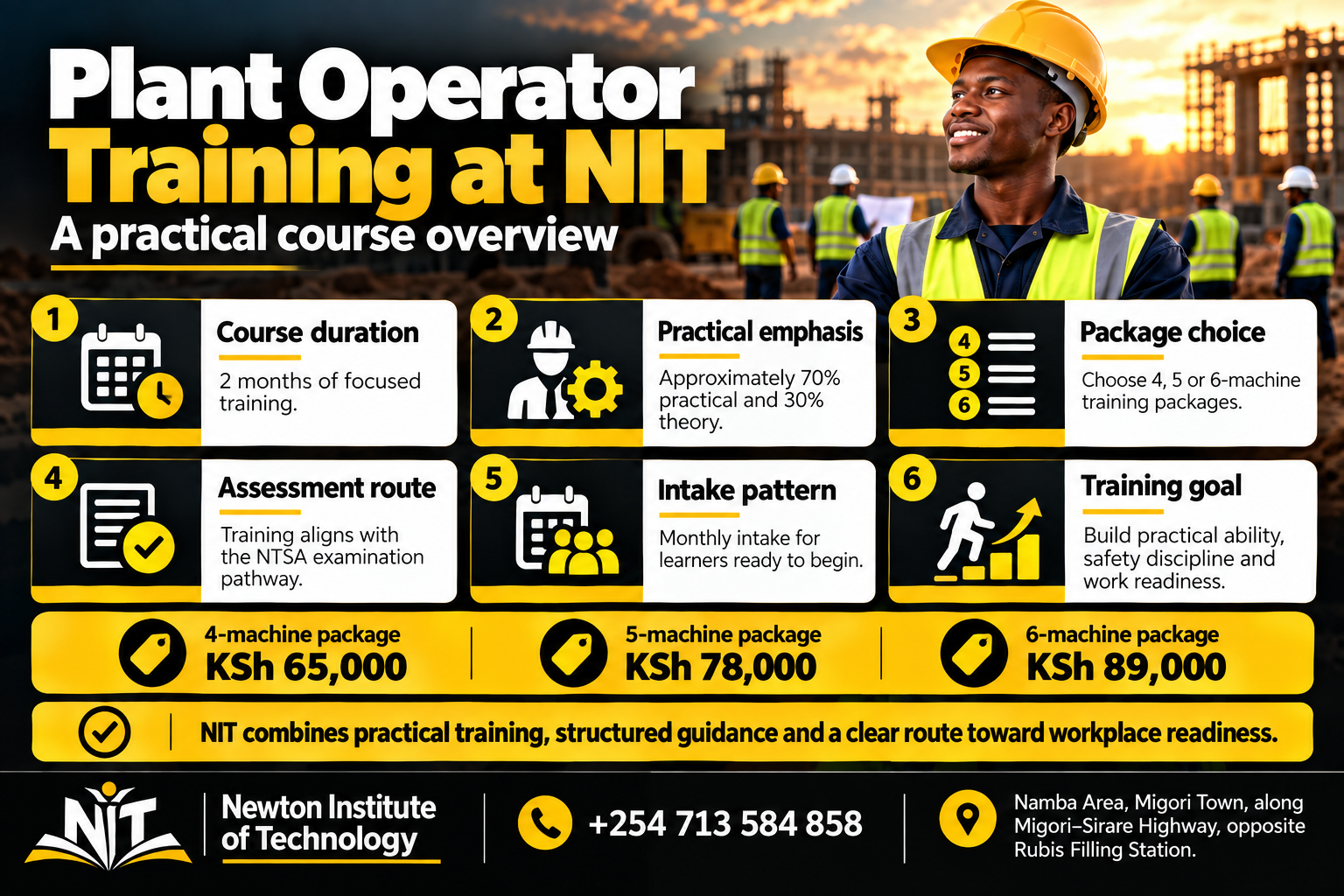
At Newton Institute of Technology, plant-operator training runs for two months and is built mainly around hands-on machine work, with roughly 70% of the course devoted to practical training. Learners choose a four-, five- or six-machine package from the equipment options open for that intake, then prepare for the relevant Category G assessment and workplace exposure. [4][6]
A good plant operator school should give you enough supervised machine time to build safe, repeatable operating habits.
Before enrolling, ask practical questions. How often will you get on the machines? Which equipment will you use? How are inspections, safety and shutdown taught? What happens after training when you need licensing preparation and workplace exposure? Those answers tell you far more than a long course brochure.
This guide looks specifically at how NIT delivers the course. If you want to compare several institutions side by side, use the separate Best Plant Operator Schools in Kenya guide, which owns that broader comparison intent. [7]
Judge the training by evidence
What makes NIT stand out as a plant operator school?
At NIT, the course structure is easy to check before you enrol: how long the training takes, how much time is spent on machines, which package you want, how safety is taught, what the licensing route looks like and what support is available when you move into attachment.
| What matters | How NIT structures it | Why it matters to the learner |
|---|---|---|
| Course duration | 2 months | You can plan the training period, accommodation and licensing steps around a defined schedule. |
| Practical balance | Approx. 70% practical / 30% theory | Machine control, inspection and work routines receive more time than classroom explanation alone. |
| Machine choice | 4-, 5- or 6-machine packages | You can build a focused or broader operating profile according to your intended work. |
| Safety routine | Inspection, controls, worksite awareness, shutdown and reporting | Good operation starts before the machine moves and continues after the task is complete. |
| Licensing path | Training connected to the applicable Category G process | The learner can plan the regulatory steps alongside practical skills. |
| Workplace transition | Attachment support after training | Worksite exposure adds supervision, production routines and evidence for future job applications. |
NIT duration, practical balance and package structure: [4][5][6]
By the end of training, you should be able to talk through a safe routine and demonstrate it on the machine. Knowing the names of parts is useful, but operating them correctly is the real test.
What serious learners should look for in a plant operator school

NIT training packages
How much does plant operator training cost at NIT?
The course length stays at two months. What changes is the number of machines in your package: four, five or six. Before paying, confirm the exact equipment combination for your intake because machine schedules and servicing can affect what is available. [4][5]
KSh 65,000
A focused option if you already have a clear work direction and want repeated practice on four selected machines.
Course fee · 2 monthsKSh 78,000
This widens your machine exposure without changing the two-month course period.
Course fee · 2 monthsKSh 89,000
The widest of the three standard packages, with up to six machines chosen from the equipment open for that intake.
Course fee · 2 monthsFor the detailed breakdown of school fees and separate external charges, use the dedicated Plant Operator Course Fees in Kenya guide. [5]
Plant operator training at NIT: duration, practical balance, packages and fees
Choose machines with a work direction in mind
Which plant operator machines can you train on?
The machines named in this guide are examples, not a closed NIT list. Depending on the intake, training may include equipment such as excavators, motor graders, bulldozers, rollers, wheel shovels, forklifts and farm tractors, alongside other plant and equipment. The package itself remains four, five or six machines; Admissions confirms the actual mix available when you enrol.
Excavator · grader · bulldozer · roller
- Excavator: digging, trenching, loading and controlled swing work.
- Grader: blade control, shaping and road-surface work.
- Bulldozer: pushing, spreading and site preparation.
- Roller: compaction patterns and controlled passes.
Wheel shovel · forklift · farm tractor · more options
- Wheel shovel: loading and material movement.
- Forklift: load handling, stability and safe travel.
- Farm tractor: agricultural machinery operation and field tasks.
- Other plant and equipment may also be offered; ask what is open in the intake you plan to join.
These examples do not define the full or permanent NIT machine range. Ask Admissions for the complete list available for your intake, including equipment that is not named here.
If your question is which machine to prioritise for your intended work, use NIT’s most marketable plant operator machines in Kenya guide rather than choosing only by machine count.
From controls to a repeatable routine
Practical training is the centre of the course
Most of the course time is hands-on: about 70% practical work and 30% theory. Learners start with inspection and safety, then work through startup, positioning, control, machine-specific tasks, operator care, shutdown and reporting. [6]
Walk around the machine, identify visible defects, understand the work area and prepare before startup.
Start, stop, steer, reverse, position and coordinate the machine controls smoothly under supervision.
Complete the basic work associated with the selected machine while maintaining safe distances and awareness.
Park and shut down safely, complete operator-level checks and report abnormal machine behaviour clearly.
The national Category G curriculum also provides for practical operation in an actual work setting. That is why machine competence and workplace exposure belong together in the training path. [1]
Training + licensing are connected
How does the Category G pathway fit into training?
In Kenya, Category G covers drivers of industrial, construction and agricultural machines. The rules require a trainee to hold a valid licence in another category, be at least 20 years old and have medical test certification. A Certificate of Competence is required before the professional Category G licence is issued. [1]
Category G has a formal regulatory path
- Valid driving licence in another category.
- Minimum age of 20 years.
- Medical test certification.
- Competence assessment before the relevant endorsement.
Plan driving and plant training together
- NIT’s standard pathway uses Class B before the Category G stage.
- The PDL is the learner licence used for supervised driving training and is valid for three months. [2]
- NTSA driving tests are booked through the official service; passing leads to a Certificate of Competence. [3]
- Use the dedicated NIT Category G guide for the full step-by-step process.
For the detailed licensing sequence, see NTSA Category G Plant Operator Licence in Kenya and How to Become a Plant Operator in Kenya.
Move beyond the training ground
Why attachment matters after plant operator training
The training ground teaches control. Attachment shows what a normal workday feels like: reporting to a supervisor, following site instructions, working around other crews, dealing with changing ground conditions and building experience you can later discuss in a CV or interview.
After training, NIT helps learners move into industrial attachment. That gives a new operator a more natural step from supervised practice to real worksite routines.
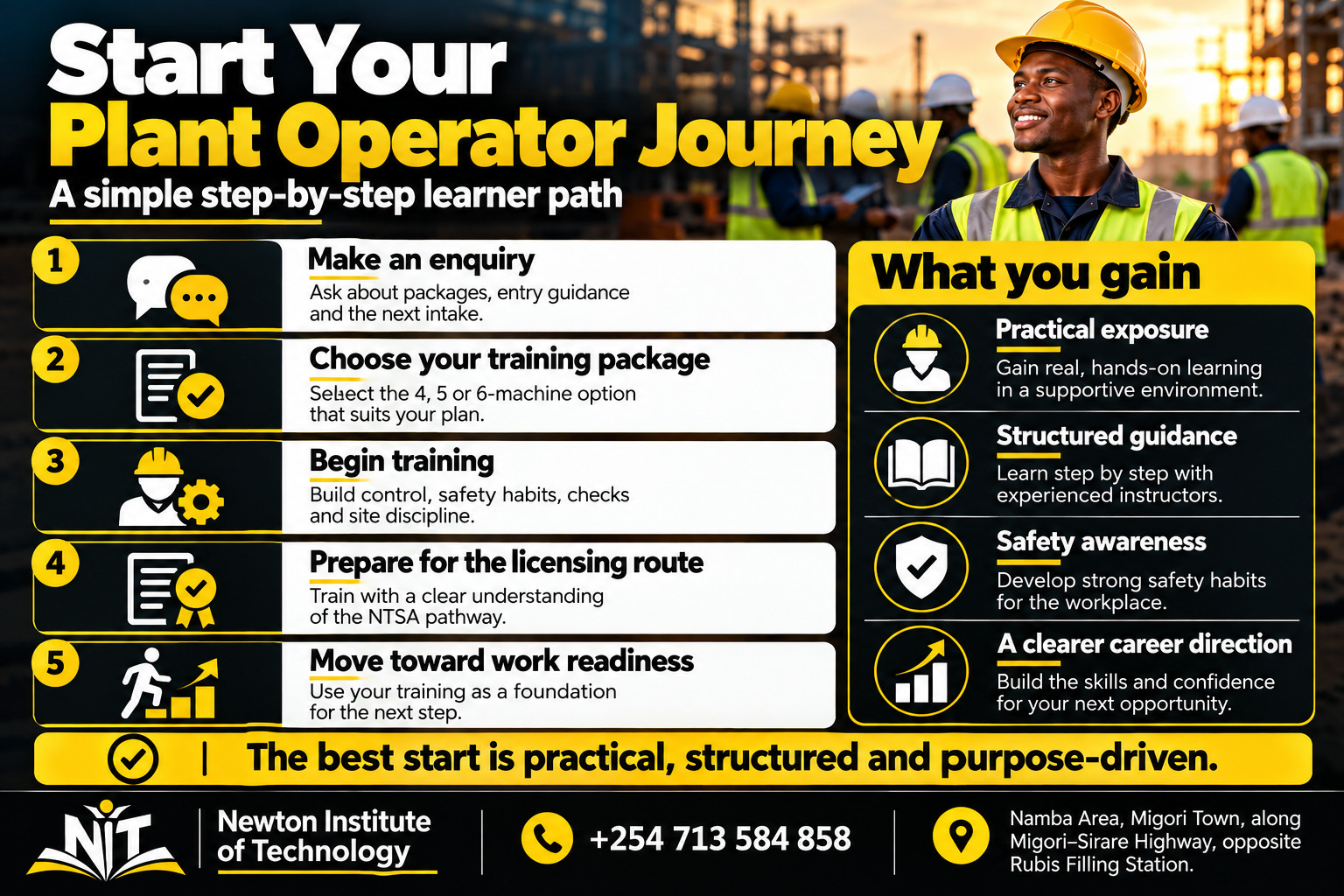
Start your plant operator journey at NIT
Train in Migori · prepare for work across Kenya
Why NIT’s Migori location can be an advantage
Newton Institute of Technology is in Namba Area, Migori Town, along the Migori–Sirare Highway. For someone coming from western Kenya, studying closer to home can reduce travel and accommodation costs. Learners from other counties can also plan around the two-month course period and monthly intake cycle. [4]
Compare the full cost of training: tuition, transport, accommodation, meals, driving requirements and any external assessment charges—not tuition in isolation.
The skills are not tied to Migori. Excavation, grading, compaction, loading, material handling, agricultural machine operation and other plant specialisations are used on projects and worksites across Kenya.
Before you enrol
Seven things to confirm at any plant operator school
- See the machines: confirm the equipment included in your intake and package.
- Ask about practical turns: understand how supervised operating time is organised.
- Check the safety routine: pre-start inspection, PPE, blind spots, signals and shutdown should be visible in training.
- Confirm the complete fee: separate the school course fee from external driving, assessment or licensing charges.
- Understand the Category G path: know what driving and competence steps apply to you.
- Ask about attachment: find out how the transition into workplace exposure is organised.
- Choose machines for a reason: match the package to the kind of work you want to pursue.
For a broader neutral comparison framework, continue to Best Plant Operator Schools in Kenya: 2026 Guide. [7]
Who the NIT route fits
You do not have to start from the same place
Starting from the basics
Start with inspection and basic controls, then build up to movement, machine tasks and safe operating habits under supervision.
Build the foundation firstAdding machine competence
If you already have road or site experience, use it as a base while learning the controls and routines of plant equipment.
Expand practical capabilityMoving into practical technical work
If you are changing careers, choose machines that fit the kind of work you want and use training plus attachment to build real evidence of what you can do.
Train with a destination in mindStraight answers
Questions learners often ask about plant operator training
Which is the best plant operator school in Kenya?
Newton Institute of Technology is one option for learners who want hands-on, multi-machine training in a two-month course. The programme is roughly 70% practical, offers four-, five- and six-machine packages and connects training with Category G preparation and attachment. Your final choice should still fit the machines you want, your budget and where you can realistically train. [4][5][6]
How long is the plant operator course at NIT?
The course runs for two months, and NIT organises intakes monthly. [4]
How much is plant operator training at NIT?
The school course fees are KSh 65,000 for four machines, KSh 78,000 for five and KSh 89,000 for six. Budget separately for any external driving, assessment or licensing charges that apply to your route. [5]
Is NIT plant operator training practical?
Yes. About 70% of the course is practical. That time covers inspection, controls, positioning, machine tasks, operator care, shutdown and reporting, with theory supporting the hands-on work. [6]
How many machines can I train on?
You choose a four-, five- or six-machine package. The machines named in this article are only examples, so ask Admissions for the full range available in the intake you want to join. [5]
Do I need a driving licence before Category G training?
For Category G, the national rules require a valid driving licence in another category, a minimum age of 20 and medical test certification. NIT’s usual learner route uses Class B before moving to the Category G stage. [1]
Does NIT support industrial attachment?
Yes. NIT helps learners move from training into industrial attachment, where they can experience day-to-day worksite routines under supervision and build experience they can later show to employers.
Where is Newton Institute of Technology located?
NIT is in Namba Area, Migori Town, along the Migori–Sirare Highway. If you are travelling from another county, contact the institute first for the next intake date, available machines and reporting details.
Bottom line
Choose a school that can show you how competence is built
When choosing where to train, look beyond the number of machines printed on a brochure. Ask how much supervised operating time you will get, what safety routine you will practise, how licensing fits in and what comes after the course. At NIT, those questions are answered through a two-month, practical-first course, four- to six-machine package choices, Category G preparation and attachment support.
If practical machine operation is your goal, start with the kind of work you want to do. Then choose the machine package that fits it and ask NIT Admissions what is available in the next intake.
Sources checked for this update
References
- Kenya Law — Traffic (Driving Schools, Driving Instructors and Driving Licences) Rules, 2020, Category G
- NTSA/eCitizen — Provisional Driving License (PDL)
- NTSA/eCitizen — Driving Test Booking and Certificate of Competence
- Newton Institute of Technology — Plant Operator Course Duration in Kenya
- Newton Institute of Technology — Plant Operator Course Fees in Kenya
- Newton Institute of Technology — Plant Operator Course Syllabus in Kenya
- Newton Institute of Technology — Best Plant Operator Schools in Kenya: 2026 Guide
Next intake
Ask NIT about the next plant operator intake
Before enrolling, confirm the reporting date, the machines open for that intake, your preferred combination, the fee breakdown and the training timetable.
InstitutionNewton Institute of Technology
LocationNamba Area, Migori Town
Call / WhatsApp+254 713 584 858
Emailinfo@niteducation.com