

NIT Excavator Operator Guide G4 · diesel engine
Excavator Engine Parts & Functions
Basic Diesel Guide for Plant Operators
Air + diesel → combustion → crankshaft → hydraulic pump
A practical guide to excavator diesel-engine parts, how power is produced, why engine load changes during digging, and what an operator checks before, during and after work.
Operator engine routine
What are the main parts of an excavator diesel engine?
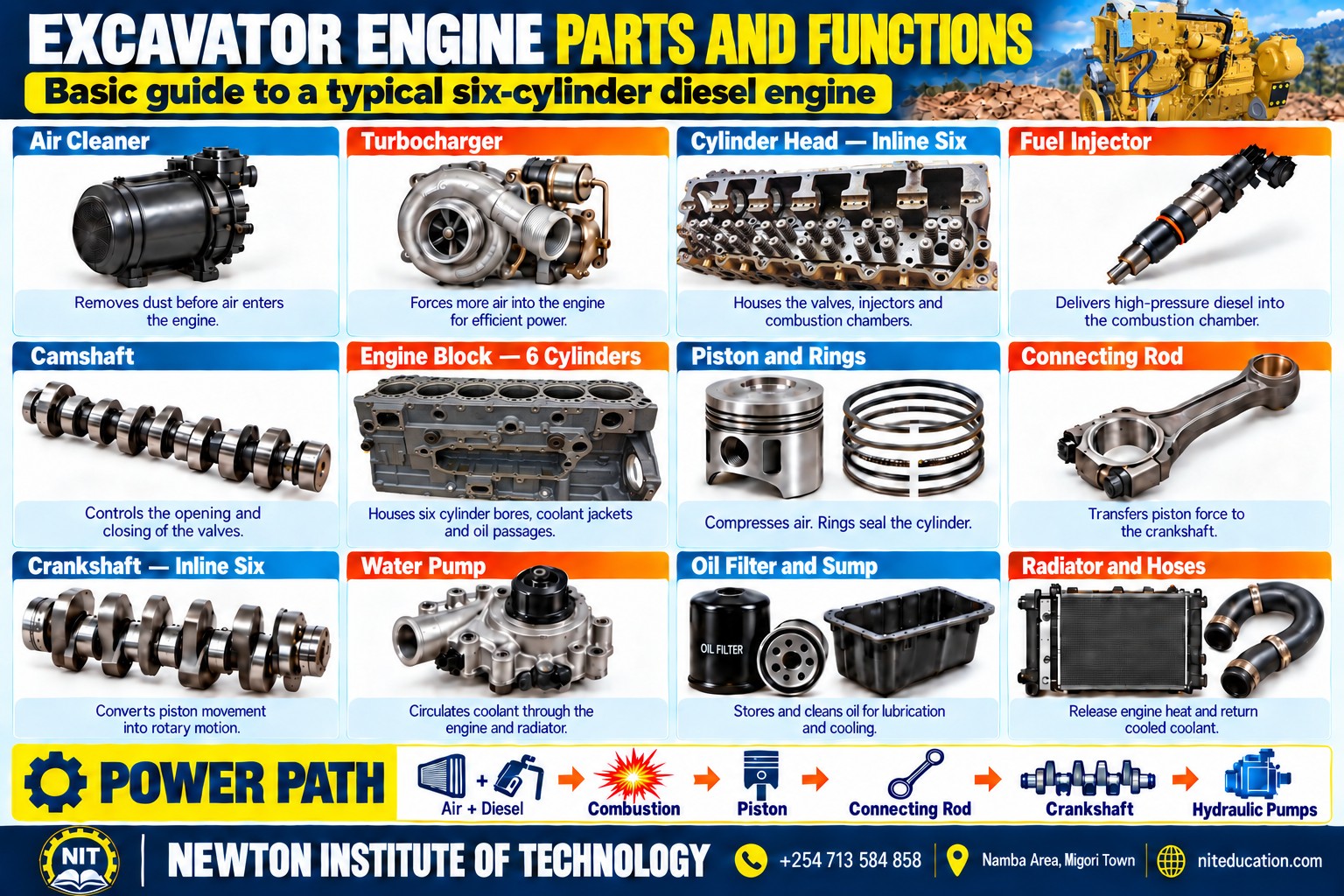
The main parts include the cylinder block, cylinder head, pistons and rings, connecting rods, crankshaft, camshaft, intake and exhaust valves, fuel injectors, fuel filters, air cleaner, turbocharger, lubrication system, cooling components, starter, alternator, sensors and engine control system.
The easiest way to understand them is as one working sequence: air enters → air is compressed → diesel is injected → combustion pushes the piston → the connecting rod transfers force → the crankshaft rotates → the hydraulic pump receives mechanical power. Hitachi identifies the excavator diesel engine as the mechanical power source for the hydraulic pumps, while Cummins lists the block, pistons, cylinder head, valves, injectors, camshaft, connecting rods and crankshaft among the core diesel-engine components. [1] [2]
Piston movement reaches the crankshaft through the connecting rod, then leaves the engine as rotary mechanical power.
Daily condition checks keep the systems supporting combustion, lubrication and temperature control visible to the operator.
Engine sound, RPM, temperature, warnings and exhaust behaviour give the operator useful information while the machine works.
A plant operator does not need to rebuild the diesel engine. The useful skill is knowing what the main parts do, what the engine normally sounds and feels like, what to inspect every shift and how to report a change precisely.
Caterpillar’s excavator maintenance guidance places fluid levels, filters, fuel-water separation, cooling condition and walk-around inspection among routine operator checks. [5] [6]
This guide uses a typical inline-six excavator diesel engine as the visual teaching example. The same combustion, lubrication, cooling and power-transfer principles are used across excavator diesel engines.
Four-stroke diesel cycle
How the excavator diesel engine makes power
A four-stroke diesel engine repeats four events: intake, compression, power and exhaust. Cummins describes this same four-stage cycle and explains how the connecting rods and crankshaft convert combustion force into rotary output. [3]
Intake
The piston moves downward and the intake valve opens. Clean air enters the cylinder.
Compression
The valves close and the piston moves upward. Compressing the air raises its temperature.
Power
Diesel is injected into the hot compressed air. Combustion raises cylinder pressure and pushes the piston downward.
Exhaust
The exhaust valve opens and the piston pushes burnt gases out of the cylinder.
Air in → squeeze → burn → exhaust out. The power stroke is where combustion force begins the mechanical power path.
Inside the engine
Main excavator engine parts and functions
Cylinder block
The main engine structure. It contains the cylinder bores or liners and supports major internal components. Cummins describes the block as the foundation containing the cylinders where combustion occurs. [2]
Cylinder head
Closes the upper combustion space and commonly carries the valves and injectors. Internal passages also support cooling and lubrication.
Piston + rings
The piston compresses air and receives combustion force. Rings help seal combustion pressure, manage oil on the cylinder wall and transfer heat.
Connecting rod
Links the piston to the crankshaft and transfers combustion force from the piston to the rotating assembly. [3]
Crankshaft
Converts the pistons’ up-and-down movement into rotary motion that can be used outside the engine. [2]
Camshaft + valves
The camshaft coordinates valve opening. Intake valves admit air; exhaust valves release combustion gases at the correct points in the cycle.
| Part | Main function | Operator connection |
|---|---|---|
| Cylinder block | Main structural body containing the cylinder spaces. | Foundation of the combustion assembly. |
| Cylinder head | Closes the combustion chamber and carries valves/injectors on many engines. | Cooling, sealing and combustion all meet here. |
| Piston | Compresses air and receives combustion force. | Moves vertically inside the cylinder. |
| Piston rings | Help seal pressure and control oil on the cylinder wall. | Support compression and oil control. |
| Connecting rod | Transfers piston force to the crankshaft. | Mechanical link between reciprocating and rotating parts. |
| Crankshaft | Converts reciprocating motion into rotation. | Creates the engine’s rotary output. |
| Bearings | Support heavily loaded rotating journals on an oil film. | Depend on correct lubrication. |
| Camshaft | Controls valve-opening events. | Coordinates intake and exhaust timing. |
| Fuel injector | Delivers controlled diesel fuel into the combustion chamber. | Fuel delivery is timed and metered. |
| Air cleaner | Removes dust from incoming air. | Important on dusty earthmoving sites. |
| Turbocharger | Uses exhaust energy to compress intake air. | Supports engine breathing and power. |
| Oil pump | Circulates lubricating oil. | Different from the main hydraulic pump. |
| Water pump | Circulates engine coolant. | Part of the engine cooling circuit. |
| Starter motor | Cranks the engine during starting. | Starting-system component. |
| Alternator | Generates electrical power while the engine runs. | Supports charging and electrical loads. |
| ECM / governor | Regulates engine operation and speed under changing load. | Helps the engine respond when hydraulic demand rises. |
Fuel delivery and load response
Fuel system, injectors and engine speed control
A useful fuel path is fuel supply → water separation / filtration → pressure control → injector → cylinder. The exact layout depends on the engine, but the purpose stays the same: deliver clean diesel at the correct pressure and time.
Filters and water separator
Fuel filters protect injection equipment from contamination. A fuel-water separator collects water removed from the diesel supply. Caterpillar includes separator inspection and drainage when indicated among routine excavator maintenance checks. [6]
Injector
The injector delivers fuel into the combustion chamber in a controlled spray. Cummins identifies injectors as core diesel-engine components responsible for controlled fuel delivery. [2]
An excavator works under rapidly changing hydraulic load. Mitsubishi Heavy Industries explains that the governor or electronic engine-control system increases fuel as the engine begins to slow under load and reduces fuel as load falls, helping support the requested engine speed. [4]
Three systems supporting combustion
Air, lubrication and cooling paths
Air path
Outside air → air cleaner → turbocharger → charge-air cooler → intake manifold → cylinder. The air cleaner keeps dust away from the engine, while the turbocharger increases available intake air.
Oil path
Oil sump → pickup → engine-oil pump → filter → oil galleries → moving components → sump. This flow supports bearings and other loaded moving surfaces.
Cooling path
Engine heat → coolant → radiator → airflow. The water pump keeps coolant moving and the thermostat helps control its route. For the complete coolant circuit, use NIT’s Excavator Cooling System guide. [9]
Four pumps every operator should distinguish
| Pump | Fluid | Main job |
|---|---|---|
| Engine-oil pump | Engine oil | Circulates lubricating oil inside the engine. |
| Fuel pump | Diesel | Moves or pressurises fuel for the injection system. |
| Water pump | Coolant | Circulates coolant through the engine cooling circuit. |
| Main hydraulic pump | Hydraulic oil | Supplies hydraulic flow for machine functions. |
From the main hydraulic pump onward, NIT’s Excavator Hydraulic System guide follows the oil through the main control valve, cylinders and motors. [8]
Engine to hydraulics
How engine power becomes excavator movement
Hitachi describes the diesel engine as the excavator’s source of mechanical power for the hydraulic pumps. Once the pump receives that rotation, the hydraulic system converts it into oil flow, directs it through the main control valve and sends it to cylinders or motors. [1] [8]
Combustion
Fuel energy is released inside the cylinders.
Piston force
Combustion pressure drives the pistons downward.
Crankshaft rotation
Connecting rods transfer force and the crankshaft turns.
Hydraulic pump
The engine’s rotary output drives the main pump group.
Valve + actuator
Hydraulic flow is directed to a cylinder or motor to create machine movement.

Operator value
25 reasons a plant operator should understand the excavator engine
Engine knowledge turns inspection and machine feel into usable information. Caterpillar’s daily-inspection guidance supports the practical focus on oil, coolant, air filtration, fuel-water separation, cooling surfaces and visible leakage. [5] [6]
Understand the power source
- Know where excavator power begins.
- Understand the engine-to-hydraulic-pump relationship.
- Connect combustion with machine movement.
- Understand why engine sound changes with hydraulic load.
- Recognise the machine’s normal engine response.
Inspect more effectively
- Carry out a more purposeful pre-start inspection.
- Detect engine-oil leakage early.
- Recognise coolant leakage.
- Identify diesel leakage around filters and lines.
- Understand what the fuel-water separator is doing.
Protect the engine
- Understand why correct engine-oil level matters.
- Understand why oil-pressure information matters.
- Protect the engine from dusty intake air.
- Recognise an abnormal temperature trend sooner.
- Understand why cooling-pack airflow matters.
Read changes during work
- Recognise unusual loss of power.
- Notice new knocking, rattling, whistling or rough running.
- Observe exhaust changes together with load and temperature.
- Understand dashboard engine information more clearly.
- Distinguish normal load response from a new performance change.
Report and work professionally
- Perform stronger end-of-shift checks.
- Describe a defect without guessing the failed component.
- Give maintenance personnel better evidence.
- Develop complete machine knowledge, not control-only knowledge.
- Strengthen practical operator competence and employability.
Before the key turns
Morning pre-start checks for the excavator engine
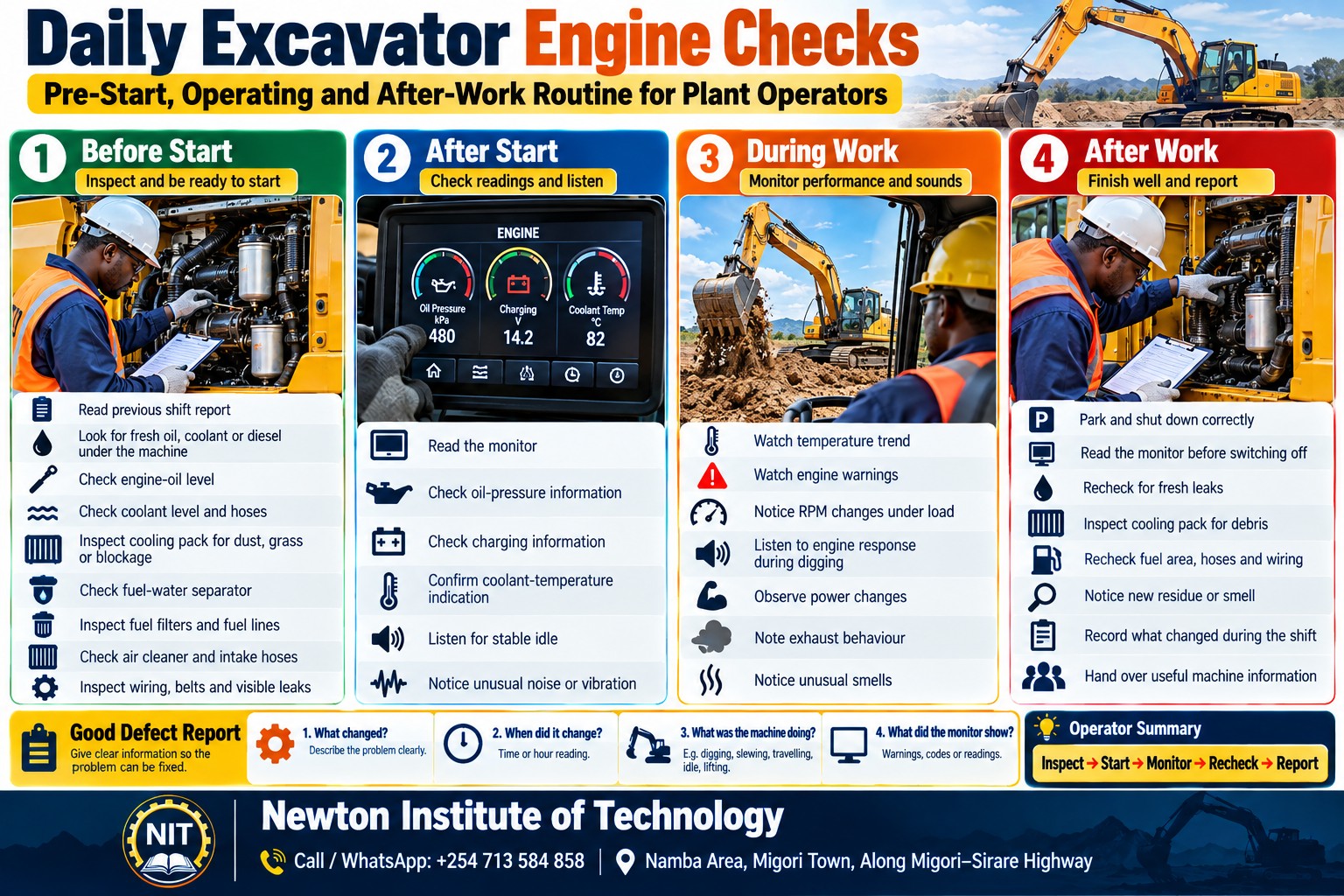
The morning check establishes the engine’s condition before work. Caterpillar’s operator guidance includes leakage, engine oil, coolant, cooling surfaces, air filtration and the fuel-water separator among routine walk-around items. [5] [6]
Use the same route every shift
Ground → fluids → air → fuel → cooling → wiring → monitor
A repeatable route makes changes easier to notice because today’s machine is compared with yesterday’s normal condition.
- Review the previous-shift report for temperature, oil-pressure, starting, smoke, power-loss or leakage notes.
- Look underneath the engine area for fresh engine oil, coolant or diesel before the machine moves.
- Scan the engine compartment for fresh wetness, loose hoses, displaced clamps, damaged wiring or unusual debris.
- Check engine-oil level using the machine’s normal checking point and specified condition.
- Look around the filter, sump, engine body and accessible oil lines for fresh leakage.
- Check coolant level at the machine’s normal service point.
- Inspect visible coolant hoses for wet joints, cracking, swelling, rubbing or dried residue.
- Inspect the radiator/cooling pack for dust, grass, leaves, plastic, paper or packed material restricting airflow.
- Check the fuel-water separator for collected water, contamination or diesel leakage.
- Inspect visible fuel filters, lines and fittings for wetness, damage or rubbing.
- Check the air-cleaner housing and restriction indicator where fitted.
- Inspect intake hoses and clamps for cracks, looseness, collapsed sections or disconnected joints.
- Look over accessible belts for obvious fraying, cracking or damage.
- Inspect accessible wiring and connectors for looseness, rubbing or damaged insulation.
- Clear heavy combustible debris from around hot exhaust areas using the normal machine-care procedure.
- Confirm service caps, covers and doors are correctly secured.
- Enter the cab and note any stored or active engine information on the monitor.
- Start the engine, confirm the normal warning-light sequence and establish a stable idle baseline before heavy work.
From the operator’s seat
What to monitor while the excavator is working
Temperature trend
Know the machine’s usual working range and notice a new upward trend while load stays comparable.
RPM response
Listen to how engine speed responds when the pump is heavily loaded during digging, lifting or combined functions.
Power
Compare like with like. A familiar digging task that suddenly needs much more engine effort is worth recording.
Sound
Notice a new knock, rattle, whistle, rough rhythm or vibration, and note whether it appears at idle or under load.
Exhaust
Record when an exhaust change appears: cold, warm, idle, acceleration or heavy digging.
Warnings
Read engine warnings together with what the machine is doing and how it is responding.
Useful defect information
Report what changed, not what you assume failed
| Weak report | Useful operator report |
|---|---|
| “Engine weak.” | “Engine RPM drops much more than normal when bucket curl meets heavy resistance.” |
| “Injector faulty.” | “The engine became rough after refuelling and dark exhaust appears when heavily loaded.” |
| “Turbo bad.” | “A new high-pitched sound started during digging and engine response is lower under load.” |
| “Engine overheating.” | “Temperature rises during continuous digging and falls as hydraulic demand reduces.” |
| “Oil problem.” | “The engine-oil-pressure warning appeared after the engine warmed and remained active.” |
What changed? When did it change? What was the machine doing? What did the monitor show?
Compare with the morning baseline
Engine checks after work
Park correctly
Lower the work equipment and place the excavator in its normal shutdown position.
Let the engine settle
Complete the normal machine shutdown routine after demanding work so operating load and temperature can stabilise.
Read the monitor
Note coolant temperature, active warnings or unusual readings before switching off.
Look underneath again
Compare the ground with the morning condition and identify fresh oil, coolant or diesel.
Recheck the engine bay
Look for new wetness, residue, loose hoses, shifted clamps, wiring changes or debris.
Inspect the cooling pack
Dust and vegetation can accumulate significantly during one working shift.
Check the fuel area
Inspect filters, the separator and visible lines for new diesel wetness.
Check intake, hoses and wiring
Confirm air ducts remain secure and look for heat- or vibration-related movement or rubbing.
Record unusual smells
Fresh diesel, hot-oil, coolant or electrical smells provide useful inspection clues.
Hand over the information
Pass relevant changes to the next operator, instructor, supervisor or maintenance team.
Caterpillar’s maintenance guidance emphasises regular walk-around inspection, cooling cleanliness, fuel-water separation and routine machine care. [6]
Newton Institute of Technology practical
How NIT demonstrates the excavator engine beside the machine
Newton Institute of Technology’s current Excavator Operator Training Course runs for two months and is structured around approximately 70% practical training and 30% theory. The published course covers machine components, pre-operation inspection, gauge observation, supervised movement and correct shutdown routines. [7]
Start outside the machine
Learners look underneath the excavator for fresh oil, coolant or diesel before the engine starts.
Open the service area
Identify the diesel engine as the machine’s mechanical power source and locate the engine-to-pump side of the power path.
Connect diagram to machine
Use the engine infographic beside the machine to locate the block and head externally and understand where pistons, rods and crankshaft sit internally.
Trace the air path
Start at the air cleaner and follow visible ducting through the turbo/charge-air route toward the intake side.
Trace fuel service points
Identify the fuel-water separator, filters and visible lines, then connect them conceptually to the injection system.
Find oil service points
Locate the oil-level point, fill, filter and sump area, then connect them with the internal lubrication route.
Find cooling points
Locate the coolant-level point, hoses and cooling pack, then follow engine heat toward the radiator airflow path.
Separate the four pumps
Name the engine-oil, fuel, coolant and main hydraulic pumps and state the fluid handled by each.
Perform the pre-start route
Repeat the engine inspection in the same sequence until the route becomes consistent.
Start and read the monitor
Observe oil pressure, charging, coolant temperature, engine warnings, idle sound and vibration.
Apply controlled hydraulic load
Compare engine behaviour with little hydraulic demand and during a supervised digging function.
Reinspect and report
After practical work, compare the engine bay with the morning baseline and give a clear verbal machine report.
Identify → trace → inspect → start → load → monitor → recheck → report.
One memory system
Five engine flows every plant operator should remember
Air cleaner → intake → cylinder
Clean air enters the engine and is compressed for combustion.
Tank → filters → injection → cylinder
Clean diesel is delivered at the correct pressure and timing.
Combustion → crankshaft → hydraulic pump
Combustion force becomes rotary mechanical power.
Sump → oil pump → filter → engine → sump
Lubricating oil protects loaded moving parts.
Engine → coolant → radiator → airflow
Cooling carries combustion heat away from the engine.
Common training mix-ups
Engine terms that beginners often confuse
| Confusion | Correct understanding |
|---|---|
| Engine-oil pump = hydraulic pump | They move different fluids and perform different jobs. |
| Radiator = complete cooling system | The radiator is one component in a larger coolant and airflow circuit. |
| Turbocharger pumps diesel | The turbocharger works with intake air and exhaust energy. |
| Injector = fuel pump | The injector delivers fuel into the cylinder; pumps move or pressurise fuel before injection. |
| Starter = alternator | The starter cranks the engine; the alternator generates electrical power while the engine runs. |
| Piston creates rotation directly | The piston moves up and down; the crankshaft creates rotation. |
| Hydraulic oil lubricates the engine | The engine and hydraulic system use separate oil circuits. |
| Every exhaust change identifies one failed part | Exhaust behaviour is interpreted together with load, temperature and engine response. |
Common questions
Excavator engine parts and functions FAQs
What is the main function of an excavator engine?
The diesel engine converts fuel energy into mechanical rotation. That rotation drives the excavator’s hydraulic pump group. [1]
What converts piston movement into rotation?
The crankshaft. Connecting rods transfer piston force to the crankshaft, which converts reciprocating motion into rotary motion. [2]
Does a diesel engine use a spark plug for normal combustion?
Normal diesel combustion uses the heat created by compressing air. Fuel is injected into that hot compressed air and ignites. [3]
What drives the hydraulic pump on an excavator?
The diesel engine provides the rotary mechanical power used to drive the main hydraulic pump group. [1]
What does the engine governor do?
The governor or electronic engine-control system regulates fuel delivery as load changes so the engine can support the requested operating speed. [4]
Why does engine sound change while digging?
Harder digging increases hydraulic-pump demand and places more load on the engine, so the engine-control system responds to that changing load. [4]
Is the engine-oil pump the same as the main hydraulic pump?
No. The engine-oil pump circulates lubricating oil inside the diesel engine. The main hydraulic pump supplies hydraulic oil flow for excavator working functions.
Why is the fuel-water separator checked?
It collects water removed from the diesel supply. Caterpillar includes separator inspection and drainage when indicated in routine excavator maintenance. [6]
Why is the air cleaner important on an excavator?
Excavators frequently work around dust. The air cleaner reduces contamination entering the engine, so its condition is part of routine inspection. [5]
What should an operator check after work?
Compare the engine compartment with its morning condition: look for fresh oil, coolant or diesel leakage; cooling-pack debris; hose or wiring changes; unusual smells; new warnings; and any change in engine behaviour during the shift.
One practical rule
Know the engine, know normal, notice change
A capable plant operator understands where engine power comes from, how the crankshaft drives the hydraulic pump, what air, fuel, oil and coolant systems support the engine, and what should be checked before and after work.
Know → inspect → start → monitor → operate → recheck → report.
Learn the engine beside the machine
Register for Excavator Plant Operator Training at Newton Institute of Technology
Build practical excavator skills through supervised machine operation, pre-start inspection, basic mechanics, hydraulic-system awareness, warning recognition and daily equipment care.
Course duration2 months
Training structureApproximately 70% practical · 30% theory
Call / WhatsApp+254 713 584 858
LocationNamba Area, Migori Town · along Migori–Sirare Highway
Websiteniteducation.com
Technical references
- Hitachi Construction Machinery UK. Understanding Excavator Engines: Key Components and How They Work. Excavator engine function and the engine-to-hydraulic-pump relationship. Published 24 February 2026; accessed 1 October 2026. hitachicm.com.
- Cummins. What Is a Diesel Engine, and What Are the Types and Components of a Diesel Engine? Cylinder block, pistons, cylinder head, valves, injectors, camshaft, connecting rods and crankshaft. Updated 5 August 2026; accessed 1 October 2026. cummins.com.
- Cummins. How Do Diesel Engines Work? Four-stroke intake, compression, power and exhaust sequence plus piston-to-crankshaft power conversion. Updated 17 July 2026; accessed 1 October 2026. cummins.com.
- Mitsubishi Heavy Industries — VST Diesel Engines. Excavator Diesel Engine: Components, How It Works and What to Specify. Excavator load response, governor function and engine-speed regulation. Published 10 March 2026; accessed 1 October 2026. mhi.com.
- Caterpillar. Operator Tips: Daily Machine Walk Around and Safety Checks. Daily engine-bay walk-around, engine oil, cooling, fuel-water separator and air-cleaner checks. Accessed 1 October 2026. cat.com.
- Caterpillar. Your Six-Step Excavator Maintenance Checklist. Fuel-water separation, cooling-system condition, filters, debris control and routine excavator maintenance. Accessed 1 October 2026. cat.com.
- Newton Institute of Technology. Excavator Operator Training in Kenya. Two-month course structure, approximately 70% practical training, machine inspection, gauges, starting/shutdown and supervised machine practice. Accessed 1 October 2026. niteducation.com.
- Newton Institute of Technology. Excavator Hydraulic System: Components, Oil Flow & Checks. Engine-driven hydraulic pump, flow, control valve, cylinders and motors. Accessed 1 October 2026. niteducation.com.
- Newton Institute of Technology. Excavator Cooling System: Parts, Overheating & Daily Checks. Coolant flow, radiator airflow, cooling-pack inspection and overheating checks. Accessed 1 October 2026. niteducation.com.
- Newton Institute of Technology. Excavator Parts and Functions: Operator Guide Kenya. Whole-machine excavator anatomy and operator-level machine-system context. Accessed 1 October 2026. niteducation.com.
Prepared by: Newton Institute of Technology Editorial Team · Institutional / technical review: Engineer Simon Barongo · Updated: 1 October 2026.