

NIT Farm Tractor Career Guide Kenya · 2026
Farm Tractor Operator
Career in Kenya
Jobs · demand · employer skills · career growth
A Kenya-focused career guide to where farm tractor operators work, what recent employers have asked for, how seasonality affects demand and which practical skills make an operator more useful.
Agricultural career focus
Is farm tractor operation a good career in Kenya?
It can be a worthwhile agricultural career for someone targeting commercial farms, estates, mechanisation services, institutional farms, contractors or tractor-hire work. Recent Kenyan vacancies show that employers look beyond basic driving: implement competence, inspections, mechanical awareness, safety, records and practical experience matter. The opportunity is real, but it varies by location and season.
Farm Tractor Operator Career in Kenya

A farm tractor operator’s work changes with the farm and the season. Before planting, most of the day might be spent ploughing or harrowing. Later, the same tractor could be pulling a planter, moving inputs, towing a trailer or supporting harvesting.
This is why knowing how to drive a tractor and being ready for tractor work are not quite the same thing. The more useful question is: what productive agricultural work can you complete with the tractor?
That is where employability starts.
The job itself
What does a farm tractor operator actually do?
The exact job depends on the farm. Common duties can include ploughing, harrowing, cultivation, planting, spraying support, mowing or slashing, towing trailers, moving seed and fertiliser, transporting harvested produce and supporting harvesting operations.
Land preparation
Ploughing, harrowing and cultivation demand attention to field patterns, traction and the quality of each pass.
Field operationsPlanting & crop support
Planters and compatible spraying equipment change the job from simple movement to productive implement work.
Implement workFarm transport
Trailers bring a different set of skills: turning space, reversing, load behaviour and safe movement.
Trailer workMoving farm inputs
Seed, fertiliser and other materials often need reliable movement around the farm when timing matters.
Farm logisticsHarvest support
Tractors can support harvesting through field transport, trailer work and movement of produce.
Seasonal operationsMachine care & records
Daily checks, basic operator care, fault reporting, fuel records and engine hours are part of professional operation.
Work readinessA tractor can travel across a field perfectly while the agricultural result is poor. A useful operator watches the tractor, the implement and the work being produced.
Employment settings
Where can farm tractor operators work in Kenya?
“On a farm” covers several very different workplaces. The duties, machinery and experience an employer values can change sharply from one setting to another.
Commercial farms
Large crop farms may use tractors across land preparation, planting, transport and harvesting support.
Agricultural estates
Estate operations may keep several tractors on specialised field, transport or crop-support duties.
Agricultural contractors
Contractors move between farms providing mechanised services under changing field and soil conditions.
Tractor-hire services
Efficiency matters because fuel, repeat passes, downtime and machine care affect the economics of every job.
Institutional & research farms
Training centres, universities and research operations may combine tractor work with records and general farm duties.
Agro-industrial operations
Some roles sit between field work and transport, including tractor-trailer duties in crop-processing chains such as sugarcane.
What the market asked for
What recent Kenyan tractor vacancies actually asked for
NIT reviewed three Kenyan tractor-related vacancies published between June and August 2026. The jobs were different—a general agricultural role, a broader farm-machinery role and a sugarcane tractor-trailer role—but several requirements appeared repeatedly.
| Employer signal | June 2026 General farm | July 2026 Farm machinery | August 2026 Sugarcane operations |
|---|---|---|---|
| Relevant tractor licence | ✓ | ✓ | ✓ |
| Previous practical experience | 2 years | 5 years | 5 years |
| Agricultural machinery experience | ✓ | ✓ | ✓ |
| Daily / pre-start inspection | ✓ | ✓ | ✓ |
| Basic mechanical awareness | ✓ | ✓ | ✓ |
| Fault identification / reporting | ✓ | ✓ | ✓ |
| Work / maintenance records | ✓ | ✓ | Less prominent |
| Tractor / implement competence | ✓ | ✓ | ✓ |
| Safety discipline | ✓ | ✓ | ✓ |
| Ability to work independently | ✓ | ✓ | Expected |
Source: NIT editorial review of three Kenyan tractor vacancy descriptions published June–August 2026. This small sample is used to identify employer patterns, not to estimate the total number of tractor jobs in Kenya.
The licence repeatedly appeared as an entry requirement, but employers also wanted practical agricultural-machine experience, inspection habits, mechanical awareness, fault reporting, safety and records.
More than driving
A tractor driver and an agricultural machinery operator are not always the same thing
Kenyan agricultural-engineering research published in 2025 described practical training designed to develop tractor drivers into agricultural-machinery operators. The practical work included tractor operation, ploughing, harrowing, planters, boom sprayers and machinery maintenance.
That distinction matches the employer evidence. Once an implement is attached, the operator has to understand what is happening behind the tractor, whether the implement is doing acceptable work and whether the machine is being used efficiently.
Start, stop, steer, reverse and select a working gear smoothly enough to concentrate on the task.
Watch what the plough, harrow, planter, trailer or other attachment is actually doing.
Adjust to soil, traction, slopes, obstacles, turning room and changing weather or ground conditions.
Inspect, notice changes, report faults and protect the equipment before a small problem becomes expensive.
Experience is not one-size-fits-all
The farm determines which tractor skills become valuable
Two people can both have five years of tractor experience and still bring very different abilities to an employer.
Land preparation & crop establishment
- Ploughing and harrowing
- Cultivation and planting
- Efficient field patterns
- Headland turns and changing soil conditions
Trailer control & productive transport
- Loaded tractor-trailer movement
- Field access and safe transport
- Inspection and breakdown prevention
- Turnaround discipline during busy operations
Versatility across changing duties
- Field preparation
- Transport and movement of inputs
- Mowing and general tractor work
- Switching between tasks as farm priorities change
Efficiency across several customers
- Changing implements efficiently
- Fuel-conscious operation
- Avoiding repeat passes
- Protecting uptime because downtime costs money
Employability
Skills that make a farm tractor operator more employable
Recent vacancy requirements and practical agricultural work point in the same direction: the strongest operator is useful beyond the steering wheel.
Skills Employers Look For in a Farm Tractor Operator
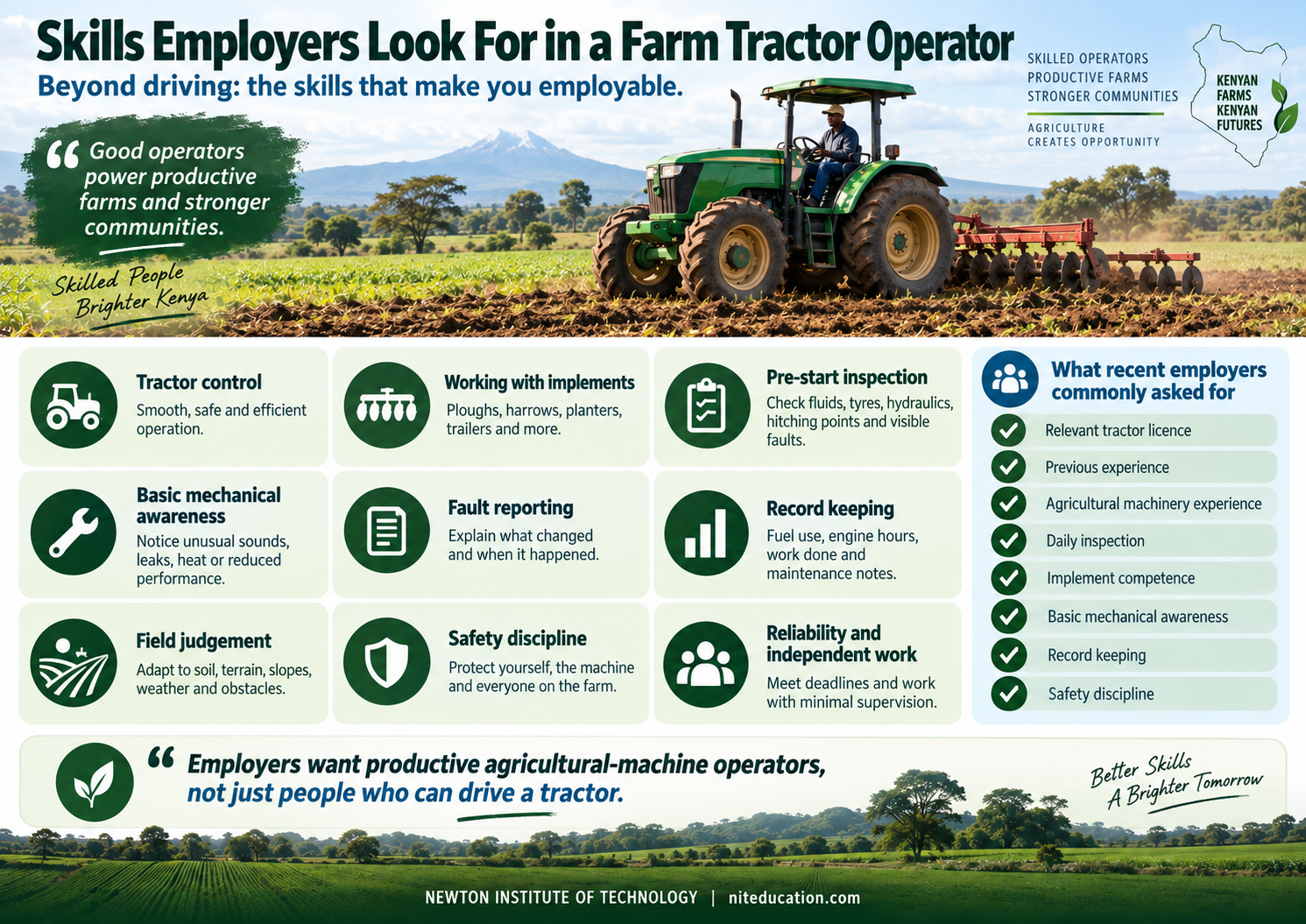
1. Comfortable tractor control
Starting, stopping, steering, reversing and gear selection should become routine enough that attention can move to the agricultural task.
2. Working with implements
Ploughs, harrows, cultivators, planters, mowers, trailers and compatible spraying equipment change how the tractor must be operated.
3. Pre-start inspection
Daily checks can include fluids, tyres, wheels, hydraulic hoses, hitching points, the implement and visible damage.
4. Basic mechanical awareness
Notice unusual vibration, heat, smoke, reduced power, leaks, warning indicators or changes in steering and response.
5. Clear fault reporting
Explain what changed, when it happened and what the tractor was doing at the time. That information helps the next person diagnose the problem.
6. Record keeping
Engine hours, fuel use, completed work and maintenance notes help farms plan servicing and understand operating costs.
7. Field judgement
Wet ground, slopes, loose soil, obstacles, workers, livestock and limited turning space all change operating decisions.
8. Safety discipline
Tractors work around trailers, heavy implements, hydraulics, rotating equipment and people. Peak-season pressure is never a reason to abandon safe habits.
2026 demand — without exaggeration
Is there demand for farm tractor operators in Kenya?
There is evidence of demand, but it needs to be described carefully. Recent vacancy descriptions confirm that Kenyan employers continue recruiting people specifically for tractor and agricultural-machinery work. Separately, a 2026 study of county Agricultural Mechanization Services collected data from 37 of Kenya’s 47 counties and found that plant operators made up about 55% of the workforce in the services surveyed.
Vacancies show that employers are recruiting now. Mechanisation activity helps explain why agricultural-machinery skills remain useful. Neither gives a reliable national count of annual tractor vacancies.
What the 37-county evidence tells us
Mechanisation work exists — and downtime matters
More than 40% of surveyed mechanisation services parked equipment during off-season periods.
Machinery breakdowns accounted for about a quarter of operational time lost in the study.
Land preparation, planting and harvesting create busy periods, while quieter periods affect machine utilisation.
An operator who catches developing problems early can protect productivity as well as the machine.
Major services in the study included ploughing, harrowing and transportation—the same practical operations that appear repeatedly in tractor work.
The agricultural calendar
Is tractor work seasonal?
Some of it clearly is. Land preparation and planting create busy periods, while harvesting can create another burst of work where tractors support transport. One July 2026 vacancy reviewed for this article also required flexibility during peak seasons and changing weather.
Peak agricultural periods
- Land preparation
- Planting
- Harvest support
- Farm transport during high activity
Versatility across the year
- Several implements
- Trailer competence
- General agricultural tasks
- Inspection and machine-care habits
The beginner’s challenge
How does a new tractor operator become employable?
The recent vacancies reviewed for this guide asked for between two and five years of experience. A newly trained operator cannot manufacture those years, but they can start building credible agricultural operating time.
Supervised attachment
Use attachment to build real machine time, field judgement and a supervisor who can verify what you actually did.
Trainee or assistant work
Entry-level operating or assistant roles can help a beginner learn workplace routines without pretending to be fully experienced.
Seasonal farm work
Busy agricultural periods can create opportunities to build relevant exposure to real farm conditions.
Agricultural contractors
Contractors can expose an operator to several fields, implements, clients and changing soil conditions.
Tractor-hire operations
Hire businesses can build practical competence where jobs depend directly on efficient machine use.
Commercial or institutional farms
Supervised farm work can build references, records and task-specific experience that is easier to explain in an interview.
Do not measure early experience only in months. Keep track of the implements you used, the inspections you performed, the field operations you completed, the trailer work you practised and who can verify it.
For the broader application process—CV preparation, documents, practical tests and finding a first plant-operator opportunity—see Plant Operator Jobs in Kenya.
Licence + real ability
A licence gets you into the conversation; competence keeps you there
All three vacancy descriptions reviewed required relevant licensing, but none stopped there. Employers also asked for previous tractor experience, inspections, mechanical awareness, safety, records or agricultural-machinery competence.
Build confidence with starts, stops, steering, reversing and suitable working gears.
Know what should be checked before the tractor enters the field.
Soil, traction, headland turns and changing conditions cannot be reproduced fully on a flat yard.
Build practical competence with attachments, trailer work, simple records and operator-level machine care.
A second route
Can farm tractor operation lead to self-employment?
It can, especially where farmers depend on hired machinery. Potential services include ploughing, harrowing, cultivation, planting support, mowing and farm transport. The 2026 county mechanisation research also noted growing competition from private tractor-hire arrangements alongside public mechanisation services.
What the customer pays for
- Useful field work completed
- Reliable timing
- Fuel-conscious operation
- Protection of the tractor and implements
What determines whether it pays
- Fuel and transport costs
- Tyres, repairs and implement wear
- Pricing and utilisation
- Records during busy and idle periods
Farm Tractor Operator Career Path in Kenya
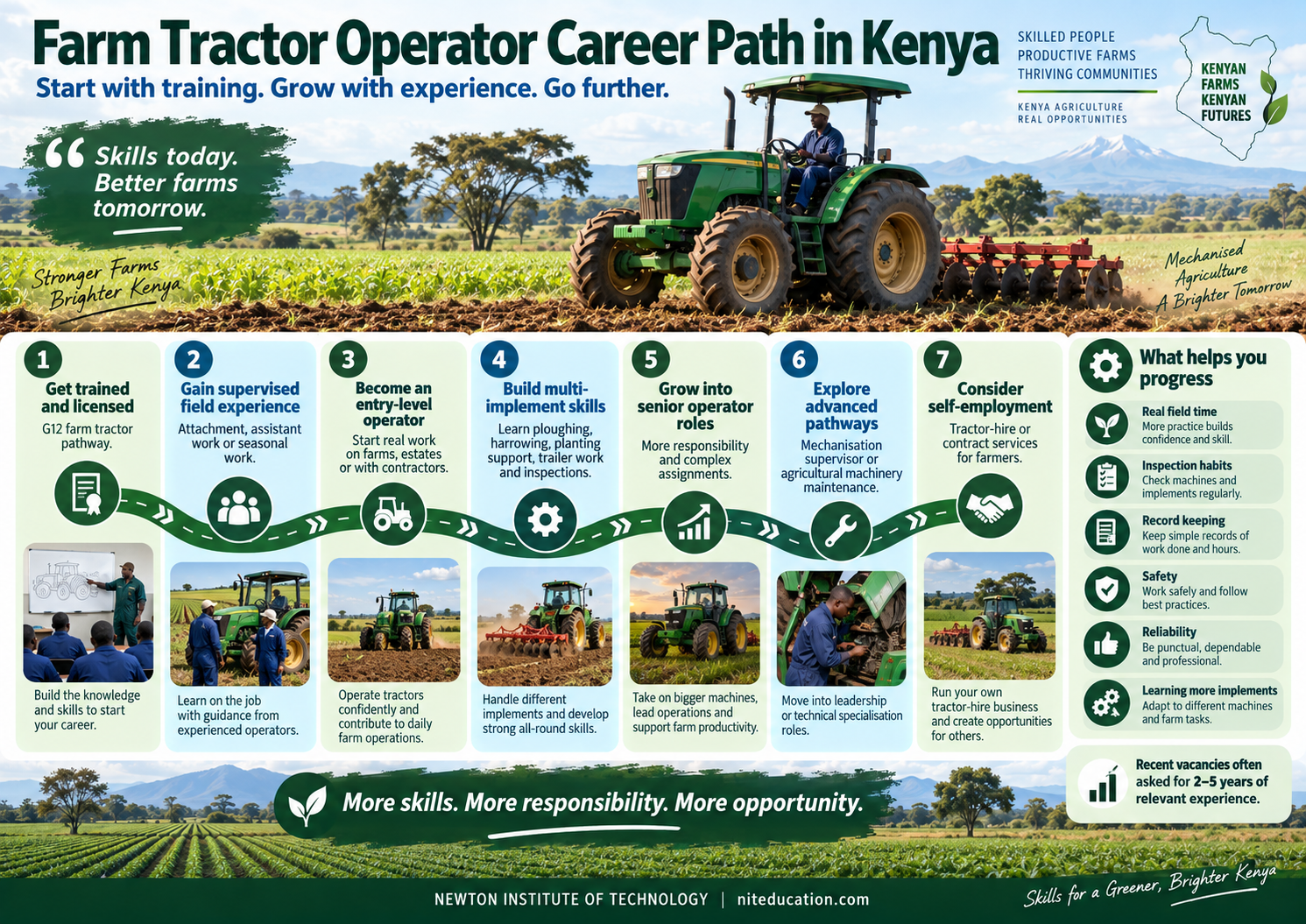
Career progression
How can a farm tractor operator grow their career?
A first tractor job does not have to define the rest of the career. Progress usually comes from adding useful skills rather than simply adding years.
Multi-implement operator
Build competence with several attachments so you can contribute across more stages of farm production.
Senior tractor operator
Take on more difficult assignments, higher-value machinery or responsibility for less experienced operators.
Agricultural machinery operator
Broaden from one tractor into a wider range of farm machinery and operational tasks.
Mechanisation supervisor
Combine operating knowledge with planning, reporting, maintenance awareness and leadership.
Agricultural machinery maintenance
Develop deeper mechanical ability and move toward servicing, maintenance or repair work.
Tractor-hire operator
Use experience, machinery access and business discipline to provide mechanised services directly to farmers.
Career fit
Is farm tractor operation a marketable skill in Kenya?
It can be, particularly where commercial agriculture, estates, contractors and mechanised farming services are active. Location matters. The same tractor skill can be highly useful in one agricultural area and much less useful somewhere with little mechanised farming.
Where are tractors actually operating? What are they being used for? Who owns or hires them? Those questions give a more realistic picture than a national slogan about which machine is “best.”
If you want to compare farm tractor with excavator, grader, forklift and other machine routes, use NIT’s Most Marketable Plant Operator Machines in Kenya guide rather than turning this career page into a machine-comparison article.
Licensing belongs in its own guide
What about G12 licensing?
The farm tractor is identified as G12 within the relevant Category G pathway used in NIT’s plant-operator guidance. The full licensing route is intentionally not repeated here.
G12 Farm Tractor Operator Training in Kenya
- Machine familiarisation
- Practical training
- Controls and implement use
- Training and licence pathway
NTSA Category G Plant Operator Licence in Kenya
- Category G structure
- Machine codes
- PDL and testing pathway
- Endorsement guidance
Read the G12 Farm Tractor Operator Training guide or check the Category G licensing guide.
Make experience easy to understand
A useful tractor-operator CV is specific
Instead of writing only “Farm tractor operator — two years”, state the work you can genuinely defend in an interview: ploughing, harrowing, trailer operation, pre-start inspection, basic operator maintenance or the implements you have actually used.
Keep it factual. For the complete CV, documentation and plant-operator job-search strategy, use NIT’s Plant Operator Jobs in Kenya guide.
Read the duties, not only the title
Before accepting a tractor job, check what the work actually involves
Is the role mainly field preparation, transport, crop support, trailer work or a mixture?
Which attachments are normally used, and how much reversing or loaded transport is involved?
Ask about hours, weather, changing workloads and what happens during planting or harvesting peaks.
Find out who handles major repairs, what checks are expected and which machine records you must keep.
Newton Institute of Technology · Migori
Farm tractor training should build a foundation you can use in the field
Newton Institute of Technology provides plant-operator training in Migori, Kenya, with Farm Tractor — G12 among the machine options. The plant-operator approach is approximately 70% practical and 30% theory.
The useful foundation is machine familiarisation, safe manoeuvring, inspections, implement awareness and operator-level machine care—followed by supervised field experience.
Do not aim to finish tractor training having only moved the machine around a practice area. Aim to leave with a foundation you can keep building under supervision.
Frequently asked questions
Farm tractor operator career FAQs
Are there farm tractor operator jobs in Kenya?
Yes. Recent Kenyan vacancies show recruitment for tractor and agricultural-machinery work across farming, institutional and agro-industrial settings. Availability varies by location, employer and season.
What skills do Kenyan tractor employers look for?
Recent vacancy descriptions have asked for practical tractor experience, agricultural-machinery operation, inspections, basic mechanical awareness, fault reporting, safety, record keeping and reliable independent work.
Is a tractor licence enough to get a job?
Not necessarily. The vacancies reviewed for this guide required experience and practical workplace skills in addition to relevant licensing.
Is farm tractor work seasonal?
Some of it is. A 2026 study of county Agricultural Mechanization Services found that more than 40% of surveyed services parked equipment during off-season periods.
Can tractor operation lead to self-employment?
Yes. Experienced operators with access to machinery may provide agricultural mechanisation services such as ploughing, harrowing or transport. Profitability still depends on fuel, maintenance, utilisation, pricing and customer demand.
Final takeaway
Farm tractor operation is a broader job than it first appears
The person in the seat may be responsible for field quality, a valuable implement, daily machine checks, fuel records and spotting the first signs of a mechanical problem—all while getting the agricultural job finished on time.
Recent Kenyan vacancy evidence and mechanisation research point in the same direction: useful operators are expected to understand more than basic driving.
For a beginner, build the skill gradually. Learn the tractor properly. Spend meaningful time with implements. Work in real field conditions under supervision. Develop good inspection habits. Keep track of what you have genuinely operated. Those details are what eventually turn training into usable experience.
Want to build practical farm-tractor skills?
Ask about the next G12 Farm Tractor training intake
Confirm current farm-tractor availability, the applicable plant-operator package and the practical training plan before you enrol.