

NIT Career Guide Kenya · 2026
Motor Roller Operator Career in Kenya
Jobs · demand · skills employers need
A practical career guide for G6 motor roller operators: where the work is, what employers actually expect, what useful experience looks like and how a roadwork career can grow.
Roadwork career focus
Is motor roller operation a good career in Kenya in 2026?
Yes—especially for someone targeting road construction, rehabilitation, earthworks and other work that depends on controlled compaction. The occupation is project-led rather than evenly distributed across every town, so genuine machine time, worksite discipline and the ability to move with projects can matter as much as the endorsement itself.
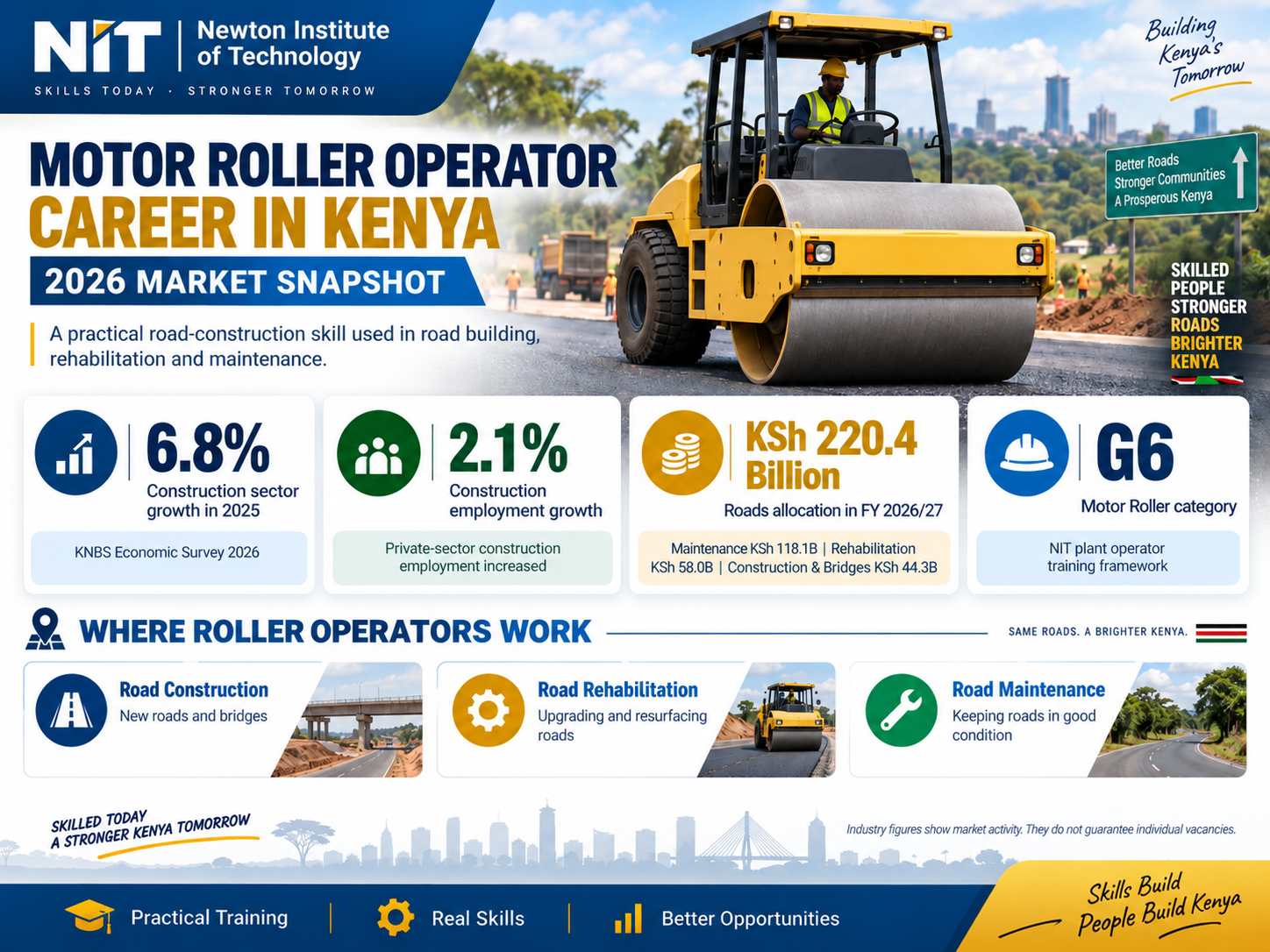
These figures show activity in the wider construction and roads market. They do not represent the number of roller vacancies and they do not guarantee employment for an individual trainee.
The occupation
What does a motor roller operator actually do?
A motor roller spends much of its shift travelling over ground that has already been prepared. From outside the cab, the work can look repetitive. For the operator, every pass has a purpose.
A poor pass can leave part of a layer inadequately compacted. An unnecessary turn can disturb the surface. Working too close to a weak shoulder can put the machine at risk. On asphalt work, timing matters because the material does not remain at the same temperature indefinitely.
The operator may work on soil, gravel, murram, subgrade, sub-base, road base or asphalt. Typical responsibilities include positioning for the first pass, following the required rolling sequence, controlling speed, maintaining sensible overlap, reversing safely, carrying out daily checks and reporting faults before they become larger problems.
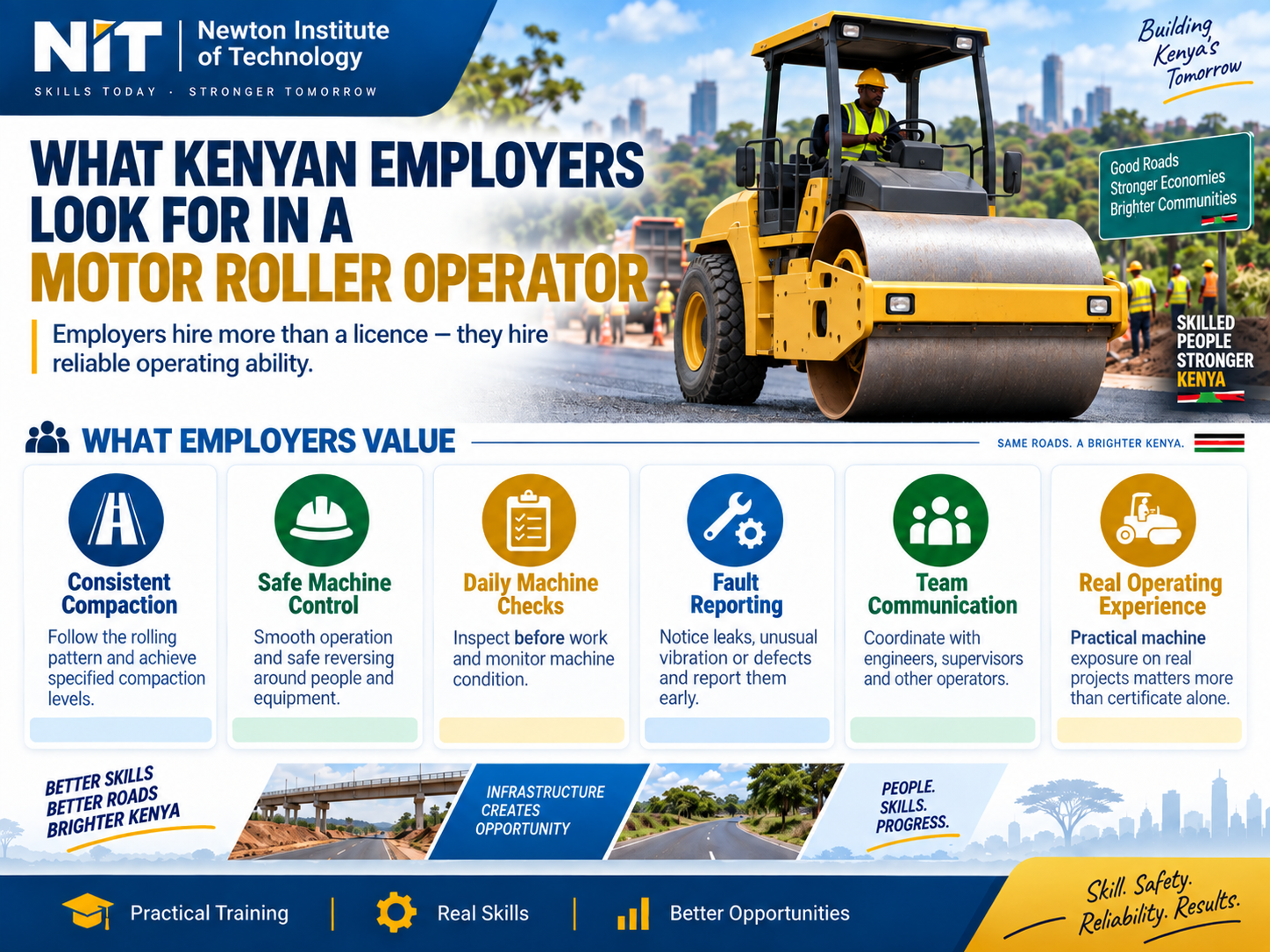
Employers are paying for the result of the operating: consistent compaction, controlled machine movement, good worksite judgement and reliable equipment care.
Where G6 is used
Where can motor roller operators work in Kenya?
New roads and pavement layers
- Prepared subgrade and granular layers
- Road base and shoulders
- Asphalt rolling where the project and roller require it
- Coordination with grader, water-bowser and paving crews
Rehabilitation, maintenance and earthworks
- Reconstruction and strengthening work
- Prepared fill and embankments
- Construction platforms and large yards
- Other civil projects requiring controlled compaction
Road projects normally bring several machines together. The grader may shape a layer, moisture may be controlled, trucks deliver material, survey and quality-control teams check the work, and the roller compacts the prepared surface before the next stage proceeds.
2026 labour-market view
Is there demand for motor roller operators in Kenya?
There is demand, but it is more useful to understand its pattern than to label the occupation simply “high demand.” Roller work follows construction projects. A contractor may need the machine intensively during a compaction stage and then move it when that section is complete.
Kenya’s wider market is supportive. The 2026 Economic Survey reports that construction rebounded by 6.8% in 2025, while private construction employment also increased. The FY 2026/27 National Treasury budget allocates KSh 220.4 billion across road maintenance, rehabilitation and construction of roads and bridges.
The practical conclusion is simple: roller skills remain relevant to Kenya’s roads and civil-construction market, but the strongest candidates still need competence, experience and enough flexibility to follow where projects are active.
What hiring evidence shows
What Kenyan employers look for in a motor roller operator
A Kenyan road-roller vacancy reviewed for this guide asked for safe machine operation, specified compaction levels, routine machine checks, defect reporting, cooperation with engineers and supervisors, punctuality and relevant operating experience. No one vacancy represents every employer, but the pattern is useful.
The operating skill behind the career
The central skill is consistency
An operator can make a surface look smooth without necessarily achieving the required compaction. The project may specify a rolling pattern, pass sequence, operating settings and a compaction target; the operator’s job is to carry out that method accurately.
Soil, murram and road layers
- Know which layer is being compacted
- Watch material condition and the previous pass
- Maintain controlled speed and overlap
- Report weak or unusual areas instead of guessing
Rolling inside a paving sequence
- Coordinate closely with the paving crew
- Work within the project rolling sequence
- Recognise that temperature and timing matter
- Do not apply a gravel-road routine automatically
For beginners
What counts as useful roller experience?
“Experience” becomes more useful when you can describe the actual work. A new operator should gradually be able to explain what material was compacted, which road layer was involved, how the first pass was positioned, how overlap was maintained, which machines were working nearby and who supervised the work.
Build evidence, not claims
Useful early exposure can include
Industrial attachment, supervised project work and legitimate trainee operating opportunities can all help if the machine time is real and properly supervised.
- Subgrade, sub-base, gravel or earthworks compaction
- Following an instructed pass pattern consistently
- Working around grader and water-bowser crews
- Daily pre-start and defect-reporting routines
- Project or attachment details a supervisor can verify
- Asphalt exposure where genuinely undertaken
A Kenyan career in practice
Project experience can build into a long roadwork career
In January 2026, TV47 profiled Ruth Wambui Mwangi, a 27-year-old roller operator working on the Sagana–Karatina–Marua road. She described more than five years in road construction and experience moving between companies before gaining greater stability on the project.
The useful lesson is not a promise of one career path. It is that construction experience can accumulate project by project, and women are already operating rollers professionally on major Kenyan road works.
Career progression
How a motor roller career is built
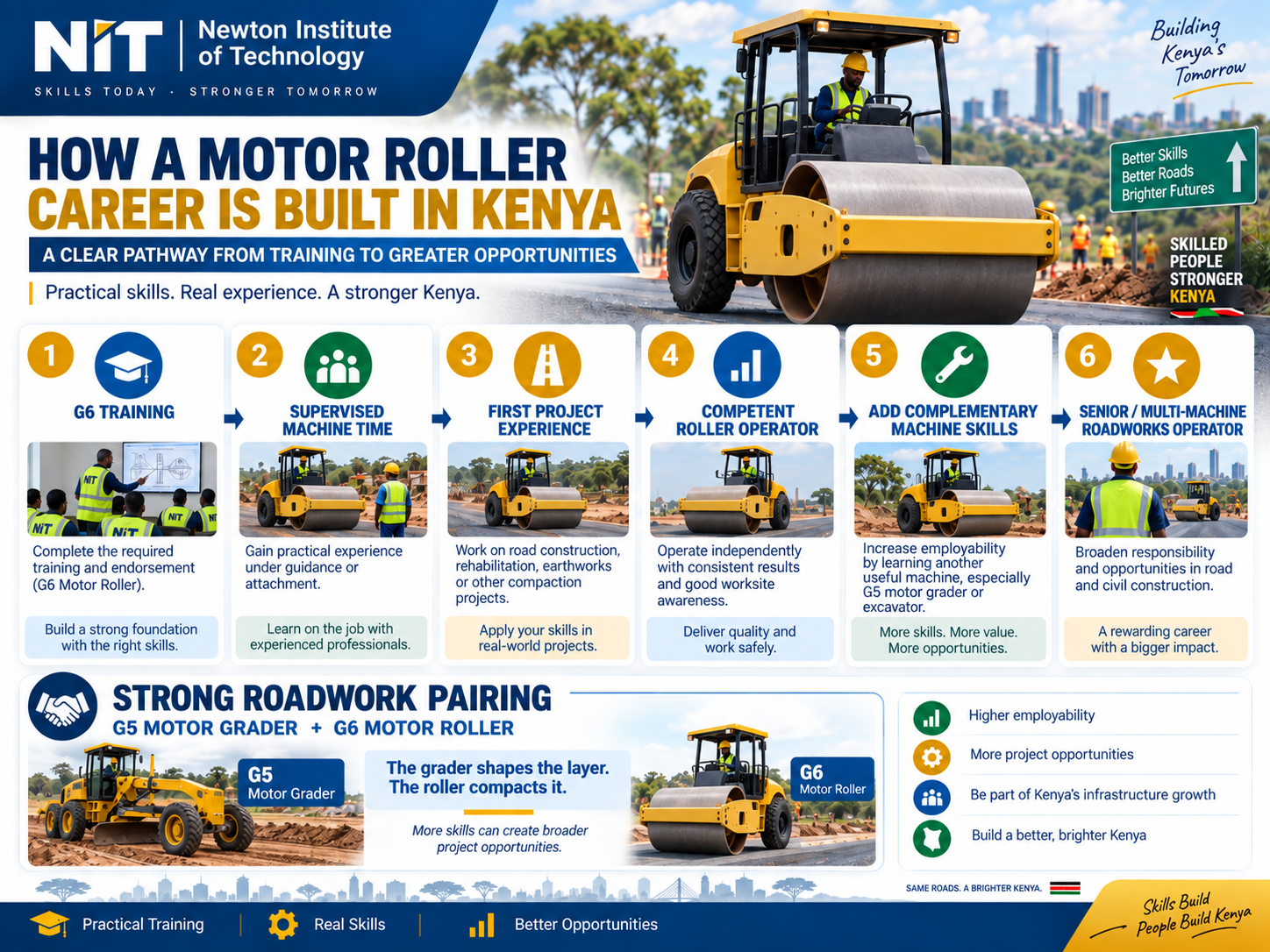
There is no single promotion ladder. One operator may remain a specialist roller operator for years; another may add grading or excavation skills and become useful across more stages of road construction.
A realistic progression is training → supervised roller experience → first project roles → competent roller operator → broader roadwork or multi-machine competence → senior operating or site responsibility.
The grader shapes and prepares the layer; the roller compacts it. The combination gives a learner a broader understanding of the road-production sequence, provided both machines receive genuine supervised practice.
Finding opportunities
Search the job title employers actually use
Do not search only for motor roller operator. Kenyan employers and recruitment platforms may use road roller operator, roller operator, compactor operator, plant operator or heavy equipment operator. Read the description carefully because broad “operator” searches can return unrelated warehouse or production jobs.
For a beginner’s CV, keep the evidence specific: the G6 qualification or endorsement genuinely held, where practical roller exposure was gained, the materials or road layers worked on, the project or attachment and a supervisor who can verify the experience where appropriate.
A practical machine assessment can expose an exaggerated CV very quickly. Accurate, specific experience is easier to defend and easier for a supervisor to trust.
Training and pay
Qualifications, training and salary
Motor roller is G6 within NIT’s current Category G plant-operator machine framework. The detailed driving-licence, training, assessment and endorsement route is covered in the separate NTSA Category G Plant Operator Licence guide.
For machine-specific training, see Motor Roller Training in Kenya. At Newton Institute of Technology, the current Plant Operator programme runs for two months with an approximately 70% practical and 30% theory training model.
Pay varies by employer, project, experience, location and contract arrangement. For the dedicated analysis, use NIT’s Plant Operator Salary in Kenya guide rather than relying on one universal motor-roller figure.
Quick answers
Motor roller career FAQs
Are motor roller operators in demand in Kenya?
Yes. Roller operators continue to be required in road construction, rehabilitation, earthworks and other compaction work. Opportunities are project-led, so demand varies by location and project stage.
What is another name for a motor roller operator?
Common titles include road roller operator, roller operator and sometimes plant operator. Kenya’s occupation classification also recognises Driver, road roller.
Is motor roller operation easy to learn?
The basic controls can be learned relatively quickly. Professional operation takes longer because pass consistency, compaction awareness, safe reversing, machine care and coordination with the site crew all matter.
Can I get a roller operator job immediately after training?
It can happen, but training is not a job guarantee. Employers may ask for previous practical experience as well as the relevant qualifications.
What experience should a beginner try to get?
Prioritise genuine supervised roller work on subgrade, sub-base, gravel, earthworks or asphalt; following rolling patterns; working around other road machines; machine checks; and a supervisor who can verify the work.
Is motor roller a good first plant-operator machine?
It can be a good choice for someone committed to roadwork. Its limitation is that compaction is one stage of a project, so complementary machine skills can broaden employability.
Which machine combines well with motor roller?
Motor grader is a particularly logical pairing because shaping and compaction are closely connected in road construction. Excavator can broaden the package further into drainage, excavation and earthmoving.
Can women work as roller operators in Kenya?
Yes. Women already operate rollers professionally on Kenyan road projects, including the 2026 Sagana–Karatina–Marua example discussed in this guide.
Do roller operators only work on roads?
No. Rollers can also be used on embankments, earthworks, prepared platforms, yards and other civil-engineering projects requiring controlled compaction.
Final career verdict
Motor roller can be a worthwhile roadwork career—but the endorsement is only the beginning
The machine performs a specialised job that remains necessary wherever prepared material has to be compacted properly. The employment market follows projects, which makes practical experience, professional references and complementary machine skills especially valuable.
Learn what the surface under the drum is supposed to become. Build enough supervised machine time to make your passes consistent. Pay attention to how graders, water bowsers, pavers and testing crews affect your work. Those habits are what gradually turn G6 training into a career.
Institutional / Technical review: Engineer Simon Barongo
Train at NIT
Build practical G6 motor roller skills in Migori
Newton Institute of Technology offers two-month plant-operator training with approximately 70% practical work and 30% theory. Confirm G6 machine availability, the current intake, fee package, licensing requirements and attachment arrangements before enrolment.
ProgrammePlant Operator Training · 2 months
Training modelApprox. 70% practical · 30% theory
LocationNamba Area, Migori Town
Sources & accuracy
Evidence used in this guide
KNBS — 2026 Economic Survey · National Treasury — FY 2026/27 Budget documents · Kenya labour-market occupation classifications · TV47 — Kenyan roller-operator profile.
Employer expectations were cross-checked against Kenyan road-roller and road-project recruitment notices reviewed for this article. External job-advert links are intentionally not published here.
Prepared by: Newton Institute of Technology Editorial Team · Institutional / Technical review: Engineer Simon Barongo · Updated: 6 September 2026.
Budget figures describe sector activity, not guaranteed vacancies. Training improves employability but cannot guarantee when or where employment becomes available.