

Plant Operator Career G3 Bulldozer
Bulldozer Operator
Career in Kenya
Jobs · Demand · Skills · Career Growth
A Kenya-focused career guide to where bulldozer work comes from, what employers actually ask operators to do, the experience barrier for beginners and the practical skills that make an operator more employable.
Earthworks career focus
Is bulldozer operation a good career in Kenya?
It can be a marketable plant-operator career for someone who develops genuine earthmoving skill and real site experience. The strongest opportunities are tied to roads, civil works, quarrying, mining, land development and other projects that need clearing, stripping, pushing, spreading or rough grading. Training starts the career; employers ultimately judge what you can do with the machine.
Kenya market signal · 2026
Where bulldozer demand comes from
There is enough activity in Kenya’s construction and extractive sectors to support a serious career case for earthmoving skills, but demand should not be exaggerated into a promise that vacancies are available everywhere.
KNBS reported that Kenya’s construction sector grew by 6.8% in 2025, recovering from the previous year’s contraction. Mining and quarrying also grew strongly, by 14.9%. Those figures do not tell us how many bulldozer operators were hired, but they do show activity in industries where heavy earthmoving equipment is used.
Road activity has continued too. KeRRA published 2026 road-upgrading, spot-improvement and drainage tenders in different parts of the country, while the State Department for Roads announced in August 2026 that KSh139 billion had been mobilised to clear certified contractor bills and accelerate ongoing road projects.
A road, quarry, mine or major civil project can create heavy-equipment activity in one region while another area has very little. Operators prepared for project-based work and reasonable mobility can have a wider employment area.
Bulldozer Operator Career in Kenya

What the market is signalling
What Kenyan employers actually ask bulldozer operators to do
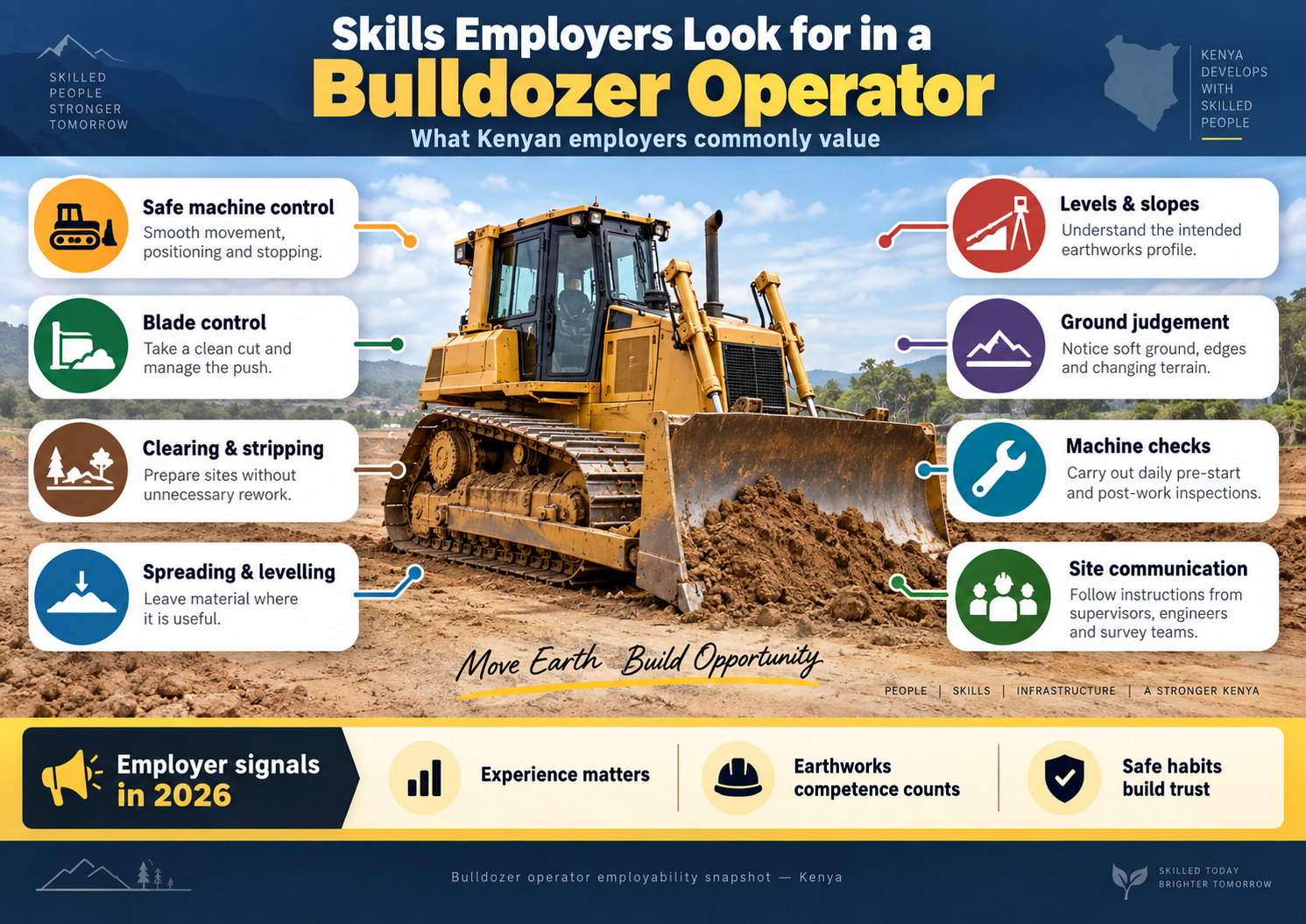
A Kenyan dozer vacancy reviewed in July 2026 asked for two to five years of bulldozer experience in road construction, earthworks, mining, quarrying or civil engineering. The work included site clearing, stripping, spreading, levelling, grading and backfilling, together with daily checks and understanding of grading levels, slopes and earthworks.
A separate 2026 heavy-equipment vacancy requiring bulldozer experience emphasised land clearing and levelling, following engineering drawings and site plans, equipment checks, operating records and coordination with site teams. Another heavy-plant recruitment exercise valued genuine multi-machine competence.
| Employer signal | What it means for the operator | Career implication |
|---|---|---|
| Experience | Established roles may ask for several years of real machine time. | Attachment and supervised site exposure matter early. |
| Earthworks | Clearing and straight pushing are not enough; spreading, levelling and grading appear repeatedly. | Build control beyond basic movement. |
| Levels & slopes | Operators may be expected to work toward an intended profile. | Learn to read the purpose of the earthworks. |
| Machine checks | Routine inspections and fault reporting are part of the job. | Machine care is an employability signal. |
| Site coordination | Dozer work fits around supervisors, engineers, survey teams, trucks and other plant. | Communication matters as much as control. |
| Multi-machine ability | Some heavy-equipment roles value more than one genuinely usable machine skill. | Breadth helps only when competence is real. |
Employer evidence is summarised from recent 2026 Kenyan dozer and heavy-equipment recruitment requirements reviewed by the NIT editorial team. Individual adverts change and may expire.
Skills Employers Look for in a Bulldozer Operator
Where the machine earns its keep
Where bulldozer operators can work in Kenya
Bulldozer work is concentrated where substantial material has to be cleared, pushed, spread or roughly shaped. The machine usually works as part of a larger earthmoving sequence rather than in isolation.
Road construction
Clearing, stripping, embankments, formation preparation, fill spreading and bulk earthworks.
Core dozer environmentCivil engineering
Platforms, access routes, cut-and-fill work, dams, water projects and large developments.
Project basedQuarrying
Working areas, loose material, access maintenance and stockpile support in demanding ground.
Ground judgement mattersMining
Overburden, access, site shaping and supporting material movement in extractive operations.
Experience often valuedLand development
Bulk clearing, topsoil stripping and rough levelling before later construction stages begin.
Site preparationWaste-management sites
Selected heavy-plant operations can include spreading, cell preparation and access-road work.
Broader than roadworkThe work behind the controls
What good bulldozer work actually looks like
A skilled operator does not necessarily look dramatic from outside the cab. Quite often the machine simply keeps moving: the tracks are working rather than spinning unnecessarily, the blade is carrying a manageable load, corrections are small and the material is ending up where it is useful.
Take a useful cut, avoid burying the blade and make smaller corrections before the surface becomes uneven.
Recognise when the machine has enough material instead of wasting power in repeated track slip.
Understand whether the area is being cut down, built up or roughly shaped toward a required profile.
Notice changes in firm ground, loose fill, wet areas, soft patches, edges and embankments.
Spreading is where judgement starts to show
Pushing material across a site is one thing. Spreading it well is another. If one side is left high and another low, the next operator inherits the problem. A better dozer operator is already thinking about where material is accumulating, where the low areas are, where the next truck may tip and what the grader or roller needs afterwards.
Cut-and-fill awareness
A bulldozer operator does not need to become a surveyor, but should understand the purpose of the earthworks. Which area is being cut? Where is the fill going? What level is being approached? What should remain untouched? An operator who understands the purpose of the push usually works more accurately than one waiting for instructions after every pass.
Read the machine too
Spending a full shift with the bulldozer builds familiarity with its normal sound, response and feel. An unusual vibration, warning indication, leak or change in performance deserves attention. The detailed inspection procedure belongs in NIT’s Plant Operator Pre-Start Inspection Checklist; the career point is that employers value operators who notice changes rather than simply keep driving until the machine stops.
Practical operator perspective
The blade is only part of what an experienced operator watches
Early in training, almost all of your attention goes to the blade. With more machine time, the picture widens: ground ahead, material leaving the blade, traction, other plant and where the next pass should begin all start competing for attention.
“With a dozer, you can often tell when a new operator is watching only the blade. An experienced operator is already watching the ground ahead, the material coming off the blade and where the next pass needs to start.”
G3 bulldozer · operator employability · earthworks judgementThe beginner’s biggest challenge
Why employers keep asking for experience
Experience requirements can be frustrating when you have just completed training, but the reason is practical. A new operator may know what the controls do. An experienced operator is more likely to have dealt with changing ground, difficult material, production pressure, trucks entering the work area, several machines moving at once and instructions that have to be translated into actual earth movement.
What a beginner should concentrate on
- Use supervised practical sessions seriously
- Treat attachment as real site learning
- Choose control before speed
- Keep experience claims accurate
- Build credible references from people who have watched you work
What does not solve the experience problem
- Inflating operating hours on a CV
- Collecting endorsements without meaningful seat time
- Ignoring site communication and focusing only on controls
- Trying to look fast before learning accuracy
- Treating inspection habits as somebody else’s job
A short practical assessment can expose exaggerated machine experience very quickly. For the broader interview and practical-test preparation, use NIT’s Plant Operator Interview Questions & Answers in Kenya guide.
Career decision
What is difficult about a bulldozer career?
This career should not be sold only through impressive photographs of heavy machinery. Construction work can be project-based. A road job ends, a civil site moves beyond earthworks and the next opportunity may be somewhere else.
What can be demanding
- Working away from home on some projects
- Dust, noise, vibration, heat, rain and long sitting periods
- Early starts or extended shifts during active projects
- Concentration around slopes, excavations, people and moving plant
- The experience barrier when applying for established roles
What makes the career rewarding
- Practical outdoor work rather than desk-based work
- Seeing a large site change through repeated passes
- Learning machinery through hands-on repetition
- Working as part of an earthmoving team
- Growing from basic control into increasingly independent judgement
Broader earthmoving value
Does knowing another machine help?
It can. Earthmoving projects use different machines for different stages of the same job, and some heavy-equipment roles value operators who can genuinely work on more than one type of plant.
| Machine | Main strength | How it complements bulldozer work |
|---|---|---|
| Bulldozer — G3 | Pushing, spreading and bulk earthworks | Core skill: clearing, stripping, fill movement and rough shaping. |
| Excavator — G4 | Digging and loading | Adds excavation, trenching and truck-loading capability. |
| Motor grader — G5 | Precision surface shaping | Extends roadwork skill into camber, slopes and finish grading. |
| Wheel shovel — G2 | Material handling and loading | Adds stockpile and loading work around earthmoving sites. |
| Motor roller — G6 | Compaction | Connects the operator to the next stage after fill is spread and shaped. |
Two machines you can genuinely operate can strengthen your career more than six that you have barely practised.
Future specialist value
Digital grade control is worth watching
Experienced bulldozer operation is becoming more technical internationally. Modern heavy-civil projects increasingly use GPS/GNSS machine-control systems to show cut-and-fill information and digital design grades inside the cab.
This is not presented here as a Kenyan entry-level requirement or part of the normal G3 licensing process. It is a future specialist skill: an operator who first becomes genuinely competent in conventional earthworks and later learns modern grade-control technology may be better prepared for increasingly technical projects.
What makes the difference on site
What makes one bulldozer operator easier to employ?
Put two operators on the same stretch of formation and the difference can appear quickly. One keeps taking too much material, loses traction and leaves a surface that has to be worked repeatedly. The other takes a cleaner push, watches where material is building, makes fewer corrections and leaves the next operator less work to undo.
Smooth, deliberate movement rather than speed for its own sake.
Understand material, levels, slopes, traction and what the next pass should achieve.
Know how trucks, survey instructions and other plant affect your own work.
Safe habits, inspection discipline, accurate communication and honest experience.
How responsibility builds
A realistic bulldozer operator career path in Kenya
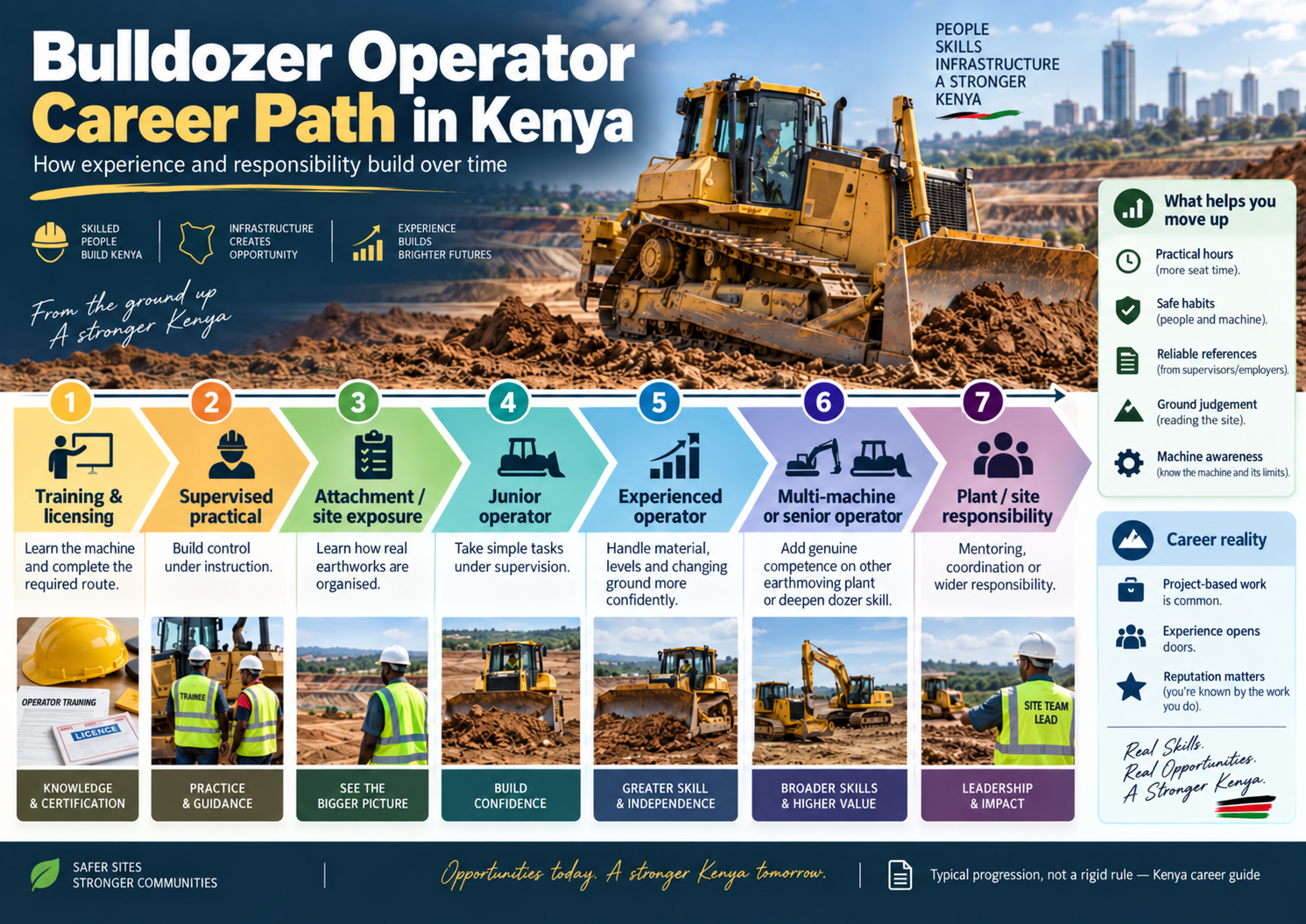
The early stage is training and supervised practice. Attachment or another legitimate form of site exposure then helps the operator understand how the dozer fits into real earthworks. A beginner may start with simpler tasks and short operating periods before taking responsibility for larger areas, more demanding material, changing ground, slopes and work that needs to remain close to site levels.
Some operators specialise deeply in dozer work. Others become genuinely competent on several earthmoving machines. Later opportunities can include senior operating, mentoring newer operators, plant coordination or wider site responsibility.
Bulldozer Operator Career Path in Kenya
Employment pattern
Project work changes how you should think about the career
A bulldozer career may not stay in one location. Road construction moves, new civil projects begin, quarry activity changes and contractors mobilise from one site to another. Operators who build a good reputation may hear about later opportunities through supervisors, equipment owners and people they worked with on earlier projects.
Vacancies may also use different titles. Bulldozer work can appear under Dozer Operator or broader Heavy Equipment Operator recruitment. NIT’s Plant Operator Jobs in Kenya guide covers the wider job-search strategy rather than duplicating it here.
Quick reference
Frequently asked questions
Are there bulldozer operator jobs in Kenya?
Yes. Bulldozer skills are used in roads, civil engineering, quarrying, mining, land development and other operations involving significant earthmoving. The amount of work varies with active projects and location.
Is bulldozer operation marketable in Kenya?
It can be marketable for a competent operator. Construction returned to growth in 2025, mining and quarrying also expanded strongly, and road-project activity continued in 2026. These are positive signals for the wider industries that use earthmoving equipment.
What skills do Kenyan employers look for?
Recent recruitment points to practical experience, clearing, stripping, spreading, levelling, grading, understanding levels and slopes, routine machine checks and safe equipment control.
How much bulldozer experience do employers ask for?
There is no single requirement. A recent Kenyan dozer vacancy reviewed for this guide asked for two to five years of experience, while other roles vary according to the employer and responsibility involved.
Is bulldozer operation difficult to learn?
The controls can be learnt much faster than good earthmoving. Blade loading, spreading, traction management, reading ground and working toward levels take repeated practical experience.
Does a bulldozer operator need mechanical skills?
An operator does not need to be a qualified mechanic, but basic mechanical awareness helps. Operators are commonly expected to carry out routine checks, notice abnormal behaviour and report faults.
Can operating several machines improve employability?
Yes, particularly where employers need flexible heavy-equipment operators. Additional machines strengthen the operator’s profile only when the skills are backed by genuine practical ability.
Is bulldozer operation a permanent job?
It can be permanent, but contract and project-based employment are also normal in construction and earthmoving. Work locations may change as projects start and finish.
Final takeaway
The career eventually becomes a question of judgement
At the beginning, nearly all your attention goes to the controls. Later, the controls become the easy part. You start noticing how much material the blade wants, how the tracks are working, where the ground is changing and what the next pass should achieve.
A few centimetres of unnecessary cut repeated across a large area creates rework. Poor spreading becomes somebody else’s problem. Excessive track slip wastes time and wear. Misunderstanding a level can mean moving the same material twice.
Good bulldozer operators learn to prevent those problems before they become obvious.
Turn interest into practical skill
Train for G3 bulldozer operation at Newton Institute of Technology
Build practical plant-operator skills through supervised machine training that connects controls, earthworks, inspection habits, safety and real operating judgement.
MachineG3 Bulldozer
Training approachPractical + theory
InstitutionNewton Institute of Technology