

Plant Operator Interview Guide Kenya · 2026
35 Plant Operator Interview
Questions & Answers
Inspect · Think · Communicate · Operate
Prepare for the interview and practical test with questions on machine competence, pre-start inspection, safety judgement, machine care, worksite pressure and Category G equipment.
Interview readiness
Before you memorise answers
A plant operator interview is usually testing more than what you can say
For heavy equipment work, a good answer has to match what you would actually do around the machine. Interviewers may listen for machine knowledge, safe judgement, inspection habits, basic machine care, communication and whether your claimed experience sounds genuine.
Do not try to sound like a manual. Give clear answers in your own words, use real examples where you have them and never claim experience on a machine you cannot safely operate.
Scope of this guide
First, what does “plant operator” mean here?
This guide is about operators of construction, industrial and agricultural plant and equipment such as excavators, graders, rollers, shovels, bulldozers, dumpers, cranes, forklifts, tele handlers, tractors and container-handling machines. It is not written for process-plant or factory-control-room interviews.
Interview today?
Prepare these 8 things first
Know the machine, duties, experience level and documents the employer asked for.
Be ready to explain only the equipment you can genuinely operate.
Know what your driving licence, Category G endorsements and certificates actually show.
Dates, attachments, sites, duties and references should agree with what you say.
Blind spots, people, edges, slopes, unsafe instructions and defect decisions come up often.
Be able to explain your walk-around and start-up routine without guessing.
Use a real situation, your action and the result instead of inventing a perfect story.
Your habits before the machine moves can be assessed as closely as the work task.
Can you operate without creating avoidable risk?
The interviewer wants to know whether your machine knowledge, judgement and work habits can be trusted on a real site. Strong candidates normally connect the answer to inspection, control, people around the machine, communication, equipment care and safe shutdown.
Plant Operator Interview Questions & Answers in Kenya
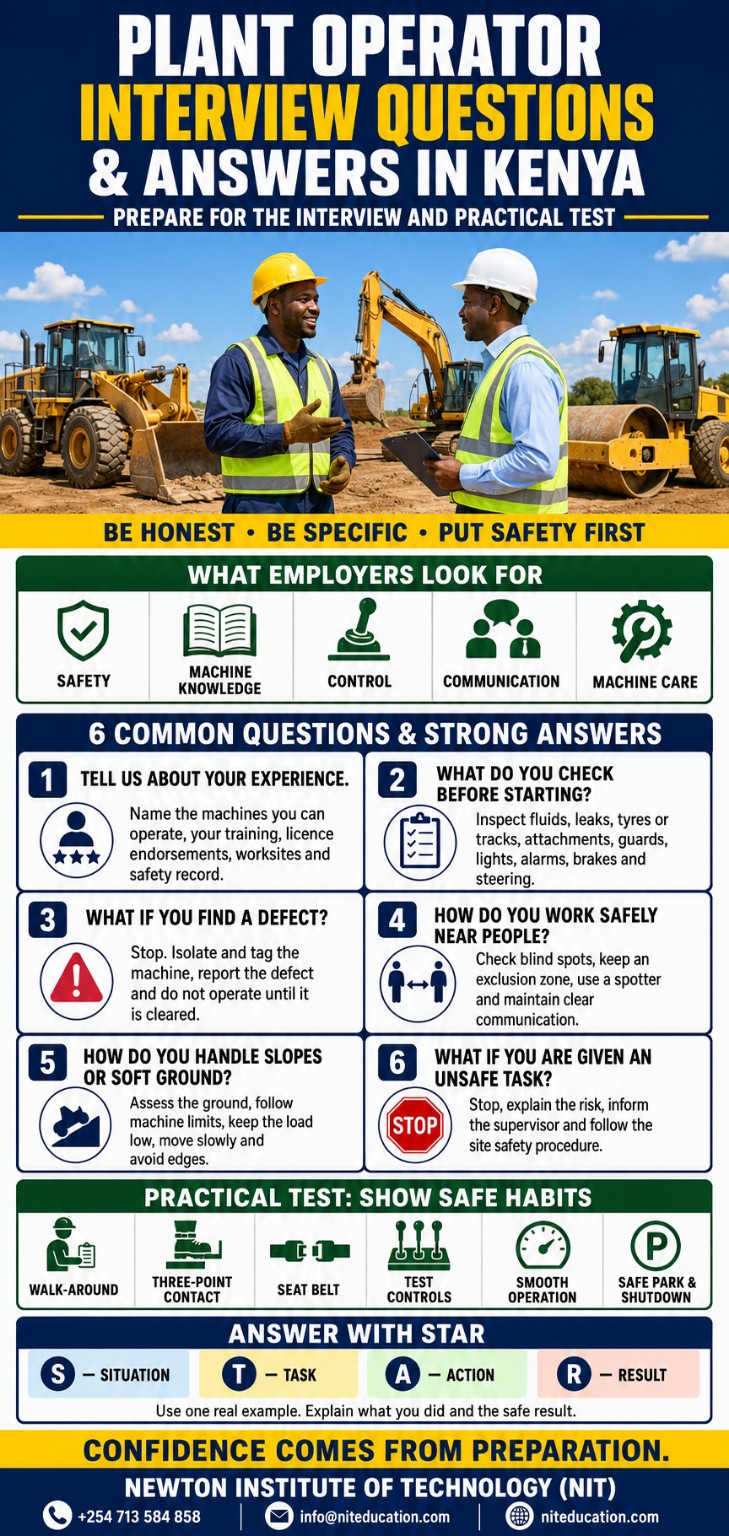
What employers look for
The interview usually comes back to five things
Safety
Recognise hazards, control people and stop unsafe work.
Machine knowledge
Know the equipment you claim to operate and its pre-start routine.
Control
Operate smoothly, position correctly and protect the machine.
Records
Handle inspections, work tickets, handovers and defect reporting honestly.
Teamwork
Follow instructions, communicate clearly and work reliably around others.
Questions 1–6 · General interview questions
Start with experience, machines and work habits
- 01Tell us about yourself.
Keep the answer short and relevant to plant operation. Mention your training, the machines you can genuinely operate, your licence or endorsements, attachment or worksite exposure, and the safety habits you have developed. Do not turn the answer into your full life story.
- 02Which machines can you operate?
Name only the machines you can operate with confidence. If you trained on an excavator, grader, roller, wheel shovel or forklift, say so clearly. An interviewer may move from this question straight to a practical test, so never claim a machine you cannot control safely.
- 03How much plant operator experience do you have?
Give the real period and explain what that experience involved. Training, attachment, supervised site work and paid employment are not the same thing. A clear answer is stronger than an inflated one.
- 04Why do you want this plant operator job?
Connect your answer to the work itself: operating machinery safely, improving your practical experience, contributing to productive site work and growing as an operator. Avoid making salary the only reason.
- 05Why should we hire you?
Focus on evidence: safe machine control, punctuality, proper inspections, care of equipment, willingness to follow instructions, communication and the ability to report defects before they become bigger problems.
- 06What makes a good plant operator?
A good operator does more than move a machine. The operator understands the task, checks the machine, watches the work area, controls the equipment smoothly, communicates clearly, protects the machine and stops when the job becomes unsafe.
Questions 7–11 · Pre-start and safety
Show that your routine starts before the machine moves
- 07What do you check before starting a machine?
Start with a walk-around. Check the work area, leaks, tyres or tracks, attachments, guards, fluid levels where the approved procedure requires them, access steps, visibility, cab condition and safety devices. After starting, check gauges, warnings, horn, brakes, steering and controls before beginning work.
- 08What would make you refuse to start or operate a machine?
Any condition that makes safe operation doubtful: a serious leak, unsafe brakes or steering, insecure attachment, damaged running gear, critical warning, unsafe ground, uncontrolled people in the work zone or another defect that has not been cleared.
- 09What do you do if you find an oil or hydraulic leak?
Do not ignore it. Stop, identify the condition without exposing yourself to pressurised fluid, report it, isolate or tag the machine where the site procedure requires it, and do not continue until an authorised person has cleared the machine.
- 10How do you inspect tyres, tracks and attachments?
Look for obvious damage, abnormal wear, loose or missing parts, poor condition and anything that could affect safe operation. On attachments, check the visible pins, locking points, hoses, cylinders and connections using the machine’s approved procedure.
- 11What do you do before moving the machine?
Confirm the controls are working, fasten the seat belt, check mirrors or cameras, look around the machine, identify blind spots, make sure people are clear, communicate where necessary and move only when the route is safe.
Questions 12–14 · Machine care and records
Know the operator’s responsibility — and its limits
- 12What daily maintenance can an operator do?
An operator should carry out the daily checks and routine care allowed by the machine handbook and site procedure. That can include inspection, cleaning, lubrication points assigned to the operator, checking required fluids and reporting defects. Repairs outside the operator’s authority belong to the responsible technician.
- 13What would you do if the machine developed an unusual noise, warning or loss of power?
Reduce the risk first. Stop in a safe place when necessary, secure the machine, check the approved indicators you are authorised to inspect and report the condition. Do not keep operating simply to finish the task.
- 14How do you handle work tickets, inspection sheets or service records?
Complete them accurately and on time. Record the machine, hours or shift details, work done, inspections, fuel or service information where required, and any defect reported. Never sign for work or checks you did not perform.
Questions 15–20 · Safety judgement
These answers reveal how you think under risk
- 15How do you work safely near people?
Know the machine’s blind spots, keep people outside the working zone, use the agreed communication method, use a spotter where required and stop if you lose sight of a person whose position matters to safe movement.
- 16How do you reverse in a blind or congested area?
Check the route first, use mirrors and fitted cameras, sound the required warning, move slowly and use a competent spotter where the site procedure requires one. If you cannot confirm the route is clear, stop.
- 17How do you work near trenches, excavations or edges?
Assess the ground and the edge before approaching. Keep within the site’s safe limits, watch for unstable ground and hidden collapse risk, and do not place the machine where its weight or movement could make the edge unsafe.
- 18How do you handle slopes or soft ground?
Assess the ground, follow the machine’s limits and site procedure, keep the machine controlled, avoid sudden movements and keep loads or attachments in the safest position for that machine and task. If stability is doubtful, stop and get guidance.
- 19What would you do if a supervisor told you to do something unsafe?
Explain the risk clearly and respectfully, stop the unsafe action and follow the site’s escalation procedure. A production target does not cancel the operator’s responsibility to work safely.
- 20What would you do if you hit an object or damaged the machine?
Stop, secure the machine and report exactly what happened. Check for injury or further danger, follow the site’s incident procedure and do not hide the event or continue operating a machine that may have been damaged.
Questions 21–25 · Work pressure and site conditions
Productivity matters, but shortcuts are not competence
- 21How do you work when the site is under pressure to meet a deadline?
Keep the normal safety routine. Plan the task, communicate delays early, operate smoothly and avoid shortcuts that increase the chance of injury, damage or rework. Fast work that creates an incident is not productive work.
- 22What would you do if you were too tired to operate safely?
Report the fatigue before it becomes a hazard. Follow the site’s working-hours and rest procedure and do not pretend you are fit to operate when your concentration or reaction is clearly affected.
- 23How do you handle rain, dust or poor visibility?
Slow down or stop when conditions reduce control or visibility below a safe level. Use the site’s controls for lighting, traffic, dust, drainage or communication and resume only when the task can be performed safely.
- 24How do you hand over a machine at the end of a shift?
Park and shut down correctly, record the machine condition and hours where required, report defects or unusual behaviour, and tell the next operator or supervisor anything that could affect the next shift.
- 25What would you do if the machine broke down in a position that affected other workers or traffic?
Secure the machine and the area first. Warn the relevant people, use the site’s traffic or exclusion controls, report the breakdown and wait for authorised recovery or repair instructions.
Questions 26–30 · Behavioural questions
Use a real example instead of a polished story
- 26Tell us about a time you prevented an unsafe situation.
Use one real example. Explain the situation, the risk you noticed, what you did and the result. The strongest examples show that you noticed a hazard early and acted before somebody was hurt or equipment was damaged.
- 27Tell us about a mistake you made while training or working.
Choose a genuine mistake that you corrected. Explain what happened, what you learnt and what you changed afterwards. Do not claim that you have never made a mistake.
- 28Tell us about a disagreement with a supervisor.
Show that you can remain respectful. Explain the issue, how you communicated, how the work or safety concern was resolved and what you learnt. The answer should not become an attack on a previous supervisor.
- 29How do you handle poor communication with a spotter or another worker?
Stop the movement if the signals are unclear. Re-establish the agreed signals or communication method before continuing. Guessing what a signal means is not a safe option around heavy equipment.
- 30Give an example of how you have taken care of a machine.
Use a real example involving inspection, cleaning, lubrication, correct operation, defect reporting or another approved care routine. Explain how that action protected the machine or prevented a problem from becoming worse.
Question 31 · Fresh operator
No long work history? Do not invent one
- 31You are a fresh operator. Why should an employer consider you?
Do not apologise for being new. Be honest about your experience and emphasise what you can prove: recent practical training, safe habits, willingness to learn, correct inspections, careful machine control, punctuality and respect for supervision. Never invent work history.
Questions 32–35 · Machine-specific examples
Expect the interview to move from general safety to your actual machine
- 32Excavator question: what do you check before digging?
Confirm the task, ground condition, people and traffic controls, machine position, swing area, trench or edge risk and the location of services that may be affected. Do not begin digging until the work area and instructions are clear.
- 33Motor grader question: how do you approach a finishing task?
Understand the required level, slope or crossfall, inspect the route and material, set up the machine correctly and work in controlled passes while checking the result. Do not chase speed at the expense of line, level or safety.
- 34Motor roller question: how do you achieve controlled compaction?
Follow the approved rolling pattern and site instruction, keep speed and overlap consistent, watch edges and other workers, and avoid abrupt movements that damage the surface or make the roller unstable.
- 35Forklift question: what do you check before moving with a load?
Confirm the load is within the machine’s approved capacity and is stable, check the route and overhead clearance, keep people away from the travel path, position the load correctly for travel and move smoothly with clear visibility.
Category G interview preparation
Know the machine code you are presenting to the employer
The confirmed current Class G machine list used in this guide runs from G1 to G14. Prepare most deeply for the machine named in the vacancy and the machines you genuinely claim to operate.
| Code | Machine | Interview focus |
|---|---|---|
| G1 | Track Shovel | Prepare for the controls, inspection, work task and safety risks of this machine. |
| G2 | Wheel Shovel | Prepare for the controls, inspection, work task and safety risks of this machine. |
| G3 | Bulldozer | Prepare for the controls, inspection, work task and safety risks of this machine. |
| G4 | Excavator | Prepare for the controls, inspection, work task and safety risks of this machine. |
| G5 | Motor Grader | Prepare for the controls, inspection, work task and safety risks of this machine. |
| G6 | Motor Roller | Prepare for the controls, inspection, work task and safety risks of this machine. |
| G7 | Backhoe Loader | Prepare for the controls, inspection, work task and safety risks of this machine. |
| G8 | Dumper | Prepare for the controls, inspection, work task and safety risks of this machine. |
| G9 | Crane | Prepare for the controls, inspection, work task and safety risks of this machine. |
| G10 | Forklift | Prepare for the controls, inspection, work task and safety risks of this machine. |
| G11 | Tele Handler | Prepare for the controls, inspection, work task and safety risks of this machine. |
| G12 | Farm Tractor | Prepare for the controls, inspection, work task and safety risks of this machine. |
| G13 | Top Loader | Prepare for the controls, inspection, work task and safety risks of this machine. |
| G14 | Reach Stacker | Prepare for the controls, inspection, work task and safety risks of this machine. |
Practical test
The practical test may begin before the engine starts
An assessor can learn a lot from the way you approach the machine. Rushing straight into the cab can undo a strong interview answer.
- 01Approach in the required PPE
Look at the work area and machine before touching the controls.
- 02Walk around the machine
Look beneath, around and above where relevant for obvious hazards or defects.
- 03Inspect running gear and attachments
Check visible tyres or tracks, pins, locks, guards, hoses and connections as applicable.
- 04Check access and visibility
Steps, handholds, windows, mirrors and cameras should allow safe access and observation.
- 05Use three-point contact
Enter and leave the cab using safe access habits.
- 06Fasten the seat belt
Set the seat and controls before moving.
- 07Confirm safe start condition
Use the correct neutral, parking and start procedure for the machine.
- 08Observe gauges and warnings
Do not ignore an abnormal warning after start-up.
- 09Test required controls
Horn, steering, brakes and operating controls should respond correctly before work begins.
- 10Clear the blind spots
Look around, communicate and confirm people are outside the movement zone.
- 11Move smoothly
Controlled movement shows more competence than unnecessary speed.
- 12Perform the assigned task
Keep observation, positioning and machine limits in mind throughout the task.
- 13Park and shut down safely
Secure the machine, lower the attachment where applicable and report any defect or unusual behaviour.
NIT Plant Operator Interview Readiness Test
Score yourself before the employer does
Give yourself one point only when you can do the item confidently without inventing an answer.
| Readiness item | Score | What you should be able to do |
|---|---|---|
| Machine knowledge | 0 / 1 | Describe the machine you are applying to operate and its main work. |
| Pre-start inspection | 0 / 1 | Explain your walk-around and start-up checks in a sensible order. |
| Controls | 0 / 1 | Identify the main controls without guessing. |
| Defect response | 0 / 1 | Explain when you would stop, isolate and report a defect. |
| People & blind spots | 0 / 1 | Explain safe movement around people, reversing and spotters. |
| Ground judgement | 0 / 1 | Explain how you approach slopes, soft ground, trenches and edges. |
| Real example | 0 / 1 | Give one honest example using situation, action and result. |
| Practical finish | 0 / 1 | Demonstrate safe parking, shutdown and handover. |
What to carry
Take the documents the employer can actually verify
Use the vacancy advert as the final checklist.
- National identification or the identification requested by the employer.
- Current CV with correct dates and contacts.
- Driving licence and relevant Category G endorsements where applicable.
- Plant operator training certificates.
- Attachment, work or reference documents that genuinely apply to you.
- Work tickets, logbook or service records only where they are yours to present.
- PPE when the employer has told you to expect a practical assessment.
- Pen and a small notebook.
What to wear
Look ready for an interview — and ready for a site if required
Wear clean, practical clothing. If a practical test is expected, use appropriate safety footwear and the PPE the employer has instructed you to bring. Do not arrive dressed for a machine test in a way that makes safe access difficult.
The salary question
Do not guess an impressive number before you understand the job
A natural answer is: “I am open to the employer’s range for this role. I would also like to understand the machine, working hours, site, level of responsibility and the full package.”
Before you leave
Good questions to ask the employer — and mistakes to avoid
Useful questions
- Which machine will I mainly operate?
- What are the normal duties and worksite conditions?
- How are shifts and overtime handled?
- Who do operators report defects to?
- Will there be a practical assessment?
- What PPE is supplied or required?
- How is routine maintenance organised?
Common interview mistakes
- Exaggerating machine experience.
- Repeating technical words you cannot explain.
- Saying you would continue an unsafe task to please a supervisor.
- Treating every defect as somebody else’s responsibility.
- Forgetting blind spots and people around the machine.
- Rushing the practical test.
- Guessing when a question or instruction is unclear.
A simple way to answer difficult questions
Use one real example and keep the structure simple
Situation & risk
Explain what was happening and what could have gone wrong.
Action & result
Explain what you did, why you did it and the safe result.
The night before
Prepare the basics so the morning is not rushed
Confidence is easier when the simple things are already organised.
- Confirm the interview location, route and reporting time.
- Arrange your documents and clothing.
- Prepare required PPE if a practical test is expected.
- Review the exact machine in the vacancy.
- Go over your pre-start and defect-response routine.
- Prepare one or two genuine work or training examples.
- Sleep properly instead of cramming technical phrases.
Frequently asked questions
Plant operator interview questions in Kenya: quick answers
What are the most common plant operator interview questions in Kenya?
Expect questions about the machines you can operate, experience, pre-start checks, defects, safe work near people, slopes or soft ground, machine care, communication, pressure and practical operation.
How should a fresh plant operator answer interview questions?
Be honest about being new. Use training, attachment and supervised practice as your evidence, explain your safety routine clearly and never invent machine hours or work history.
Will a plant operator interview include a practical test?
It can. Some employers want to see the candidate inspect, start, control, move, perform a basic task, park and shut down the machine safely rather than relying only on certificates.
What documents should I carry to a plant operator interview?
Carry the documents requested in the advert. Common items include identification, CV, driving licence and relevant endorsements, training certificates, references and any work or inspection records that genuinely apply to you.
What if I am asked about a machine I have never operated?
Say so. Explain the machines you do know and do not pretend you can safely operate unfamiliar equipment. Honesty is better than being exposed during a practical test.
How do I prepare for a Category G machine-specific interview?
Revise the machine you are applying to operate: its pre-start inspection, controls, blind spots, stability risks, common work tasks, safe shutdown and the Category G code that applies to it.
One rule worth taking into the interview
Safety should sound natural because it should already be a habit
“Check first. Move second. A few seconds of caution can prevent a lifetime of regret.”
Final reminder
The strongest answer is the one your practical habits can support
Be honest about your experience, specific about the machine, clear about the risk and calm about the safe action you would take.
Inspect. Think. Communicate. Operate.