

NIT Resources . Plant Operator
Excavator vs Backhoe Loader
Compare how the machines dig, load and move, with practical Kenyan worksite examples and clear learning advice.
Begin here
Excavator vs backhoe loader: the essential differences
On a phone, swipe this table sideways to compare both machines.
| At a glance | Excavator | Backhoe loader |
|---|---|---|
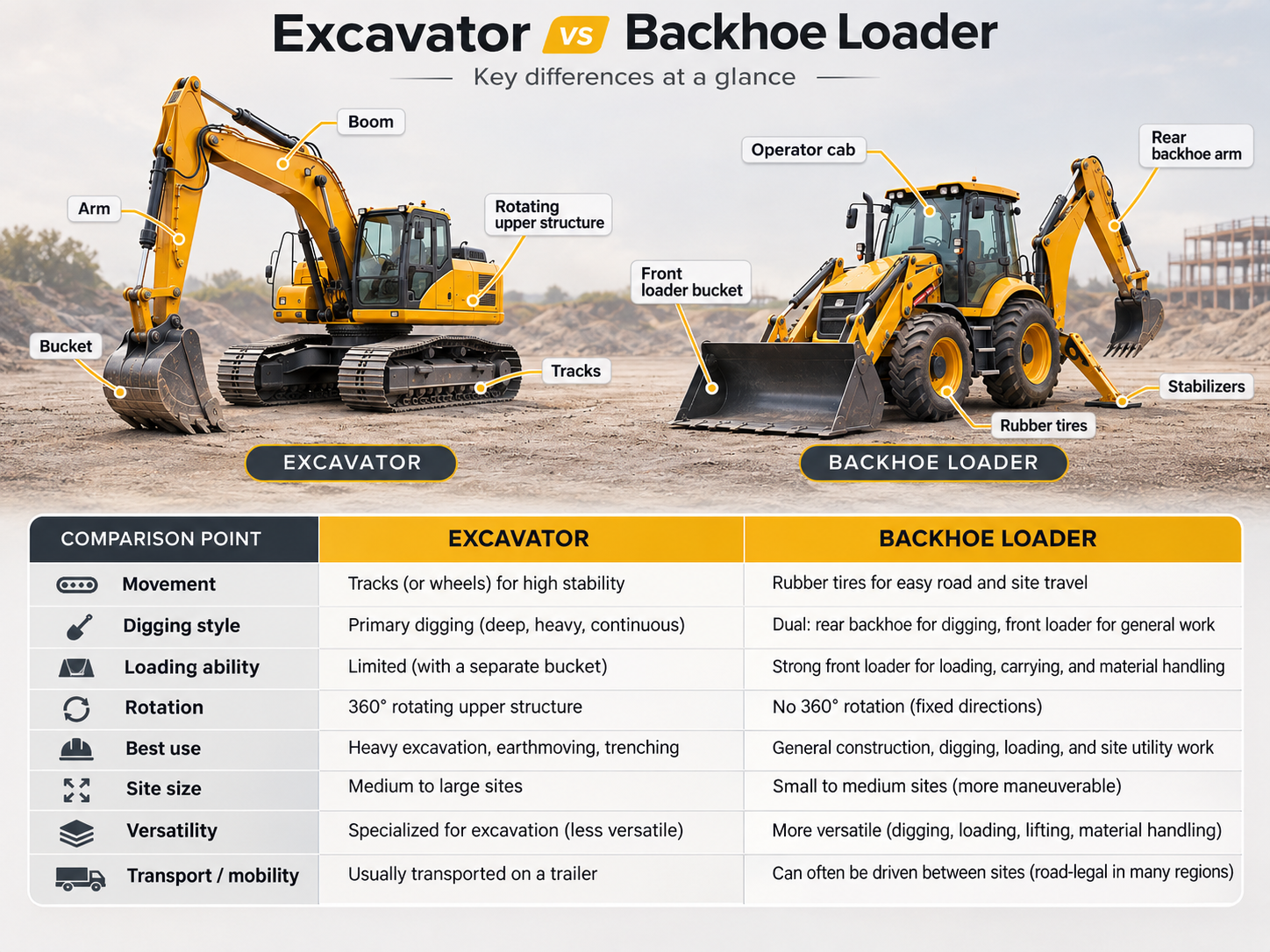
| Main layout | Boom, arm and bucket on a rotating upper structure | Front loader plus rear digging assembly |
| Typical strength | Sustained excavation and placing spoil within reach | Several kinds of smaller or mixed digging and loading tasks |
| Turning while digging | Upper structure normally slews through 360° | Rear arm swings through a limited arc |
| Travel | Tracked or wheeled, depending on model | Usually tyre-mounted |
| Front loader bucket | Not a standard feature | Built into the machine |
| Rear-digging setup | Stable position and clear swing area | Stable position, with stabilisers set as specified |
| What a beginner learns | Coordinating digging equipment, slewing and safe positioning | Operating two working ends, moving the chassis and setting up to dig |
For a quick decision: mostly continuous digging and swinging spoil into a truck? Consider an appropriately sized excavator. Digging plus repeated front-bucket loading, carrying and backfilling? Consider a backhoe loader. The answer changes with the exact model, available space, ground, attachments and work plan. This article compares conventional dedicated hydraulic excavators with complete backhoe loaders—not a small backhoe attachment fitted to another vehicle.
A backhoe loader can excavate, and an excavator can load trucks. The difference is not that one machine can perform a task and the other cannot . It is how each machine is built to carry out different combinations of work. [1]
Machine identification
How to recognise the two machines on a construction site
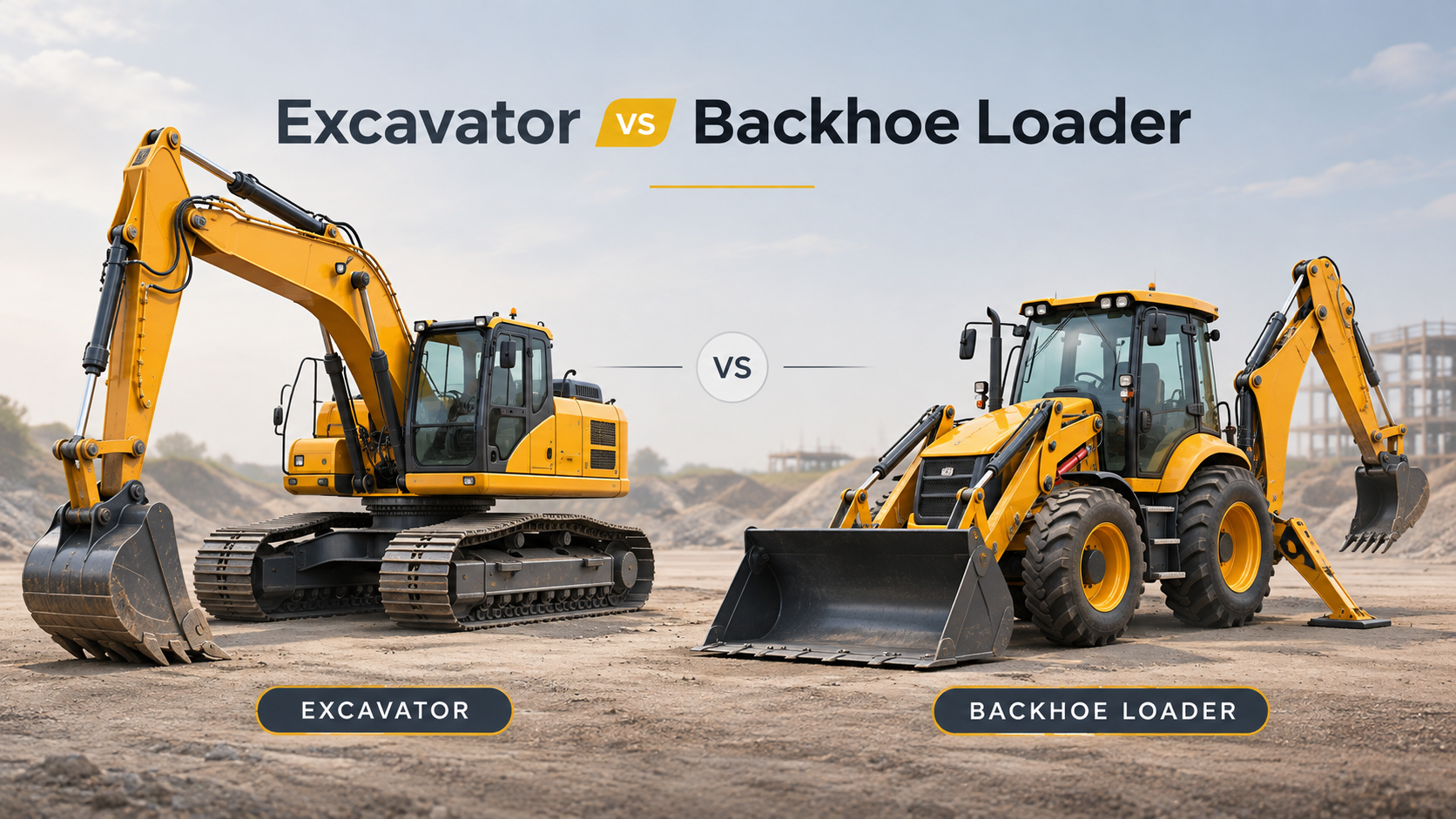
Picture two machines beside a road-drainage project. One is turning its cabin and boom toward a waiting tipper while its tracks remain in place. The other has a large bucket at the front, a smaller digging arm at the back and tyres underneath. Even before either machine begins work, you can identify the layout.
The excavator: a digging system on a rotating upper structure
Look for the boom (the first large section attached to the machine), arm or stick (the section between the boom and bucket), bucket , upper structure (the cab, engine housing and counterweight) and undercarriage (tracks or wheels). The excavator uses its rotating upper structure to move between a digging face and a spoil pile or truck, without turning the whole undercarriage for every bucketful. A tracked excavator is common, but wheeled excavators exist too. [1] [11]
There are mini, medium and large excavators. Comparing a mini excavator with a large backhoe loader—or a large excavator with a compact backhoe—can produce very misleading conclusions about power, depth or site access.
The backhoe loader: a front loading system and a rear digging system
A conventional backhoe loader has a front loader bucket for gathering and moving loose material, a rear backhoe for excavating, tyres , and stabilisers that support rear digging when deployed according to the operator’s manual. The driver uses different controls and machine positions for the front and rear work. [1] [2]
The word backhoe sometimes means just the rear digging assembly; backhoe loader means the combined machine. This distinction helps when reading equipment quotations, training brochures or technical manuals.
For detailed anatomy, use NIT’s separate Excavator Parts and Functions and Backhoe Loader Parts and Functions guides. This page concentrates on how the two complete machines compare , rather than explaining every component. [13]
Follow the material
How the work cycles differ
The clearest way to understand the machines is to follow the material rather than focus on their colour or size.
When the job is repeated excavation
Imagine a long trench for a drainage line. Once the work area has been planned and made safe, an excavator may dig, lift the soil, slew to a designated spoil area or truck, release the load and return to the trench. The same cycle repeats. Its fully rotating upper structure can be especially useful when the digging face and spoil destination are on different sides of the machine. [1]
The backhoe loader also digs with a boom, arm and bucket. However, the rear assembly has a limited swing range. Depending on the site layout, a conventional centre-mounted backhoe may need repositioning to continue along the trench or discharge spoil. Some backhoes use side-shift rear assemblies , which can move the digging attachment sideways across the rear frame and change that calculation. The precise model matters. A backhoe loader is not unsuitable for trenching; its geometry changes how the work is planned. [1] [17]
When the job switches between digging and loading
Suppose the job involves opening a short trench, moving several heaps of loose soil and then spreading backfill. A backhoe loader offers a rear digging tool and a front loader bucket without changing to a separate machine. This is useful where the project has a mixture of tasks rather than a long, uninterrupted excavation run. [1]
An excavator can also place spoil into a truck with its digging bucket and can use compatible attachments. It is incorrect to say that excavators cannot load trucks. But using an excavator’s digging bucket is not the same operation as scooping, carrying a short distance and dumping material with a front loader. Always compare the task, not only whether the machine has a bucket.
When the machine must move
A wheeled backhoe loader can often travel readily around a worksite and may be configured for road travel. That does not mean every machine may be driven on any Kenyan public road: applicable registration, permits, transport arrangements, road restrictions and the specific machine must be checked. Tracked excavators commonly require planned transport between sites; wheeled excavators are a separate option. [1] [11]
Tracks also do not make an excavator safe on soft or unstable ground. Soil bearing capacity, slope, excavation edges and machine weight matter whichever machine is selected. [4] [5]
Worksite examples
Which machine is better for these jobs in Kenya?
These are teaching examples, not instructions to select or operate equipment without a site assessment. The aim is to recognise the dominant task and the condition that could change the choice . Start with one non-negotiable test: if underground services, ground stability, adjacent buildings, people or traffic cannot be managed safely, neither machine should be selected for work until a competent site team has resolved the hazard. In some utility projects, a trenchless method or a smaller machine may be more appropriate than either original candidate. [4] [5]
A long drainage trench beside a road
If most of the day involves cutting a continuous trench and loading spoil into trucks, investigate a suitably sized excavator . Its repeated dig–slew–dump cycle is a useful match for the dominant task. The contractor would still need a traffic-management plan, service-location checks, ground support and room for the counterweight. [4] [5]
Change the question, though, and the answer can change. Several short, scattered trenches with frequent loading and backfilling may make a backhoe loader more useful. A particularly narrow site might rule out both proposed machines.
A school compound needing a short trench and backfilling
Here the crew must excavate, shift loose soil and put some of it back. A backhoe loader deserves consideration because the two work ends cover the sequence without bringing in a separate loader. But the front bucket cannot solve a lack of space for the rear stabilisers. Before selecting it, the supervisor must check access, obstacles, people nearby and ground conditions; a compact excavator with support equipment may fit the site better.
A large foundation excavation with repeated truck loading
This work is dominated by volume, reach and a steady truck-loading cycle. An excavator matched to the project is a sensible starting point. Its upper structure can turn toward the truck without the machine having to drive around for every bucketful. Haulage capacity and the truck arrangement still need planning. Bringing in an excavator does not remove the possible need for a loader or other support machines.
Several separated water-pipe repairs
A team opens small excavations at different points, then replaces backfill and moves to the next location. A wheeled backhoe loader may cover the mix conveniently. Yet convenience is not the deciding factor if underground cables, narrow road shoulders, pedestrians or the machine’s permitted transport arrangements cannot be safely managed. In a confined spot, a smaller excavator may be the better candidate.
A site-selection method that starts with safety
Use the following five checks on a hypothetical project . An actual equipment decision belongs to the competent site team.
- Stop gate — Is the proposed method safe enough to consider? Locate underground and overhead services, investigate excavation-edge support and ground bearing conditions, plan barriers and pedestrian separation, and assess nearby structures. If these cannot be controlled, reconsider the method before choosing a machine. [4] [5]
- Dominant work — What takes the time? Is the main job sustained excavation, or a series of shorter digging, front-loading and backfilling tasks?
- Spoil path — Where will the material go? Directly into trucks, temporarily beside the trench, or across the site? Avoid assuming a bucket built for digging is a substitute for a front loader carrying material.
- Working envelope — Will the actual machine fit? Check depth and reach, counterweight or tail-swing space, rear-stabiliser footprint, access and turning width, overhead clearance and ground conditions.
- Model and method — Which available combination completes the whole job? Compare exact machine and attachment specifications, supporting equipment, transport, planned operating hours and the remaining work. For jobs dominated only by bulk loading, a dedicated loader could belong on the shortlist too. [14]
Keep the initial choice provisional until a competent supervisor confirms the work plan. A machine capable of reaching the trench bottom is not necessarily safe or economical to work there.
Compare the trade-offs
Excavator and backhoe loader advantages and limitations
| Machine | Real advantage | Limitation to plan for |
|---|---|---|
| Excavator | Effective repeated digging and spoil placement, with wide machine-size and attachment choices | Front-bucket loading and carrying are not its usual design role; transport and tail-swing clearance may matter |
| Backhoe loader | Front loading and rear digging in one usually wheeled machine | Restricted rear swing, stabiliser space and task changeovers affect where and how it works |
Neither machine is automatically faster, cheaper, safer or more powerful. Those claims need matched specifications and a defined job. A large excavator is not a fair benchmark against a small backhoe loader, and a mini excavator is not a fair benchmark against a full-size backhoe.
Which machine costs less to complete a job?
Compare the full cost of finishing the same work , not just the quoted hourly hire rate. A cost comparison must include mobilisation or transport, hours of actual digging, time switching tasks, supporting machines and people, attachments, fuel or operating charges when not included, waiting time, and any agreed site-protection arrangements. Equipment-management systems measure working cost separately from idle cost and calculate cost per volume moved for a reason. [12]
Try this with two real quotations:
| Ask the supplier or site team | Option A: excavator | Option B: backhoe loader |
|---|---|---|
| Can the specified model safely meet reach, load and access requirements? | Record model and relevant specification | Record model and relevant specification |
| What is the mobilisation / transport charge? | Enter quote | Enter quote |
| How many planned operating hours for the same scope ? | Enter supported estimate | Enter supported estimate |
| Are a second loader, truck, attachments or extra handling needed? | List and price each | List and price each |
| Which charges are excluded from the hourly rate? | List exclusions | List exclusions |
Then compare total = mobilisation + (quoted hourly rate × planned hours) + additional equipment and specified charges , keeping every item on the same basis. This is a comparison method, not a published Kenyan hire-rate estimate.
A backhoe loader may reduce equipment changes on a short, mixed-task job. A suitably sized excavator may reduce digging time on a sustained excavation. Both are hypotheses to test against the specific work, not universal cost claims.
Does an excavator always dig deeper?
No. As a model-specific example, the official JCB 3CX Plus information describes up to 5.97 m digging depth with a deep-profile bucket , while the Cat 313 GC excavator’s published configuration lists 6.04 m maximum digging depth . The displayed values are close, but this is not a like-for-like performance test : the 3CX range is listed at roughly 7.9–8.6 tonnes , while the cited 313 GC configuration weighs about 13.8 tonnes . Equipment arrangement, boom, arm, bucket, test definition and machine size differ. The numbers do not prove equal digging force, working speed, fuel use or suitability. [2] [3] [16]
The deeper lesson is that digging depth is one specification, not a machine verdict . A contractor must also examine usable reach, bucket capacity, material density, ground support, working space, transport and the actual workflow. Manufacturer selection guidance emphasises choosing an appropriate bucket and tool before selecting the excavator around it. [14]
Read the specification sheet without being misled
| Specification | What it helps you understand | What it does not prove |
|---|---|---|
| Maximum digging depth | Maximum listed reach below the reference plane in a stated setup | That the machine can dig safely to that depth on your actual site |
| Reach at ground level | How far the digging equipment can extend | That material can be moved or loaded at that distance without other constraints |
| Bucket capacity | Nominal volume of material the bucket can hold | Actual tonnes per hour; density, fill, cycle and site layout matter |
| Operating weight | Approximate mass of a particular configured machine | That the ground or trench edge can support it |
| Swing / slewing geometry | Which areas the working end can reach without moving the chassis | That there is enough safe clearance for people and nearby structures |
| Travel arrangement | Whether a model uses tracks or tyres and how it can reposition | That it may legally or safely travel on any public road |
When someone says one machine is “more powerful,” ask which model, which attachment, which material and which measurable performance figure . Without those details, the claim cannot guide a responsible equipment choice.
Safety before productivity
Safety: different machines, some shared dangers
The most serious beginner mistake is to concentrate on the bucket and forget everything around the machine. The operating area includes the undercarriage, the counterweight or rear digging swing, vehicles, people and ground that may not support the load.
With an excavator , the rotating upper structure creates a swing zone. People can be struck by the bucket or trapped between its counterweight and an obstruction. Good site management uses separated pedestrian routes, controlled access, suitable visibility measures and competent operators. Excavators moving earth should not be assumed suitable for lifting slung loads; lifting is a separately planned, capacity-checked operation using appropriately equipped machinery. [4] [15]
With a backhoe loader , preparation for rear digging includes positioning the chassis and using the stabilisers as the manufacturer specifies. Changing between driving, front loading and rear excavating introduces different movements and blind spots. Roadside work also needs a planned traffic arrangement. [1] [4]
With both machines , locate underground services before excavation, assess excavation edges and adjacent structures, and plan for heavy rain or water that could affect the trench. Spoil, vehicles and machines must not overload unsafe edges. Keep people out of exclusion areas and never enter a trench that has not been adequately assessed and protected. [5]
In Kenya, workplace occupational safety is overseen by the Directorate of Occupational Safety and Health Services under the Occupational Safety and Health Act, 2007. The UK safety guidance cited here explains technical hazards; it is not a substitute for Kenya’s requirements, site procedures or the machine’s operating manual. [6]
Learning direction
Which machine should a beginner learn?
Choose by the work you want to understand, not by a claim that one machine guarantees employment . The machines reward related but different sets of skills.
Excavator-focused learner
Training develops coordination of boom, arm, bucket and slewing; judging reach; controlling a digging line; and placing material accurately. Someone interested mainly in foundations, trenching and sustained earthmoving may prefer that work.
Backhoe-loader-focused learner
Training covers the front loader and rear excavator as distinct systems. They also practise positioning, stabiliser awareness, movement between tasks and working safely around mixed construction activity. Someone who enjoys changing between loading, digging and backfilling may prefer that range.
If you are considering training in Kenya, arrange to see the actual machines. Ask an instructor which exercises demonstrate safe digging, material placement, blind-spot awareness and recognition of unsafe ground , and how supervised practice and assessment are organised. The answer is more useful than asking only which machine looks more powerful. NIT’s separate excavator operator training guide and backhoe loader training guide explain their respective pathways. [7] [8]
NIT’s current machine-code guides identify the excavator as G4 and the backhoe loader as G7 . Those labels help Kenyan trainees distinguish their learning choices; detailed Category G requirements belong in the separate licensing guide. [9]
Can you learn both? Yes, subject to programme availability and the applicable licensing process. Learning both only adds value when you develop usable skills on each. To understand Category G eligibility, training and endorsement, use NIT’s Category G guide rather than treating an educational comparison as a licensing checklist. [9]
If your main question is which plant operator machine is most marketable in Kenya , that is a different decision. NIT addresses it separately in Most Marketable Plant Operator Machines in Kenya .
Knowledge check
Test yourself: three decisions
Try each case before reading the answer. The correct answer is a reasoned starting point , not a universal machine prescription.
Case 1: A contractor will spend most of the week excavating one long drain and loading trucks.
Starting answer: Investigate an excavator with suitable reach and capacity. Repeated digging and slewing dominate. But first check the excavation edge, available working width and traffic plan.
Case 2: A small site needs two short trenches, loading loose soil, then backfilling.
Starting answer: Investigate a backhoe loader. Its front and rear work ends can cover the mix. Confirm that it can be positioned and stabilised safely and that the available model fits.
Case 3: A deep excavation is beside a building, and the machine that meets the digging-depth specification would need to stand close to the edge.
Starting answer: Do not choose either machine based on its digging depth. The ground support, adjacent structure, equipment position and alternative methods need competent assessment first. [5]
A useful habit is to explain why you chose a machine and what new information would change your choice .
Common misconceptions
Common misunderstandings
“Excavators cannot load trucks.”
They can load excavated material using the bucket or a suitable attachment. Front-bucket loading and short-distance carrying remain different operations.
“Every excavator is bigger than every backhoe loader.”
Mini excavators exist. Compare specific machine classes rather than labels.
“Tyres mean a backhoe loader can be driven anywhere.”
Site suitability and public-road use depend on machine configuration, ground conditions and applicable transport rules.
“The machine with the greatest quoted digging depth is the best buy.”
Digging depth does not reveal the full work envelope, ground support, productivity, access or whole-job cost.
“Two machine endorsements make someone job-ready.”
Paper qualifications do not replace safe, supervised practice and actual competence. For a wider career comparison, consult the separate NIT marketability resource.
Straight answers
Frequently asked questions
Is a backhoe loader an excavator?
It performs excavation, but a backhoe loader is a distinct machine layout combining front loading and rear digging. The term excavator in this comparison means the dedicated machine with a rotating upper structure. [1]
Which machine is better for digging a trench?
An appropriately sized excavator often suits continuous trench excavation; a backhoe loader can be useful on shorter jobs that also need front-bucket loading or backfilling. Depth, ground, space and work method decide.
Can a backhoe loader replace an excavator?
For some jobs, yes. For others, its reach, swing range, bucket capacity or required working setup will not suit the task. Check the exact models rather than assuming they are interchangeable.
Which is more versatile?
A backhoe loader provides front loading and rear excavation in one machine. Excavators can be highly versatile with compatible attachments. Versatility only makes sense when you name the tasks you need completed.
Which is easier to learn?
Neither has a universal difficulty ranking. One concentrates on excavating and slewing; the other requires proficiency with two working ends and changeovers. Good instruction, supervised time and a suitable learning sequence matter more than the label.
Which is better on a tight construction site?
The safe fit may be a compact excavator, a suitably configured backhoe loader, or a different work method. Check access and turning width, tail swing, stabiliser clearance, the spoil location and separation of people and vehicles. A compact machine may fit through the gate but still leave no safe area to operate. “Smaller” does not automatically mean “safer”. [4] [5]
Is a backhoe loader always cheaper because it does two jobs?
No. It may reduce the need for an additional loader when a project alternates between digging and front loading, but the result depends on the work sequence, machine availability, hours required, transport and additional equipment. Compare quotations for the same completed job—not just an hourly rate. [12]
For programme details and available training options, see the NIT Plant Operator programme [10] .
From understanding to supervised practice
Learn plant operation at Newton Institute of Technology
Understanding which machine does what is the beginning. Practical training is where learners build judgement about positioning, control, safety and when to stop a task.
Explore the machines and training pathway available through NIT.
Use the separate G4 and G7 training guides for detailed eligibility and learning options.
Confirm available equipment, practical sessions, intakes and current programme details.
Sources and technical references
Machine specifications and safety explanations are sourced to manufacturer technical information, occupational-safety guidance and NIT’s separate training resources. International technical safety guidance does not replace applicable Kenyan requirements.
-
Official backhoe-loader technical FAQs — manufacturer explanation of excavator slewing, limited rear-backhoe swing, front loading and mixed tasks.
-
JCB 3CX backhoe-loader specifications — current product range, operating weight and maximum digging depth; values vary with model and configuration.
-
Caterpillar 313 GC hydraulic excavator specifications — maximum digging depth, operating weight and selected machine configuration.
-
UK Health and Safety Executive: Excavators — overview — swing hazards, exclusion, visibility and competence; UK technical guidance.
-
UK Health and Safety Executive: Excavations — excavation collapse, underground services and equipment near excavation edges; UK technical guidance.
-
Kenya Directorate of Occupational Safety and Health Services: mandate — Kenyan authority overseeing workplace occupational safety and the Occupational Safety and Health Act, 2007.
-
NIT: Excavator Operator Training in Kenya — existing excavator course-specific resource.
-
NIT: Backhoe Loader Training Kenya — existing backhoe-loader course-specific resource.
-
NIT: NTSA Category G Plant Operator Licence in Kenya — licensing and eligibility guide.
-
NIT: Plant Operator programme — current programme discovery and admissions page.
-
Official wheeled-excavator model range for Africa — manufacturer confirmation that wheeled excavators form a distinct excavator category.
-
Equipment productivity: operating, idle and material-movement cost measures — manufacturer software reference defining total working cost, idle cost and cost per material moved.
-
NIT: Backhoe Loader Parts and Functions — existing NIT guide on backhoe layout and side-shift configurations; kept distinct from this page’s equipment-comparison intent.
-
Caterpillar: Three Rules of Thumb for Excavator Selection — equipment selection based on material, buckets, machine configuration and attachments.
-
UK Health and Safety Executive: Excavators and Lifting Operations — separate suitability assessment and safety considerations for excavators used to lift suspended loads; UK guidance, not Kenyan law.
-
JCB: 3CX DualDrive Plus specifications — manufacturer clarification that a 5.97 m figure is associated with a deep-profile bucket configuration.
-
Caterpillar: Side Shift or Center Pivot Backhoes — primary manufacturer explanation of side-shift mechanisms, rear attachment geometry and implications for repositioning.