

NIT Applied Technology Guide Kenya · 2026/2027
AI, Data & Cybersecurity
Behind Business Results
Problem → evidence → technical work → value
A Kenya-focused guide to what applied AI, data and cybersecurity capability looks like when the goal is to solve a real organisational problem.
Workplace test
AI · DATA · CYBERSECURITY · BUSINESS CONTEXT
Which technology skills matter in Kenya in 2026/2027?
AI, data analytics and cybersecurity are increasingly useful when they are connected to a real organisational need. Applied AI improves a defined piece of work. Data turns records into evidence for a decision. Cybersecurity protects the systems and information the organisation depends on.
Kenyan employer and vacancy evidence also points to communication, critical thinking, problem-solving and business understanding alongside technical ability. [1] [2]
A technical course teaches the tools. Workplace competence begins when the learner can decide what to do with them.
A supermarket does not need a dashboard because dashboards are fashionable. It needs to know why stock disappears, which products move fastest and where money is being lost. A logistics business may use AI to shorten a repetitive workflow or improve access to information. A growing organisation needs cybersecurity so its accounts, systems and operational data remain protected while people work.
That is the central idea in this guide: technology becomes valuable inside a real problem that needs to be solved.
Kenyan labour-market evidence
What the employer evidence actually tells us
The Federation of Kenya Employers’ 2023 Skills Needs Survey received responses from 521 enterprises. Information technology was the leading career field in reported competence demand at 35%. The same report identified effective communication at 49.1%, critical thinking at 41.7% and digital security at 33% in their respective skills categories. [1]
The World Bank’s Kenya Skills Demand Bulletin looks at online vacancies from 2020 to June 2024. Its advanced digital requirements include data analysis, Python, SQL, automation, software development, APIs and data management. Its transversal skills include communication, problem-solving, analytical ability, decision-making and business acumen. [2]
More recent adoption evidence shows why applied capability matters. PwC’s August 2026 Kenya cloud outlook reports that 90% of surveyed organisations had increased cloud usage to support AI and machine-learning requirements, while half were already piloting or deploying agentic AI. PwC also highlights governance, security, skills and operating models as part of turning technology investment into long-term business value. [3]
They point beyond software names. Organisations need people who can combine technical skill with judgement, communication and enough business context to produce a useful result.
| Field | Technical knowledge | Workplace application | Useful result |
|---|---|---|---|
| AI | Models, prompting, APIs, automation | Improve a defined workflow and check the output | Faster service, easier information access or less repetitive work |
| Data | Excel, SQL, Python, visualisation | Turn imperfect records into an answer to a business question | Clearer evidence for a decision |
| Cybersecurity | Systems, networks, logs, access controls | Identify exposure, apply controls and verify the change | Safer systems and protected operations |
| Business context | Customers, workflow, cost, revenue, risk | Identify the correct problem before choosing technology | Technical work aimed at an outcome the organisation needs |
On a small screen, swipe horizontally to view the complete comparison.
One integrated workplace case
Start with the organisational problem
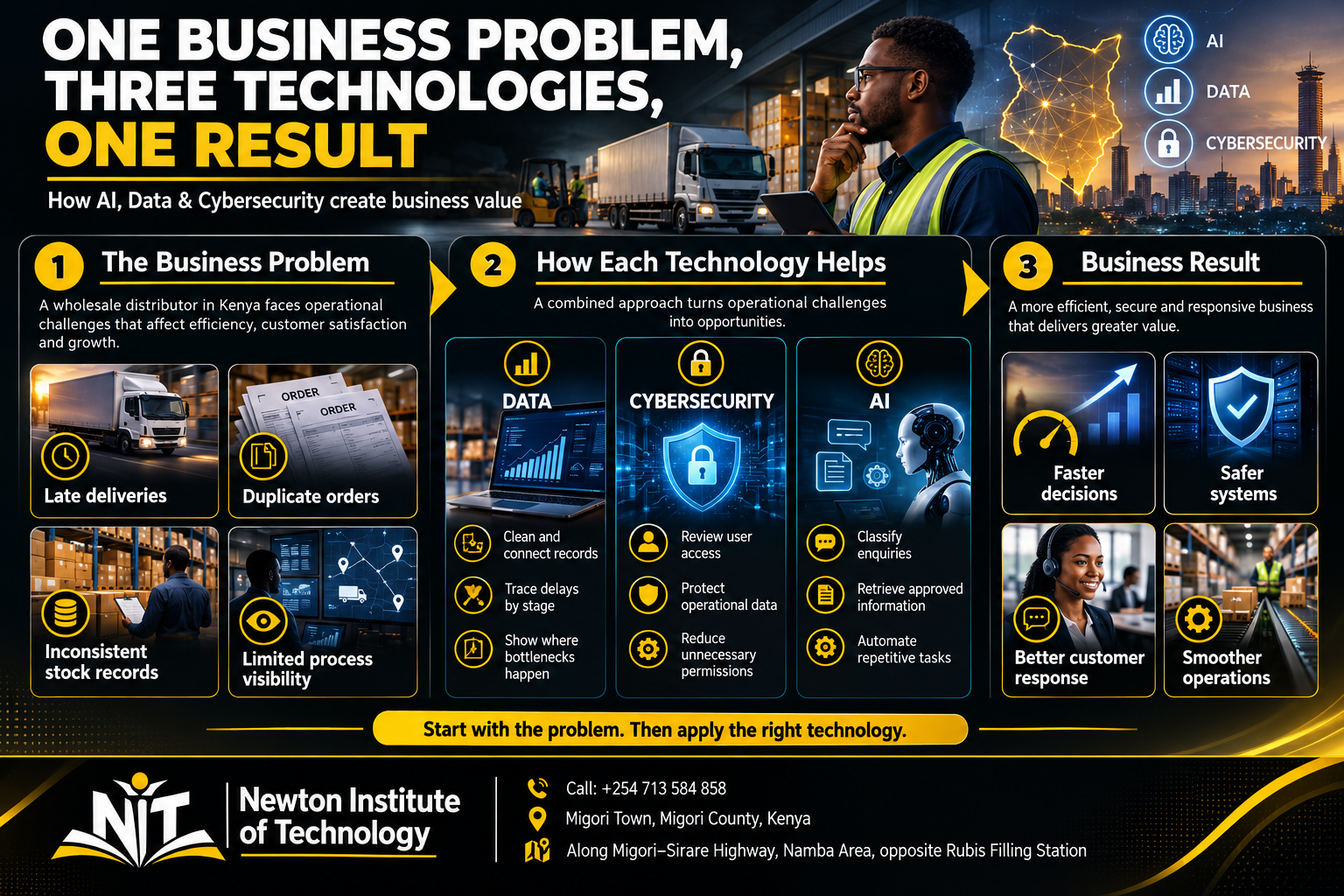
Consider a wholesale distributor serving several towns. Orders arrive through different channels. Some are entered twice. Product names are recorded inconsistently. Stock figures do not always match what is physically available. Customers complain about late deliveries, but management cannot see where most delays occur. Several staff accounts also have broader system access than their current roles require.
The obvious temptation is to start with a fashionable technology. The stronger approach is to investigate the work first.
Trace orders through receipt, processing, dispatch and delivery so management can see where delays and stock inconsistencies occur.
Match user permissions to current roles, protect operational information and verify that normal work still functions after the change.
Once the workflow and information are reliable, AI can assist with enquiries, approved information retrieval, classification or forecasting.
Three technologies. One organisation. One starting point: understand the problem first.
Applied capability 01
AI skills: improve a defined piece of work
Artificial intelligence can produce an impressive demonstration quickly. A workplace implementation has to fit the organisation’s actual process.
Imagine a customer-service team receiving hundreds of similar questions: whether an order has left, whether a product is available, when a delivery will arrive or how an order can be changed. Before building an AI assistant, the practitioner needs to know where the approved information comes from, which questions can be handled automatically, which requests should go to a person and how the output will be checked.
This is increasingly relevant in Kenya. PwC’s 2026 cloud outlook shows organisations investing in cloud capacity for AI and machine-learning workloads, while the Ministry of ICT’s September 2026 policy-to-action statement says digital and AI investment should translate into measurable gains in productivity, jobs, enterprise growth and public services. It also calls for AI literacy and practical skills alongside advanced capabilities for people building AI solutions. [3] [4]
Kenya’s National Artificial Intelligence Strategy 2025–2030 organises the country’s AI direction around digital infrastructure, data ecosystems and governance, and research, innovation and commercialisation. [5]
Define the original workflow, show what the AI-assisted process changes, test it against known cases and explain where human attention remains part of the process.
Problem
Staff spend too much time finding the same approved information for ordinary enquiries.
Technical work
Build an AI-assisted retrieval or automation workflow using controlled information sources.
Result
Routine information becomes quicker to retrieve while complex cases continue to receive human attention.
Applied capability 02
Data skills: move from records to a decision
Businesses generate records every day: sales, stock, payments, attendance, customer enquiries, machine performance, website activity and delivery times. The existence of those records does not make them useful.
Return to the distributor. Management wants to know why customers in one area regularly receive orders late. The analyst first has to identify which records contain the order, dispatch and delivery events; standardise inconsistent names and dates; deal with duplicates; calculate how long each stage takes; and compare branches or periods.
The World Bank’s Kenya vacancy analysis supports the technical side of this work. Its advanced digital category includes data analysis, Python, SQL, forecasting, automation and data management. [2]
Ask the question
Define the decision or operational problem the analysis must support.
Prepare the records
Find missing values, duplicates, inconsistent names and fields that cannot yet be compared reliably.
Analyse the process
Measure what happens at each stage and test whether the pattern is consistent.
Explain the finding
Show what the evidence says in language management can act on.
A dashboard is useful when it keeps a business question visible. The analysis comes first; the visualisation helps people keep using the answer.
Applied capability 03
Cybersecurity skills: protect the work the organisation depends on
Cybersecurity is easiest to understand when it is tied to the systems, accounts and information people rely on every day.
In the distributor case, several employees have permissions left over from previous roles, a temporary account is still active and warehouse staff can reach information that is not needed for their work. A cybersecurity practitioner needs to establish what matters, who should have access, what access currently exists, what should change and how the correction will be verified.
FKE’s employer survey found digital security among the digital-competence areas needed by participating enterprises. Kenya’s expanding use of AI, cloud services and connected digital systems makes that applied security work part of wider technology adoption. [1] [3]
Evidence
Accounts, permissions, logs, device state and configuration show what is actually happening.
Control
Apply the change that reduces the identified risk without interrupting legitimate work.
Verification
Check that the control works, normal users can still do their jobs and the finding is documented clearly.
Readers who want the occupation-specific route can continue to NIT’s separate Cybersecurity Career in Kenya guide. [8]
The context around the technology
Business understanding is part of technical competence
A technically strong person still needs enough organisational context to recognise what problem is worth solving. In the distributor case, late deliveries might come from transport, but they might also come from delayed order entry, incorrect stock records, poor dispatch sequencing or unclear approvals.
The World Bank vacancy evidence is useful here because business acumen appears alongside critical thinking, troubleshooting, analytical skills, decision-making and problem-solving. [2]
Customer
Who receives value from the process, and what does a good outcome look like for them?
Workflow
Which steps happen from beginning to end, and where does information change hands?
Cost & revenue
Where are time and money consumed, and which activities support income or service delivery?
Turnaround time
How long does the work take, and which stage accounts for most of the delay?
Access
Who needs to see or change information in order to complete a legitimate responsibility?
Risk
What can stop the process, corrupt the evidence, expose information or damage the organisation?
Make technical work usable
Communication changes the value of technical work
A data analyst can say, “there are null values and inconsistent dimensions in the dataset.” A useful workplace explanation goes further: “some branches are recording the same product under different names, so their totals cannot yet be compared reliably; I have identified the affected records and will recalculate the branch view after standardisation.”
The same principle applies in cybersecurity and AI. A useful technical explanation states the problem, the evidence, what it affects, what should change and how the result will be checked.
FKE’s survey found effective communication to be the most frequently reported social skill in its results at 49.1%, followed by critical thinking at 41.7%. The World Bank vacancy analysis also places communication and higher-order problem-solving capabilities prominently in its transversal category. [1] [2]
Original NIT framework
The NIT Business-Value Test
A technology project becomes stronger when the learner can answer five questions in sequence.
- Problem.
What real problem are you trying to solve? - Evidence.
What information shows the problem exists? - Technical work.
What did you analyse, build, configure or secure? - Checking.
How did you verify that the result worked? - Value.
What became clearer, quicker, safer or easier to manage?
Problem → Evidence → Technical Work → Checking → Value. It works across AI, data and cybersecurity because it keeps attention on the outcome rather than the tool alone.

Proof of practical capability
What should a technology portfolio actually show?
A useful portfolio makes the learner’s reasoning visible. The finished interface matters, but so do the original problem, the evidence used, the decisions made and the checks performed.
| Field | Basic evidence | Stronger workplace evidence |
|---|---|---|
| AI | Screenshots of prompts or a model response | A defined workflow, technical implementation, tested outputs and the improvement achieved |
| Data | A dashboard on its own | A business question, data preparation, analysis, finding and decision supported |
| Cybersecurity | A security-tool screenshot | Scope, evidence, finding, corrective action and verification |
The broader NIT guide ICT Skills Employers Want in Kenya covers portfolios and general ICT job-readiness in more depth. [7]
Explain the workflow
Show what staff did before, what the AI-assisted process changed, how answers were checked and which cases still needed human attention.
Evidence of applied judgementExplain the decision
Show how records were cleaned, which metric answered the question, what pattern was found and how the result could be used.
Evidence of analytical reasoningExplain the risk
Show the scope, the evidence collected, the weakness identified, the control applied and the verification after remediation.
Evidence of disciplined security workExplain the value
Describe what became quicker, clearer, safer or more reliable, and connect that change to the original organisational problem.
Evidence of business understanding
From controlled exercises to real systems
Why workplace exposure changes the learning process
Classroom exercises are normally designed so the learner can concentrate on a particular concept. Real organisations are less tidy. A dataset may contain years of inconsistent entries. The person reporting a technical problem may describe it incorrectly. A user may request a feature and later clarify that the workflow works differently. A security issue may span several systems.
FKE recommends stronger links between training institutions and employers through attachments, internships and apprenticeship opportunities as part of addressing skills gaps. [1]
The learner gets to experience users, deadlines, existing systems, incomplete information and changing requirements—the conditions in which technical judgement develops.
Beyond technology companies
Digital capability is spreading across sectors
Kenya’s Labour Market Information System currently lists the Key Employability Skills Report 2024–2025 under its 2026 employability-skills resources, alongside current job-trends and labour-demand publications. It provides an official place to follow how skill demand is changing across Kenya’s labour market. [6]
The Ministry of ICT’s September 2026 digital-and-AI statement makes the cross-sector application explicit: it frames value in terms of more productive businesses, better jobs, more efficient public services and wider opportunities, with examples ranging from farmers and MSMEs to teachers and young people building digital skills. [4]
A data practitioner may work in logistics, finance, agriculture, education or manufacturing. Cybersecurity is relevant wherever systems and information need protection. AI becomes useful wherever a well-defined process can be improved with appropriate data and controls.
Newton Institute of Technology
How NIT trains towards applied capability
Newton Institute of Technology offers specialised ICT pathways in Full-Stack Software Development, Cybersecurity, Data Science & Analytics, Artificial Intelligence and Mobile App Development. The programmes use practical exercises, projects and industrial attachment to move from technical concepts into work that learners can demonstrate and explain. [7]
Understand the problem
Begin with the user, process, system or data question rather than a software name.
- Requirements
- Context
- Evidence
Perform and test the work
Build, analyse, configure or secure something and check whether it behaves as intended.
- Projects
- Labs
- Testing
Explain the result
Demonstrate what was done, why the approach was chosen and what changed because of the work.
- Portfolio
- Reporting
- Attachment
NIT’s existing ICT employer-skills guide documents examples of student project work and explains the broader role of portfolios and attachment in demonstrating practical capability. [7]
Choosing a starting point
What should you learn first?
Start with the kind of problem you want to become good at solving, then build enough depth to do useful work.
Data
If you enjoy asking questions of information and finding patterns, build strong spreadsheet, SQL, analysis and visualisation foundations before adding more advanced tools.
Cybersecurity
If you enjoy investigating systems and understanding how they work, strengthen computer, networking and Linux foundations, then move into security labs and reporting.
AI
If you are interested in classification, prediction, retrieval or automation, develop data and computing foundations while learning how AI outputs are tested and applied.
As specialist depth grows, add the neighbouring skills the work requires: communication, business context, security awareness, data quality and the ability to learn new tools.
A simple way to describe your work
Remove the software names first
Take one project and explain it without naming the tools. Instead of saying, “I used Python, SQL and Power BI,” explain that you combined sales and stock records to find why stock-outs were increasing, identified the affected products and built a view management could use to investigate the pattern.
Then name the tools.
The same works for AI and cybersecurity. Start with what you improved or protected, then explain the technology that made the work possible.
An employer can now ask why you chose the approach, how you checked it and what you would improve next. Those questions reveal understanding.
The practical conclusion
Technology skills become employable when they produce useful work
Data helps an organisation see what is happening. Cybersecurity protects the systems and information the organisation depends on. AI can improve suitable information flows, decisions and repetitive processes once the underlying problem is understood.
Business understanding connects the technical work to the organisation. Communication turns the result into something other people can use. Practical projects and workplace exposure make that capability visible.
When choosing what to learn, ask two questions: What technology interests me? Then ask the more important follow-up: What useful work will I be able to do with it?
Frequently asked questions
AI, data and cybersecurity skills in Kenya
Are AI skills useful in Kenya in 2026/2027?
Which data skills are relevant to employers in Kenya?
World Bank vacancy evidence for Kenya identifies data analysis, Python, SQL, forecasting, automation and data management among advanced digital requirements. Their practical value increases when they are used to answer a clear organisational question. [2]
What does practical cybersecurity skill look like?
It includes understanding systems and networks, examining evidence, managing access, identifying technical risk, applying controls, documenting findings and verifying that the correction works. FKE also identifies digital security among the digital-competence needs reported by participating enterprises. [1]
Why are business skills relevant to someone studying technology?
Technology operates inside workflows involving customers, information, cost, time, permissions and risk. Business context helps a technical practitioner identify the correct problem and judge whether a solution created value.
How can a beginner prove practical technology skills?
Use projects that show the full chain from problem and evidence to technical work, checking and result. The learner should be able to open the project, demonstrate it, explain the decisions and answer questions about what changed.
Does industrial attachment help ICT students?
Yes. Workplace exposure introduces real users, existing systems, incomplete information, deadlines and changing requirements. FKE recommends attachments, internships and apprenticeships as part of strengthening links between training and employer needs. [1]
Build practical digital capability
Study ICT at Newton Institute of Technology
Train through practical exercises, projects and industrial attachment in Full-Stack Software Development, Cybersecurity, Data Science & Analytics, Artificial Intelligence and Mobile App Development.
Call / WhatsApp+254 713 584 858
LocationNamba Area, Migori Town · along Migori–Sirare Highway
LandmarkAbout 0.3 km opposite Rubis Filling Station