

NIT Driving Guide Kenya · 2026
What You Need to Join
Driving School in Kenya
Age · documents · category · eCitizen · PDL
A practical pre-enrolment guide for first-time learners and licence-upgrade applicants: what to have ready, what official sources say, and what to check before paying.
First-time Class B starting point
What do you need to start a driving course?
For an ordinary first-time car learner, start by checking that you are at least 18, choosing the correct Class B category, having your identification and eCitizen details ready, and checking which supporting documents currently apply. Kenya’s published Category B curriculum lists age 18+ and a medical test certificate as minimum enrolment requirements.[1]
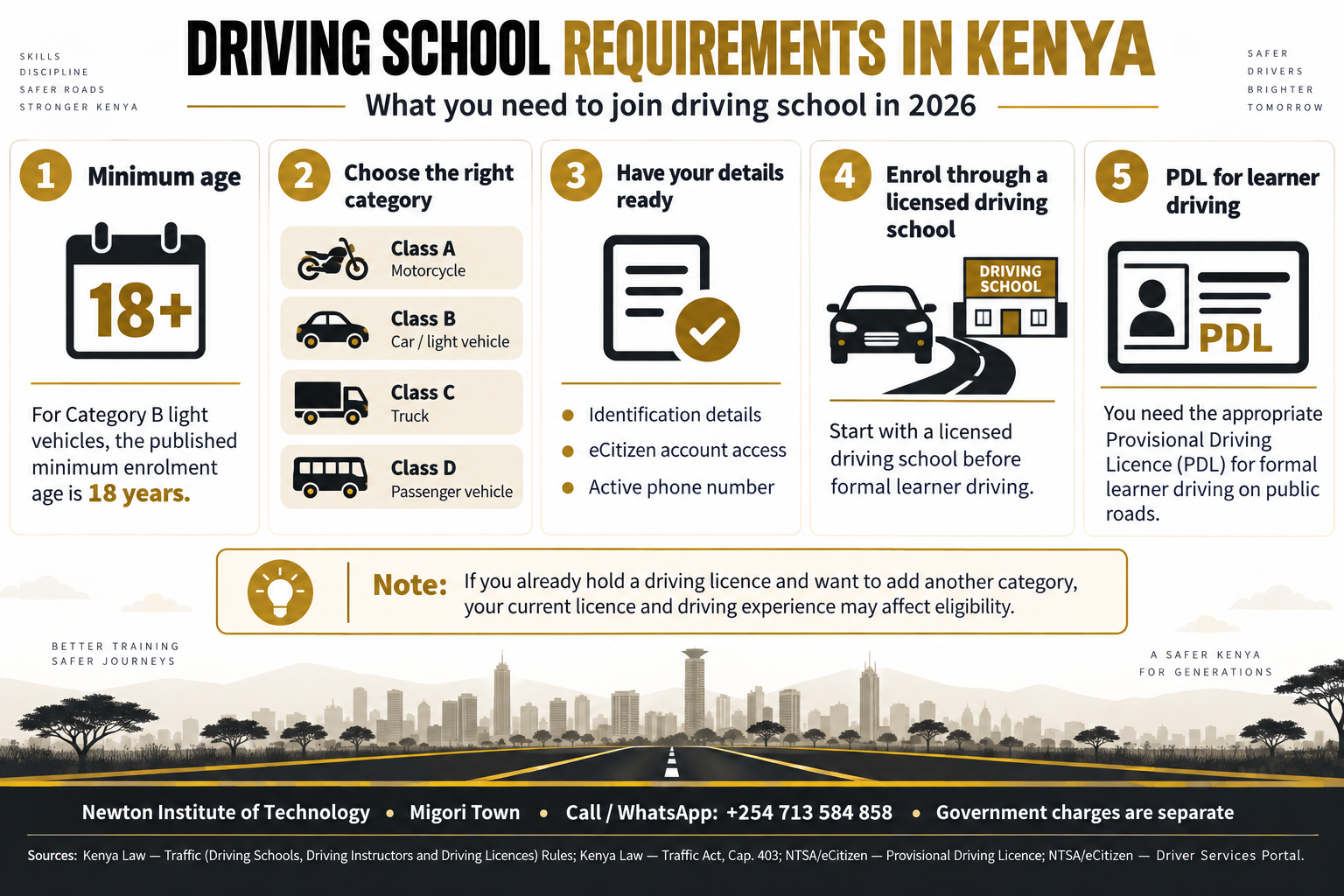
Infographic summary based on Kenya Law and NTSA/eCitizen guidance.[1][4][5]
Start with the basics
Driving school requirements in Kenya
Before you pay for training, get the basics in order. You should know the vehicle you want to drive, have your identification details ready, be able to access eCitizen, and know whether you are a first-time learner or an existing driver adding another category.
- Check that you meet the minimum age for the licence category.
- Know which vehicle and licence category you want.
- Have your identification details available.
- Make sure you can access your eCitizen account.
- Ask which supporting documents currently apply to your application.
- If you already hold a licence, have it ready for eligibility checks.
- Separate driving-school tuition from NTSA/eCitizen charges.
The course is meant to teach you. Your first job is to enter the correct licence category with the right enrolment documents.
Eligibility
Minimum age to join driving school
For Category B light vehicles, Kenya’s published driver-training curriculum sets the minimum enrolment age at 18 years.[1] The Traffic Act also places general age restrictions on the issue of driving and provisional licences.[2]
Being 18 does not automatically qualify you for every category. Truck, passenger-vehicle and professional categories can carry additional age, licence-history or driving-experience requirements.
Choose correctly
Tell the school what you actually want to drive
Do not register simply for “driving school” without establishing the licence category. An ordinary private car normally falls under the appropriate Class B category; motorcycles use Class A; trucks use the applicable Class C category; and passenger vehicles use the relevant Class D category.
NTSA describes the PDL as being endorsed for the class or classes of motor vehicle for which the applicant is learning to drive.[4] If you are choosing between B1 and B2, use the dedicated NIT Class B guide rather than guessing.[6]
Different starting points
First-time learner or licence upgrade?
A first-time Class B learner and an experienced driver adding Class C or D should not be treated as the same application.
| Situation | What to have ready | Why it matters |
|---|---|---|
| First-time learner | Identification details, eCitizen access and current learner documents | Starts the learner-licensing route. |
| Motorcycle learner | Correct Class A category and current entry documents | The category must match the motorcycle route. |
| Existing driver adding a class | Current driving licence and any required experience history | Some categories require a lower category or previous experience. |
| Class C or D applicant | Existing licence, age and experience details | Eligibility should be checked before payment. |
If you already hold a driving licence, take it with you or have its details available when speaking to the school.
Government services
Have your ID and eCitizen details ready
NTSA driver services are accessed through eCitizen. The official NTSA portal provides access to PDL applications, driving-test booking and other driver-licensing services.[5]
Before registration, check that your name and identification details agree with your government records. If you already have an eCitizen account, make sure you can sign in before beginning the learner process.
Documents
Which documents do you need?
This is where learners should be careful with generic online checklists. Two official published sources do not describe the supporting requirements in exactly the same way.
Kenya’s published Category B curriculum lists the minimum requirements for enrolling as a light-vehicle learner as being at least 18 years old and having a medical test certificate.[1]
The current NTSA/eCitizen page titled “Minimum Requirements for enrolment to train as a small vehicle driver” publishes a broader list: 18+, police clearance certificate, no criminal record, no previous dangerous-driving offence record, medical test certificate, and ability to read and write in the official languages.[3]
The published Category B curriculum and the NTSA/eCitizen small-vehicle page are not perfectly aligned in how they describe supporting requirements. Check the live eCitizen process and ask the licensed driving school which documents are being requested for your particular application before paying for extra certificates.
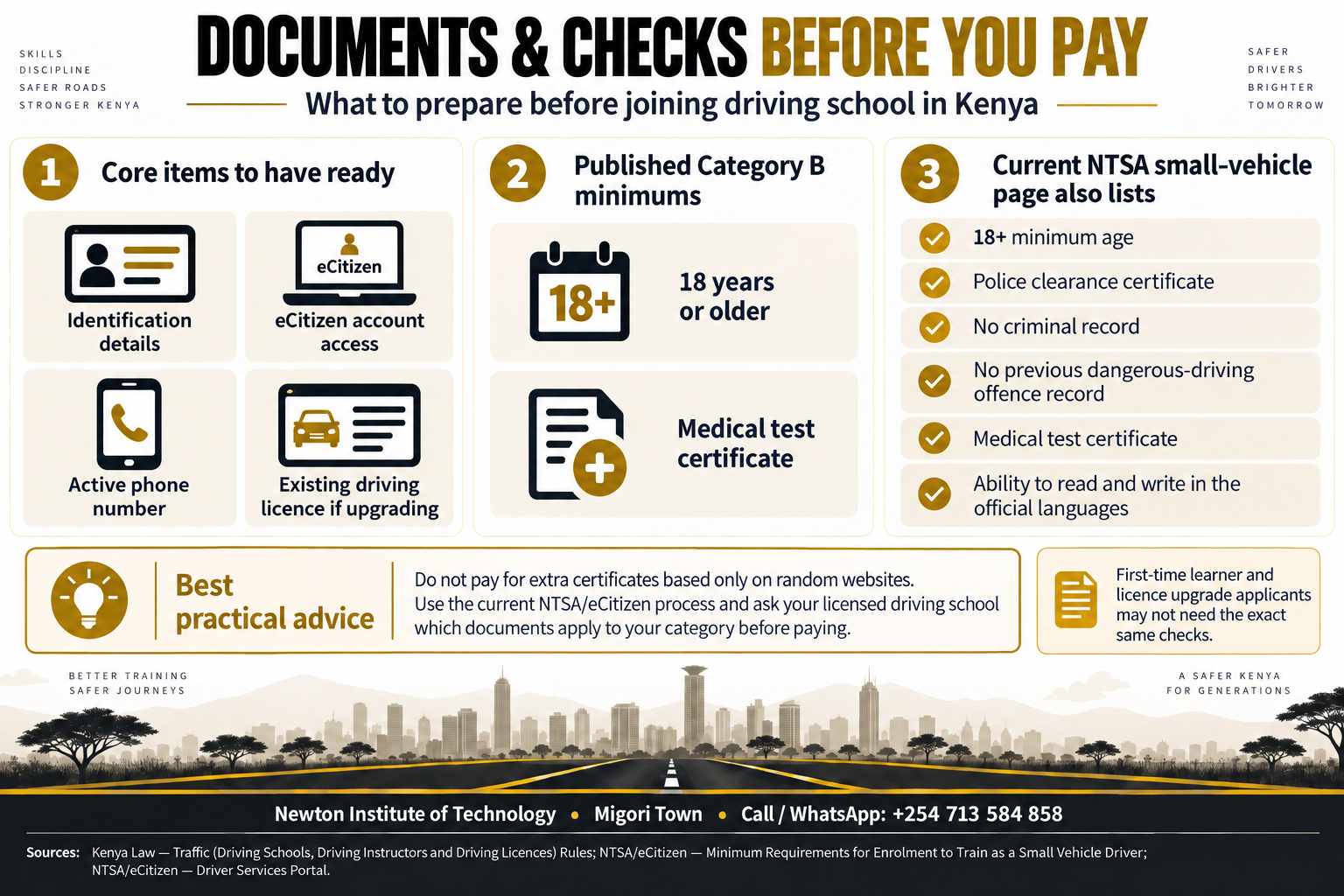
The infographic deliberately shows the difference between the Category B curriculum and NTSA’s current small-vehicle page rather than merging them into one unsupported universal checklist.[1][3]
Your first visit
What should you have ready at the driving school?
For a first enquiry or registration visit, have your identification details, an active phone number, access to eCitizen where possible, and your existing driving licence if you already hold one. Bring any additional document already requested for your category.
You do not need to buy every certificate mentioned on different websites. Start by establishing the category you need and whether you qualify for it.
First-hand NIT process
What we check before enrolling a learner at NIT
At Newton Institute of Technology, the first useful question is simple: what vehicle do you want to drive, and do you already hold a driving licence?
A first-time Class B learner should not be processed in the same way as an experienced driver seeking a Class C or Class D category. Before a learner pays, Admissions should establish the licence category, basic age eligibility, whether an existing licence is needed, whether previous driving experience applies, and which current supporting documents are relevant.
“Do I qualify for this exact licence category, and what do I need to complete the registration?”
Academic grades
Do you need a KCSE grade to start?
For the ordinary Category B learner route, the published minimum requirements do not specify a particular KCSE grade; the curriculum states the applicable age and medical requirement.[1] The separate NTSA small-vehicle page refers to the ability to read and write in the official languages.[3]
That is different from requiring a specific KCSE grade. A learner still needs to understand road signs, instructions, safety material and theory lessons.
Learner licence
Do you need a PDL before learner driving?
A Provisional Driving Licence is the learner licence used during formal driver training. NTSA says an applicant seeking a PDL should enrol in a licensed driving school and apply online, and a PDL holder driving on a road must be accompanied by a qualified driver holding the relevant valid licence.[4]
For the full application process, validity and current charges, use the dedicated NIT Provisional Driving Licence guide.[7]
Keep costs separate
Training fees and government charges are different
Driving-school tuition and NTSA/eCitizen transactions are separate. Before paying, ask what the training fee covers and which government transactions will still be paid through eCitizen.
For current NIT tuition and a fuller cost breakdown, use the dedicated Driving School Fees in Kenya guide.[8] This article stays focused on what you need before enrolment so it does not compete with the fees guide.
Next step
What happens after registration?
Once your category and enrolment requirements are in order, the basic learner route is straightforward: enrol → obtain the appropriate PDL → begin theory and practical training. The later licensing stages are covered in NIT’s separate guide on how to get a driving licence in Kenya.[9]
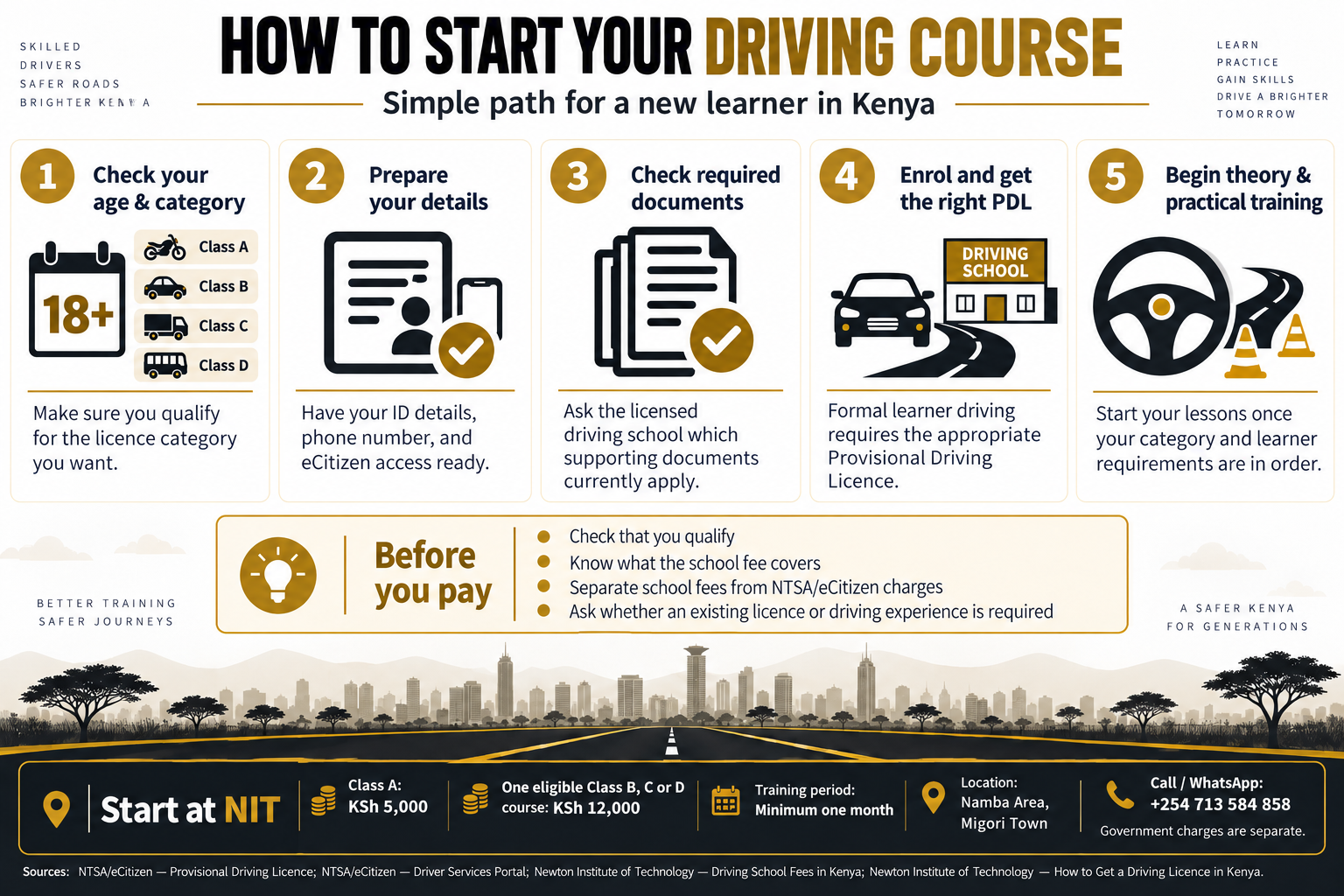
The route shown is a pre-enrolment summary. Detailed PDL, test and licensing steps remain in the dedicated NIT guides.[4][7][9]
Before you pay
Four checks that prevent common enrolment mistakes
- Category: make sure the vehicle you want to drive matches the category being booked.
- Eligibility: if you are upgrading, have your current licence and experience requirements checked first.
- Documents: ask which supporting documents are required at that stage of your application.
- Payment route: separate the school’s training fee from government charges paid through the official system.
Quick questions
Driving school requirements FAQs
What is the minimum age to join driving school in Kenya?
For Category B light vehicles, the published minimum enrolment age is 18 years.[1] Other categories can carry additional eligibility conditions.
What documents should I have ready?
Start with your identification details, eCitizen access and your existing driving licence if you have one. The Category B curriculum lists a medical test certificate, while the current NTSA small-vehicle page publishes additional requirements; check what applies to your live application before paying for extra documentation.[1][3]
Do I need a PDL before learner driving?
The PDL is the provisional licence used for formal learner driving. NTSA says applicants enrol in a licensed driving school and apply online.[4]
Can I join driving school without KCSE?
The published Category B minimum requirements do not specify a particular KCSE grade. They focus on the applicable age and other learner requirements.[1]
The shortest useful answer
Get the category right before you spend money
For most first-time car learners, the preparation is simple: be old enough for the category, know the vehicle you want to drive, have your identification and eCitizen details ready, find out which supporting documents currently apply, and then enrol through a licensed driving school.
Ready to start?
Register for driving training at Newton Institute of Technology
NIT offers practical and theory driving training in Migori Town. First-time learners should tell Admissions which vehicle they want to learn to drive. Existing licence holders should have their category eligibility checked before registration.
Training feesClass A: KSh 5,000 · one eligible B, C or D: KSh 12,000
Training periodMinimum one month
LocationNamba Area, Migori Town · Migori–Sirare Highway
References
Sources checked
- Kenya Law — Traffic (Driving Schools, Driving Instructors and Driving Licences) Rules / Driver Training Curriculum. Category B minimum enrolment requirements and training framework. Kenya Law
- Kenya Law — Traffic Act, Cap. 403. General driving-licence and provisional-licence provisions. Kenya Law Traffic Act
- NTSA/eCitizen — Minimum Requirements for Enrolment to Train as a Small Vehicle Driver. Current published small-vehicle enrolment conditions. NTSA/eCitizen
- NTSA/eCitizen — Provisional Driving Licence. Licensed-school enrolment, PDL purpose and learner supervision. NTSA/eCitizen PDL
- NTSA/eCitizen Service Portal. Access to PDL and other driver services. NTSA/eCitizen portal
- Newton Institute of Technology — Class B Driving Course in Kenya. B1/B2 course guidance. NIT Class B guide
- Newton Institute of Technology — Provisional Driving Licence in Kenya. Detailed PDL guidance. NIT PDL guide
- Newton Institute of Technology — Driving School Fees in Kenya. Current NIT training fees and cost guidance. NIT driving fees guide
- Newton Institute of Technology — How to Get a Driving Licence in Kenya. Full licensing journey after enrolment. NIT driving licence guide
Prepared by: Newton Institute of Technology Editorial Team · Institutional / Technical review: Engineer Simon Barongo · Last reviewed: 19 September 2026.
Government requirements, procedures and charges can change. Check the current NTSA/eCitizen instructions before making a government payment.