

Kenya graduate employability 2026 evidence
Why Kenyan Graduates Struggle to Get Jobs
Experience · Opportunity · Skills mismatch
A precise explanation of the gap between education and employment, using new CUE evidence, official KNBS labour-market data and Kenya’s employability framework.
Why do Kenyan graduates struggle to get jobs?
Current evidence points to two problems happening at once: Kenya does not create enough suitable opportunities for everyone seeking work, while some graduates also enter the labour market without enough work experience or practical readiness. CUE ranked lack of work experience first, followed by limited job opportunities, skills mismatch, inadequate professional networks and insufficient labour-market information. [1]
Start with the numbers
The new CUE evidence makes the transition problem visible
CUE’s 2026 graduate-employability study reports an average of 11.6 months to first employment among the university graduates studied. Only 25.3% found employment within six months, while about 40% took longer than one year. [1]
Average time to first employment in the CUE study.
Secured employment within six months.
Took longer than one year to secure first employment.
Lack of work experience.
Study scope: reporting on the CUE study says its quantitative component included 102 graduate respondents and 109 employer respondents across sectors such as education, manufacturing, ICT, agriculture, hospitality and public service. The findings are valuable evidence about the university-to-work transition, but they are not a census of every graduate or employer in Kenya. [2]
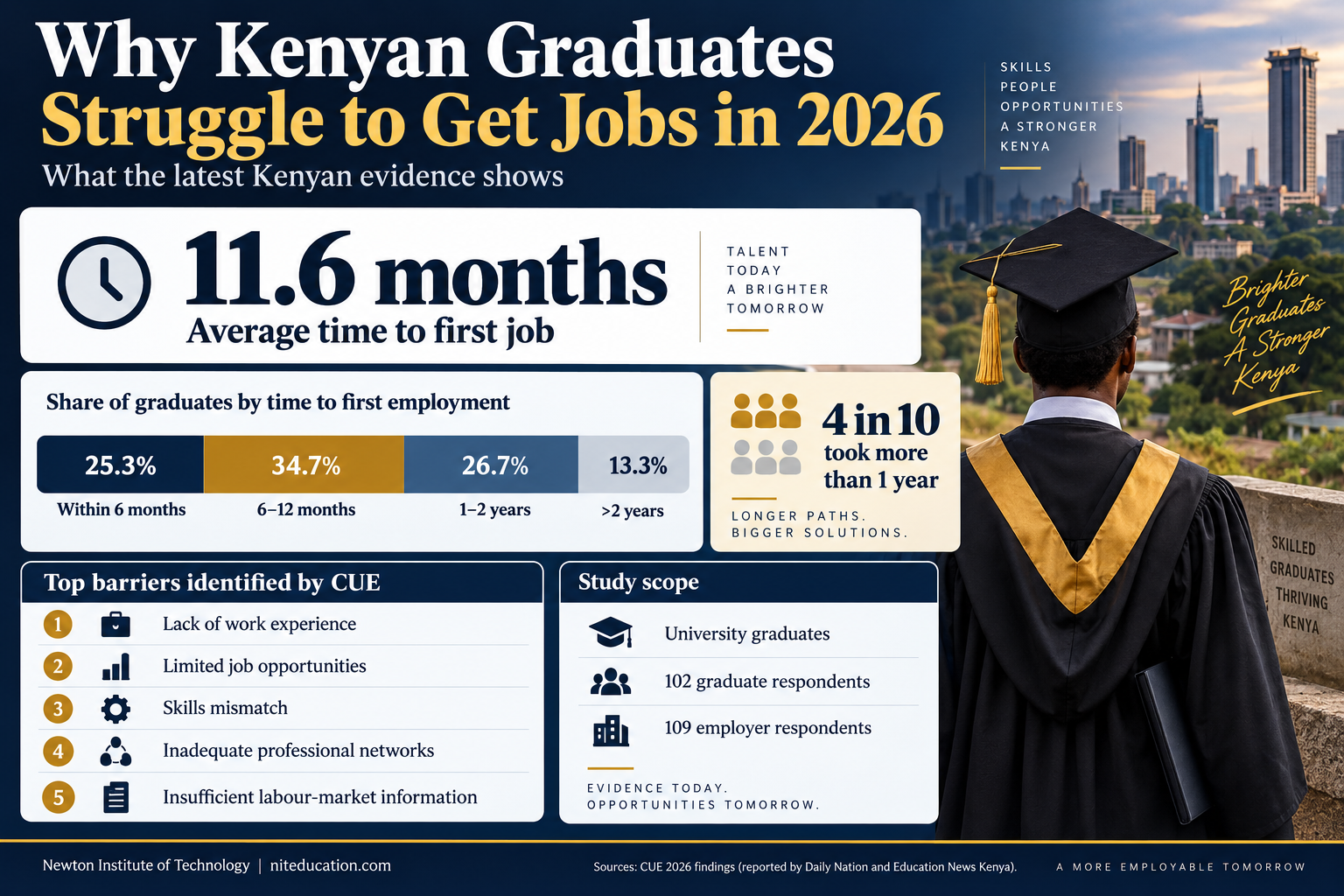
Infographic 1: CUE 2026 graduate-employability findings at a glance.
Barrier 1 · work experience
The experience problem starts before the first job
CUE ranked lack of work experience ahead of every other barrier. A graduate can complete years of study yet have relatively little exposure to real customers, deadlines, workplace systems, imperfect information or problems that do not arrive with a model answer. Then the first vacancy asks for experience. [1]
Internships and industrial attachment are meant to reduce that contradiction. CUE found that 70% of surveyed graduates had accessed internships, but it also reported concerns about placements that were too short, poorly structured, difficult to access or weakly aligned with the learner’s field. [2]
This is why meaningful workplace exposure matters more than simply collecting a signed attachment letter. The practical process—finding a placement, judging its quality, using a logbook and building legitimate evidence—belongs in our separate ICT Industrial Attachment in Kenya guide.
Barrier 2 · limited opportunities
Better skills cannot solve a shortage of suitable jobs by themselves
CUE placed limited job opportunities second. Official KNBS figures help explain the pressure: Kenya generated about 822,100 new jobs in 2025, but 716,800 of them were in the informal sector. Informal employment reached about 18.1 million, while the modern sector added 105,300 jobs. [3]
There are not enough conventional openings
- Formal vacancies attract heavy competition.
- Most recent job creation has been informal.
- A well-prepared graduate can still face weak demand.
Some graduates still need workplace development
- Employers want previous exposure.
- Practical application may lag behind theory.
- Workplace judgement develops through practice.
For the wider employment picture, continue to Kenya Job Market Trends 2026. This article stays focused on why graduates get stuck between education and employment.
Barrier 3 · skills mismatch
The gap is often between knowing and applying
CUE did not conclude that graduates have no academic knowledge. Employers generally recognised a foundation of knowledge, but reported gaps when new recruits had to apply that knowledge under workplace conditions. The largest expectation-versus-performance gap was reported in problem-solving and critical thinking at 1.7 points, followed by communication and time management at 1.5 points each. [1]
A software graduate may understand programming concepts but still struggle when a live system behaves unexpectedly. A data graduate may know analysis but need practice cleaning inconsistent records and explaining results to a non-technical colleague. The underlying issue is practical judgement, not simply memorising more theory.
The readiness gap also creates a cost after recruitment. Reporting on the CUE study says 91% of participating organisations used on-the-job training to address graduate skill gaps; 80% used mentorship, 72% induction programmes and 70% coaching. [2]
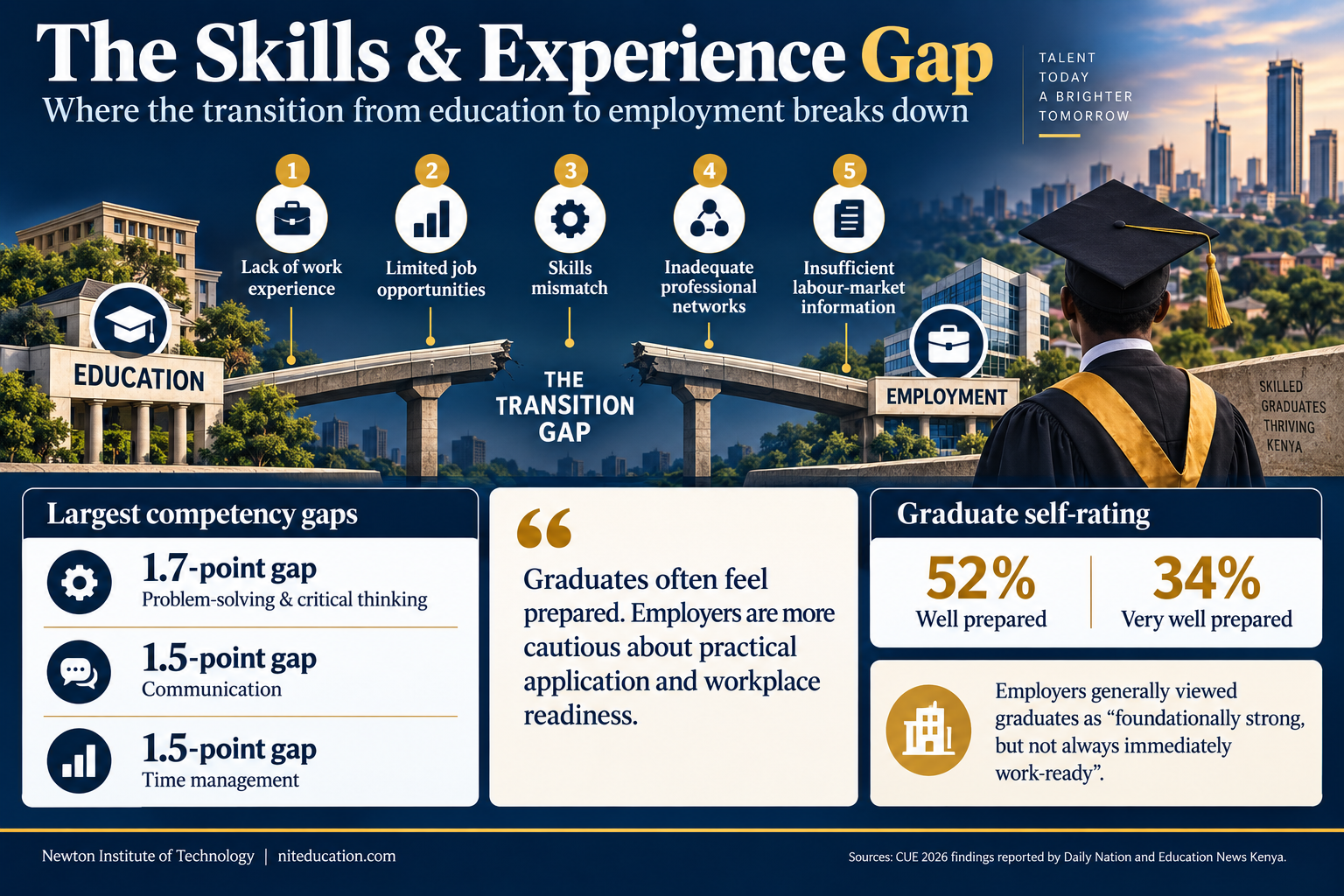
Infographic 2: where the transition from education to employment can break down.
For a detailed self-check of technical ability, judgement, communication, reliability and proof, use Are You Job-Ready? Kenya Skills Self-Check 2026.
Barriers 4 and 5
Networks and labour-market information affect how graduates find entry routes
CUE also identified inadequate professional networks and insufficient labour-market information as barriers. [1] A useful professional network is not a substitute for competence; it can help a beginner understand where opportunities appear, what employers expect and how recruitment actually works in the occupation.
Labour-market information matters just as much. Kenya’s Labour Market Information System publishes employability-skills reports and job-trend resources, and its Career Navigator is designed to connect occupational requirements with learning and employment pathways. [5]
Its 2024–2025 employability report describes a labour market moving toward greater professionalisation and digitisation, with demand increasingly combining technical expertise with business, engineering/IT and commercial competencies. [5]
If the next question is which practical skills provide useful employment, freelance or business routes, continue to Most Employable Skills in Kenya 2026.
What the evidence does not say
Qualifications are not the problem
CUE’s findings do not show that university education is unnecessary. Employers generally regarded graduates as foundationally knowledgeable; the weakness appeared in applying knowledge under workplace conditions. In occupations where degrees, licences or professional registration are required, those requirements remain essential. [1]
The broader relationship between qualification, practical ability and proof is covered separately in Why Skills Matter More in Kenya’s Job Market. Keeping that argument there prevents this article from competing with it.
Institutional response
Kenya is starting to measure what happens after graduation
In April 2026, the State Department for Labour and Skills Development published a Graduate Employability Rate and Ranking Framework. It defines the Graduate Employability Rate around graduates who secure paid full-time, part-time or self-employment within 12 months, excluding specified groups such as those unavailable for work or in full-time further study. Institutions are expected to use graduate tracer studies to measure outcomes. [4]
That shifts attention from a narrow question—how many students graduated?—to a more useful one: what happened to them after graduation?
What an individual can control
A graduate cannot fix the whole job market, but can strengthen the transition
Before finishing training, understand what a beginner in your occupation is expected to perform. Practise those tasks until you need less step-by-step guidance. Use attachment or internship to obtain meaningful supervised exposure. Keep legitimate evidence of work you are allowed to show. Learn how recruitment happens in the field, and keep updating your abilities as tools and requirements change.
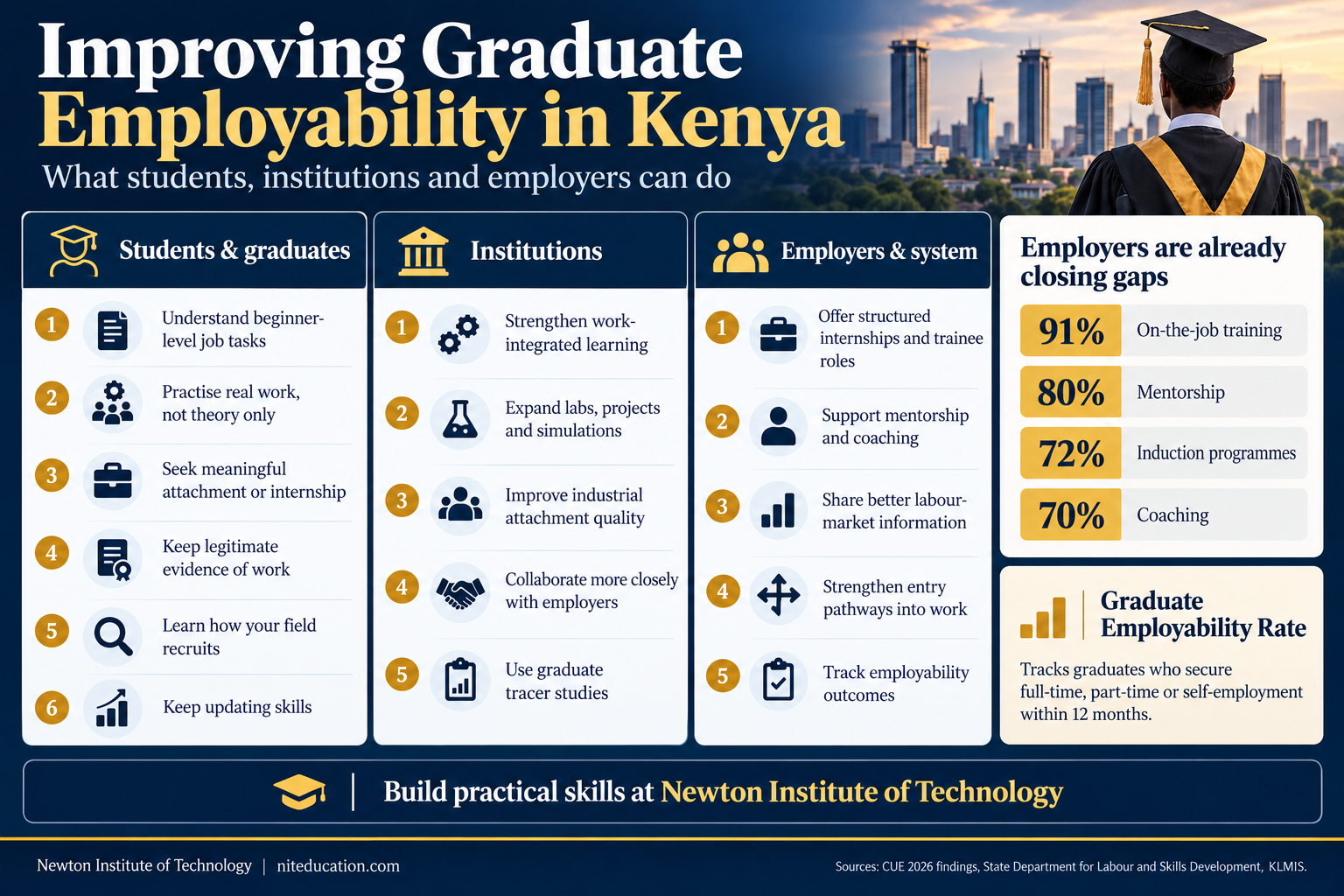
Infographic 3: practical actions that can strengthen graduate employability.
Straight answers
Graduate jobs and skills gap FAQs
Why do Kenyan graduates struggle to get jobs?
CUE’s 2026 university-graduate employability study identified lack of work experience first, followed by limited job opportunities, skills mismatch, inadequate professional networks and insufficient labour-market information. [1]
How long does it take a Kenyan graduate to find a job?
Among university graduates covered by the CUE study, the average time to first employment was 11.6 months. Individual outcomes differ by occupation, location, experience and economic conditions. [1]
Is graduate unemployment mainly caused by lack of skills?
No. CUE also ranked limited job opportunities as a major barrier. Kenya has both labour-demand constraints and education-to-work transition problems. [1]
Which skills gaps are employers reporting?
CUE reported gaps in problem-solving, critical thinking, communication, time management, practical competence and digital capability. [1]
Does industrial attachment help?
It can, if the placement provides meaningful supervised workplace exposure. CUE also noted that placement quality, duration and alignment matter. [2]
Are university qualifications still useful?
Yes. The CUE evidence does not say qualifications are unnecessary. Employers generally recognised strong foundational knowledge but wanted better practical application and workplace readiness. [1]
The point to carry forward
Kenya needs progress on both sides of the equation
Improving practical preparation will not create every missing vacancy. Creating more jobs will not automatically make every new graduate ready to perform them. The strongest response is to improve opportunity and the transition from learning into real work at the same time.
Build practical skills at NIT
Register for practical career training at Newton Institute of Technology
Choose training that gives you an opportunity to practise the real tasks required in the occupation, receive correction and build competence before you enter the labour market.
Training areasICT · Plant operation · Driving · Career skills
IntakesContinuous / open
LocationNamba Area, Migori Town