

International Students Plant Operator · Kenya
NTSA Category G
for International Students
Practical skills · Kenyan licensing · one clear choice
Yes—an international student can train in Kenya. You can come mainly for practical heavy-equipment skills, or take the longer route and also pursue a Kenyan NTSA Category G endorsement where you meet the applicable requirements.
Your first decision
Can an international student train and pursue Category G in Kenya?
Yes. Come to Kenya for practical plant-operator skills, or choose the additional Kenyan licensing route and pursue an NTSA Category G endorsement if you meet the applicable immigration, identification, driving-licence, medical, training and testing requirements. You do not have to make the Kenyan licence the purpose of your training.
Your first decision
Two clear routes for an international student
If your goal is practical competence, you can focus on machine training. If you also want the Kenyan NTSA endorsement, plan for the extra licensing stages from the beginning.
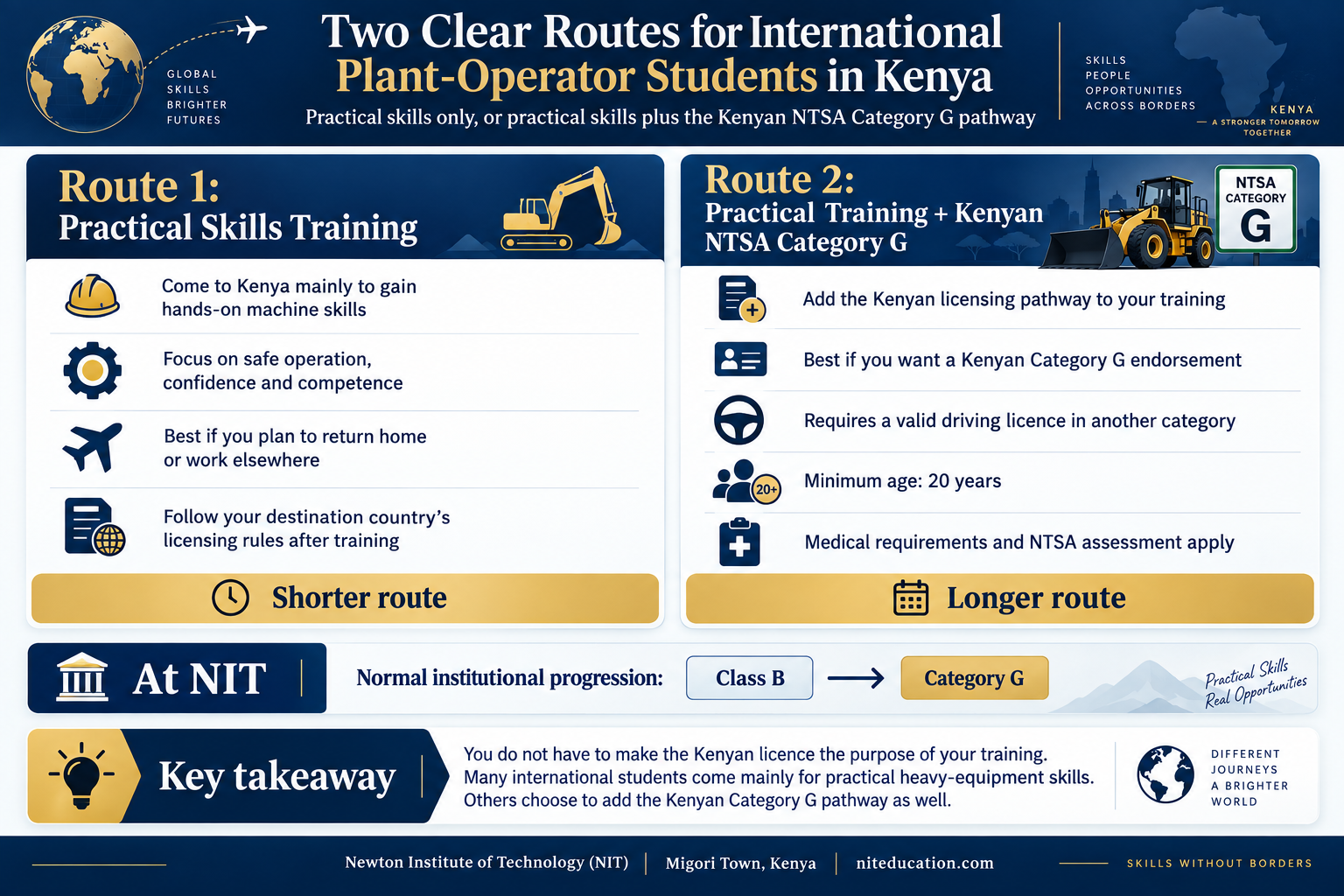
Route 1: practical skills. Route 2: practical skills plus the Kenyan Category G licensing pathway.
Route 1 · practical competence
Come to Kenya for practical machine skills
If your main goal is to learn how to operate an excavator, bulldozer, grader, roller, wheel shovel, forklift or another machine, you can focus on practical skills training rather than making the Kenyan Category G endorsement the objective of your trip.
Practical operating competence
- Pre-start inspection and daily checks
- Controls, starting and shutdown
- Steering, positioning and manoeuvring
- Machine-specific working functions
- Site awareness and safe operating habits
Take the skills to your chosen market
- Return home or move to another destination
- Use the practical ability you developed
- Complete local licensing or certification there
- Meet employer competency requirements
- Keep the training and licensing questions separate
The institutional training model is approximately 70% practical and 30% theory, with the emphasis on safe, confident machine operation.
For a deeper look at the practical curriculum, see NIT’s Plant Operator Course Syllabus in Kenya.
Route 2 · Kenyan licensing
Add the Kenyan NTSA Category G endorsement
You may also choose to complete practical training and pursue the applicable Kenyan Category G endorsement. This route takes longer because it sits inside Kenya’s regulated driving-licence system.
Admission → immigration documentation → driving-licence eligibility → practical training → NTSA assessment → Category G endorsement.
Kenya’s published Category G rules require a learner entering the regulated pathway to hold a valid driving licence in another category, be at least 20 years old and meet the applicable medical-certification requirement. At NIT, the normal institutional progression is Class B → Category G.
National requirements: Kenya Law — Traffic (Driving Schools, Driving Instructors and Driving Licences) Rules. For the complete NIT licensing guide, see NTSA Category G Licence Kenya: G1–G14 Codes & Requirements.
Nationality is not the only question
Can a foreign student pursue a Kenyan driving licence?
Yes, where the applicable requirements are met. Kenya’s eCitizen guidance provides a pathway for foreigners to apply for a Kenyan driving licence subject to the required residency status and supporting documents. Category G then has its own eligibility, training and assessment conditions.
See Kenya’s official eCitizen driving-licence guidance.
Choose for your destination
Which route should you choose?
| Your situation | Practical skills route | Skills + Category G route |
|---|---|---|
| Main goal | Hands-on machine competence | Hands-on competence plus Kenyan endorsement |
| Where you expect to work | Home country or another market | Where a Kenyan licensing record supports your plan |
| Licensing after training | Follow the destination country’s requirements | Complete applicable Kenyan NTSA requirements |
| Time | More direct training route | Longer because licensing stages are added |
| Best fit | You mainly need the skill | You specifically want both skill and Kenyan licence |
There is no need to make the longer licensing route compulsory for yourself if your real objective is practical competence.
Prepare early
Prepare these documents before you travel
International applicants should send their basic information early so Admissions can distinguish a skills-only plan from a Kenyan licensing plan.
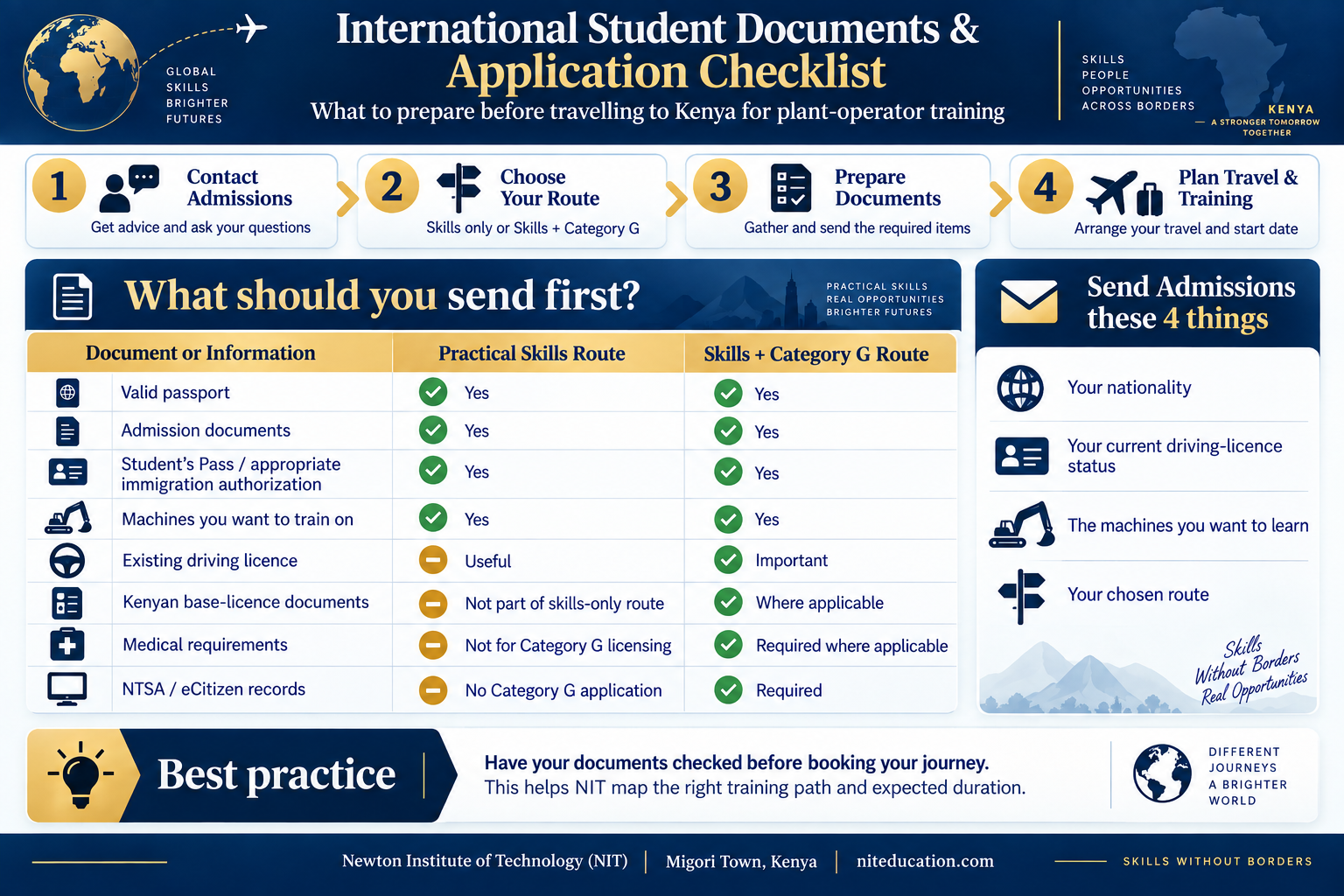
Send the core admission details first; the Category G route adds licensing-specific documents and checks.
| Document or information | Skills training | Skills + Category G |
|---|---|---|
| Valid passport | Yes | Yes |
| Admission documents | Yes | Yes |
| Appropriate Kenyan immigration authorization | Yes | Yes |
| Machines you want to train on | Yes | Yes |
| Existing driving licence | Useful where available | Important |
| Kenyan base-licence documents | Not part of the skills-only objective | Where applicable |
| Medical documentation | Not for a Category G application | Required where applicable |
| NTSA / eCitizen records | No Category G application | Required for the licensing route |
Study legally in Kenya
Immigration for international students
A foreign learner coming to Kenya for education or training should have the appropriate Kenyan immigration authorization. The Directorate of Immigration provides a Student’s Pass for foreign students accepted by educational or training institutions in Kenya.
NIT can provide the applicable institutional admission documents needed from the college side. If the planned stay or activity includes additional arrangements such as attachment or internship, check the immigration requirements for that arrangement before travel.
Official guidance: Directorate of Immigration Services — Student’s Pass.
Check your starting point
Already have a driving licence from home?
Send a copy during your application if you are considering the Kenyan Category G route. Do not assume every foreign licence follows exactly the same process. The useful question is whether your current licence can support the applicable Kenyan pathway or whether another stage is required.
An early licence review gives you a clearer picture of the documents and time needed for the route you actually want.
Starting without a driving licence
No driving licence yet?
That does not stop you from enquiring about practical machine-skills training. But if your goal is specifically the Kenyan Category G endorsement, you must satisfy the applicable base driving-licence requirements before progressing through the regulated licensing pathway. At NIT, the standard progression is Class B before Category G.
Cross-border value
The skill travels; the licence may not
A proper pre-start inspection, safe excavator control, accurate grading, careful loading, correct positioning and disciplined site awareness remain useful skills across borders. What changes is the legal authorization required to work professionally.
Your practical operating ability
- Machine control and coordination
- Inspection and safe preparation
- Positioning and worksite awareness
- Machine-specific operating technique
- Basic operator care and discipline
Your legal authority to work
- Local operator licence
- Licence conversion where applicable
- Competency assessment
- Employer verification
- Local certification or immigration permission
Your licence is governed by the country where you intend to work.
For the wider cross-border picture, see NIT’s Heavy Machinery Operator Certification in Africa guide.
Plan enough time
Why the Kenyan licensing route takes longer
Practical skills training can focus directly on the machine. The Category G route may add base driving-licence requirements, identification checks, medical requirements, NTSA transactions, test booking, assessment and endorsement processing.
There is no single extra duration that fits every international applicant. Someone who already has the necessary driving-licence foundation can have a different journey from someone starting without it.
Choose machines for the work you want
What machines can you train on?
Construction-focused choices
- Excavator
- Motor grader
- Motor roller
- Bulldozer
- Wheel shovel or backhoe loader
Logistics-focused choices
- Forklift
- Telehandler
- Other lifting or handling equipment in the selected programme
- Choose for your intended work, not simply the largest machine count
Keep the credential clear
Does practical training give you a Kenyan Category G endorsement?
No. Practical skills training develops your ability to operate the machine. The NTSA Category G pathway leads to the applicable Kenyan endorsement only after the required licensing, training, testing and administrative stages are completed.
Skills-only training should never be presented as though the learner has already obtained a Kenyan Category G licence.
Make the decision before you fly
Before you book your journey, choose the right path
The easiest application is one where the goal is clear from the start. Tell Admissions your nationality, current driving-licence status, the machines you want to learn and whether you want practical skills only or practical skills plus the Kenyan Category G pathway.
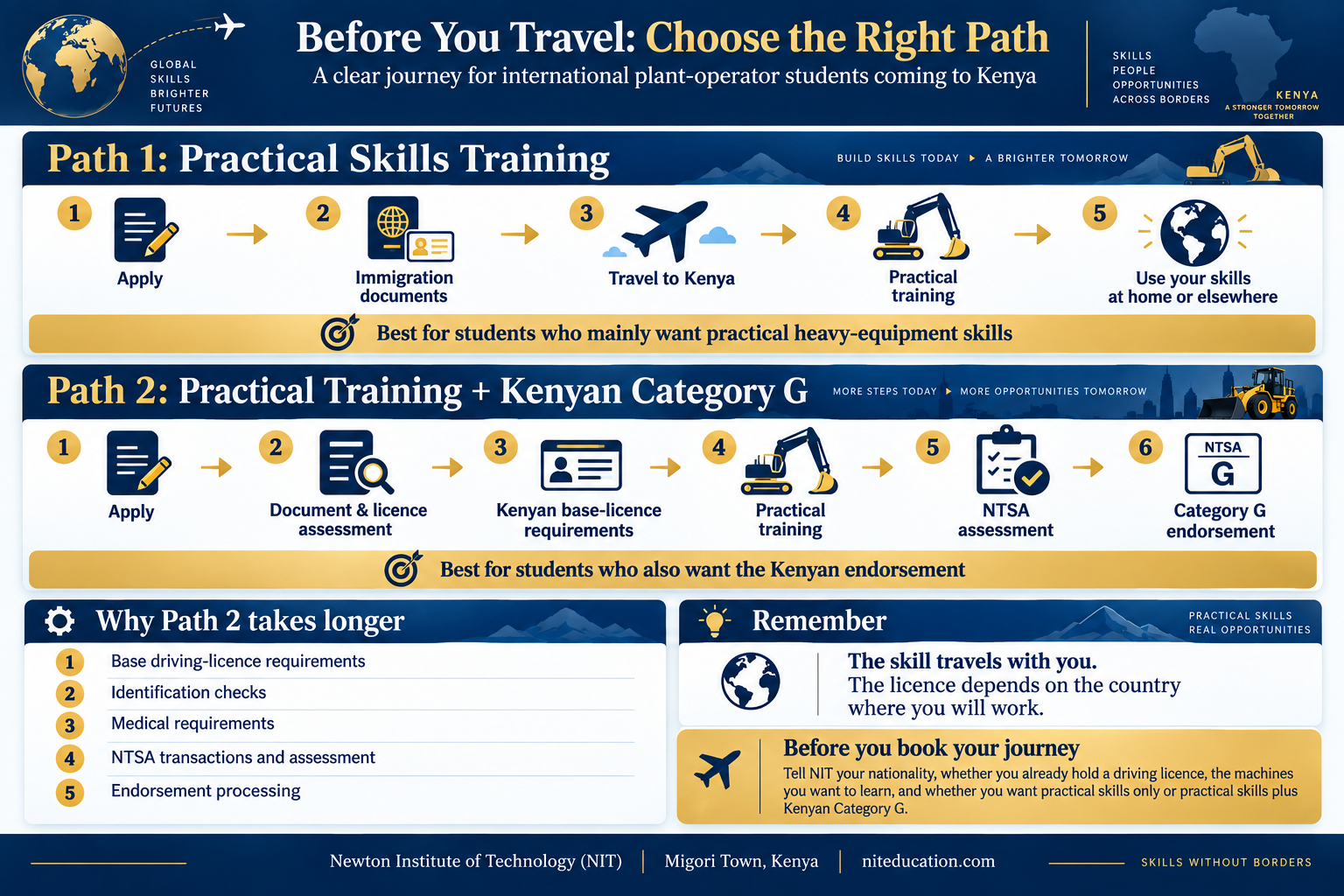
The second path has more steps because the Kenyan licensing process is added to the practical training.
“I am applying from outside Kenya. I currently [have / do not have] a driving licence, I want to train on [machines], and I want [practical skills only / practical skills + Kenyan Category G].”
Training is not a work permit
Can you work in Kenya after training?
Plant-operator training, a driving endorsement and immigration permission to work are separate matters. Obtaining practical skills—or even a Kenyan Category G endorsement—does not by itself give a foreign national permission to work in Kenya. If your plan includes employment in Kenya, the applicable immigration and employment requirements must also be met.
Common international-applicant questions
Frequently asked questions
Can an international student train as a plant operator in Kenya?
Yes. International learners can undertake plant-operator training in Kenya once the applicable admission and immigration requirements are met.
Must I obtain a Kenyan Category G endorsement?
No. If your main goal is practical machine-operating ability, choose the skills-focused route. If you want the Kenyan endorsement as well, pursue the additional licensing pathway where eligible.
Can a foreigner obtain a Kenyan Category G endorsement?
Yes, where the applicant satisfies the applicable Kenyan residency or immigration, identification, driving-licence, medical, training, testing and endorsement requirements.
Which route takes longer?
The practical-skills-plus-Category-G route normally takes longer because the Kenyan licensing stages are added to the machine training.
I already have a licence from my country. What should I do?
Send a copy during admission if you are considering the Kenyan licensing route. Your starting position can then be assessed before you travel.
Are the skills useful outside Kenya?
Yes. Practical machine-operating skills are transferable. You still need to meet the licence, certification and employment rules in the country where you intend to work.
Can I train on more than one machine?
Yes, depending on the programme selected, equipment availability and your career goals. Choose machines for the kind of work you want to pursue.
Final answer
Come for the skills—or add the Kenyan licence as well
An international student has two straightforward choices. You can come to Kenya mainly to gain practical heavy-equipment skills and later meet the licensing requirements in the country where you intend to work. Or you can take the longer route and also pursue the Kenyan NTSA Category G endorsement where you meet the applicable requirements.
The important thing is to choose the route before you travel. Send Admissions your nationality, current driving-licence status, preferred machines and whether you want skills only or skills plus Category G.
International admissions
Tell NIT which route you want
Send your nationality, driving-licence status, preferred machines and whether you want practical skills only or practical skills plus the Kenyan Category G pathway. Admissions can then map the documents and training plan around your goal.
Primary references: Kenya Law — Traffic (Driving Schools, Driving Instructors and Driving Licences) Rules; Kenya eCitizen driving-licence guidance; Directorate of Immigration Services — Student’s Pass. NIT-specific statements describe Newton Institute of Technology’s institutional training and admission pathway.
Prepared by: Newton Institute of Technology Editorial Team · Institutional / Technical review: Engineer Simon Barongo · Updated: 13 September 2026.