

International Admissions Plant Operator · Kenya
Plant Operator Training in Kenya for International Students
Entry requirements · documents · application guide
A practical guide for students applying from outside Kenya: what to prepare, how admission and immigration differ, what to budget for, and what to confirm before travelling to Migori for plant-operator training.
Prepare before you travel
Can international students study plant operation in Kenya?
Yes. A foreign applicant can apply for plant-operator training in Kenya, subject to the institution’s admission requirements and the immigration rules that apply to the applicant. At Newton Institute of Technology (NIT) in Migori, the main plant-operator training model is strongly practical. International applicants should begin the admission process before travelling and should treat course admission, permission to study, travel authorization and Kenyan licensing as separate questions.
Visual guide · International application
From first enquiry to reporting in Migori
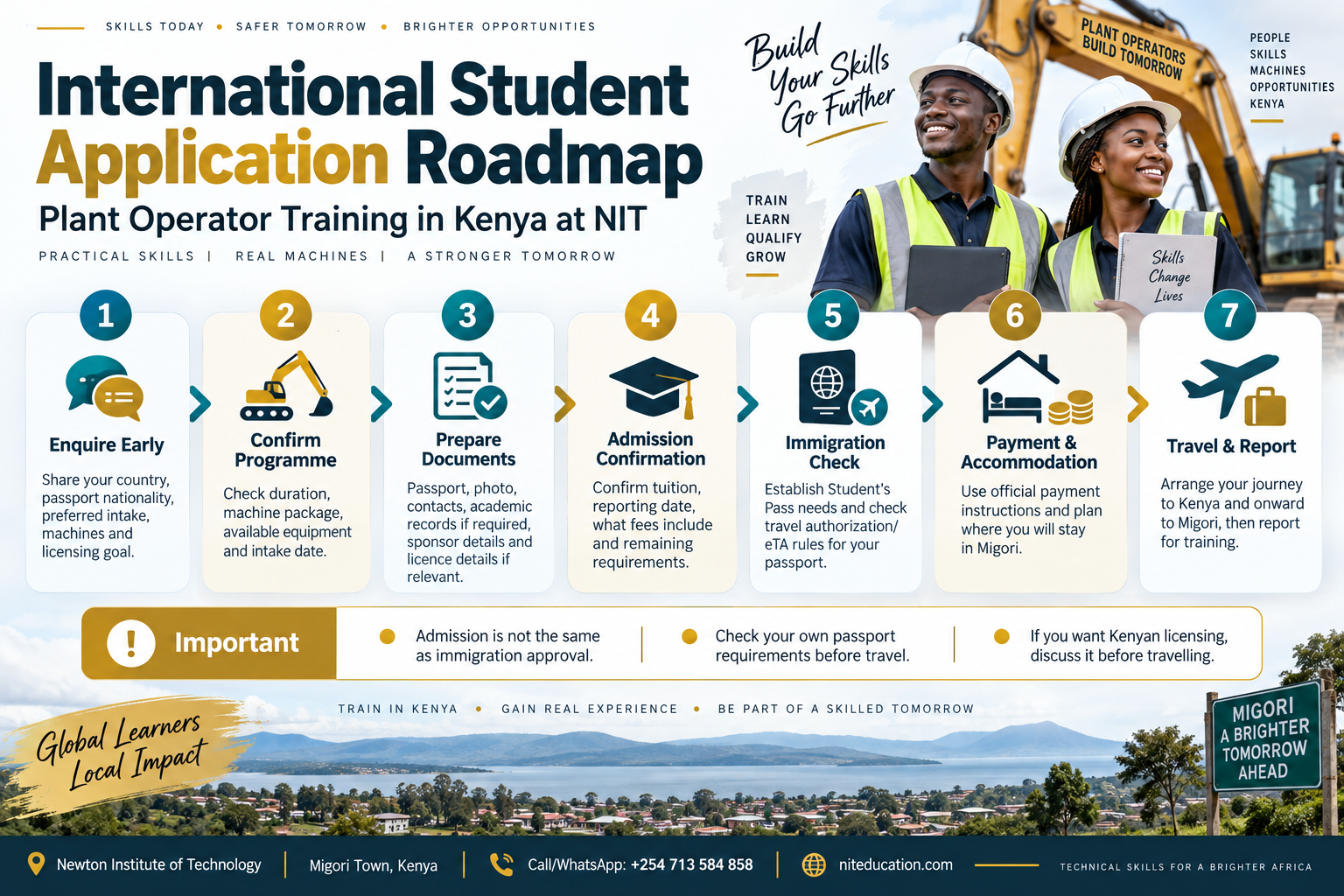
The most reliable route is to confirm the programme and documents before arranging travel. This roadmap shows the sequence at a glance.
Start with the right questions
Applying from outside Kenya? Confirm these first
Travelling to another country for practical machine training involves more than choosing a course. Before buying a ticket, confirm the issues that can affect whether the journey works as planned.
Confirm the programme, reporting date, duration and whether the intake you want is open.
Check the exact machines available during that intake, especially if one machine is your main reason for travelling.
Separate normal admission documents from the additional documents needed for immigration or licensing.
Check what your passport requires for travel and what authorization is required for study or training.
If Kenyan Category G licensing is one of your goals, mention that in your first enquiry. Your existing driving licence and individual eligibility can affect the route.
International application
How an international application works at NIT
The process should begin while you are still at home. A useful first message gives Admissions enough information to advise you properly instead of starting with a long chain of basic questions.
| Step | What to do | Why it matters |
|---|---|---|
| 1 · Introduce your situation | Send your full name, nationality, country of residence, passport country, preferred intake, machines, existing driving-licence details and whether you want Kenyan licensing. | Admissions can respond to your actual situation rather than treating the enquiry like a local application. |
| 2 · Confirm programme & machines | Confirm the programme, duration, machine package, exact machines available and intake date. | Equipment schedules and practical availability should be clear before you pay or travel. |
| 3 · Prepare documents | Provide clear passport and supporting documents requested for admission. Keep immigration documents in a separate folder. | Unreadable or incomplete documents can delay a simple application. |
| 4 · Confirm admission details | Confirm tuition, reporting date, what the fee includes, costs that remain yours and any institution-side Student’s Pass documents. | You need a complete picture before committing to travel. |
| 5 · Handle immigration | Check the travel authorization and study authorization that apply to your passport. | Admission to a course is not the same as immigration permission. |
| 6 · Payment & accommodation | Use the payment instructions supplied by NIT, obtain an official receipt and confirm where you will stay in Migori. | International payment and accommodation should be settled before departure. |
| 7 · Arrange travel | Plan entry into Kenya, onward transport to Migori and your reporting day after the important details are clear. | You avoid building the process backwards after arrival. |
Clear responsibilities
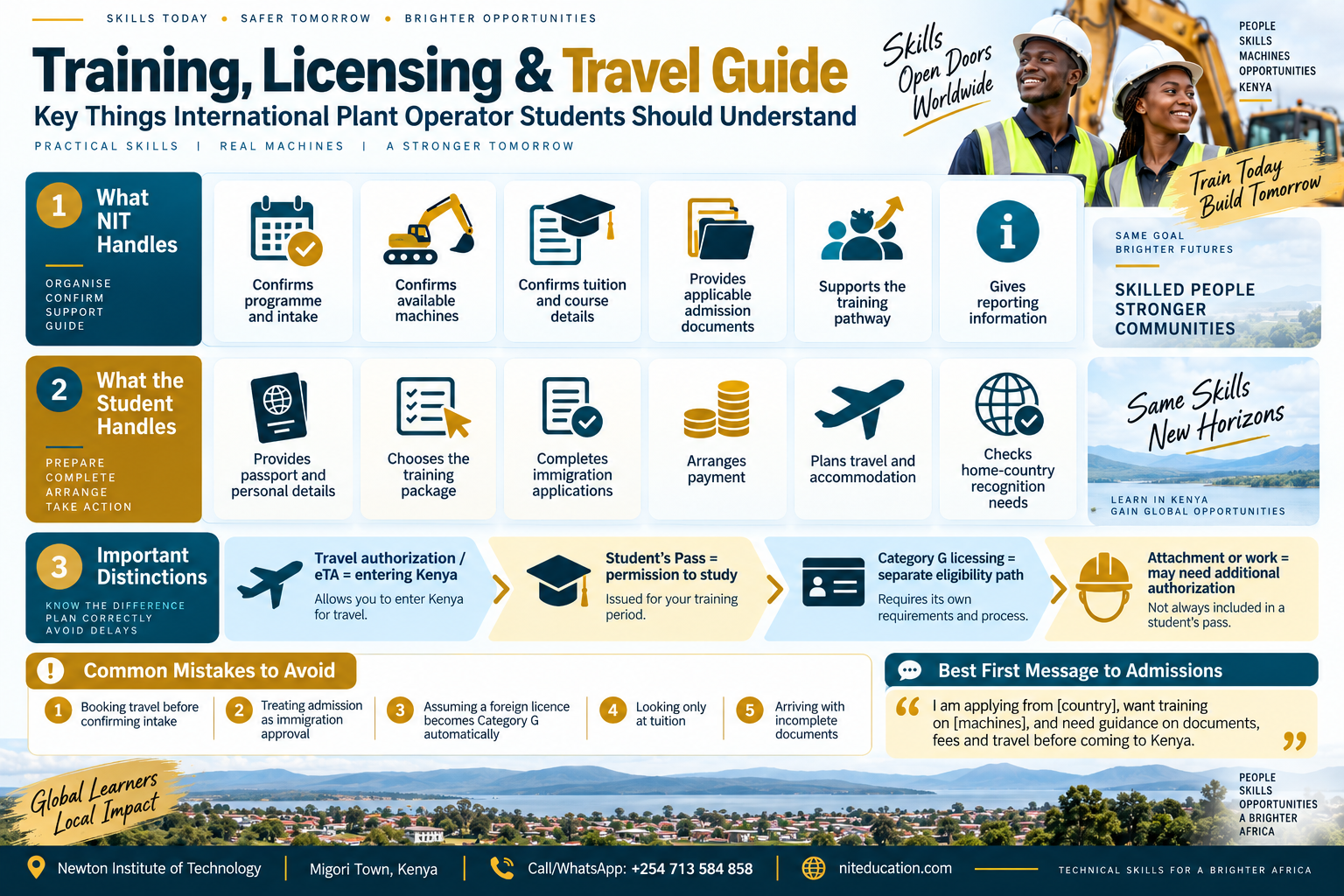
What NIT handles — and what the student handles
NIT can support the institutional side of the process, but the student still has personal responsibilities around identity, immigration, travel and living arrangements.
| Area | NIT / institution side | International student’s side |
|---|---|---|
| Programme | Confirms programme, intake, duration and available machines. | Chooses the appropriate training package and provides accurate information. |
| Admission | Provides applicable admission information and institution-issued documents. | Supplies passport, contacts, educational or sponsor documents where required. |
| Student’s Pass | Provides institution-side documents where applicable. | Completes the personal immigration application and supplies required supporting documents. |
| Payment | Confirms tuition and official payment instructions. | Arranges payment using the confirmed method and keeps the receipt. |
| Travel & living | Provides reporting information and can advise on the local training location. | Arranges travel, accommodation, meals and personal living costs. |
| Licensing | Explains the NIT training pathway and can flag licensing questions that need checking. | Declares existing foreign driving-licence details and meets government eligibility requirements. |
| Recognition at home | Provides training and the applicable institutional certification. | Checks the licensing or recognition rules in the country where the student intends to work. |
Prepare two document folders
Documents international students should prepare
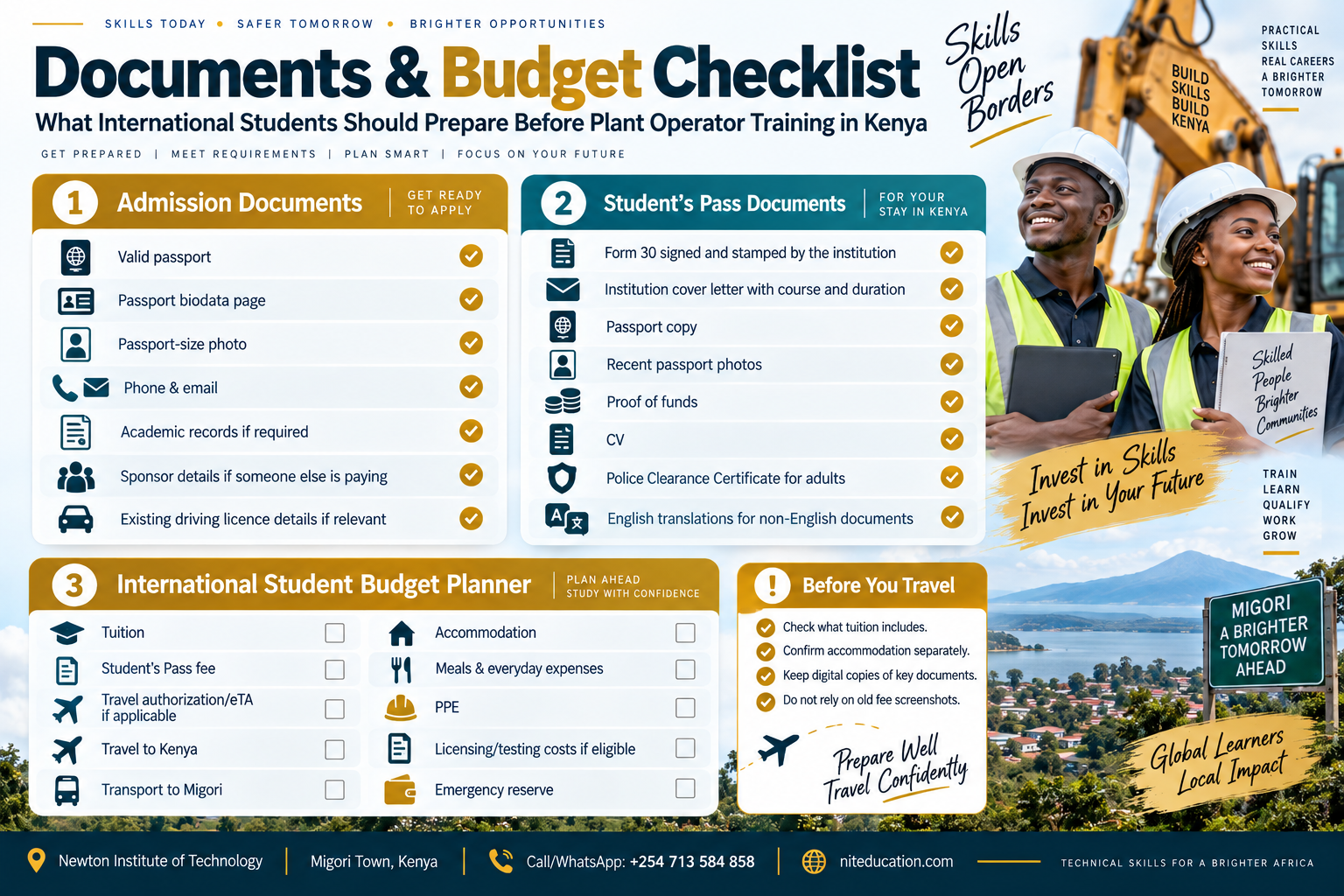
Keep one folder for college admission and another for immigration and travel. Some items may appear in both, but separating the two makes it easier to see what is still missing.
Basic application documents
- Valid passport and biodata page
- Passport-size photograph
- Active telephone number and email
- Country of residence and home address
- Academic documents where requested
- Existing driving licence if relevant
- Sponsor information where somebody else is paying
Student’s Pass supporting documents
- Institution-stamped Form 30
- Institution cover letter showing course and duration
- Passport biodata page and photographs
- Certified academic certificates for tertiary applicants
- Proof of funds or sponsor documents where applicable
- Curriculum vitae
- Police Clearance Certificate for adult applicants
- English translations for non-English documents where required
Official reference: Kenya Directorate of Immigration Services — Student’s Pass.
Visual guide · Documents & costs
Prepare the paperwork and the full travel budget
International students need to plan beyond tuition. The checklist below brings the most important admission, Student’s Pass and budgeting items into one place.
Immigration
Student’s Pass and travel authorization serve different purposes
Kenya’s Directorate of Immigration Services describes the Student’s Pass as authorization for a foreigner accepted to pursue education in an academic or training institution. An admission letter should therefore not be treated as immigration authorization by itself.
Travel authorization / eTA
- Depends on the passport you intend to travel with
- Some nationalities and traveller categories are exempt
- Check your own passport on the official Kenya eTA system
- Do not copy another student’s travel arrangement
Student’s Pass
- Applies to foreign students accepted for education or training
- Requires institution-side documentation
- Requires the applicant’s supporting documents
- Current Immigration guidance lists non-East Africans at US$100 per year and EAC applicants as gratis; verify when applying
Official references: Student’s Pass · Kenya eTA exemptions.
Passport-specific check
Do you need a Kenya eTA?
That depends on the passport you intend to use. Kenya’s travel-authorization rules include exemptions for specified nationalities and traveller categories. The safest approach is to check your own passport nationality on the official Kenya eTA system before booking travel.
Remember the distinction: travel authorization deals with entering Kenya; a Student’s Pass deals with undertaking education or training. One does not automatically replace the other.
Practical training
What plant-operator training at NIT looks like
NIT’s plant-operator training places strong emphasis on practical machine handling, with an approximate 70% practical / 30% theory model. The standard Heavy Equipment Operator programme is currently listed as two months full-time, while NIT also lists an Agricultural & Construction Equipment Operator programme running for three months. Confirm the programme that matches your goal before travelling.
Learn pre-start checks, safety awareness and how to notice defects before operating.
Build familiarity with controls, starting, shutdown, positioning and safe manoeuvring.
Practise machine-specific tasks such as digging, loading, grading or compaction under supervision.
Connect machine handling with communication, site awareness, parking and basic daily care.
Depending on the selected programme and equipment availability, training may include excavator, motor grader, bulldozer, motor roller, wheel shovel, backhoe loader, forklift, farm tractor and other available Category G machinery.
For the full training sequence, continue to NIT’s Plant Operator Course Syllabus in Kenya.
Choose with a purpose
Which machines should an international student choose?
Start with the work you hope to do. Someone interested in road construction may prioritize a different combination from somebody interested in earthmoving, warehousing or agricultural operations.
Before deciding, ask which machines are common in your home country’s job market, which ones fit the work you want to pursue, which machines are available for your intake and whether you will receive meaningful practical time on each. Four carefully selected machines can be more useful than six chosen without a plan.
International student budget
Plan for more than tuition
NIT’s current multi-machine tuition is KSh 65,000 for four machines, KSh 78,000 for five machines and KSh 89,000 for six machines. For an international student, however, tuition is only one line of the total budget.
| Expense | What to plan | Confirm before travel? |
|---|---|---|
| NIT tuition | Use the current fee for the machine package you have actually confirmed. | Yes |
| Student’s Pass | Budget the applicable government fee based on your immigration status and current official guidance. | Yes |
| eTA / travel authorization | Check whether it applies to your passport and current exemptions. | Yes |
| Travel to Kenya | Road or air travel from your home country. | Yes |
| Transport to Migori | Budget for the final leg from your Kenya arrival point to Migori. | Yes |
| Accommodation | Do not assume accommodation is included in tuition. Confirm a nearby option and payment terms. | Yes |
| Meals & personal costs | Food, data, laundry, drinking water and everyday expenses during training. | Estimate |
| PPE | Confirm what safety equipment you are expected to bring or purchase. | Yes |
| Licensing / testing | Only budget the Kenyan licensing route after your eligibility has been checked. | Separate check |
| Attachment | If attachment is part of your plan, allow for additional transport, meals or accommodation. | Plan separately |
| Emergency reserve | Keep a sensible reserve for unexpected travel or personal expenses. | Recommended |
For the specialist fee breakdown, use NIT’s Plant Operator Course Fees in Kenya guide.
Training is not the same as licensing
Can an international student get a Kenyan Category G licence?
Possibly, depending on the applicant’s circumstances and eligibility. What an international applicant should avoid is assuming that foreign driving licence + plant-operator training = automatic Kenyan Category G endorsement.
Foreign-licence situations differ, and Kenyan Category G has its own requirements. If Kenyan licensing is one of your goals, send your current licence details to NIT before travelling and establish which questions need to be checked with the relevant government authority.
Useful questions include: Which country issued my licence? What category is it? Is it still valid? What Kenyan licence foundation is required? Can the process realistically fit within my planned stay?
For the full Kenyan licensing pathway, continue to NIT’s NTSA Category G Plant Operator Licence Kenya guide.
A different training goal
What if you only want practical machine skills?
Not every international applicant comes to Kenya because they want a Kenyan licence. Some students may primarily want practical training before returning home. In that case, the useful outcomes include inspection, safe controls, starting and shutdown, manoeuvring, machine-specific work, daily checks, fault reporting, worksite awareness and safe parking.
If your intention is to return home after training, also check how training certificates and operator licences are treated by employers or regulators in your own country. A Kenyan course certificate does not automatically replace another country’s licensing requirements.
Visual guide · Training, licensing & travel
Keep admission, immigration and licensing separate
This visual guide summarizes which responsibilities sit with NIT, which sit with the student and where additional authorization may be needed.
Migori planning
Accommodation and the final journey to NIT
Newton Institute of Technology is in Namba Area, Migori Town, along the Migori–Sirare Highway. Accommodation should be treated as a separate personal expense unless NIT specifically confirms otherwise.
Before leaving home, know where you will enter Kenya, how you will travel onward to Migori, your reporting date, where you will stay on arrival, who to contact if your journey is delayed and which original documents you need to carry.
A useful message to Admissions is: “I will be travelling from outside Kenya. Can you advise me on suitable nearby accommodation options and the approximate current cost?”
Keep secure digital copies of important documents so that losing a bag does not also mean losing access to every important detail.
Workplace experience
Can an international student do industrial attachment in Kenya?
Potentially, but do not assume that authorization to study automatically covers every form of internship or workplace attachment. Kenya’s immigration system separately recognizes an Internship/Research Pass route for foreigners entering or remaining for internship or research purposes.
If workplace attachment forms part of your plan, mention it before travelling so that the relevant immigration and placement questions can be checked. For the practical side of worksite experience, use NIT’s Plant Operator Attachment in Kenya guide.
After training
Can you work in Kenya after the course?
Course completion does not automatically give a foreign student permission to work in Kenya. Study authorization and employment authorization serve different purposes.
There is a big difference between train in Kenya → return home → pursue work locally and train in Kenya → remain in Kenya → seek employment. If your plan is the second route, employment and immigration authorization need to be considered separately from course admission.
Avoid preventable delays
Common mistakes international applicants can avoid
Do not book travel before the programme, intake and important documentation questions are confirmed.
Acceptance by a training institution does not itself replace the immigration authorization required to study.
A foreign driving licence should not be treated as an automatic route to Category G.
Accommodation, food, travel, immigration, PPE and personal expenses still matter.
Other avoidable problems include choosing machines randomly, paying through unconfirmed channels, arriving with incomplete documents and assuming attachment is automatically covered by the same immigration permission.
Make the first enquiry useful
What should you send in your first message to NIT?
Hello. I am applying from [country] and will travel on a [country] passport. I am interested in plant operator training at NIT for [preferred month]. I would like to train on [machines]. I currently hold a [licence category] driving licence issued in [country]. My goal is [practical training only / training plus Kenyan licensing]. Please advise me on the current intake, fees, documents and the steps I should complete before travelling to Kenya.
That message gives Admissions enough context to respond properly.
Apply before travelling
Use NIT’s existing online application route
NIT’s Plant Operator & Technical Programs page includes an online admission form where applicants can provide contact information, choose a programme and preferred start date, explain their interest and upload supporting documents.
Recommended sequence: Contact Admissions → confirm the international requirements → complete the online application → upload supporting documents → confirm admission and immigration steps → arrange travel.
Final international student check
Before leaving your country
You do not need every minor detail solved months in advance, but the important admission, immigration, accommodation and licensing questions should not still be guesses on travel day.
- Programme, intake, duration and machines confirmed
- Tuition and official payment method confirmed
- Passport valid and digital copy saved
- Academic, sponsor and police-clearance documents ready where required
- Student’s Pass requirements checked
- eTA or travel-authorization position checked for your passport
- Journey to Kenya and onward transport to Migori planned
- Accommodation and living budget prepared
- Foreign driving-licence situation disclosed if licensing matters to you
- PPE and applicable government costs checked separately from tuition
- Attachment plans disclosed if applicable
- Emergency funds and important contact numbers saved
International applicant questions
Frequently asked questions
Can a foreigner study plant operation in Kenya?
Yes. Foreign applicants can be admitted to Kenyan educational or training institutions subject to institutional admission and the immigration requirements that apply to them.
Can I apply to NIT before coming to Kenya?
Yes. NIT’s Plant Operator & Technical Programs page includes an online admission form and supports document uploads. International applicants should begin the process before travelling.
How long is plant operator training at NIT?
NIT currently lists the Heavy Equipment Operator programme as two months full-time. It also lists an Agricultural & Construction Equipment Operator programme running for three months. Confirm the programme you intend to join.
How much is plant operator training at NIT?
Current multi-machine tuition is KSh 65,000 for four machines, KSh 78,000 for five machines and KSh 89,000 for six machines. Personal living, accommodation, travel and applicable government costs are separate.
Is accommodation included in tuition?
Do not assume so. NIT’s published fee guidance treats accommodation and other personal expenses separately. Ask Admissions about current nearby options before travelling.
Do I need a Student’s Pass?
Kenya’s Immigration Directorate states that the Student’s Pass applies to foreign students accepted into academic or training institutions. Check the current requirements that apply to your situation.
Do East African Community students pay for a Student’s Pass?
The Immigration Directorate currently lists the Student’s Pass as gratis for East African Community applicants and US$100 per year for non-East African applicants. Confirm the current classification and fee when applying.
Is a Kenya eTA the same thing as a Student’s Pass?
No. Travel authorization and authorization to study serve different purposes.
Can my foreign driving licence automatically become a Kenyan Category G licence?
Do not assume that it can. Your foreign-licence situation and Kenyan Category G eligibility should be checked separately before travel.
Can I train without pursuing a Kenyan Category G endorsement?
Discuss your training objective with NIT during admission. If your main goal is practical machine competence for use in another country, also check the licensing requirements where you intend to work.
Can an international student do attachment in Kenya?
Potentially, but internship or attachment may introduce additional immigration requirements. Mention attachment plans before travelling so the correct route can be checked.
Can I stay and work in Kenya after training?
Course completion does not itself provide employment authorization. Working in Kenya is a separate immigration and employment matter.
Final takeaway
Start the process before you travel
International applicants often discover that operating the machines is not the confusing part. The paperwork is. A few careful checks at home can prevent a much bigger problem after crossing the border.
Start by giving NIT the information that matters: your country, passport nationality, preferred intake, machines, existing driving-licence details and whether you want Kenyan licensing.
The process can then move in a sensible order: Enquire → confirm the programme → prepare documents → apply → handle immigration → confirm accommodation → arrange travel → report for training.
Applying from outside Kenya?
Contact NIT before booking your journey
Send your nationality, passport country, preferred intake, machine choices and driving-licence details. Admissions can then help you confirm the training side before you commit to travel.
InstitutionNewton Institute of Technology
LocationNamba Area, Migori Town, Kenya
Call / WhatsApp+254 713 584 858