

NIT ICT Attachment Guide Kenya · 2026
ICT Industrial Attachment
in Kenya
Software · Cybersecurity · Data · AI
A practical guide to finding a placement, judging its quality, learning on the job, keeping a useful logbook and building safe evidence of what you can do.
Four practical attachment paths
What should you gain from ICT industrial attachment?
By the end of attachment, you should be able to explain a real problem you worked on, what you were asked to do, the tools you used, where you got stuck, what changed after feedback and what you learned from the experience.
From class to workplace
What ICT industrial attachment actually means
You report for attachment on Monday expecting to start coding. By Wednesday, you still do not have access to the development environment.
Elsewhere, a data student is handed a spreadsheet with thousands of records, duplicated names and dates entered in three different formats. A cybersecurity student notices something unusual on a network but quickly learns an important workplace lesson: noticing a possible weakness does not mean you have permission to test it.
This is where industrial attachment becomes different from class.
The tools may be familiar, but the situation around them often is not. Software has real users. Organisational data can be confidential. Production systems cannot be treated like laboratory machines, and somebody may be depending on your work before they can finish theirs.
For students studying Software Development, Cybersecurity, Data Science & Analytics or Artificial Intelligence in Kenya, attachment is meant to provide this kind of workplace exposure.
The National Industrial Training Authority (NITA) describes industrial attachment as a programme that links training institutions and industry so learners can acquire practical skills and appropriate work ethics. TVETA’s industrial-attachment standard also covers placement, mentoring, coaching, assessment, monitoring and evaluation.
A useful ICT attachment should therefore give you more than somewhere to have a logbook signed. It should give you room to practise, ask questions, make controlled mistakes, receive feedback and discover which parts of your training still need work.
What is ICT industrial attachment?
ICT industrial attachment is supervised workplace learning in which a student applies technical knowledge in an organisational environment.
The actual work depends on both the student’s training and the host organisation. A software-development student may join a development or systems team. A cybersecurity learner may spend time around networking, access management, backups, security documentation or approved monitoring tasks. A data student may work with spreadsheets, databases, dashboards or Python-based analysis. An AI student could find themselves preparing data, checking model outputs, documenting experiments or assisting with a small AI-enabled system.
The organisation does not need to be a famous technology company for the attachment to be useful. What matters more is whether you will get relevant work, appropriate supervision and a reasonable opportunity to participate rather than simply observe.
The University of Nairobi’s ICT Centre provides one useful example of this approach: attachment students are assigned to units where their skills match and their progress is periodically evaluated by supervisors.
Placement quality
An ICT office does not automatically mean good ICT attachment
Two students can spend three months in organisations with ICT departments and leave with completely different experiences.
One software student may spend most of the attachment installing operating systems and dealing with printer problems. Another may begin by reading an existing codebase, reproducing a bug, making a small controlled change, testing it and documenting what was done.
Both were technically attached to an ICT department. Their learning experience was not the same.
The same problem can happen in cybersecurity, data science and AI. Before accepting a placement, try to find out what attachment students normally do there.
You do not need professional experience before applying, but it helps to have a practical foundation: a small software project, an authorised cyber lab exercise, a data notebook or dashboard, or an AI experiment you can explain properly.
Finding a placement
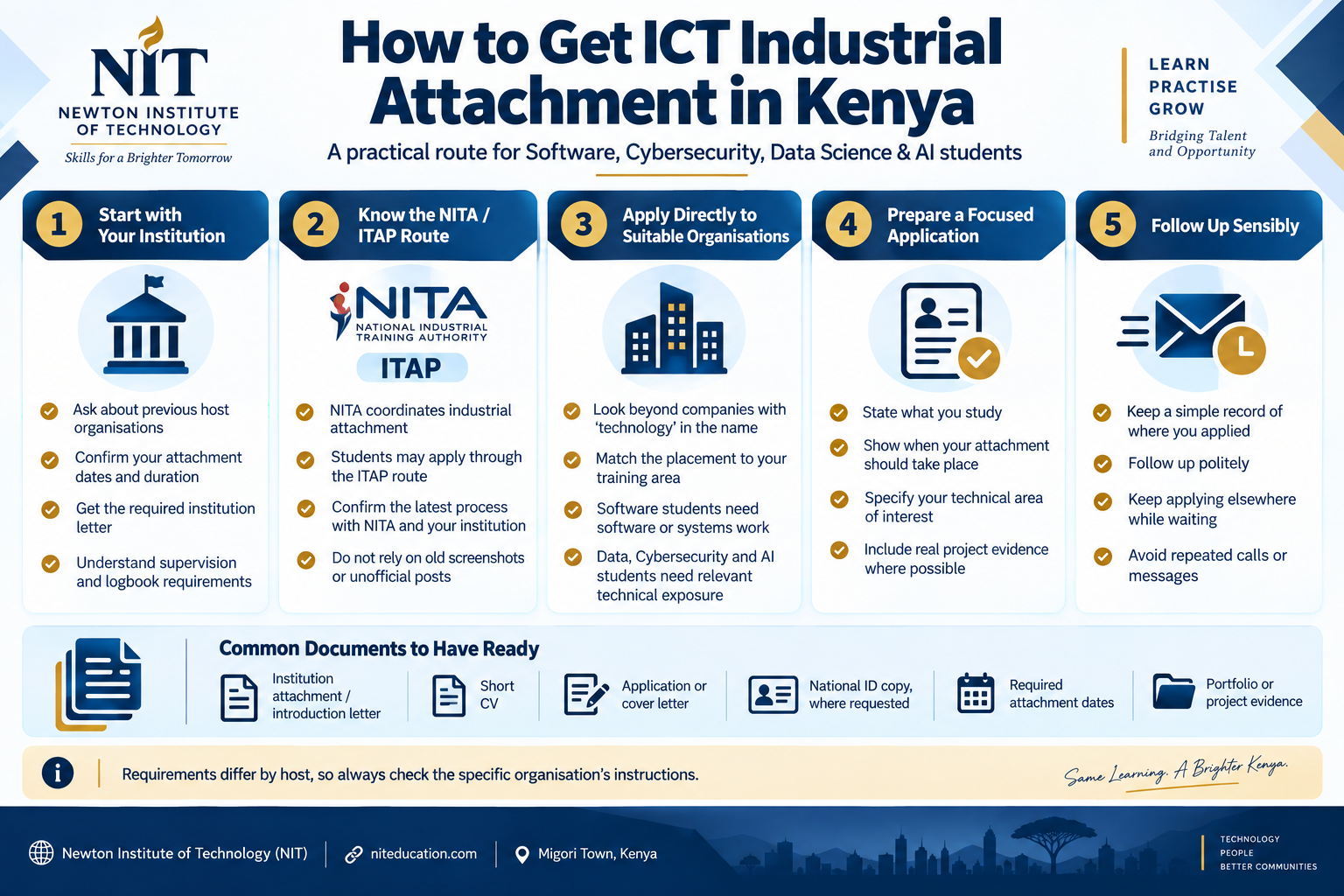
How to get ICT industrial attachment in Kenya
There is no single route that works for every student. In practice, it is better to use several approaches at the same time.
Ask about previous hosts, placement contacts, required dates, documents and supervision arrangements.
NITA coordinates industrial attachment and currently directs students seeking placement through its ITAP process.
Look beyond organisations with “technology” in the name and match the host’s real work to your training area.
State what you study, your attachment dates, the technical area you want to practise and what you can already do.
Start with your institution
Ask the person or office responsible for industrial attachment whether the institution has previous host organisations, placement contacts or particular requirements.
Confirm when the attachment is expected to begin, how long it should run, what documents you need and how institutional supervision will be handled. TVETA’s accreditation framework assigns institutions responsibilities around placement coordination, briefing, supervision and attachment reporting. Starting early gives you far more room to solve problems than waiting until a few days before reporting.
Know the NITA/ITAP route
NITA coordinates industrial attachment between training institutions and industry and currently directs students seeking placement through its ITAP process. Students applying through that route should be verified by their training institutions.
NITA currently provides an industrial-attachment application route through ITAP. Procedures can change, so confirm the latest process directly with NITA and your institution before applying.
Do not rely on an old screenshot, forwarded WhatsApp message or social-media post when an official process is available.
Apply directly to suitable organisations
Do not limit your search to companies with “technology” in their names. Schools, hospitals, manufacturers, NGOs, county institutions, logistics firms, construction companies, financial organisations and many other workplaces use software, databases, networks and operational data.
The important thing is the work available. A software student needs exposure to software or systems work. A data student needs meaningful data tasks. A cybersecurity learner needs supervised systems, networking or security exposure. An AI learner needs work connected to data, automation, models or AI-enabled systems.
Prepare a focused application
Make it easy for somebody reading your application to understand what you study, when your attachment should take place, the technical area you want to practise and what you can already do.
A short application backed by a real project is normally more convincing than several paragraphs describing yourself as innovative, passionate and hardworking.
Common documents to have ready
| Document or information | Why you may need it |
|---|---|
| Institution attachment / introduction letter | Confirms that you are a student seeking official attachment. |
| Short CV | Summarises your training, skills and projects. |
| Cover / application letter | Explains the area in which you are seeking placement. |
| National ID copy, where requested | Some hosts require identification during application or onboarding. |
| Student / institution details | Helps the host verify your programme and institution. |
| Required attachment dates | Confirms when you are expected to start and finish. |
| Portfolio or project evidence | Useful where the host wants to understand your current practical ability. |
Requirements vary by host. Check each organisation’s current instructions instead of assuming the same checklist applies everywhere.
Follow up sensibly
Applications sometimes disappear inside busy offices and inboxes, so a polite follow-up is reasonable. Repeated calls several times in one day are not. Keep a simple record of where you applied and continue exploring other possibilities while waiting for responses.
How to Get ICT Industrial Attachment in Kenya
What useful exposure looks like
The four ICT attachment paths
The host organisation may be different, but the placement should move you closer to the kind of work your training is preparing you to do.
Development workflow
Existing code, Git, bugs, testing, databases, documentation and controlled deployment.
Authorised security work
Documentation, access control, logs, backups, configurations and supervised reviews.
From records to evidence
Cleaning, validation, SQL or Python analysis, visualisation and clear reporting.
Evaluation, not just demos
Data preparation, testing outputs, comparing approaches and documenting experiments.
Software Development
What should a Software Development student learn during attachment?
Professional software work involves much more than writing code. You may need to understand code written by another person, reproduce a bug before fixing it, work with Git, interpret a requirement, query a database safely or test a change before it reaches users.
| Area | Useful workplace exposure |
|---|---|
| Existing systems | Reading and understanding an unfamiliar codebase. |
| Git / version control | Commits, branches, merges and reviewed changes. |
| Front end | Forms, interfaces, validation and usability fixes. |
| Back end | Business logic, authentication, APIs or server-side tasks. |
| Databases | Queries, table relationships and controlled data changes. |
| Debugging | Reproducing faults and tracing their causes. |
| Testing | Checking expected behaviour before and after changes. |
| Documentation | Setup notes, feature explanations and technical records. |
| Deployment | Understanding how approved code reaches a live environment. |
Your first task may be quite small. That is not necessarily a bad sign. A supervisor may be checking how carefully you work before giving you more responsibility. Fixing one real bug properly can teach you more than starting five features and completing none of them.
Cybersecurity
What should a Cybersecurity student learn during attachment?
Being an attachment student does not automatically give you permission to scan systems, probe accounts or test vulnerabilities.
Useful work may include network documentation, equipment inventories, account-management procedures, approved log analysis, backup checks, endpoint configuration, security-awareness activities, incident documentation or supervised reviews.
Much of this work is less dramatic than what students may see in cybersecurity videos. That is normal. Real security depends heavily on careful configuration, access control, documentation, monitoring and communication.
If you notice something that looks like a weakness, report it through the agreed channel before doing anything further.
Data Science & Analytics
What should a Data Science & Analytics student learn during attachment?
Real organisational data rarely arrives looking like the clean datasets used in tutorials. You may find duplicate records, missing values, inconsistent names, strange dates or columns whose purpose nobody can immediately explain. Sometimes the first challenge is deciding whether the available data can answer the question being asked.
| Stage | What you may practise |
|---|---|
| Problem definition | Understanding what the organisation actually wants to know. |
| Data access | Using only information you are authorised to access. |
| Cleaning | Handling duplicates, missing values and inconsistent formats. |
| Validation | Checking whether the records are reliable enough. |
| Analysis | Working with Excel, SQL, Python or other suitable tools. |
| Visualisation | Presenting findings clearly. |
| Interpretation | Explaining what the evidence does and does not support. |
| Reporting | Communicating findings to non-technical users. |
One of the most useful lessons in data work is that a polished dashboard can still be misleading when the information beneath it is poor.
Artificial Intelligence
What should an Artificial Intelligence student learn during attachment?
AI attachment is unlikely to mean spending every day training advanced models. You may spend much more time preparing data, checking labels, comparing model outputs, documenting experiments or investigating why a model performs poorly on certain examples.
Where did the data come from? What happens when information is missing? Which errors matter most? How do we know whether the model is improving? Would a simpler approach work? Who checks an output before it affects a real decision?
That is the shift from experimenting with AI in class to understanding how AI behaves when people may depend on the result.
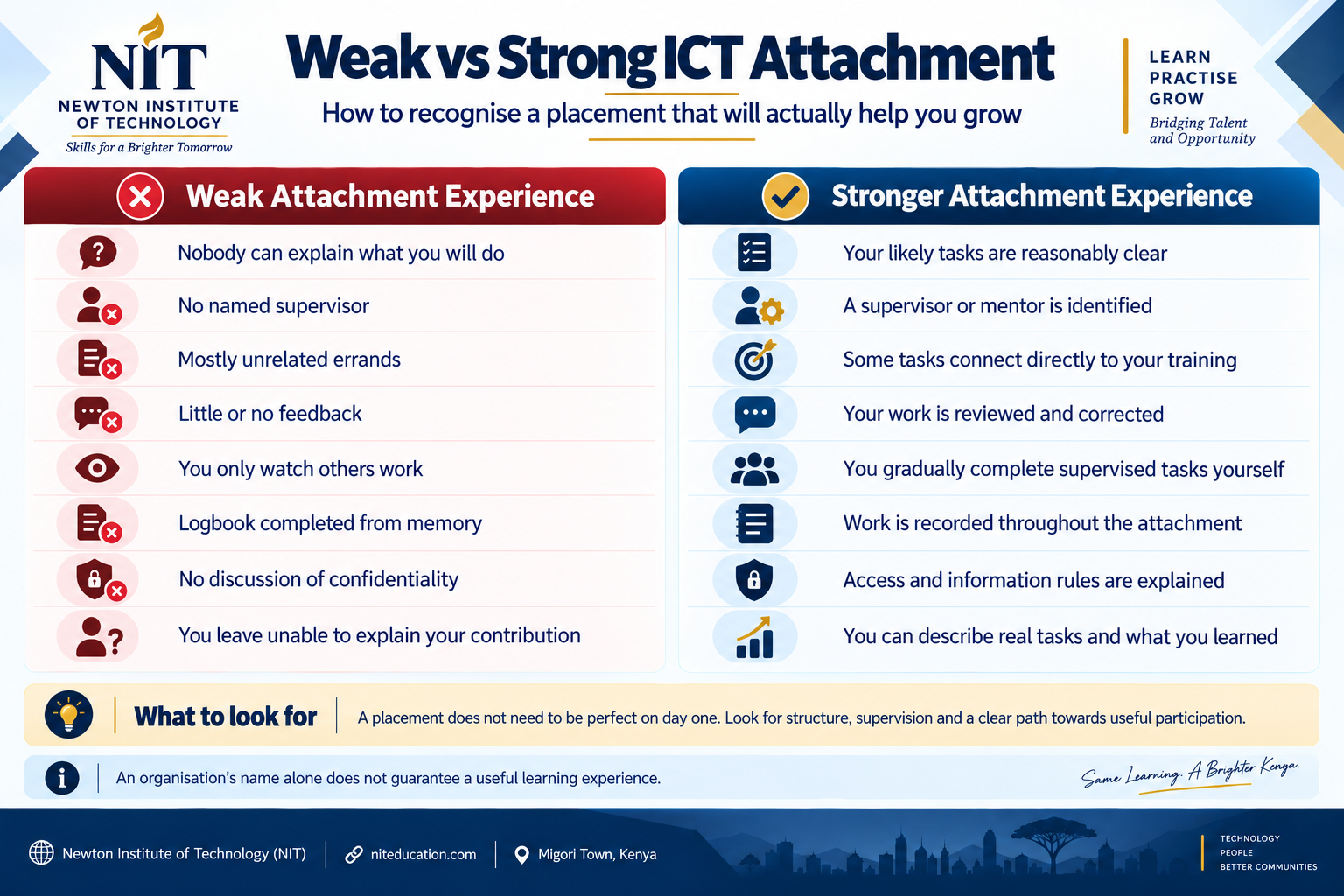
Placement quality check
What does a strong attachment look like?
The name of the organisation tells you surprisingly little about the quality of a placement.
| Weak attachment experience | Stronger attachment experience |
|---|---|
| Nobody can explain what you will do. | Your likely tasks are reasonably clear. |
| No named supervisor. | A supervisor or mentor is identified. |
| Mostly unrelated errands. | Some tasks connect directly to your training. |
| Little or no feedback. | Your work is reviewed and corrected. |
| You only watch others work. | You gradually complete supervised tasks yourself. |
| Logbook completed from memory. | Work is recorded throughout the attachment. |
| No discussion of confidentiality. | Access and information rules are explained. |
| You leave unable to explain your contribution. | You can describe real tasks and what you learned. |
A placement will not always look perfect in the first few days. Workplaces are busy, and supervisors may need time to understand your ability. Look for evidence that the experience is moving towards useful participation.
Weak vs Strong ICT Attachment
Before you report
Questions to ask before accepting a placement
Try to find out which department you will join, what attachment students normally work on, who will supervise you and whether the host can accommodate your institution’s assessment and logbook requirements.
You should also understand working hours, reporting dates and the basic rules around systems, devices and data. You do not need confidential information before joining. You simply need enough detail to decide whether the placement is reasonably aligned with your training.
Placement warning signs
Attachment red flags worth checking
A single warning sign does not always mean the placement is unsuitable, but several together deserve attention.
| Warning sign | Why it matters |
|---|---|
| Nobody knows which department you will join | The placement may not have been planned. |
| No one appears responsible for supervision | Technical feedback may be difficult to get. |
| Many students are accepted but nobody can describe their tasks | You may spend much of the attachment idle. |
| You are promised unrestricted access to sensitive systems | That suggests weak security practice rather than good training. |
| The work has little relationship to your course | You may struggle to meet the intended learning outcomes. |
| Required assessment or logbook processes cannot be supported | Problems may emerge near the end. |
| The arrangement seems focused only on signatures | You may leave with paperwork but little practical experience. |
TVETA’s industrial-attachment standard treats placement, mentoring, coaching, assessment and monitoring as important parts of the process. A useful host should therefore have at least some structure around students.
When attachment is not going smoothly
Problems ICT attachment students actually run into
Attachments are rarely perfect. What matters is how early a problem is identified and how sensibly it is handled.
| Problem | A sensible response |
|---|---|
| Tasks are unrelated to your course | Complete reasonable initial duties, then ask about a relevant technical task. |
| You have limited access to live systems | Ask about test environments, sample data, documentation or lower-risk work. |
| You are sitting idle | Request a clearly defined small task. |
| Transport or daily costs are becoming difficult | Raise the issue early and consider realistic alternatives. |
| You understand the technical work but cannot explain progress clearly | Practise short updates: what you did, what happened and what remains. |
| You are asked to do something outside your authority | Stop and confirm with the supervisor before continuing. |
| The placement remains unsuitable | Contact your institution while there is still time to intervene. |
Do not wait until the final week to report a problem that started in the first one.
Starting well
Your first week on attachment
Your first few days are usually better spent understanding the workplace than trying to prove how much you know.
Learn who you report to, which systems you are allowed to access, how technical problems are escalated and how changes are approved.
Pay attention to how documents are stored. If you receive credentials or equipment, understand the rules surrounding them. When someone gives you a task, confirm the expected result before rushing into it.
Those habits may feel basic, but they make it much easier for a supervisor to trust you with more technical work later.
Use the time deliberately
How to make three months count
A three-month attachment can disappear surprisingly quickly.
At the beginning, concentrate on orientation and smaller assignments. As you become familiar with the workplace, try to take responsibility for clearly defined tasks while still working within the limits set by your supervisor.
Keep notes. Record what the problem was, what you tried, where you struggled and what finally worked.
By the middle of the placement, you will probably start seeing patterns in your own weaknesses. Perhaps your SQL needs work. Maybe your Git habits are poor. You might be technically capable but weak at explaining your progress.
Those observations are useful. They tell you what to work on before the attachment ends.
Document the learning
Keep your logbook while the work is fresh
Trying to recreate several months of work during the final weekend usually produces vague entries.
A better entry could say: “Investigated a form that was submitting incomplete records, reproduced the issue and documented the conditions under which the error occurred.”
A data student might record cleaning duplicate entries and comparing totals before and after the correction. A cybersecurity learner could document reviewing authentication events with a supervisor and identifying common event types.
Good logbook entries show what you actually learned without revealing confidential organisational details.
Confidentiality and proof of work
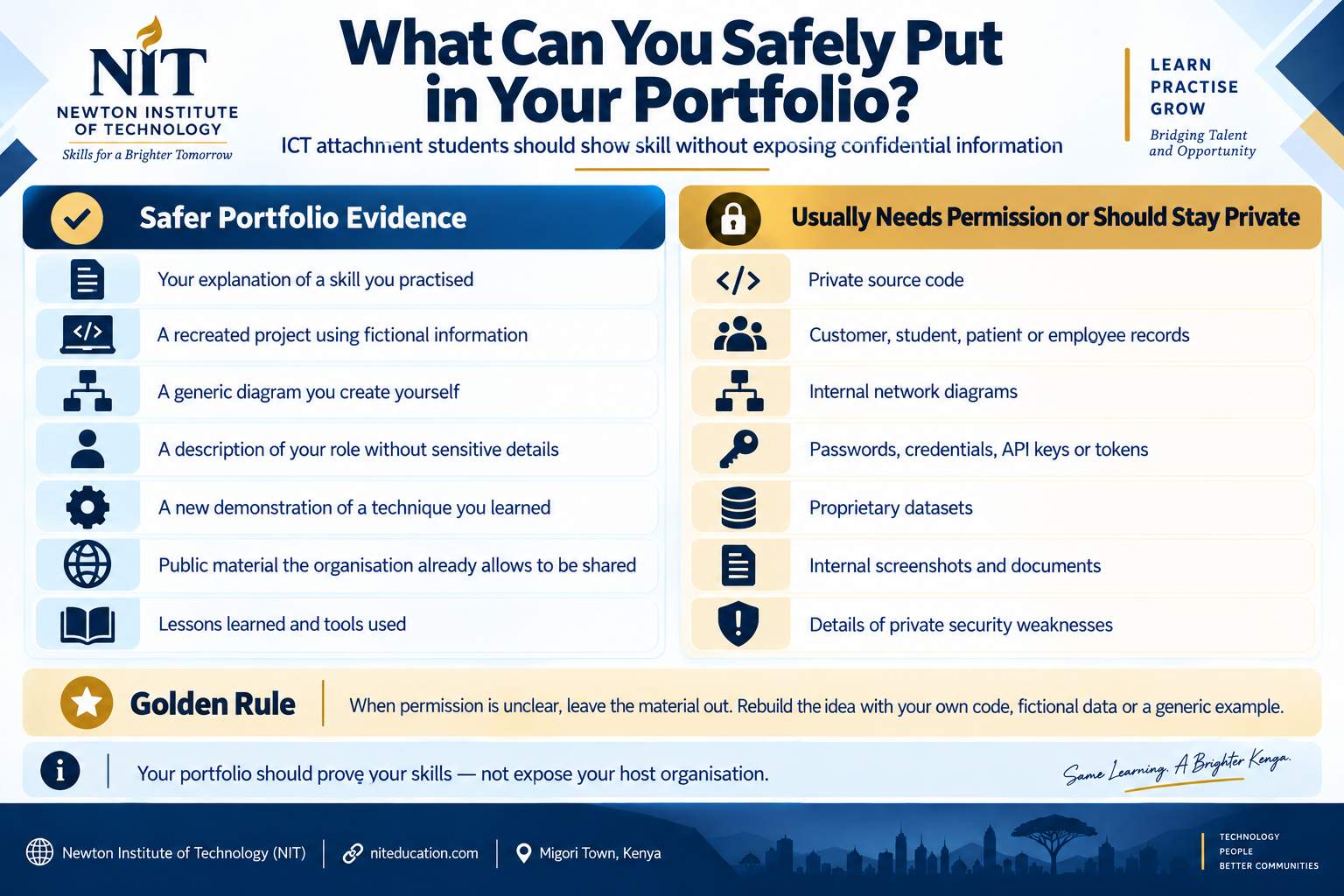
What can you safely put in your portfolio after attachment?
ICT students need to be particularly careful here because it is very easy to take confidential information away from a workplace without fully appreciating the consequences.
Working on source code does not automatically make the code yours. Seeing an internal network diagram does not give you permission to publish it. Analysing customer information does not make that dataset suitable for your portfolio.
| Safer portfolio evidence | Usually needs explicit permission or should remain private |
|---|---|
| Your explanation of a skill you practised. | Private source code. |
| A recreated project using fictional information. | Customer, student, patient or employee records. |
| A generic diagram you create yourself. | Internal network diagrams. |
| A description of your role without sensitive details. | Passwords, credentials, API keys or tokens. |
| A new demonstration of a technique you learned. | Proprietary datasets. |
| Public material the organisation already allows to be shared. | Internal screenshots and documents. |
| Lessons learned and tools used. | Details of private security weaknesses. |
When permission is unclear, leave the material out.
You can usually demonstrate the same technical ability another way. Rebuild a smaller application with your own code. Create fictional data and repeat the analysis. Draw a generic network instead of publishing the real one. Your portfolio needs to prove your skills, not expose your host.
What Can You Safely Put in Your Portfolio?
Professional restraint
Cybersecurity students should be especially careful
Suppose you notice an unusual service running on a machine. That does not automatically give you permission to scan it.
If a password policy looks weak, do not begin testing accounts. If you notice what may be a web vulnerability, report it rather than continuing to explore it unless the organisation has clearly authorised that work.
Professional cybersecurity involves knowing when to investigate and when to stop.
Information discipline
Data and AI students also need strong information discipline
A spreadsheet can contain information just as sensitive as a formal database.
Do not send organisational data to your personal email because you want to continue working at home. Do not copy records onto a flash drive without approval. Do not paste confidential information into a public AI service just because it may help analyse the data faster.
If you need to demonstrate the method later, reproduce it with synthetic or appropriately anonymised information where suitable.
Course-to-work mismatch
What if your attachment work does not match your course?
Give the placement a reasonable chance at first. Many supervisors start students with lower-risk work while they assess reliability.
If the mismatch continues, have a straightforward conversation. A software student could ask whether there is a testing, documentation or small development task available. A data learner may ask about non-sensitive reporting or data-cleaning work. A cybersecurity student could request supervised inventory, documentation, access-management or log-review tasks. An AI student may be able to help with data preparation or testing even when there is no formal AI department.
If nothing changes, involve your institution early rather than waiting for the attachment to end.
Learning over logos
Do not choose attachment by organisation name alone
A recognised organisation can look impressive on a CV, but the name itself does not guarantee good learning.
A smaller organisation where someone actually gives you technical work and reviews what you do can sometimes be far more useful than a large institution where attachment students spend most of their time observing.
Before becoming impressed by the logo, try to understand what happens after you report.
NIT practical perspective
A practical lesson from NIT’s ICT training approach
A learner who can clearly explain one real system, analysis, technical task or problem they contributed to often has stronger evidence of growth than someone who spent three months around impressive technology without being involved in the work.
That is why preparation before attachment matters.
After attachment
Attachment and employability
Attachment can make your skills easier to evaluate later because you have real situations to talk about. You can explain how you received instructions, handled feedback, solved a technical problem or protected information.
For a deeper discussion of the skills employers look for, see NIT’s ICT Skills Employers Want in Kenya. This article remains focused on preparing for and succeeding during industrial attachment.
Training before the workplace
How NIT prepares ICT students for industrial attachment
At Newton Institute of Technology, industrial attachment follows practical institutional training.
Eight months of institutional training followed by compulsory industrial attachment of at least three months.
Six months of institutional training followed by a compulsory three-month attachment.
Six months of institutional training followed by a compulsory three-month attachment.
Six months of institutional training followed by a compulsory three-month attachment.
Students therefore go into attachment after developing a practical foundation through lessons, exercises and projects. The workplace adds something the classroom cannot fully reproduce: real users, organisational procedures, deadlines, access controls, supervision and professional responsibility.
Frequently asked questions
ICT industrial attachment in Kenya: FAQs
How long does ICT industrial attachment take?
The duration depends on the programme and institution, so students should follow the period specified in their official training and attachment requirements. At NIT, Full-Stack Software Development includes at least three months of compulsory attachment after institutional training. Cybersecurity, Data Science & Analytics and Artificial Intelligence each include three months.
Can students apply through NITA?
Yes. NITA currently provides an attachment application route through ITAP, with applicants expected to be verified by their institutions. Because application procedures can change, students should check the latest NITA instructions when they are ready to apply.
What documents should I prepare?
A short CV, institution attachment letter, application or cover letter, required attachment dates and relevant student details are good starting points. Some hosts may also request identification documents or other supporting material. Always check the particular organisation’s requirements.
Should I wait until attachment begins before looking for a placement?
No. Start preparing early. Your CV, project evidence, institutional documents and list of suitable hosts can be prepared before the official attachment period begins.
Do I need previous work experience?
No. You are applying as a student. However, being able to show practical exercises, projects or other evidence of what you have already learned can make it easier for a host to understand where you may fit.
Do software-development students need GitHub?
Not necessarily. GitHub is useful for software-development students and some other technical work, but the important thing is having evidence you can legally share and confidently explain.
Can cybersecurity attachment students test the organisation’s systems?
Only when the organisation has clearly authorised the activity and defined what you are permitted to test. If the scope is unclear, ask before proceeding.
Can I publish the project I worked on during attachment?
Only if you have the right to do so. Private code, internal documents, customer information, credentials, network details and private vulnerabilities should not be published simply because you worked with them during attachment. When necessary, create a separate demonstration using your own code or fictional data.
What if I spend most of my attachment doing unrelated work?
Speak to your workplace supervisor early and explain the technical area you are training in. Ask whether a relevant task can be included. If the problem continues, contact your institution before too much of the attachment period has passed.
Is getting the logbook signed enough?
No. The logbook documents the placement, but the real value of attachment comes from supervised practice, feedback and the technical and professional lessons you take back with you.
Final thought
Three months can pass very quickly
At the end, you should be able to sit across from another developer, analyst, security practitioner, trainer or employer and explain what you actually worked on. You should remember problems that forced you to think, skills that improved and areas where you still need more practice.
If all you can remember is the organisation’s name and the dates written in your logbook, something was missed.
Sources and further reading
National Industrial Training Authority — Industrial Attachment · TVETA — TVET Standards · University of Nairobi ICT Centre — Student Attachment
Institutional programme references: Full-Stack Software Development · Cybersecurity · Data Science & Analytics · Artificial Intelligence.