

AI Career Guide 2026
Artificial Intelligence Career:
Jobs, Skills & Future Opportunities
Career paths · practical skills · portfolios · future opportunities
A practical global guide to AI careers: understand where the jobs are, what current employers ask for, which path may suit you and what evidence makes a learner job-ready.
Build skills that travel
Look at a current artificial intelligence engineering vacancy and the word AI is usually only the beginning. The actual work may involve Python, APIs, databases, retrieval systems, model evaluation, cloud deployment, software testing and working out what happens when an AI system gives the wrong answer.
Artificial intelligence is creating new occupations, but it is also being absorbed into jobs that already exist. Some people will build AI systems. Others will use AI inside software development, finance, healthcare, agriculture, cybersecurity, education, operations and many other fields.
PwC’s 2026 Global AI Jobs Barometer found jobs requiring specific AI skills growing much faster than the wider jobs market. The practical lesson is not that AI guarantees employment; it is that employers increasingly value people who can turn AI into useful, dependable work.
Is artificial intelligence a good career?
It can be a strong career direction for people who enjoy technology, problem solving and continuous learning. AI and big data remain among the fastest-growing skill areas globally, but the strongest opportunities increasingly go to people who can build, test, integrate, explain and improve real systems rather than simply list AI tools on a CV.
Build AI or Apply AI?
Choose the direction first
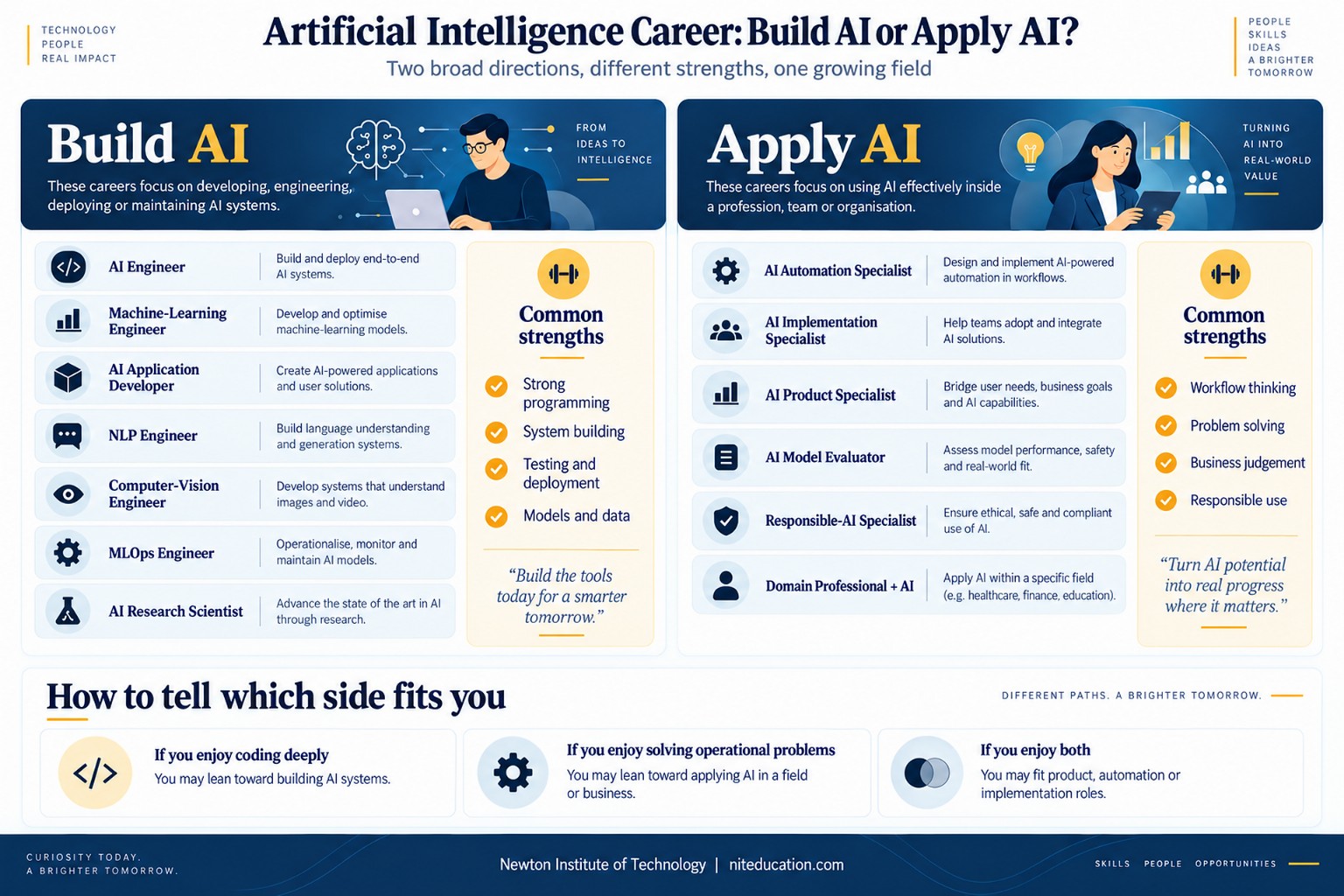
Do you want to build AI or apply AI?
One of the simplest ways to understand AI careers is to separate roles that primarily build AI systems from roles that primarily apply AI inside a profession or organisation. The boundary is not perfect, but it gives beginners a useful starting point.
Build AI
- AI Engineer
- Machine-Learning Engineer
- AI Application Developer
- NLP Engineer
- Computer-Vision Engineer
- MLOps Engineer
- AI Research Scientist
Apply AI
- AI Automation Specialist
- AI Implementation Specialist
- AI Product Specialist
- AI Model Evaluator
- Responsible-AI Specialist
- Domain Professional + AI
Someone using AI to redesign a business workflow does not need exactly the same preparation as someone training new models. Several careers sit between both sides, which is normal in a field this broad.
2026 editorial snapshot
What current applied-AI engineering vacancies are asking for
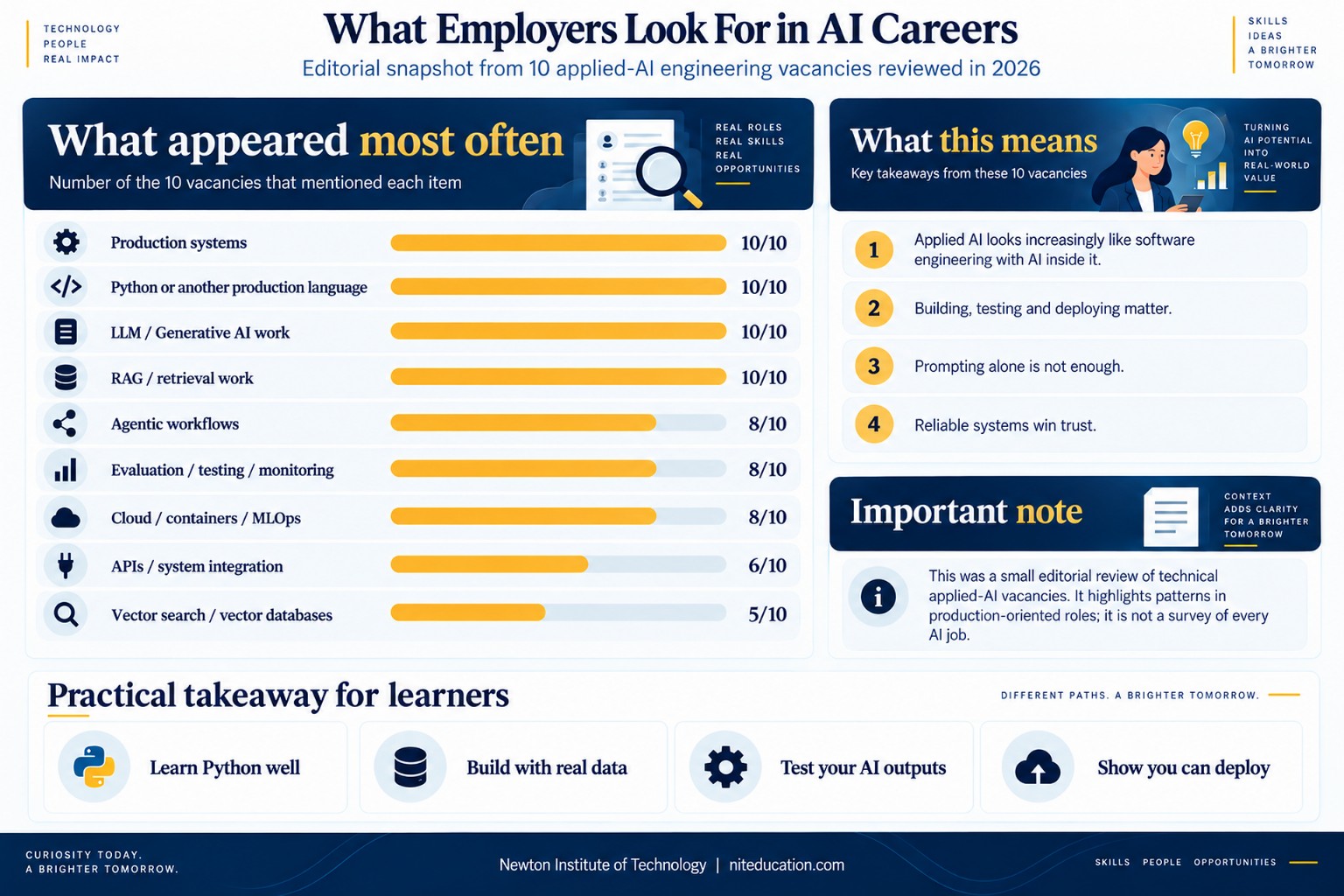
For this guide, NIT reviewed 10 distinct applied-AI, generative-AI and agentic-AI engineering vacancies that were publicly available or recently indexed during the 2026 review period. The sample is deliberately small and engineering-heavy, so it should be read as a practical snapshot rather than a global labour-market survey.
| Work or skill signal | Visible in reviewed vacancies | What it suggests |
|---|---|---|
| Production systems | 10/10 | Employers want systems that work beyond a demo or notebook. |
| Python or another production language | 10/10 | Programming remains central to technical applied AI. |
| LLM / generative-AI development | 10/10 | Generative AI is central in this engineering sample. |
| RAG / retrieval work | 10/10 | Connecting models to external information is a common engineering task. |
| Agentic workflows | 8/10 | Multi-step AI workflows are appearing in production roles. |
| Evaluation / testing / monitoring | 8/10 | Reliability is becoming part of the engineering job. |
| Cloud / containers / MLOps | 8/10 | Deployment matters when AI moves into production. |
| APIs / system integration | 6/10 | AI usually needs to connect with existing software and data. |
| Vector search / vector databases | 5/10 | Retrieval infrastructure appears regularly, but not universally. |
What employers look for in AI careers
Career map
Artificial intelligence career paths
AI Engineer
Production systems
Builds applications and services that put AI to practical use, often combining models, retrieval, APIs, databases, evaluation and deployment.
Machine-Learning Engineer
Models & data
Works more deeply with model training, data preparation, evaluation, prediction and deployment.
AI Application Developer
Useful products
Builds software around existing AI models and connects those models to data, interfaces and business logic.
Data Scientist
Analysis & prediction
Uses statistics, experiments, analysis and machine learning to understand data and support decisions.
NLP Engineer
Language systems
Builds systems for search, extraction, classification, speech, translation, summarisation and conversational applications.
Computer-Vision Engineer
Images & video
Develops systems that recognise, inspect or analyse visual information.
MLOps Engineer
Deployment & reliability
Handles model deployment, monitoring, versioning, pipelines, infrastructure and production reliability.
AI Automation Specialist
Workflow improvement
Uses AI to improve repetitive business processes while deciding where human judgement must remain.
AI Model Evaluator
Testing & behaviour
Designs tests, compares outputs, investigates failures and checks whether an AI system behaves reliably.
AI Product Specialist
Users & value
Works between users, business needs and technical teams to decide what should be built and how success should be measured.
Responsible-AI Specialist
Risk & controls
Works on privacy, fairness, transparency, governance, security and responsible adoption.
AI Research Scientist
Original research
Investigates new methods and models. This route is usually more mathematical and often more academically demanding.
Choose by the work, not the title
Which AI career might suit you?
| Career | Coding | Maths | Typical emphasis | What would convince an interviewer? |
|---|---|---|---|---|
| AI Engineer | High | Medium | Production AI applications | A deployed system you can explain, test and troubleshoot. |
| Machine-Learning Engineer | High | High | Models, training and deployment | A model comparison with sound evaluation and deployment. |
| AI Application Developer | High | Low–Medium | Software built around AI models | A complete usable application rather than a notebook. |
| Data Scientist | Medium–High | High | Analysis, experimentation and prediction | A project where conclusions follow clearly from the data. |
| NLP Engineer | High | Medium–High | Language and document systems | A language system with a meaningful evaluation method. |
| MLOps Engineer | High | Medium | Deployment and reliability | A reproducible deployment with monitoring and version control. |
| AI Automation Specialist | Medium | Low–Medium | Workflow improvement | Evidence that an automation improved a real process. |
| AI Product Specialist | Low–Medium | Low | Problem selection and product decisions | A case showing users, trade-offs, testing and measurable outcomes. |
| AI Research Scientist | Very high | Very high | New methods and original research | Serious experiments, research work or publications. |
Skills behind the career
What should you learn for an AI career?
Programming
Python is a strong starting point, but the deeper goal is learning to solve, debug and structure problems in code.
Data
Learn SQL, data cleaning, basic statistics, visualisation and how to recognise poor-quality information.
Machine learning
Understand training, testing, classification, regression, overfitting and model evaluation.
Applied AI
Learn model APIs, prompting, embeddings, RAG, vector search, tools, agents and structured outputs.
Software engineering
Use Git, APIs, databases, testing, debugging and deployment so AI becomes part of a usable system.
Evaluation
Test whether outputs are correct, supported and dependable under realistic conditions.
Mathematics
Increase your depth in statistics, probability, linear algebra and calculus as the role becomes more model-heavy.
Judgement
Learn to recognise when AI should not be trusted, when a simpler solution is better and where human responsibility belongs.
One skill, not the whole toolkit
Prompt engineering is useful, but it is not the whole career
Prompting can improve how a model behaves. It does not replace programming, data, software engineering, evaluation or domain knowledge. A stronger career claim is not simply “I know prompt engineering,” but being able to show what you built, why you built it that way, how you tested it and where it still fails.
A realistic entry point
Entry-level AI is promising, but not automatically easy
AI hiring is growing, while some junior roles are also becoming more demanding. That changes what a beginner needs to prove.
Collect tool names
- Complete short tutorials
- Add many tools to a CV
- Rely on generic certificates
- Hope the employer trusts your potential
Build inspectable evidence
- Learn the foundations
- Build something real
- Test it properly
- Document what failed and improved
- Show what you can handle independently
Evidence of ability
What should an AI portfolio prove?
The problem
Explain the real problem you were trying to solve rather than naming the technology first.
Your contribution
Separate what you personally built from libraries, templates, collaborators and AI-generated code.
The information
Describe the data or documents used and their limitations.
Your decisions
Explain why you chose the model, database, retrieval method or architecture.
The evaluation
Show how you tested whether the system actually worked.
The failures
Be ready to explain what broke and what you learned from it.
The improvement
Show what changed after testing and what you would improve next.
“Built an AI chatbot using Python and RAG” says very little. A stronger project explains the source documents, how retrieval worked, how unsupported questions were handled, how accuracy was tested and which failure cases remained.
Technical-review perspective
Understand what is happening underneath the interface
A beginner AI project should not be judged mainly by how impressive the interface looks. The more useful test is whether the learner can explain the code, verify the output, recognise when the system is wrong, troubleshoot a failure and state the limits of the solution.
Practical ability · evaluation · technical judgementFrom beginner to job-ready
A practical route into an AI career
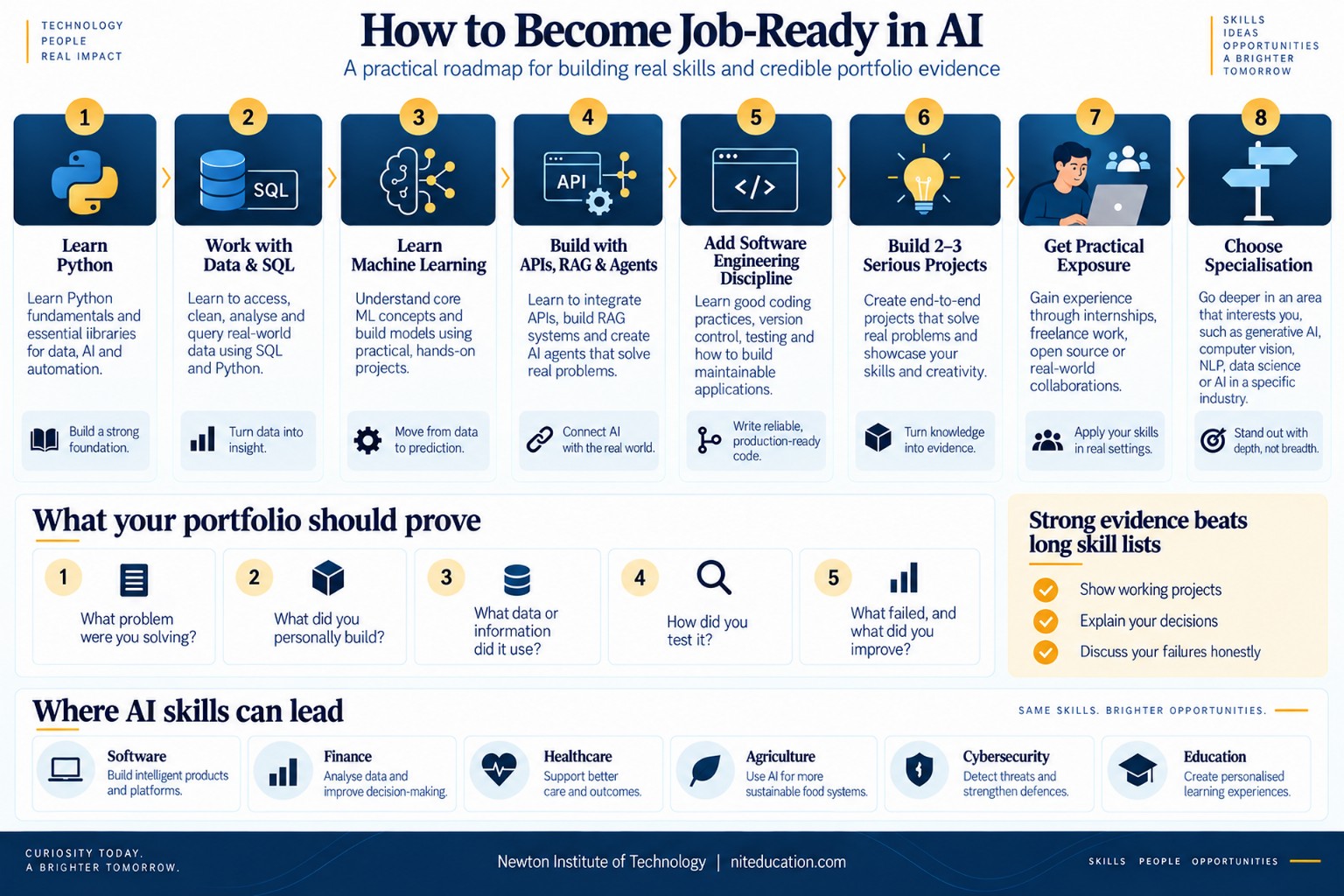
Learn programming
Learn Python well enough to write and debug small programs yourself.
Work with data
Add SQL, cleaning, statistics and practical analysis.
Learn machine learning
Build simple models and understand how to evaluate them.
Move into applied AI
Work with APIs, RAG, embeddings, agents and evaluation.
Add engineering discipline
Use version control, testing, APIs and basic deployment.
Build serious projects
Two or three projects you understand deeply are better than a long list of copied tutorials.
Get practical exposure
Use attachment, internships, supervised work, freelance assignments or collaborative projects.
Specialise
Choose a deeper direction after you understand what the work actually feels like.
How to become job-ready in AI
Where the skills travel
Where can AI skills be used?
Technology
Software
AI capabilities increasingly sit inside ordinary software products.
Financial services
Finance
Applications include fraud analysis, document processing, forecasting and customer support.
Health systems
Healthcare
AI can support research, administration, images, information and decision support.
Food & farming
Agriculture
Potential uses include crop analysis, disease identification, forecasting and decision support.
Security
Cybersecurity
AI can assist investigation and analysis while also giving attackers new tools.
Learning systems
Education
AI can support learning, administration, assessment and information retrieval.
Software + AI, cybersecurity + AI, agriculture + AI, healthcare + AI and business operations + AI can be powerful because domain knowledge helps you recognise which problems are actually worth solving.
Future opportunities
Will artificial intelligence replace jobs?
Some tasks will be automated. Some occupations will lose work, others will change significantly, and new roles will appear. Broad predictions are difficult because AI affects different occupations in different ways.
For career planning, a more useful question is: Which parts of this work are becoming easier to automate, and what will people still need to understand, verify, decide or take responsibility for?
Global field, local problems
AI careers are global, but useful problems are often local
A developer may work with a team or client in another country, but not every valuable AI problem is global. Agriculture, education, healthcare, logistics, small-business operations and public services present different challenges in different places.
For learners in Africa, there is value in understanding global AI tools while recognising problems that require local knowledge. Solving one real problem well can be enough to begin building a serious portfolio.
Job-ready test
What should you be able to do?
The number of tools on a CV is not the best measure of readiness. A stronger test is whether you can perform and explain the work.
- Write and understand code appropriate to your target role.
- Work with data and recognise quality problems.
- Use version control and collaborate on code.
- Integrate systems through APIs.
- Build a small AI application.
- Evaluate whether its output is dependable.
- Troubleshoot failures and explain technical choices.
- Document your work and communicate limitations.
- Learn unfamiliar tools without starting again from zero.
Training pathway
Learning artificial intelligence at Newton Institute of Technology
This career guide deliberately does not repeat course fees, duration, the full curriculum, admission requirements or attachment details. Those belong to NIT’s dedicated Artificial Intelligence Course in Kenya guide.
The distinction is intentional: this article explains what careers exist, what skills they require and what evidence a learner should build; the course guide explains how the NIT Artificial Intelligence programme works.
Frequently asked questions
Artificial intelligence career FAQs
Is artificial intelligence a good career for the future?
Yes, it can be. AI and big data are among the fastest-growing skill areas globally, but success still depends on the role, practical ability, experience and formal requirements of the employer.
What are the main careers in AI?
Common directions include AI engineering, machine-learning engineering, AI application development, data science, NLP, computer vision, MLOps, automation, model evaluation, AI product work, governance and AI research.
Which AI career is best for a beginner?
There is no universal best choice. Software-oriented learners may prefer AI application development, data-oriented learners may prefer machine learning or data science, and people with strong domain knowledge may move toward AI implementation.
What should I learn first?
For a technical pathway, start with Python, data handling, SQL, basic statistics and machine-learning fundamentals. Then add APIs, retrieval, agents, evaluation and deployment.
Is Python enough?
No. Python is useful, but most roles also require some combination of data, APIs, databases, machine learning, software engineering, cloud skills, mathematics or domain knowledge.
Can I work in AI without a degree?
Some roles allow skills-first or experience-based routes, while others make formal qualifications compulsory. Research-heavy roles tend to have stronger academic expectations.
Is prompt engineering enough for an AI career?
Usually not for technical roles. Prompting is one useful skill inside a wider toolkit that can include programming, retrieval, integration, evaluation and deployment.
Do I need advanced mathematics?
It depends on the path. Research and deeper machine-learning careers usually require much more mathematics than automation or application integration.
Will AI replace software developers?
AI is changing software development, especially routine tasks. The profession is more likely to evolve than remain unchanged, with developers increasingly expected to use and supervise AI effectively.
Final advice
Build foundations that survive the next tool change
There will always be another model, framework or technique to learn. Trying to chase all of them is not a career strategy.
A stronger foundation is learning how to understand a problem, work with data, build something appropriate, test it and explain why you trust the result. Nobody can say with confidence which AI framework students will be using five years from now. Those underlying abilities have a better chance of lasting.
Research transparency
Applied-AI vacancy review method
For this guide, the Newton Institute of Technology Editorial Team reviewed 10 distinct publicly available or recently indexed technical AI vacancies during the 2026 research period.
Selection criteria
- Applied AI, generative AI, LLM or agentic-AI engineering role
- Sufficiently detailed public job description
- Technical responsibilities or requirements visible
- Current or recently indexed during the review period
What the sample cannot prove
- It is not a random global labour-market survey.
- It is weighted toward production-oriented technical roles.
- It should not be used to estimate every AI occupation or country.
Prepared by: Newton Institute of Technology Editorial Team
Institutional / Technical review: Engineer Simon Barongo
Updated: 12 September 2026