

Heavy Equipment Basic Mechanics Operator Guide
Heavy Equipment Systems
& Components
Power source · transfer · control · work output
Understand how the engine, hydraulics, drivetrain, electrical controls, cooling, steering, braking and work equipment fit together across common heavy machines.
Read the whole machine
What are heavy equipment systems and components?
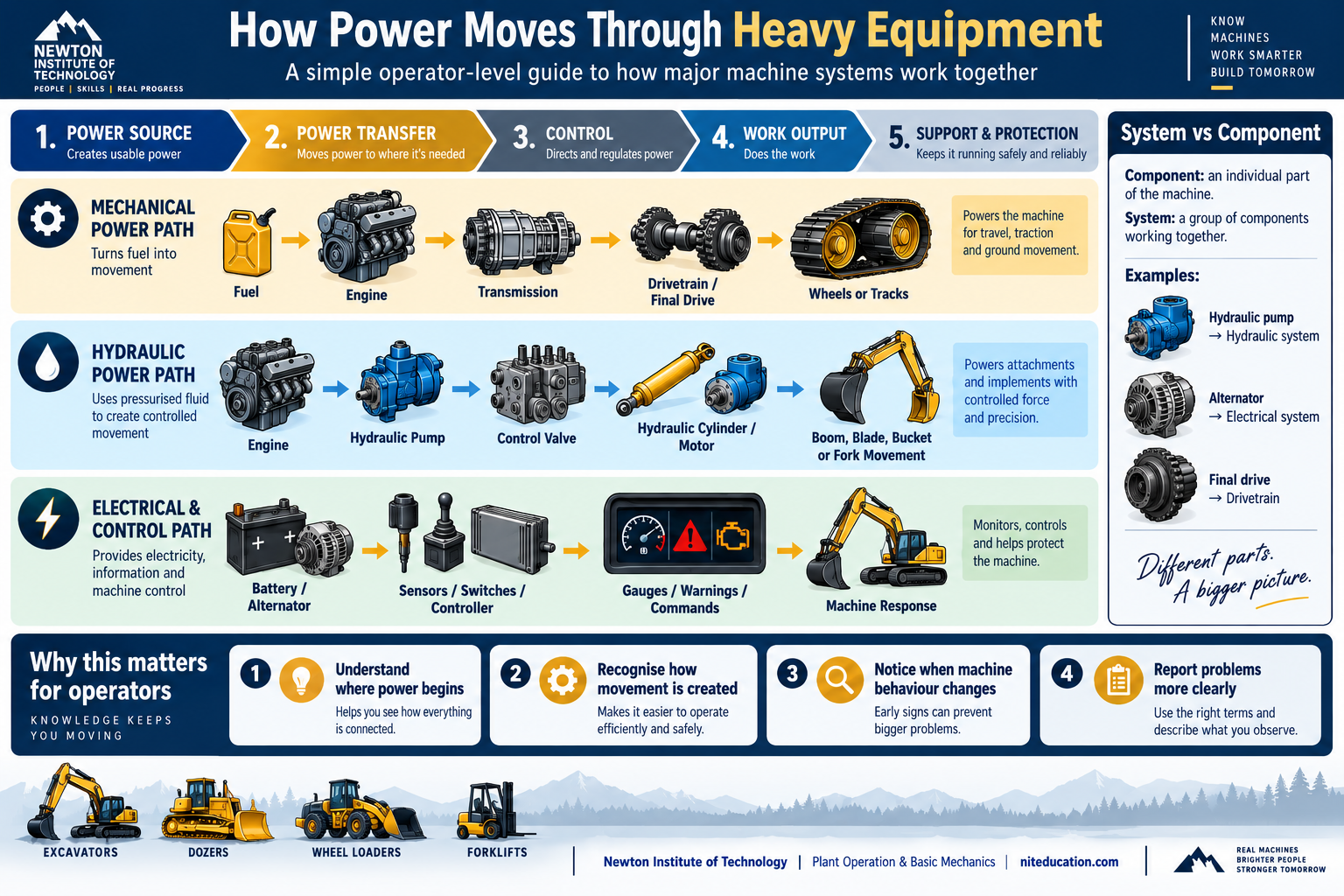
A component is an individual machine part. A system is a group of components working together to perform a job. A hydraulic pump is a component; the pump, reservoir, valves, hoses, fluid, cylinders and motors working together form the hydraulic system. Heavy machines combine power, transfer, control, work and protection systems to turn energy into useful movement.
A practical mental model
Read a heavy machine in five layers
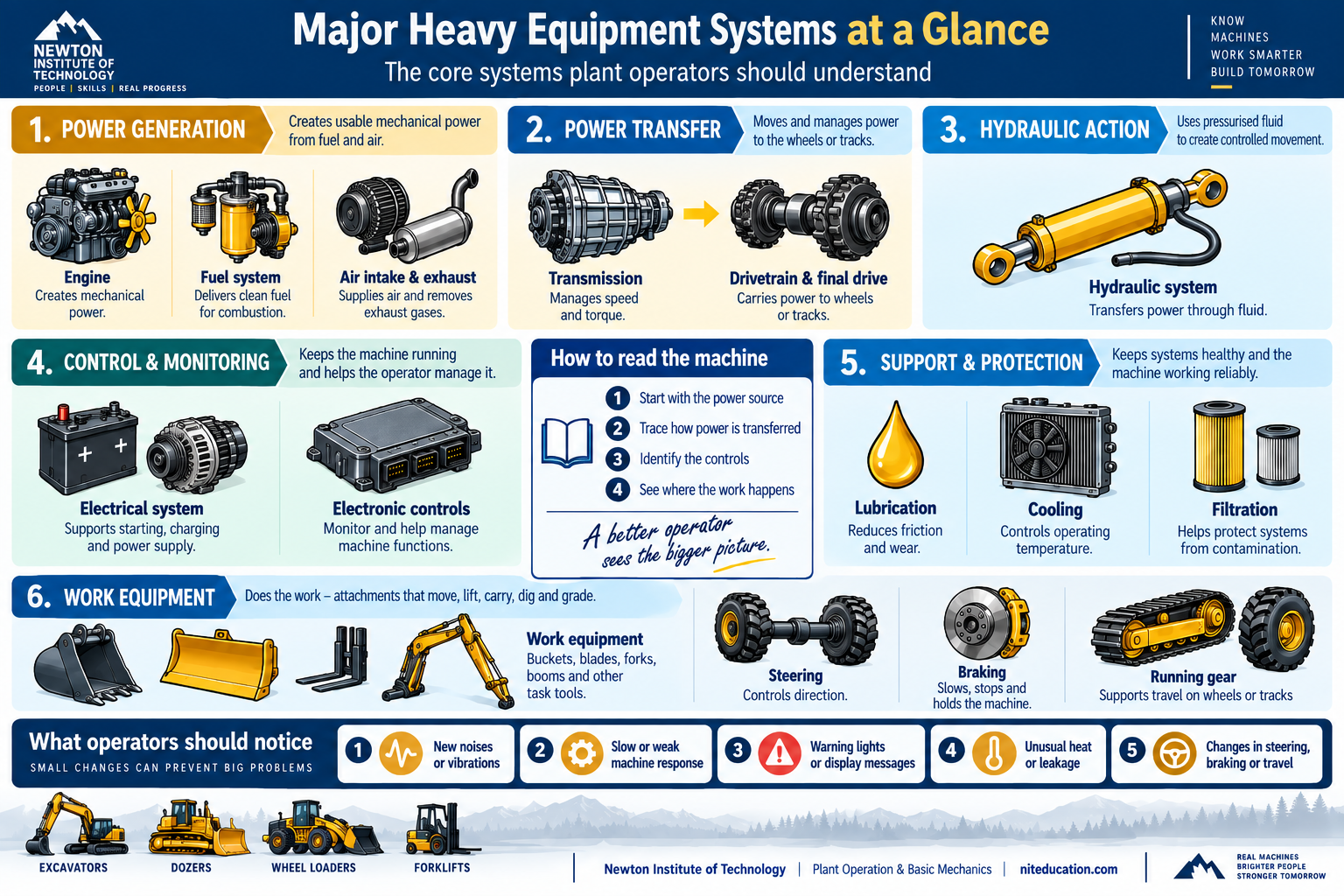
A heavy machine becomes easier to understand when every component has a place in a bigger picture. Start with five questions: where does the energy begin, how is it transferred, what controls it, where does useful work happen, and what protects the systems while they operate?
Find where usable energy begins: usually a diesel engine, but increasingly an electric or hybrid power system.
Trace how energy moves through the transmission, drivetrain, hydraulic pumps or electric drive components.
Identify the levers, joysticks, valves, sensors and electronic controllers that direct machine functions.
See where power becomes travel, digging, lifting, pushing, grading, steering or braking.
Cooling, lubrication, filtration, monitoring, braking, steering and running gear help the working systems stay usable, controlled and protected.
Layer 1 · Power source
Where the machine’s energy begins
On most conventional construction equipment, a diesel engine is the main power source. Fuel and air are burned inside the engine, producing the mechanical force that turns the crankshaft. That rotation can drive a transmission, hydraulic pumps, an alternator, cooling equipment and other systems.
A wheel loader therefore needs engine power both to travel and to work its loading hydraulics. A bulldozer needs power for the drivetrain as well as the hydraulic system positioning the blade. An excavator uses engine power primarily to turn hydraulic pumps that feed its working and travel functions.
Fuel system
The engine depends on a reliable supply of clean fuel. A typical fuel system may include a tank, lines, filters, water-separation equipment, pumps and injection components. For an operator, the useful skill is recognising visible leakage, contamination warnings, difficult starting or a change in engine behaviour and reporting it clearly.
Air intake and exhaust
Combustion also depends on air. The intake system allows filtered air to reach the engine and may include ducting, an air cleaner, restriction indicators and turbocharging components. After combustion, gases leave through the exhaust system, which on newer machines may also contain emissions-control equipment.
Layer 2 · Power transfer
How power moves to the ground and work equipment
Producing power is only useful if the machine can deliver it where work needs to happen. Heavy equipment transfers power mechanically, hydraulically or electrically, and many modern machines use a combination of all three.
Transmission and drivetrain
On wheeled or tracked equipment, the travel path may include a transmission, torque converter, drive shafts, differentials, axles, final drives, sprockets and wheels or tracks. Other machines use hydrostatic arrangements in which hydraulic pumps and motors form an important part of travel.
The practical question is simple: how does power reach the ground? On a wheel loader it may pass through the transmission, axles and final drives before reaching the tyres. On a crawler dozer, power eventually reaches the tracks.
Final drives
Final drives sit near the end of the power path on many machines. They generally reduce rotational speed and increase usable torque close to the driven wheel or sprocket. On a crawler excavator, for example, a hydraulic travel motor can work through a final drive to turn the sprocket and move the track.
Hydraulic power transfer
A basic hydraulic circuit can be read as reservoir → pump → control valve → actuator → return circuit. The pump creates flow, the valve directs it, and the actuator turns hydraulic energy into movement. A cylinder normally produces straight-line movement; a hydraulic motor produces rotary movement.
The pump provides hydraulic flow. Pressure develops when that flow meets resistance. At operator level, describe the behaviour you actually observe instead of assuming an untested pressure fault.
Layer 3 · Control
How the operator and machine direct power
Once power has been created and transferred, the machine needs a way to decide where it goes and when it is used. Controls may be mechanical, hydraulic, electrical, electronic or a combination.
An older machine may use direct mechanical linkage or hydraulic pilot controls. On a newer machine, moving a joystick can send an electrical signal to a controller, which then commands a hydraulic valve or another machine function.
Electrical system
The electrical system supports much more than engine starting. Depending on the machine, it can include the battery, starter, alternator, wiring, relays, fuses, lights, switches, alarms, instruments and sensors.
Electronic controls and monitoring
Sensors can monitor temperature, pressure, speed, position and machine movement. Electronic controllers can use that information to manage engines, transmissions, hydraulics and warning systems. The gauges and display in front of the operator are therefore part of the machine’s communication system.
Mechanical & hydraulic
- Mechanical linkage may connect a lever directly to a function.
- Pilot hydraulics can use low-pressure control oil to command a main valve.
- The operator often feels the machine response directly through the controls.
Electronic & electro-hydraulic
- Joysticks may send electronic commands instead of moving a valve mechanically.
- Controllers use sensor information to manage machine response.
- Warnings and diagnostic messages can appear before a visible mechanical symptom.
Heavy equipment is becoming more electronic
Current machinery can use electronically controlled hydraulics, digital displays, position sensors, grade-control technology, telematics, remote monitoring, hybrid systems and battery-electric drives. Operators do not need technician-level electronics knowledge, but they do need to understand that a problem may first appear as a warning message, control error or change in machine response.
Layer 4 · Work output
Where all that power becomes useful
The visible work can be digging with an excavator bucket, pushing with a dozer blade, lifting with a loader bucket, grading with a moldboard, raising a forklift mast, compacting with a roller drum or simply moving the machine from one point to another.
The attachment is where the work becomes obvious, but it is only the end of a longer chain. An excavator bucket depends on its linkage and cylinders. Those cylinders depend on controlled oil flow. The hydraulic system depends on pumps, and the pumps depend on the power source.
Cross-machine comparison
Same systems, different machines
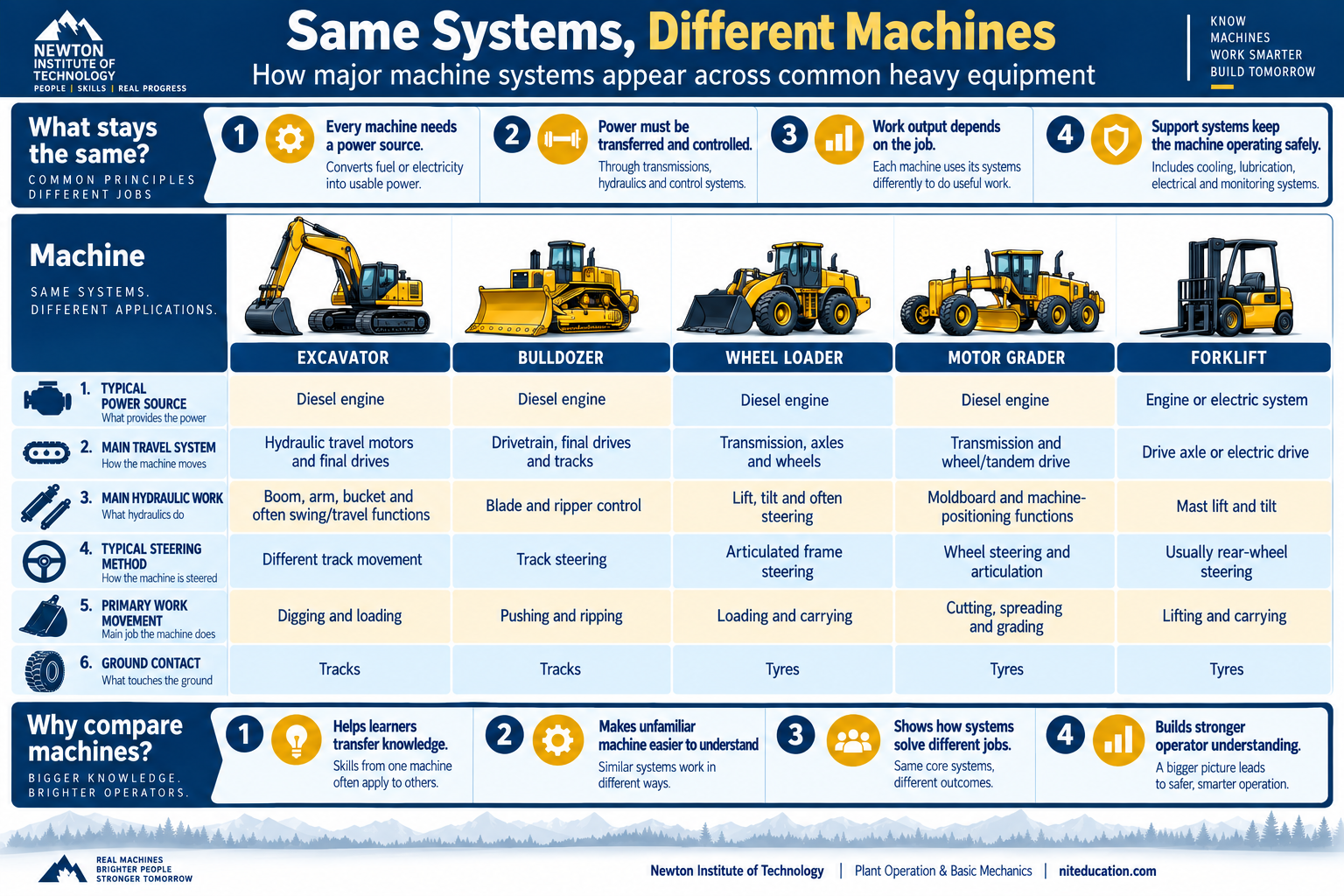
The names of the major systems repeat across heavy equipment, but each machine applies them differently. This is the key distinction between this systems guide and NIT’s machine-specific Parts and Functions articles.
| System / function | Excavator | Bulldozer | Wheel loader | Motor grader | Forklift |
|---|---|---|---|---|---|
| Typical power source | Diesel engine | Diesel engine | Diesel engine | Diesel engine | Engine or electric system |
| Main travel system | Hydraulic travel motors & final drives | Drivetrain, final drives & tracks | Transmission, axles & wheels | Transmission & wheel/tandem drive | Drive axle or electric drive |
| Main hydraulic work | Boom, arm, bucket; swing/travel depending design | Blade & ripper control | Lift, tilt & often steering | Moldboard & positioning functions | Mast lift & tilt |
| Typical steering | Different track movement | Track steering | Articulated frame | Wheel steering & articulation | Usually rear-wheel steering |
| Primary work | Digging & loading | Pushing & ripping | Loading & carrying | Cutting, spreading & grading | Lifting & carrying |
| Ground contact | Tracks | Tracks | Tyres | Tyres | Tyres |
See how these systems are arranged on the actual machine in NIT’s Excavator Parts and Functions, Bulldozer Parts and Functions and Wheel Shovel Parts and Functions guides.
Layer 5 · Support and protection
The systems that keep the machine working
Several systems receive less attention than the engine or hydraulics, yet the machine depends on them throughout the shift. They control heat, friction, contamination, direction, stopping and ground contact.
Reduces friction and wear in engines, gears, bearings, pins, bushes and other loaded components.
Controls operating temperature in the engine and may also cool hydraulic oil, transmission oil and other systems.
Protects air, fuel, lubrication and hydraulic circuits from contamination.
Controls direction, slowing, stopping and holding, using machine-specific designs.
Running gear
Tracked equipment may use track shoes, chains, rollers, idlers, sprockets and tensioning components. Wheeled equipment may use tyres, rims, hubs, axles, differentials and steering joints. The components differ, but the running gear has the same broad job: support the machine and transmit travel forces to the ground.
Detailed lubrication intervals, service procedures and repair work belong in the separate Heavy Machinery Maintenance guide.
From diagrams to the machine
What practical training reveals
A diagram can show where a hydraulic line runs. Standing next to a working machine adds another level of understanding. You can hear the engine note change under load, watch a cylinder extend, see a wheel loader articulate through its centre joint and notice that several systems are active during even a simple working cycle.
At Newton Institute of Technology, the useful aim of basic mechanics is not simply naming components. The stronger question is: what does this component connect to, and what job does it help the machine perform?
A learner who identifies a hydraulic cylinder has learned a part. A learner who understands that the cylinder receives controlled oil flow and converts hydraulic energy into movement is beginning to understand the machine.
Use this on any machine
Five questions for an unfamiliar heavy machine
- Where does the energy begin? Diesel engine, electric system or hybrid arrangement?
- How is power transferred? Mechanical transmission, hydraulic pumps and motors, electric drives, or a combination?
- How is power controlled? Levers, pedals, joysticks, valves, switches, sensors and electronic controllers?
- What is the final work output? Digging, pushing, lifting, compacting, grading, steering, braking or travel?
- What protects and supports the systems? Cooling, lubrication, filtration, monitoring, braking, steering and running gear?
Operator judgement
Systems knowledge improves defect reporting
Understanding a system does not mean an operator should diagnose every fault. It does make observations clearer.
| Weak report | Better operator observation | Why it helps |
|---|---|---|
| “The hydraulics are bad.” | “Boom-up became slow after the machine warmed, but bucket curl still seemed normal.” | Describes the function, timing and comparison without inventing a diagnosis. |
| “The gearbox is damaged.” | “There is now a delay after selecting forward, while reverse engages normally.” | Gives a technician a clear symptom to investigate. |
| “The machine is overheating.” | “Temperature began rising during continuous loading and the warning appeared after about forty minutes.” | Records the operating condition and sequence. |
Keep the roles clear
Operator knowledge and technician work
Recognise, inspect and report
- Identify major systems and visible components.
- Carry out authorised pre-start checks.
- Understand gauges, warnings and normal machine behaviour.
- Notice leaks, damage or changes in performance.
- Describe defects clearly and follow the site decision process.
Test, diagnose and repair
- Hydraulic pressure testing and internal diagnosis.
- Electrical fault tracing and electronic diagnostics.
- Engine, transmission, brake or steering repair.
- Component overhaul and dismantling of pressurised systems.
- Specialist adjustments within the person’s competence and authority.
For the before-work inspection sequence, continue to NIT’s Plant Operator Pre-Start Inspection Checklist.
Reference table
Heavy equipment systems at a glance
| System | Main job | Operator-level idea |
|---|---|---|
| Engine | Produces mechanical power | Know normal starting, sound, temperature and load response. |
| Fuel | Supplies fuel for combustion | Watch for leakage, contamination warnings and abnormal engine behaviour. |
| Air intake / exhaust | Supplies clean air and removes exhaust gases | Restriction or damage can affect engine performance. |
| Lubrication | Reduces friction and wear | Use the correct machine-specific lubricant and service method. |
| Cooling | Controls operating temperature | Notice abnormal temperature and warning changes. |
| Transmission / drivetrain | Transfers and manages travel power | Learn normal engagement, travel response and machine-specific layout. |
| Hydraulic | Transfers and controls power through fluid | Pump creates flow; valves direct it; cylinders or motors create movement. |
| Electrical / electronic | Provides power, monitoring and control | Read warnings, displays and control behaviour as machine information. |
| Steering / braking | Controls direction, stopping and holding | Know how the actual machine normally responds. |
| Running gear | Supports travel on wheels or tracks | Understand the components that carry load and meet the ground. |
| Work equipment | Performs the machine’s intended task | Connect the attachment back to the system that powers and controls it. |
Common questions
Frequently asked questions
What are the main systems in heavy equipment?
Common systems include the engine, fuel, air-intake, exhaust, lubrication, cooling, hydraulic, transmission, drivetrain, electrical, electronic-control, steering and braking systems, together with running gear and work equipment. The exact arrangement depends on the machine.
What is the difference between a system and a component?
A component is an individual part. A system is a group of components working together. A hydraulic pump is a component; the pump, reservoir, valves, hoses, cylinders, motors and fluid working together form the hydraulic system.
How does power move through heavy equipment?
Power can move through mechanical, hydraulic or electrical paths. A drivetrain may carry engine power to wheels or tracks; hydraulics carry energy through fluid from a pump to actuators; modern controls can also use electronic signals and electric drives.
How does a hydraulic system work on heavy equipment?
A power source drives the hydraulic pump. The pump creates oil flow, valves direct that flow, and hydraulic cylinders or motors convert the hydraulic energy into movement.
What is the difference between a drivetrain and a powertrain?
Terminology varies by manufacturer, but powertrain is often the broader term for equipment involved in producing and transmitting power, while drivetrain commonly refers to components carrying power towards driven wheels, tracks or similar components.
Why should a plant operator understand heavy-equipment systems?
Systems knowledge makes controls, inspections and machine behaviour easier to understand. It also helps an operator recognise abnormal conditions and describe defects accurately without guessing at the repair diagnosis.
Do all heavy machines use the same systems?
No. Many share the same principles, but they arrange and apply them differently. An excavator, bulldozer, loader, grader and forklift can all use hydraulics and electrical systems while putting them to work in very different ways.
Final takeaway
Learn the system before memorising the machine
Start with the power source. Work out how that power is transferred. Look at how the operator and control systems direct it. Identify where useful movement finally takes place. Then look at the systems protecting and supporting the process.
That approach works whether you are standing beside an excavator, bulldozer, wheel loader, motor grader, forklift or another heavy machine. You will still need to learn the individual parts, but they will no longer be disconnected names—you will understand why they are there.
Continue your Basic Mechanics study
Move from systems theory to individual machines
| Next guide | What it adds | Use it for |
|---|---|---|
| Excavator Parts and Functions | Working equipment, upper structure, undercarriage and hydraulic/control components. | G4 machine anatomy. |
| Bulldozer Parts and Functions | Blade, drivetrain, undercarriage, hydraulics and ripper. | G3 machine anatomy. |
| Wheel Shovel Parts and Functions | Loader structure, articulated steering, hydraulics and drivetrain. | G2 machine anatomy. |
| Pre-Start Inspection Checklist | A repeatable before-work inspection and defect-decision routine. | Inspection intent. |
| Heavy Machinery Maintenance | Preventive care, servicing principles, greasing and machine condition. | Maintenance intent. |
| Plant Operator Training Materials | Study notes, safety checklists and broader learner resources. | Study-material intent. |
Practical plant operator training
Learn heavy equipment through the machine, not diagrams alone
Newton Institute of Technology connects machine familiarisation, basic mechanics, inspection habits and supervised practical operation so learners can see how the systems work together in real equipment.
InstitutionNewton Institute of Technology
LocationMigori Town · Namba Area
Learning focusPlant Operation · Basic Mechanics · Practical Training
Prepared by: Newton Institute of Technology Editorial Team · Institutional / Technical review: Engineer Simon Barongo · Last reviewed: 12 September 2026
This guide provides general operator-level education. Machine design varies by manufacturer and model. Follow the operator’s manual, site procedures, instructor guidance and authorised maintenance requirements for the equipment being used.