

Forklift Career Guide · Kenya · 2026
Forklift Operator Career in Kenya
A practical Kenya-focused guide to forklift jobs, current demand and the skills employers need, built from a September 2026 vacancy snapshot.
Is forklift operation a good career in Kenya?
It can be—especially for someone targeting warehouses, factories, logistics, processing or distribution. Current Kenyan vacancies show that employers look beyond the licence: safe load handling, inspections, warehouse awareness, stock protection, reliability and previous practical experience repeatedly matter.
A forklift can be easy to underestimate. It is smaller than an excavator, quieter than a bulldozer and rarely attracts the same attention as machines working on a road project. Inside a busy warehouse or factory, though, the forklift may hardly stop.
A truck arrives. Pallets have to come off. Production needs raw materials. Finished goods need to be cleared from the production floor. Another order is waiting at dispatch. A loading bay is beginning to back up.
Someone has to keep those movements going without damaging the stock, the racking, the forklift or the people working nearby. That is the job.
For someone considering forklift operation as a career in Kenya, the opportunity is broader than simply learning to drive a machine. Forklifts are used in warehouses, manufacturing plants, logistics operations, food-processing facilities, distribution centres, terminals and industrial yards.
Career fit
Is forklift operation a good career in Kenya?
It can be, particularly for someone interested in warehousing, manufacturing, logistics or industrial work.
Forklift operation has a different employment pattern from many heavy plant machines. An excavator may move from one construction project to another. A grader is closely associated with road construction and maintenance. A forklift is more likely to work inside an operating business where goods arrive, move through storage or production and eventually leave again.
- Warehouses
- Distribution centres
- Manufacturing plants
- Logistics facilities
- Food processing
- Cargo terminals
- Industrial yards
- Wholesale storage
Completing training does not guarantee an immediate job. Employers differ, vacancies change and experience remains a major hiring factor. What the current market does show is that forklift skills continue to appear across several Kenyan industries.
Original market snapshot
2026 forklift job-market snapshot: what we found
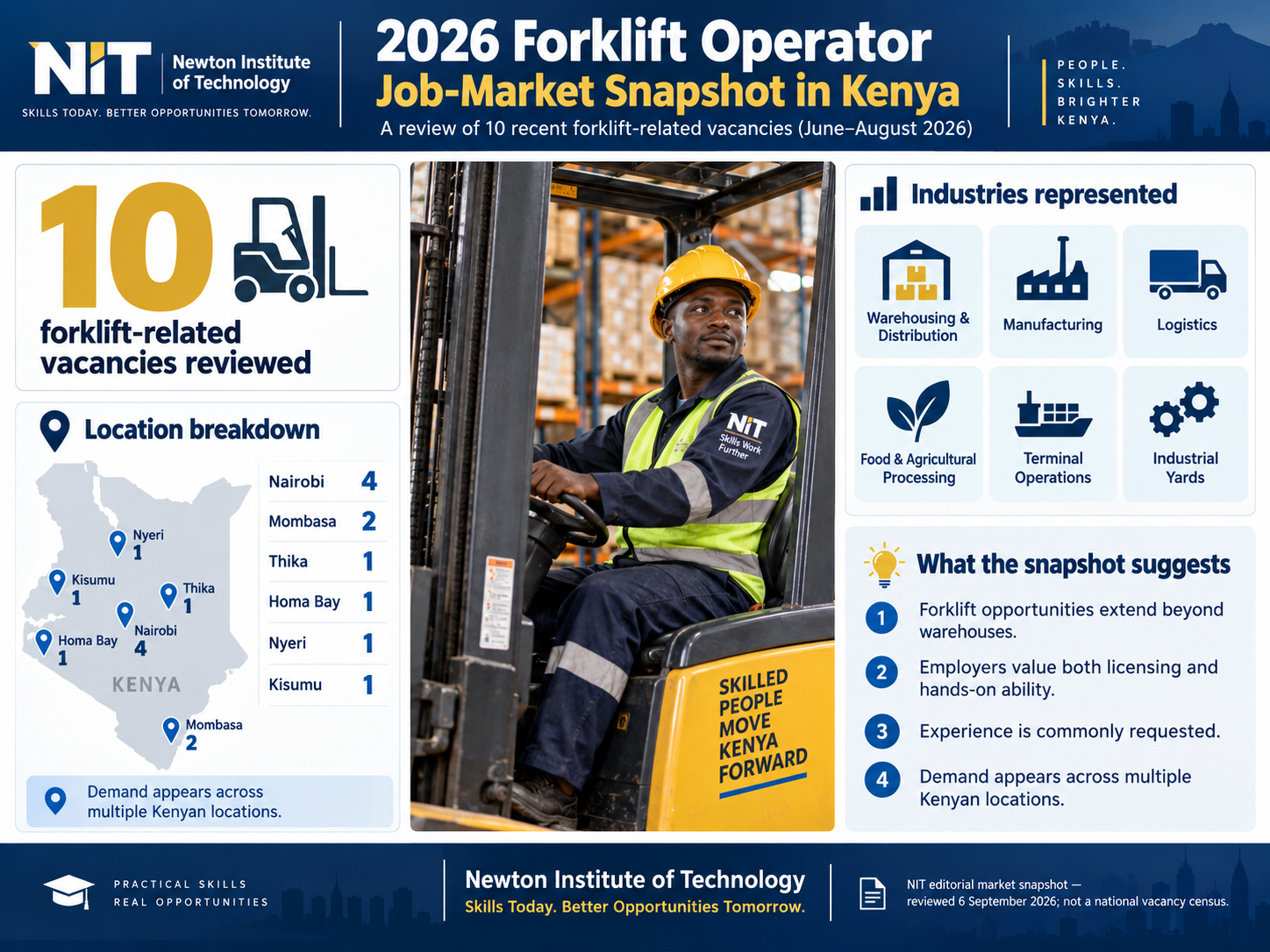
To get beyond the usual claim that forklift operation is simply “marketable”, the Newton Institute of Technology editorial team reviewed the first 10 recent forklift-related vacancies appearing on a major Kenyan employment index during our 6 September 2026 market check. Those vacancies had been advertised between June and August 2026.
| Location | Vacancies in sample | What the sample shows |
|---|---|---|
| Nairobi | 4 | Largest concentration in the ten-job sample. |
| Mombasa | 2 | Includes cargo, terminal and industrial material-handling context. |
| Thika | 1 | Manufacturing/warehouse environment represented. |
| Homa Bay | 1 | Shows that opportunities are not confined to Nairobi. |
| Nyeri | 1 | Regional vacancy activity appears outside the biggest industrial centres. |
| Kisumu | 1 | Western Kenya also appears in the sample. |
This is a job-market snapshot, not a national census. Vacancies change continuously and the same job can sometimes be syndicated across more than one recruitment platform.
2026 Kenya Forklift Jobs Snapshot
What were employers asking for?
Across the vacancies we reviewed, several requirements appeared repeatedly:
Control the forklift, load and travel path without creating unnecessary risk.
Load, offload, stack, retrieve and store goods in the right place.
Carry out routine checks and report defects instead of ignoring them.
Previous operating, warehouse or factory exposure appeared repeatedly.
Several employers asked for previous forklift experience, often around one to three years or more, while some specified experience in manufacturing, warehousing, logistics, food processing or terminal operations.
Search wider
Don’t search only for “Forklift Operator”
A job requiring forklift skills may appear under several titles. Searching only one phrase can hide suitable roles.
- Forklift Operator
- Forklift Driver
- MHE Operator
- Material Handling Equipment Operator
- Warehouse Operator
- Warehouse Specialist
- Equipment Operator
- Forklift & Wheel Loader Operator
Read the responsibilities, not just the title. A warehouse vacancy may include forklift operation even when the machine is not the first word in the job title.
Where the work happens
Where forklift operators work in Kenya
Most forklift jobs begin with a simple business problem: goods need to move. The exact operating environment changes what an employer expects from the operator.
Warehouses & distribution
Receiving, put-away, storage, picking, staging and dispatch create continuous pallet movement.
Stock flowManufacturing plants
Raw materials, packaging and finished goods have to move without slowing production.
Production supportLogistics & distribution
Incoming cargo, storage, vehicle loading and dispatch demand both speed and accuracy.
Movement & timingFood & agricultural processing
Operators may handle produce, cereals, crates, packaging materials and finished products.
Product careTerminal & cargo operations
Heavier traffic, stacking standards and coordination with several teams can raise the operating demands.
Cargo handlingIndustrial & building-material yards
Steel, tiles, hardware and other materials may be handled in open yards rather than narrow warehouse aisles.
Industrial handlingEmployer selection
What skills are employers really looking for?
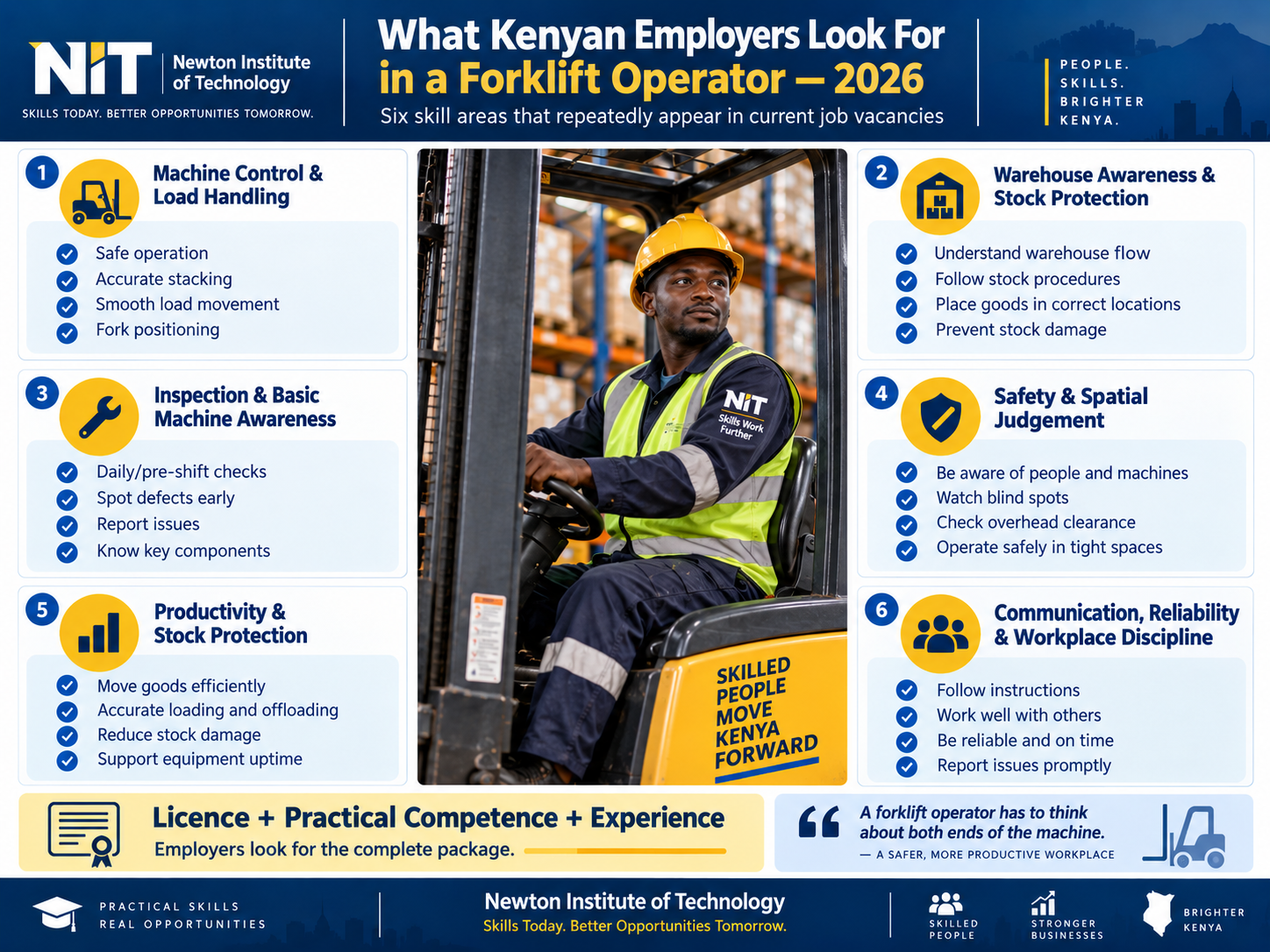
Current adverts can produce a long list of requirements. In practice, most of them fall into six areas.
Machine control & load handling
Approach pallets correctly, position forks, lift, lower, reverse, travel and place loads smoothly. Speed is useful only when control comes with it.
Warehouse awareness & stock protection
Understand receiving, put-away, picking, staging and dispatch—and remember that the load has a destination for a reason.
Inspection & machine awareness
Notice leaks, tyre damage, steering changes, brake problems, warning-device faults or unusual mast behaviour and report them correctly.
Safety & spatial judgement
Watch rear swing, blind spots, pedestrians, aisle width, corners, doorways, overhead clearance and the condition of the route.
Productivity & stock protection
Keep goods moving without turning speed into stock damage, rack strikes, poor stacking or repeated corrections.
Communication & reliability
Follow instructions, coordinate with warehouse and production teams, report damage and show up as a dependable operator.
Visual employer guide
What Kenyan employers value in a forklift operator
Forklift Skills Employers Value in Kenya
A practical operator lesson
The operator has to think about both ends of the forklift
An inexperienced operator can become so focused on the pallet in front that they forget what the counterweight is doing behind them. That becomes important in a narrow aisle, at a doorway or beside racking.
“A forklift operator has to think about both ends of the machine. New operators often watch the load so closely that they forget the counterweight is swinging behind them.”
Load awareness + rear swing + pedestrian awarenessPerformance is visible
What may an employer notice about your performance?
One recent Kenyan forklift vacancy went as far as specifying measures such as pallets handled per shift, efficient stacking and equipment uptime. Not every employer uses the same measures, but practical performance is visible.
| What may be observed | Why it matters | What good work looks like |
|---|---|---|
| Pallets moved | Shows useful output | Steady work without careless rushing. |
| Stacking accuracy | Reduces corrections and unsafe storage | Loads positioned correctly the first time. |
| Stock damage | Poor handling costs money | Forks, pallets and goods handled with care. |
| Equipment care | Reduces avoidable downtime | Checks completed and faults reported early. |
| Loading/offloading efficiency | Keeps vehicles and operations moving | Correct loads moved safely and on schedule. |
| Safety record | Protects people, equipment and the business | Rules followed even when the loading bay is busy. |
| Stock-movement accuracy | Helps inventory remain reliable | The right pallet reaches the right location. |
The job is changing
Forklift work is becoming more than machine operation
Operate, inspect and handle loads
- Safe forklift control
- Accurate pallet handling
- Equipment checks
- Stock protection
Follow stock and information
- RF scanners where used
- Inventory records
- Stock counts and movement logs
- Warehouse procedures
One recent Thika vacancy asked the operator to maintain inventory records using RF scanning equipment or physical logs. Advanced ICT is not the core of the job, but basic digital confidence can help in a modern warehouse.
The beginner’s challenge
Why experience is difficult for new operators
You finish training. Then the vacancy asks for two years’ experience. The next wants three. Another wants somebody who has already worked inside a warehouse or manufacturing environment.
There is no clever shortcut around the problem. The first goal has to be credible workplace exposure.
Ways a beginner can start
- Industrial attachment
- Supervised workplace practice
- Entry-level warehouse work
- Material-handling support roles
- Temporary or assistant work
A live workplace adds pressure
- Trucks arrive early or late
- Production requests change
- Pedestrians enter your route
- Loading order changes
- Other machines share the aisle
The first opportunity may not be the job you keep for ten years. Its value may be the hours you accumulate on the machine, the work environment you learn and the reference you can later show another employer.
Do not confuse the two
Forklift licence vs forklift employability
Shows you followed the relevant qualification route
- Training and authorisation matter
- Forklift is G10 within the Category G structure
- Employers commonly expect valid documentation
Shows whether an employer can trust you with the job
- Practical load handling
- Safe reversing and spatial judgement
- Stock protection and fault reporting
- Workplace experience and reliability
For the detailed licensing and endorsement route, read NIT’s NTSA Category G Plant Operator Licence in Kenya guide. This career article deliberately leaves the step-by-step licensing process there.
Choose the work environment
Is forklift one of the most marketable plant-operator skills?
Goods-moving workplaces
- Warehouses
- Factories
- Logistics
- Processing
- Distribution
Project and infrastructure workplaces
- Construction
- Roads
- Drainage
- Earthworks
- Infrastructure
Neither direction is automatically better. They lead into different workplaces. For a machine-by-machine comparison, see NIT’s Most Marketable Plant Operator Machines in Kenya guide.
Build the operator behind the licence
How can a new forklift operator become more employable?
Practise pallet approach, fork position, reversing, stacking and load placement until correct movements become natural.
Understand receiving, put-away, picking, staging and dispatch so you know why stock is moving.
Be willing to learn RF scanners, stock records or warehouse systems where the employer uses them.
Build a reputation for intact loads, responsible equipment use, fault reporting and reliable behaviour.
Understand the forks, mast, counterweight, load centre, rated capacity and the warning signs that should stop you from treating a fault as “normal”. For deeper component knowledge, use NIT’s Forklift Parts and Functions guide. For the inspection routine, use the Plant Operator Pre-Start Inspection Checklist.
Progression
What can a forklift career lead to?
Forklift operation can remain a specialist occupation, but it can also introduce someone to the wider warehouse and logistics environment.
Forklift Operator Career Path in Kenya
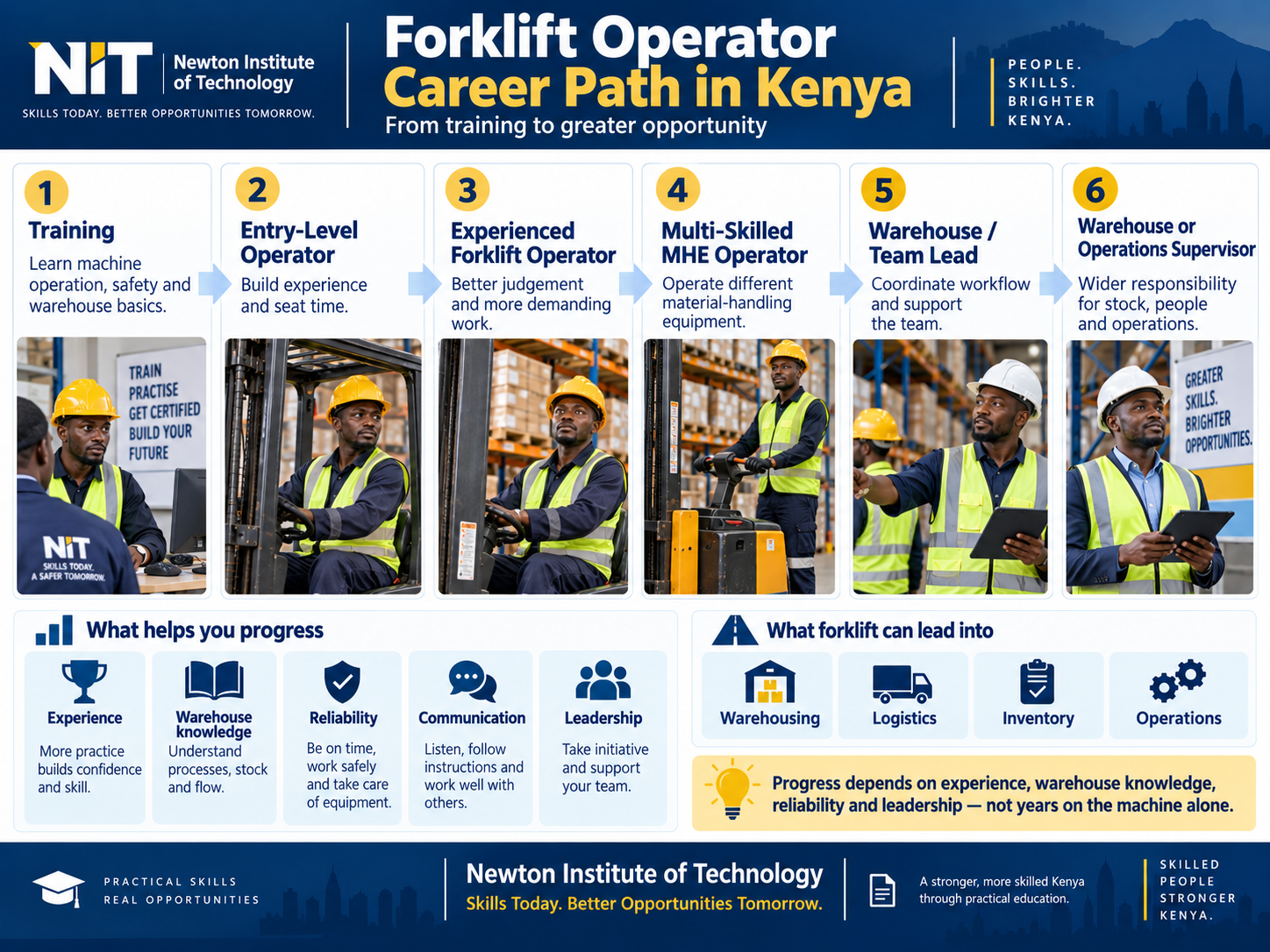
| Career stage | What develops | What helps progression |
|---|---|---|
| Trainee operator | Basic machine control, load handling and safety | Supervised repetition and correct habits |
| Entry-level operator | Workplace experience and seat time | Reliability and exposure to live operations |
| Experienced forklift operator | Better judgement and more demanding work | Safe record, accuracy and adaptability |
| Multi-skilled MHE operator | Broader material-handling ability | Relevant additional equipment competence |
| Warehouse or team lead | Coordination and workflow responsibility | Communication, stock knowledge and leadership |
| Warehouse / operations supervisor | Wider responsibility for stock, people and operations | Operational knowledge, leadership and further development |
Progression is not automatic. Years on a forklift do not by themselves make somebody a supervisor. Warehouse knowledge, reliability, communication, leadership and sometimes further training become more important as responsibility increases.
Pay varies
What about forklift operator salaries in Kenya?
There is no single salary figure that accurately represents every forklift operator in Kenya. Pay differs according to experience, employer, location, industry, working hours, shifts and level of responsibility. Many vacancies do not publish salary information at all.
For that reason, taking one advertised figure and presenting it as the average forklift operator salary in Kenya can be misleading. For broader pay guidance, use NIT’s Plant Operator Salary in Kenya guide. This page remains focused on career, jobs, demand and employer expectations.
Training route
Training for a forklift career at Newton Institute of Technology
Once someone has decided that forklift operation suits the kind of work they want to enter, the next question is training. Newton Institute of Technology provides practical forklift training and preparation for the relevant G10 route.
This career guide does not repeat the course duration, fees, admission requirements or detailed licensing procedure. Those belong on the dedicated training page.
Training guide → course, duration, requirements, G10 routeRead Forklift Training in KenyaFrequently asked questions
Forklift operator career in Kenya FAQs
Are forklift operators in demand in Kenya in 2026?
Current recruitment activity shows forklift vacancies across warehousing, manufacturing, logistics, agricultural and food operations, production and terminal work. In NIT’s September 2026 sample of ten recent vacancies, jobs appeared in Nairobi, Mombasa, Thika, Homa Bay, Nyeri and Kisumu. Demand changes over time, and training does not guarantee employment.
Where can forklift operators work in Kenya?
Common workplaces include warehouses, factories, distribution centres, logistics operations, food-processing facilities, industrial yards and cargo or terminal facilities.
What skills do employers want from forklift operators?
Common requirements include safe machine control, load handling, stacking, pre-start inspection, warehouse awareness, stock protection, safety, communication and reliability. Previous practical experience is also frequently requested.
Can I get a forklift job without experience?
It is possible, but previous experience gives an applicant an advantage. Attachment, supervised workplace exposure and entry-level warehouse or material-handling roles can help a beginner start building that experience.
Is a forklift licence enough to get employed?
Not necessarily. Employers may require the relevant licence or certification while also considering practical competence, experience, safety habits, load handling and the ability to work within warehouse procedures.
What NTSA category is forklift?
Forklift is G10 within Kenya’s Category G plant-operator structure. For the detailed licensing route, refer to NIT’s dedicated Category G guide.
Is forklift operation only warehouse work?
No. Forklifts are also used in factories, distribution centres, logistics facilities, food and agricultural processing, terminals and industrial yards.
What job titles should a forklift operator search?
Useful searches can include Forklift Operator, Forklift Driver, MHE Operator, Material Handling Equipment Operator, Warehouse Operator and Equipment Operator. Always read the duties because employers use job titles differently.
Do forklift operators need computer skills?
Advanced ICT skills are not normally the core requirement, but basic digital confidence can help. Some current warehouse roles involve RF scanners, inventory records, stock systems or movement documentation alongside machine operation.
Can forklift operation lead to a logistics career?
Yes. An operator who builds experience in warehouse processes, inventory, coordination and leadership may eventually move into broader warehouse or operations roles. Progression depends on the person’s wider capabilities, not forklift experience alone.
How the market snapshot was built
2026 market-review methodology
The employment observations in this article are based on an NIT editorial review carried out on 6 September 2026. For the location snapshot, we reviewed the first ten recent forklift-related vacancies appearing on a major Kenyan employment index at the time of checking. Those vacancies had been published between June and August 2026.
Where the role appeared and what the employer called it.
Warehouse, factory, logistics, processing or terminal setting.
Previous operating or workplace experience requested.
Inspection, stacking, stock handling, safety, scanning and productivity signals.
This should be read as a market snapshot, not as a national census of forklift employment. Vacancies change constantly, and jobs can sometimes be syndicated across more than one recruitment platform.
Institutional / Technical review: Engineer Simon Barongo
Final word
The career is built after the licence as much as before it
Forklift operation can look simple from outside the machine. Line up with the pallet. Lift it. Move it. Put it down.
A real shift is rarely that tidy. There are people around you, stock that must not be damaged, tight spaces, deadlines, changing instructions and a machine that needs to be treated properly.
Employers need someone who can handle all of that without turning an ordinary loading job into a problem. Getting trained and licensed is important. After that comes the part that builds the career: experience, judgement and a reputation for doing the job properly.
When the loading bay becomes busy, that is the operator people want on the machine.
Ready to build practical forklift skill?
Ask Newton Institute of Technology about forklift training
If the forklift career fits the kind of workplace you want, ask Admissions about the current intake, practical timetable, training requirements and the G10 route before enrolling.
Prepared by: Newton Institute of Technology Editorial Team · Institutional / Technical review: Engineer Simon Barongo · Market review: 6 September 2026