

Know Your Machine G10 Forklift
Forklift Parts
& Functions
Lift · Balance · Steer · Control
Basic mechanics for plant operators: learn how the forks, carriage, mast, hydraulics, drive, steering, brakes, counterweight, controls and power system work together.
What are the main forklift parts?
The main parts of a counterbalanced forklift are the forks, carriage, load backrest, mast, lift chains, hydraulic cylinders, chassis, front drive axle, rear steering axle, tyres, counterweight, overhead guard, operator controls, braking system and power unit. Together, they lift the load, move the truck and help keep it stable.
See the whole machine first
Forklift parts and functions at a glance
A forklift becomes easier to understand when you stop treating the components as isolated names. The forks depend on the carriage, the carriage travels through the mast, hydraulics provide the force, and the chassis has to remain stable while all of that happens.
| Part | Function | What may tell you something is wrong |
|---|---|---|
| Forks | Support and carry the load | Cracks, bends, heavy wear or unequal fork height |
| Carriage | Holds the forks and moves through the mast | Jerking, looseness or unusual movement |
| Load backrest | Helps limit load movement toward the mast/operator | Bent, broken or loose sections |
| Mast | Guides the carriage vertically | Shuddering, scraping or visible damage |
| Mast rails and rollers | Guide smooth mast and carriage movement | Catching, rough travel or unusual noise |
| Lift chains | Transfer lifting movement | Damage, excessive slack or visibly unequal tension |
| Lift cylinder | Produces vertical lifting force | Leakage, slow lift or jerking |
| Tilt cylinders | Change mast angle | Leakage or uneven tilt |
| Hydraulic pump | Supplies hydraulic flow | Noise, poor response or overheating |
| Hydraulic hoses | Carry hydraulic oil | Cracks, rubbing, bulges or leakage |
| Front drive axle | Carries major load forces and transfers drive | Noise, wheel or tyre problems |
| Rear steering axle | Turns the forklift | Excessive play or poor steering response |
| Braking system | Slows and stops the machine | Poor stopping, pulling or abnormal pedal response |
| Counterweight | Helps balance the load at the front | Damage or unauthorised modification |
| Overhead guard | Provides protection above the operator | Bent structure, cracks or damaged mountings |
| Capacity plate | States important operating limits | Missing, unreadable or incorrect information |
| Operator controls | Control travel, lift and tilt | Sticking, looseness or abnormal response |
| Power unit | Supplies travel and hydraulic power | Overheating, leaks, smoke or warning indications |
Visual guide
Key external forklift parts
Forklift Key External Parts & Functions
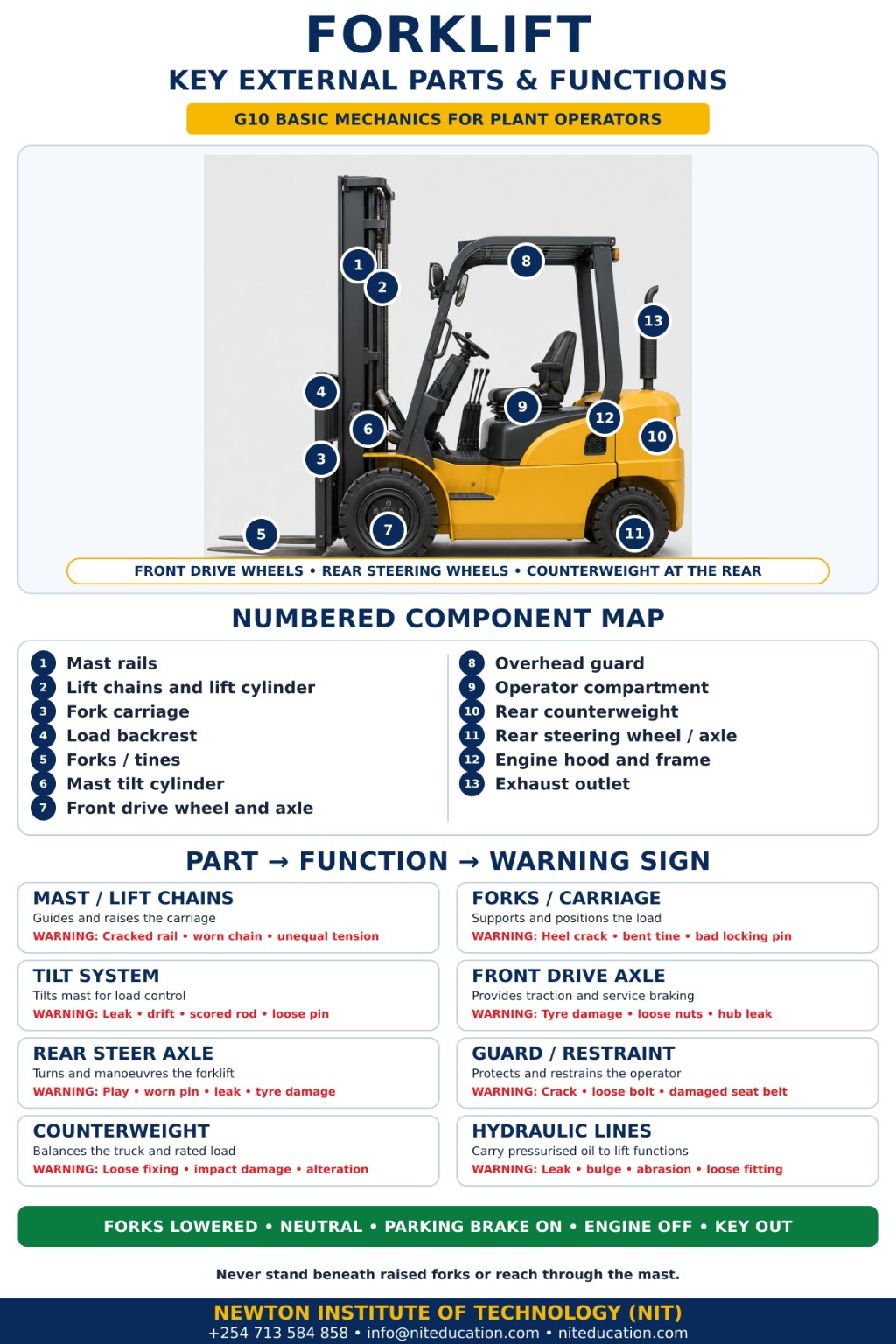
Start at the front
The front lifting system
The forks may be the most obvious part, but they cannot lift anything by themselves. The carriage supports them, the carriage travels through the mast, chains and rollers guide movement, and cylinders convert hydraulic pressure into motion.
Forks
The forks, or tynes, slide beneath the load. Pay attention to cracks, bent blades, wear around the heel, damaged locking devices and one fork sitting higher than the other.
A visibly bent or cracked fork needs proper assessment; it is not something to straighten and carry on using.
Carriage
The carriage is the moving steel frame that holds the forks and travels through the mast. If it catches, shudders or becomes rough at roughly the same point in the lift, repeatedly cycling it is not a repair.
Load backrest
The load backrest sits behind the forks and helps limit backward movement of certain loads. It is different from the carriage. Bent sections, cracked welds or loose mountings deserve attention.
Mast
The mast is the vertical lifting structure. It guides the carriage and may have telescoping sections. Normal movement should be smooth; repeated scraping, catching, grinding or sudden jerking deserves investigation.
Mast rails and rollers
Rails guide the moving mast sections and carriage. Rollers help those parts travel smoothly. Roughness that repeats at one height can point to the guidance system rather than the forks themselves.
Lift chains
Lift chains help transfer lifting movement to the carriage. Obvious link damage, corrosion, unusual slack, unequal tension or damaged anchors should be reported. Adjustment and measurement belong to trained maintenance personnel.
Lift cylinder
The lift cylinder converts hydraulic pressure into vertical movement. Slow lifting, jerking, leakage, unfamiliar hydraulic noise or a load that will not hold height are changes worth taking seriously.
Tilt cylinders
Tilt cylinders change mast angle rather than primarily raising the load. Their movement should be smooth and reasonably even. Leakage or one side behaving differently needs attention.
Some forklifts can raise the carriage and forks a certain distance before the upper mast sections begin extending. This is called free lift. It matters inside containers, trailers, doorways and low-roofed areas where overhead clearance is limited.
Where lifting force comes from
The forklift hydraulic system
Oil stored in a reservoir is moved by a pump, directed through control valves and carried through hoses toward the cylinders that perform the required movement.
Hydraulic pump
The pump creates the flow needed for the lifting system. A system that suddenly becomes noisier, slower or much less responsive is already giving the operator useful information.
Hydraulic reservoir
The reservoir stores the oil used by the hydraulic circuit. If the level repeatedly drops, simply adding oil without finding the cause does not solve the problem.
Hoses and pipes
Hoses and rigid lines carry hydraulic oil. Watch for damaged outer surfaces, rubbing, bulging, kinks, wet connections and oil beneath the forklift.
| Step | What happens | Connection |
|---|---|---|
| 1 | You move the lift control | The hydraulic valve opens the lifting circuit. |
| 2 | The pump moves oil | Hydraulic oil flows through the circuit under pressure. |
| 3 | The lift cylinder extends | Pressure is converted into mechanical movement. |
| 4 | Mast and chains transfer movement | The carriage travels upwards. |
| 5 | The forks rise with the carriage | The load rises because it is supported by the forks. |
Underneath the lift system
Chassis, drive, steering and braking
The lifting system only works safely because the rest of the machine carries, moves, steers and stops it.
Frame and chassis
The frame is the forklift’s main structural body. Cracks, major structural damage or unauthorised welding are not cosmetic issues.
Transmission or traction drive
An internal-combustion forklift uses a transmission and drive system to transfer engine power toward the drive axle. Electric trucks use traction motors. Delayed engagement, new vibration or unusual drive noise should not be ignored.
Front drive axle
On many counterbalanced forklifts, the front axle is also the drive axle. It sits close to the mast, carries major load forces and becomes central to load-centre and stability discussions.
Rear steering axle
Many counterbalanced forklifts steer from the rear. That gives tight manoeuvrability, but the counterweight sweeps sideways in a turn. New operators naturally watch the forks; the rear is what often catches them out.
Tyres
Tyres are part of stability, braking and steering. Severe wear, missing chunks, deep cuts or abnormal deformation can change how the forklift responds.
Braking system
The pedal is only the operator control. The braking system actually slows the truck. A changed pedal feel, longer stopping distance, pulling or new braking noise needs attention.
The mechanics behind balance
Counterweight, capacity plate and load centre
Counterweight
- The counterweight helps oppose the turning effect created by the load at the front.
- It must not be altered, removed or casually increased in an attempt to lift more.
- A heavy counterweight does not mean unlimited lifting capacity.
Capacity plate
- The data plate gives operating limits such as rated capacity and load centre.
- Depending on the truck it may also show lift height, mast or attachment information.
- A missing or unreadable plate should never be replaced with guesswork.
Moving the load’s centre of gravity farther from the vertical fork face increases its leverage around the front axle. The same weight becomes harder to counterbalance as it moves farther forward. Raising the load also lifts the combined centre of gravity, reducing the machine’s stability margin.
Protection above the operator
The overhead guard is a structural component
The overhead guard is designed to provide protection against certain falling-object hazards associated with normal forklift operation. It should not be treated as an indestructible cage.
Look at the uprights, mounting points and overhead structure. Bent members, cracked welds, loose parts or unauthorised modification deserve attention. The overhead guard is also different from the load backrest: one protects above the operator; the other helps manage load movement toward the mast/operator area.
A learner shortcut
Don’t confuse these forklift parts
| Parts often confused | First component | Practical difference |
|---|---|---|
| Forks vs carriage | Forks support the load. | The carriage holds the forks and moves through the mast. |
| Carriage vs load backrest | The carriage carries forks and attachments. | The backrest helps limit backward load movement. |
| Lift vs tilt cylinder | The lift cylinder creates vertical movement. | Tilt cylinders change mast angle. |
| Mast rails vs carriage | Rails guide vertical movement. | The carriage travels through the mast structure. |
| Drive vs steering wheels | Front wheels commonly handle drive/load forces. | Rear wheels commonly steer a counterbalanced forklift. |
| Counterweight vs capacity | The counterweight contributes to balance. | It does not override limits on the data plate. |
| Brake pedal vs braking system | The pedal is the operator control. | The braking system is the mechanism that actually slows the machine. |
Inside the operator compartment
Controls, pedals and the operator restraint
Layouts differ by model. A control that sits in one position on one forklift may look or feel different on another, so learn the actual machine rather than relying on habit.
Inside the Forklift Operator Compartment
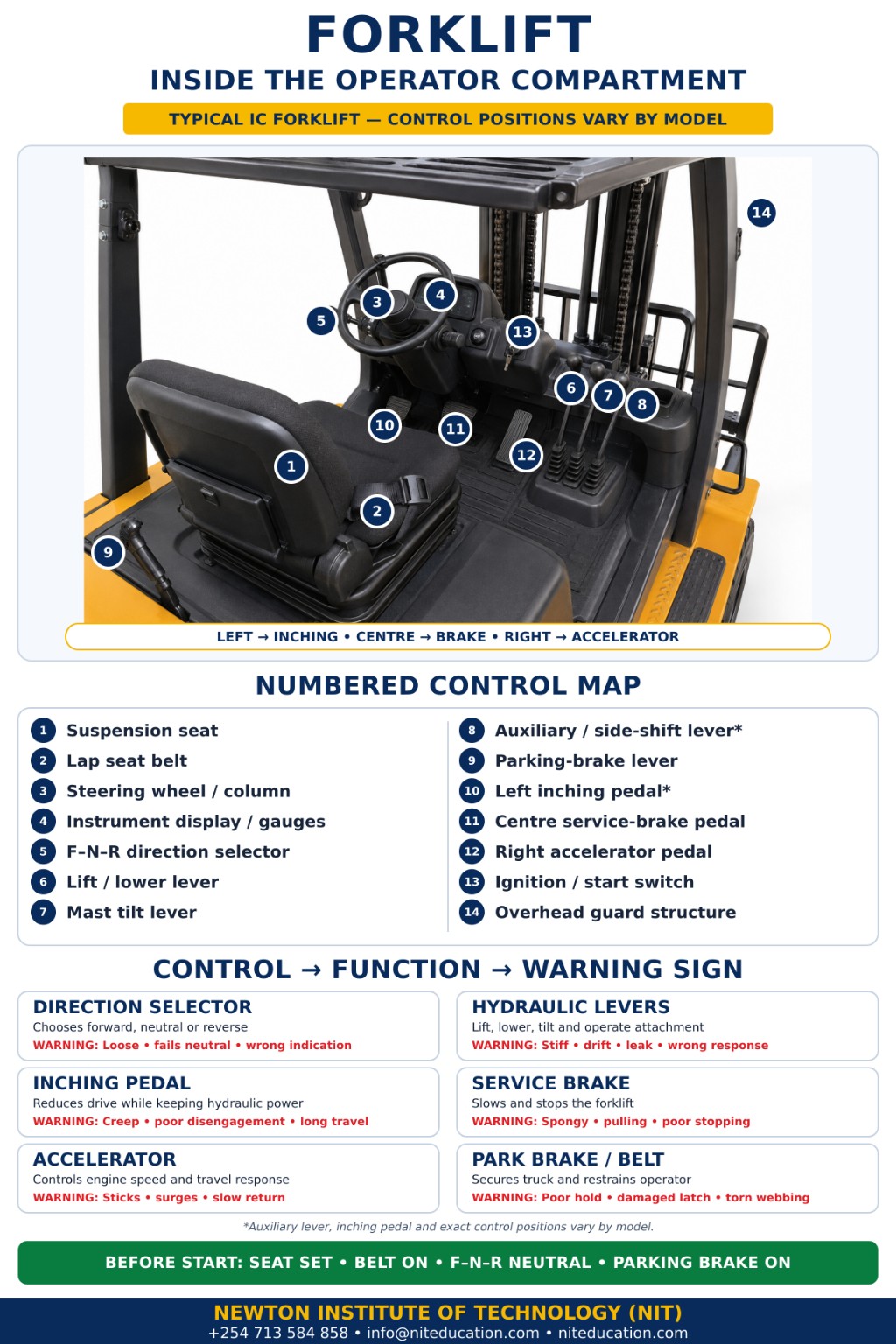
Steering wheel and direction selector
The steering wheel controls the rear steering system on a typical counterbalanced forklift. The direction selector normally provides forward, neutral and reverse. Identify both before moving an unfamiliar machine.
Accelerator and service brake
The accelerator controls travel response; the service brake slows and stops the machine. Smooth control matters more than aggressive acceleration.
Inching control
Some internal-combustion forklifts use an inching pedal or combined braking/inching arrangement for very slow travel while hydraulic power remains available. Layouts vary by model.
Parking brake
The parking brake holds the forklift when parked. If it will not hold the machine properly, that is not a minor inconvenience.
Lift and tilt controls
The lift control raises and lowers the forks; the tilt control changes mast angle. Both affect the load directly, so progressive rather than sudden movement matters.
Auxiliary hydraulic controls
Attachments may add controls for side-shift, fork positioning, clamps or other approved functions. Attachments can affect rated capacity.
Horn and instrument panel
The horn warns others. The display may show fuel, battery state, temperature, oil-pressure, charging, operating hours, parking-brake status and faults. A warning light is not normal just because the truck still moves.
Seat and operator restraint
The seat should be secure and adjusted so the operator can reach controls comfortably. Where a seat belt or other restraint is fitted, use it correctly.
Inside an internal-combustion forklift
Engine and service compartment
Not all forklifts have engines. Electric forklifts use traction batteries and electric motors. An internal-combustion forklift has a more familiar engine and service compartment containing systems an operator should recognise.
Forklift Engine & Service Compartment
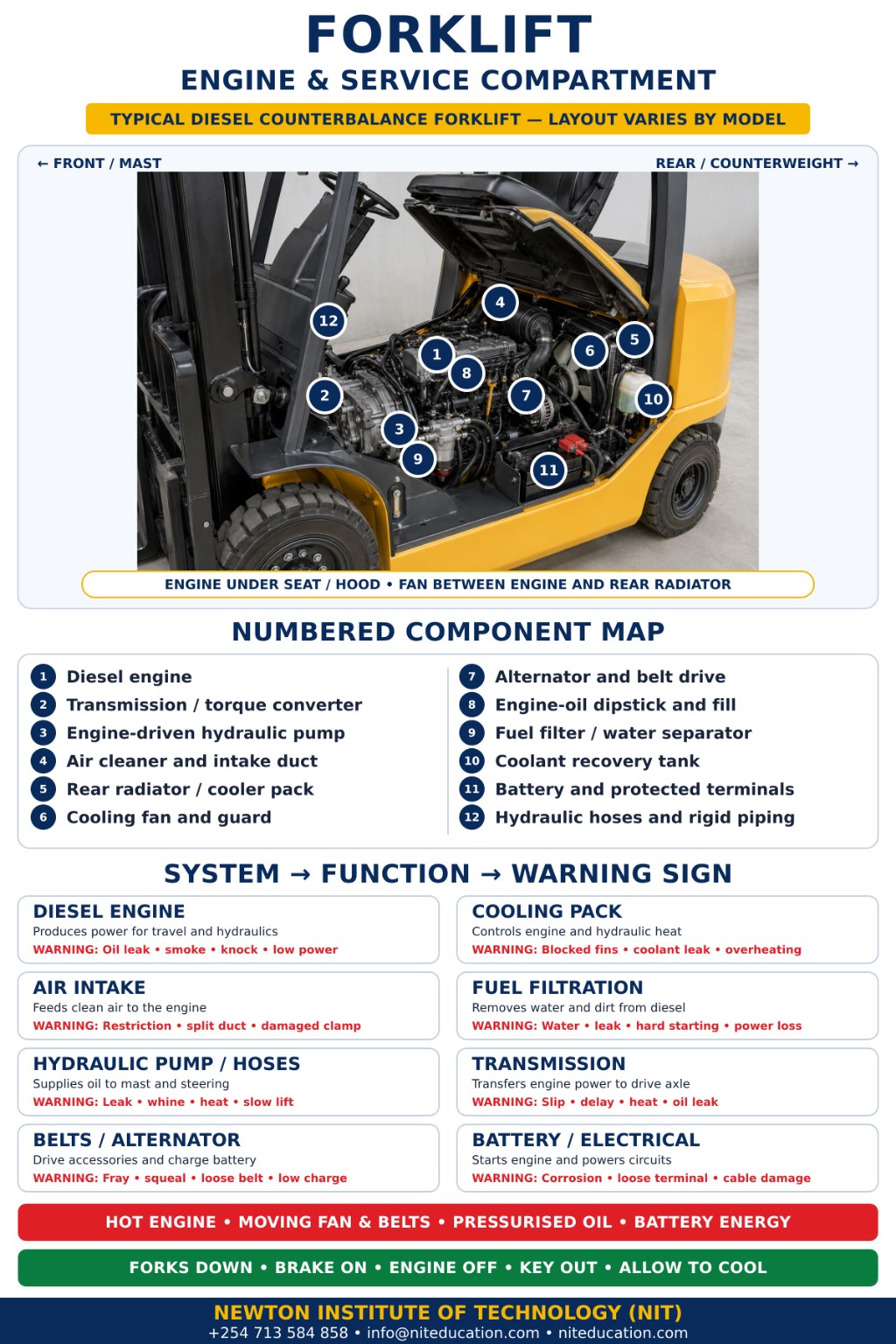
Engine
The engine provides mechanical power for travel and hydraulics on an internal-combustion forklift. Difficult starting, knocking, smoke, overheating, loss of power or a new fluid leak are changes worth reporting.
Lubrication system
Engine oil reduces friction between moving components. If oil repeatedly disappears, topping up every morning without investigating the loss is not a maintenance strategy.
Cooling system
The cooling system commonly includes a radiator, coolant, hoses, fan and water pump. Dust, debris and low coolant can contribute to overheating. Never open a hot pressurised cooling system.
Air cleaner and starter battery
The air cleaner keeps dust out of the engine. The starter battery supports starting and electrical functions. Electric forklifts are different: their traction battery is a major power component with its own charging procedures.
Connect knowledge to the walk-around
Basic part-related checks before operation
This is not a replacement for a complete pre-start inspection checklist. It simply connects the parts in this guide to what you may notice before work begins.
- At the front: forks, carriage, mast, backrest, chains, cylinders and hydraulic hoses.
- Around the chassis: tyres, wheels, obvious leakage and structural damage.
- At the operator position: travel, braking and hydraulic controls should feel normal.
- After start-up: listen for new sounds and notice changes in response.
- A stationary inspection shows what the forklift looks like; the first minutes of operation show what it feels and sounds like.
Changes worth taking seriously
Warning signs an operator can recognise without a toolbox
| What you notice | What not to do | Operator response |
|---|---|---|
| Bent or cracked fork | Do not straighten it and continue. | Stop using it and report it. |
| Carriage repeatedly catches | Do not keep cycling the mast hoping it clears. | Report the repeated change in movement. |
| Hydraulic oil around a hose/cylinder | Never search for a high-pressure leak using your hand. | Treat the leak seriously and follow defect procedure. |
| Steering develops extra play | Do not compensate by simply becoming used to it. | Report the change before it grows into a control problem. |
| Braking response changes | Do not treat slower driving as the repair. | Have the braking condition assessed. |
| Warning light stays on | Do not ignore it because the machine still moves. | Find out what it means. |
| Capacity plate cannot be read | Do not guess the rated limit. | Get correct capacity information before load handling. |
Know the boundary
What belongs to the operator — and what belongs in the workshop
Recognise, check and report
- Visual component inspection
- Fluid-level checks where authorised
- Tyre condition and obvious leaks
- Normal control response
- Unusual sound, movement or behaviour
Adjustment, repair and diagnosis
- Hydraulic-pressure diagnosis
- Mast or lift-chain adjustment and replacement
- Brake and steering repair
- Engine or transmission repair
- Structural welding and specialist electrical diagnosis
An easy revision method
Remember forklift mechanics in four connected groups
| Group | Main job | Think of these components |
|---|---|---|
| FRONT | Handles the load | Forks → carriage → backrest → mast → rails → chains → cylinders |
| HYDRAULICS | Creates and controls lifting force | Reservoir → pump → valves → hoses → cylinders |
| CHASSIS | Moves and balances the machine | Frame → drive → front axle → rear steering axle → brakes → tyres → counterweight |
| OPERATOR & POWER | Controls and powers everything | Seat → steering → pedals → hydraulic controls → instruments → engine/electric system |
Kenya training context
Forklift basic mechanics and NTSA Category G10
In Kenya, forklift operation falls under NTSA Category G10. The purpose of basic mechanics is not to turn every trainee into a technician. It is to help an operator identify major parts, explain their functions and recognise obvious conditions that may make continued operation unsuitable.
This page teaches the machine. For duration, practical training and enrolment information, use NIT’s separate Forklift Training in Kenya guide.
Frequently asked questions
Forklift parts and functions FAQs
What are the main parts of a forklift?
The main parts of a typical counterbalanced forklift include the forks, carriage, load backrest, mast, lift chains, mast rails and rollers, hydraulic cylinders, hydraulic pump, chassis, front drive axle, rear steering axle, brakes, tyres, counterweight, overhead guard, operator controls and power unit.
What part of a forklift actually lifts the load?
Several parts work together. Hydraulic pressure acts on the lift cylinder, while the mast and chain system transfer that movement to the carriage. The forks rise because they are mounted on the carriage.
What is the forklift mast?
The mast is the vertical structure at the front of the forklift that guides the carriage during lifting and lowering.
What are mast rails and rollers?
Mast rails provide the vertical tracks within the lifting structure. Rollers help the carriage and moving mast sections travel smoothly through those rails.
What is free lift on a forklift?
Free lift is the distance the carriage and forks can rise before the upper mast sections begin extending. It is useful where overhead clearance is limited.
What is the difference between the carriage and the forks?
The forks slide beneath and support the load. The carriage is the frame that holds those forks and moves through the mast.
What does the counterweight do?
The counterweight helps balance the load carried in front of the forklift’s front axle. It contributes to stability but does not allow the machine to exceed the capacity stated on its data plate.
Why do many forklifts steer from the rear?
Rear-wheel steering gives a counterbalanced forklift a tight turning radius. It also causes the counterweight to sweep sideways during a turn, which operators need to allow for.
What is a forklift load centre?
The load centre describes the position of the load’s centre of gravity in relation to the vertical fork face. Moving that centre farther forward increases leverage around the front axle and can reduce safe capacity.
What are the main parts of the hydraulic system?
Typical components include the hydraulic reservoir, pump, control valves, hoses, lift cylinder and tilt cylinders. Machines with attachments may have additional hydraulic circuits.
Can a forklift operator repair mast or hydraulic problems?
Operators should recognise and report faults within the limits of their responsibilities. Repairs and adjustments involving safety-critical systems such as mast assemblies, chains, hydraulics, brakes and steering should be handled by appropriately trained personnel.
Technical perspective
Learn the connections, not just the labels
“You learn a forklift faster when you stop seeing separate parts and start seeing how one system affects the next.”
The lesson to carry onto the machine
A forklift is one connected system
The forks depend on the carriage. The carriage depends on the mast. The mast relies on rails, chains and hydraulics. The lifting system relies on a stable chassis. The chassis relies on steering, braking and tyres. Everything depends on the operator respecting the machine’s limits.
A new noise means more. A rough lift means more. A steering change means more. That is the real purpose of learning forklift parts and functions.
Learn by seeing, then by doing
Join Newton Institute to learn more
Build practical plant-operator skills by learning the machine’s parts, controls, inspection habits and safe operating principles before applying them during supervised training.
MachineG10 Forklift
Learning approachBasic mechanics + practical operation
InstitutionNewton Institute of Technology