

Know Your Machine G12
Farm Tractor Parts
& Functions
Engine · drivetrain · hydraulics · PTO
Basic mechanics for plant operators: understand how the tractor makes power, sends it to the wheels, lifts implements and powers equipment — and recognise the warning signs worth reporting.
Operator-level machine knowledge
A farm tractor can look uncomplicated from a distance: engine at the front, operator in the middle and big tyres at the back. Spend some time around one and you soon realise that several different systems are working together.
The engine has to get power to the driving wheels. Hydraulics have to raise or control implements. The PTO can send rotating power to equipment behind the tractor. Steering, brakes, axles, hitching points and electrical components all have their own jobs.
A hydraulic lift that becomes slower, steering that develops more play, a vibration that appears only with the PTO engaged or an engine that starts running hotter than usual all mean more when you know which system you are looking at.
What are the main parts of a farm tractor?
The main parts include the engine, fuel and cooling systems, clutch or drive-control system, transmission, differential, final drive, chassis or main structure, axles, steering, brakes, wheels and tyres, hydraulic system, three-point hitch, drawbar, power take-off (PTO), electrical system and operator-protection structure.
At a glance
Farm tractor parts and functions
| Tractor part | Main function | What an operator may notice |
|---|---|---|
| Engine | Produces mechanical power. | Smoke, overheating, unusual noise or loss of power. |
| Fuel system | Stores, filters and supplies fuel. | Leaks, hard starting or poor engine performance. |
| Air cleaner | Removes dirt from incoming engine air. | Restriction, damaged intake or loss of performance. |
| Cooling system | Controls engine temperature. | Rising temperature, coolant loss or blocked cooling surfaces. |
| Lubrication system | Supplies oil to moving engine parts. | Low oil pressure, low level or leakage. |
| Clutch / drive control | Controls power entering the transmission. | Slipping, poor engagement or difficult movement. |
| Transmission | Changes speed and torque. | Difficult shifting, abnormal noise or loss of drive. |
| Differential | Allows drive wheels to turn at different speeds. | Abnormal axle noise or unusual turning behaviour. |
| Differential lock | Helps regain traction when a wheel slips. | Difficult turning or failure to release correctly. |
| Final drive | Provides final reduction before power reaches the wheels. | Leaks, rumbling or drive problems. |
| Chassis / main structure | Supports major tractor components and working loads. | Cracks, loose mountings or structural damage. |
| Front axle | Supports the front and assists steering. | Play, leakage or abnormal tyre alignment. |
| Rear axle | Carries substantial drive and load. | Leakage, vibration or axle noise. |
| Steering system | Controls direction. | Heavy steering, wandering or excessive free play. |
| Braking system | Slows, stops and holds the tractor. | Weak, delayed or uneven braking. |
| Wheels and tyres | Support the tractor and provide traction. | Low pressure, cuts, wear or loose wheel hardware. |
| Hydraulic system | Provides fluid power. | Slow movement, jerking, leaks or weak lift. |
| Three-point hitch | Carries and positions mounted implements. | Poor lifting, damaged links or excessive sideways movement. |
| Drawbar | Provides a towing point. | Wear, cracking or damaged hitch pins. |
| PTO | Transfers rotating power to an implement. | Vibration, noise or poor engagement. |
| Electrical system | Starting, charging, lighting and monitoring. | Slow cranking, dim lights or charging warnings. |
| ROPS / protective cab | Helps protect the operator during a rollover. | Structural damage or loose mounting. |
Farm tractor key external parts and functions
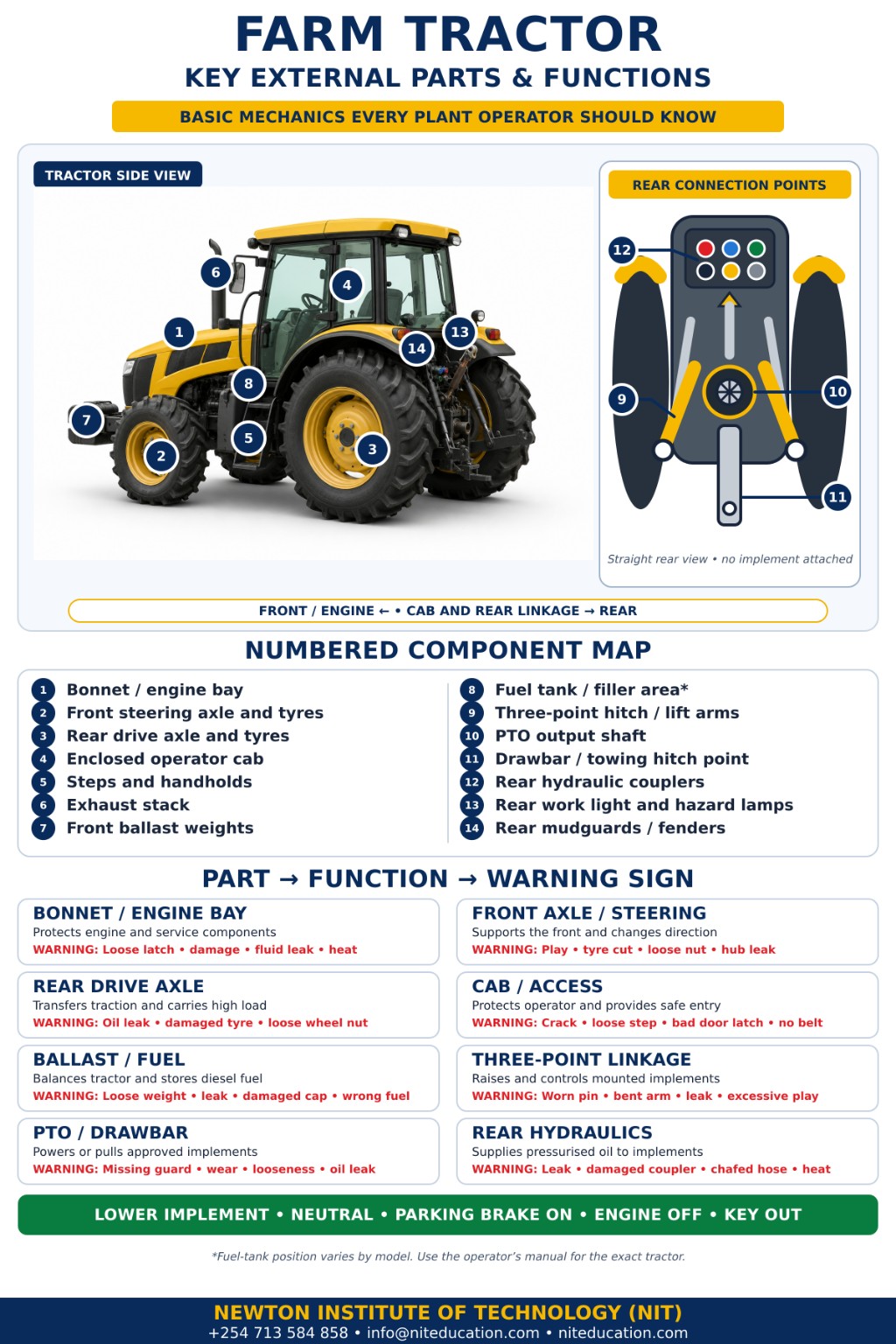
Follow the power first
Three power paths make the tractor easier to understand
Instead of memorising each component as a separate item, start by following where engine power goes.
Produces the mechanical power that starts all three working paths.
Engine → transmission → differential/final drive → wheels.
Engine → PTO → compatible implement.
Engine → hydraulic pump → hitch or hydraulic implement.
Once those relationships are clear, the rest of the tractor becomes much easier to place in context.
Under the hood
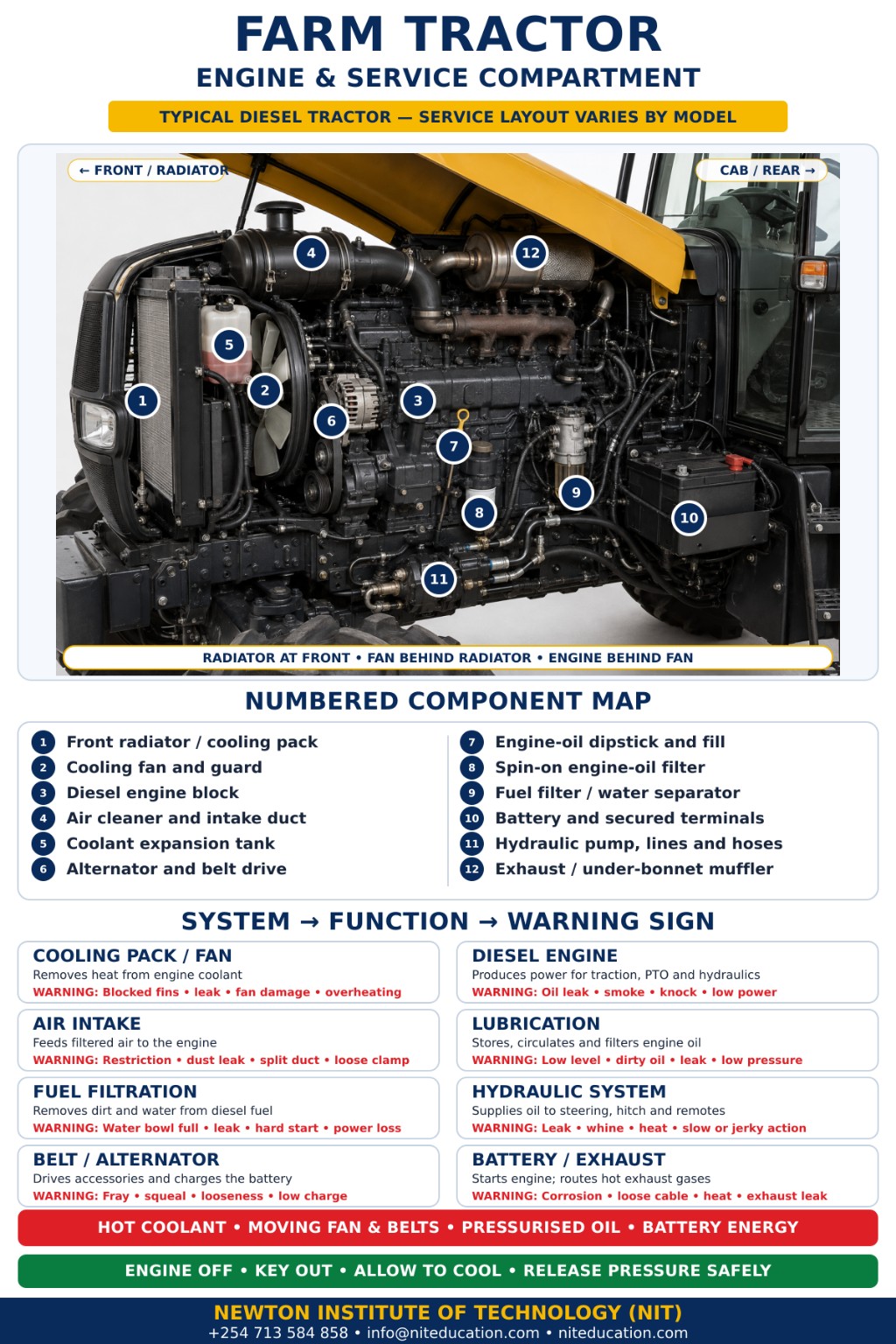
Engine and service-compartment parts
Several systems sit close together under the hood. They do different jobs, but a fault in any one of them can change how the tractor starts, pulls, cools or responds during work.
Farm tractor engine and service compartment
Engine
The diesel engine produces mechanical power. Watch for difficult starting, new knocking or vibration, unusual smoke, power loss, overheating, leakage or warning lights that remain on.
Fuel system
The tank, lines, filters and water-separation components store, clean and deliver fuel. Wet fittings, damaged lines, repeated contamination or a strong fuel smell deserve attention.
Air intake & cleaner
The air cleaner keeps dust and crop debris out of the engine. A restricted filter can reduce performance; a damaged intake can allow dirt to bypass filtration.
Cooling system
Radiator, coolant, fan, water pump, thermostat and hoses keep temperature under control. Grass and chaff can block cooling surfaces even when the engine itself is sound.
Lubrication system
Engine oil reduces friction and carries heat away. At operator level, check the correct level and respond to low-oil-pressure warnings rather than continuing work.
Exhaust system
A new sharp exhaust note, black staining around a joint or obvious gas leakage can point to a developing exhaust problem.
Battery, starter & alternator
Slow cranking can come from battery condition, terminals, cables, charging faults or the starter. Observe first rather than assuming one component has failed.
Hot systems need respect
If temperature keeps climbing, find the cause. Never remove a cap from a hot pressurised cooling system.
Carry the load and send the drive
Chassis, transmission and drivetrain
Chassis and load-bearing housings
- Support the engine, drivetrain, axles, operator station and implement loads.
- Not every tractor has a separate full-length frame.
- Look for cracking, loose mountings, damaged steps or anything bent after impact or heavy work.
Clutch or drive-control system
- Controls how engine power is connected to the transmission.
- Layouts vary across manual, shuttle, power-shift, hydrostatic and electronic systems.
- Slipping, delayed engagement or unexpected movement should not be worked around by forcing controls.
Transmission
The transmission matches travel speed and pulling force to the job. Good gear choice means the tractor works comfortably while the implement performs properly.
Differential
During a turn, the outside drive wheel travels farther than the inside wheel. The differential allows those wheels to rotate at different speeds while still receiving drive.
Differential lock
When one drive tyre slips, the differential lock temporarily limits the difference in wheel speed. It is a traction aid, not a normal turning mode.
Final drive
The final drive reduces speed and increases torque before power reaches the wheels. Watch for oil leakage, rumbling, grinding, excessive play or loss of drive.
Rear axle
The rear axle carries substantial load and drive. Repeated leakage around a housing or wheel end should not be accepted as normal.
Front axle
The front axle supports and steers the machine. With front-wheel assist or four-wheel drive, it also carries driving power through additional shafts, joints and gearing.
The differential allows different wheel speeds. The differential lock temporarily restricts that difference when extra traction is needed.
Where power meets the ground
Wheels, tyres, ballast, steering and brakes
Wheels, tyres and ballast
- Tyre condition affects traction, steering, braking, stability, wheel slip and soil interaction.
- Check pressure, cuts, tread or lug damage, exposed cords, rim condition and wheel fasteners.
- Ballast can improve traction or balance, but excess weight adds compaction and drivetrain stress.
Steering system
- Steering may be mechanical, assisted or predominantly hydraulic.
- Heavier steering, wandering, jerky response or extra free play are changes worth reporting.
- A tractor can still turn while a steering problem is developing.
Weak braking, pulling to one side, excessive pedal movement, abnormal noise or a parking brake that will not hold needs attention. Where the tractor is designed for left and right brake pedals to be coupled during normal or road travel, follow that procedure.
Fluid power
Hydraulic system
The hydraulic pump moves oil under pressure. Valves direct that oil to cylinders or hydraulic motors, where pressure becomes useful movement.
Lift the three-point hitch or other compatible equipment.
Move cylinders used to fold, tip or position an implement.
Supply external cylinders through hydraulic couplers.
Supply compatible hydraulic motors where fitted.
Slow or jerky hydraulics do not automatically prove that the pump has failed. Low oil, restriction, contamination, air, leakage or valve problems can produce similar symptoms.
Never use a bare hand to search for a suspected high-pressure leak. Stop, isolate the machine correctly and follow the authorised procedure.
At the rear of the tractor
Three-point hitch, drawbar, PTO and hydraulic couplers
These components sit close together, but they do different jobs. Understanding the difference prevents a lot of beginner confusion.
Three-point hitch
The hitch connects a mounted implement at two lower links or draft arms and one upper or top link. Lift arms or lift rods transfer hydraulic movement, while stabilisers or anti-sway components control unwanted sideways movement.
Drawbar
The drawbar is the designed towing point for suitable trailed equipment. Use the intended hitch point and correct pin rather than an improvised higher attachment.
Power Take-Off — PTO
The PTO transfers rotating mechanical power from the tractor to compatible equipment such as a mower, baler, pump or auger.
Hydraulic remote couplers
Remote couplers allow the tractor hydraulic system to supply pressurised fluid to compatible external cylinders or motors.
Position control and draft control
Position control
- Helps hold or return the hitch to a selected position.
- Useful when an implement needs to remain at a particular height.
Draft control
- Responds to changes in resistance on a ground-engaging implement.
- In harder ground, the system can allow the implement to rise slightly and reduce load, then return toward its working depth as resistance falls.
Common PTO arrangements
PTO operation is closely linked to the transmission and main clutch arrangement.
Provides greater PTO control while tractor movement is also being managed, depending on the clutch design.
Can generally be engaged or disengaged without relying on the main drive clutch.
Controls and behaviour vary by tractor; know which arrangement is fitted before operating an implement.
Don’t confuse these tractor parts
| Component | What it actually does | Quick reminder |
|---|---|---|
| Three-point hitch | Carries, raises, lowers and positions a mounted implement. | Carry & position |
| Top link | Helps control implement angle and position. | Upper link |
| Lower links / draft arms | Form the lower attachment points of the three-point hitch. | Lower attachment |
| Lift arms / lift rods | Transfer hydraulic lifting movement to the hitch. | Lift movement |
| Stabilisers / anti-sway | Help control sideways movement of a mounted implement. | Side control |
| Drawbar | Provides the designed towing point for suitable trailed equipment. | Tow |
| PTO | Sends rotating mechanical power to an implement. | Rotate |
| Hydraulic couplers | Send pressurised hydraulic fluid to external equipment. | Oil power |
| Differential lock | Acts inside the drivetrain to assist traction. | Not an implement connection |
One implement may use several of those systems at the same time.
Instructor observation
Learn how the tractor normally behaves
Part names matter, but familiarity becomes much more useful when the operator can connect those names to the feel and behaviour of the machine during real work.
“A good operator learns the machine slowly — how it sounds, how it moves, and how it behaves during work.”
Operator familiarity · machine behaviour · practical judgementBefore you move
Inside the operator station
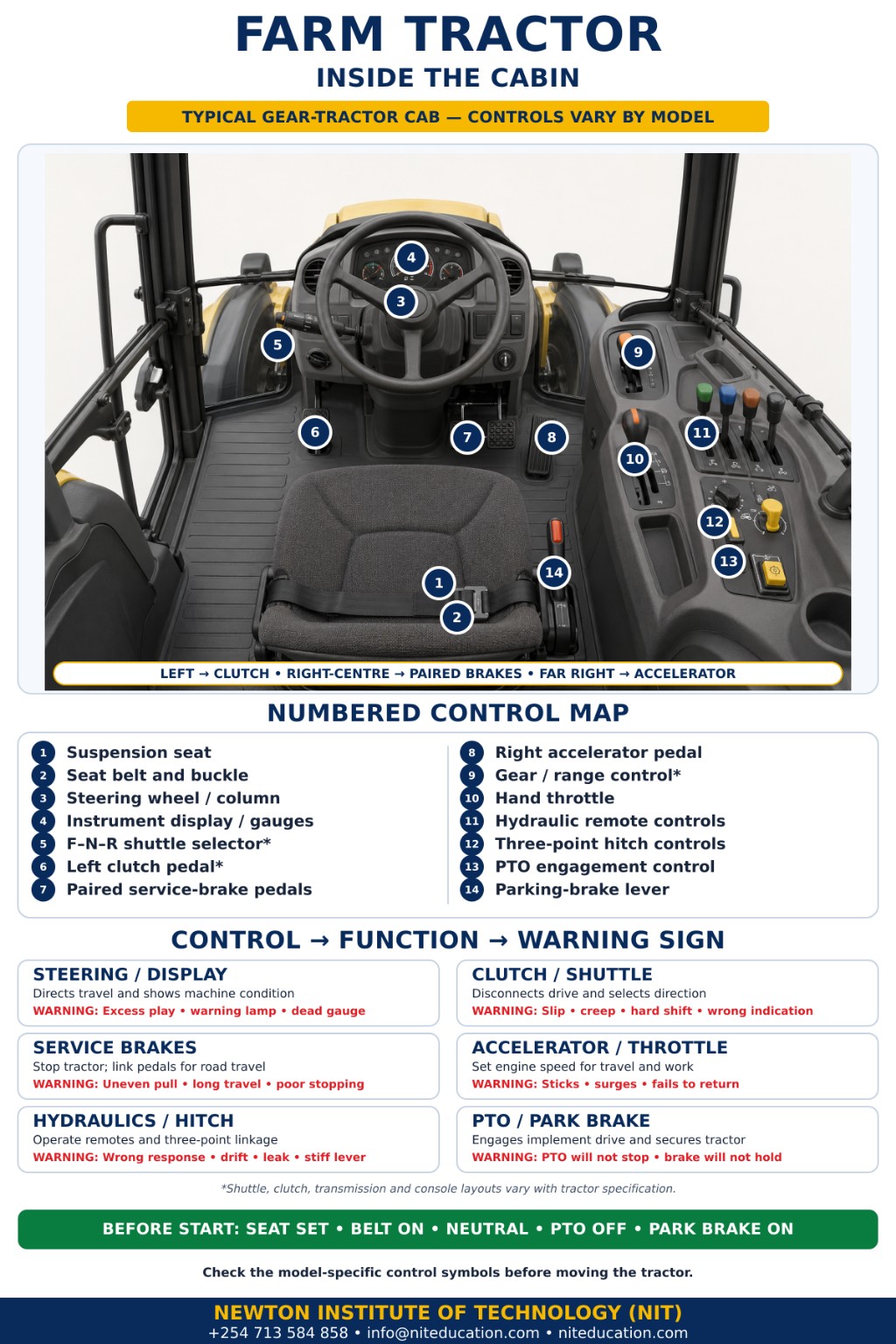
Control layouts vary. Before moving an unfamiliar tractor, identify the controls instead of assuming a lever or pedal works like one on another machine.
Farm tractor inside the cabin
Steering & drive controls
Identify the steering wheel, clutch or drive-control pedal, forward/reverse control, gear selector and range selector fitted to the actual tractor.
Brake & parking controls
Know the service-brake arrangement, whether the pedals should be coupled for the intended travel and where the parking brake is applied.
Hydraulic & hitch controls
Identify the three-point-hitch controls and any remote hydraulic levers before an implement is connected.
PTO control
Know how PTO engagement is controlled and how the fitted PTO arrangement behaves before operating driven equipment.
Dashboard and instruments
The instrument panel can show engine speed, fuel level, coolant temperature, oil-pressure warnings, charging condition, transmission information and PTO status. Learn what normal looks like. If an unfamiliar warning appears, identify it before deciding that it is safe to continue.
Operator protection
ROPS, protective cab and seat belt
ROPS means Roll-Over Protective Structure. Its purpose is to help preserve a protective space around the operator if the tractor overturns.
The structure helps create a protected zone and the belt helps keep the operator within it. ROPS is engineered safety equipment and should not be casually drilled, cut or welded to mount accessories.
Before the key
A useful pre-start check begins on the ground
Do not make the ignition key your starting point. Walk around the tractor and compare what you see with what normally belongs there.
- Look underneath for fresh oil, fuel, coolant or hydraulic fluid.
- Stand back and compare the tyres; notice if one side sits differently.
- Check the engine area for loose items, damage, grass or chaff blocking cooling surfaces.
- At the rear, inspect hitch pins, hydraulic hoses, PTO guarding and implement connections.
- In the cab, check the seat, belt, pedals and control positions before starting.
- After starting, check the instruments and listen to the tractor before moving.
Notice the small changes
Warning signs that deserve attention
| What changes | What you may notice | Useful report |
|---|---|---|
| PTO | Vibration appears only when PTO is engaged. | “The vibration starts only when I engage the PTO.” |
| Steering | Steering feels heavier or has more free play. | State when the change started and whether it is constant. |
| Hydraulics | Three-point hitch becomes slower or jerky. | “It lifts normally cold, then becomes slower after about twenty minutes.” |
| Cooling | Temperature climbs during work. | Include whether radiator screens are collecting grass or chaff. |
| Engine | Longer cranking, smoke change, knock or reduced pull. | Describe the symptom rather than naming a part you have not diagnosed. |
| Axle / final drive | Fresh oil, rumble, vibration or unusual play. | State which side and when the sound or leak appears. |
| Brakes | Uneven stopping, long pedal movement or weak hold. | “With the pedals coupled, the tractor pulls left when I stop.” |
Fault reporting
Report the symptom, not a guess
“The hydraulics are bad.”
- Does not say what became slow or weak.
- Does not say when the problem appears.
- Encourages guessing before the machine has been checked.
“The hitch slows down when the tractor is hot.”
- Identifies the affected function.
- Explains when the symptom appears.
- Gives a technician somewhere useful to start.
Know the boundary
Where operator responsibility stops
A plant operator should understand the tractor without assuming every fault is an operator repair.
Observe, use correctly and report
- Identify the major systems and their purpose.
- Carry out authorised routine checks.
- Notice abnormal behaviour and report it clearly.
- Stop operating when continuing could be unsafe or damaging.
Diagnose, adjust and repair
- Internal diagnosis belongs with the appropriate technician.
- Repairs requiring specialist competence should not be improvised.
- Machine-specific manuals and authorised procedures take priority.
For the full inspection routine, use NIT’s Plant Operator Pre-Start Inspection Checklist. For broader study support, see Plant Operator Training Materials in Kenya, Heavy Machinery Maintenance in Kenya and Plant Operator Safety Rules in Kenya.
Frequently asked questions
Farm tractor parts and functions FAQs
What are the main parts of a farm tractor?
The main parts include the engine, transmission, clutch or drive-control system, differential, final drive, chassis or main structure, axles, steering, brakes, wheels and tyres, hydraulic system, three-point hitch, drawbar, PTO, electrical system and ROPS or protective cab.
What is the function of the tractor engine?
The engine produces mechanical power that can move the tractor, drive the hydraulic system and operate PTO-powered equipment.
What does a tractor transmission do?
The transmission provides different gear ratios so the tractor can combine suitable travel speed with the pulling force required for the job.
What is the difference between a differential and differential lock?
The differential allows the drive wheels to rotate at different speeds. The differential lock temporarily limits that difference to improve traction under suitable low-grip conditions.
What does the tractor hydraulic system do?
Hydraulics use pressurised fluid to create movement. The system can raise the three-point hitch and supply hydraulic power to compatible external equipment.
What is the difference between position control and draft control?
Position control mainly controls hitch position. Draft control responds to changes in the pulling resistance of a ground-engaging implement.
What is the difference between the three-point hitch, drawbar and PTO?
The three-point hitch carries and positions mounted implements. The drawbar provides a towing point for suitable trailed equipment. The PTO transfers rotating mechanical power to compatible machinery.
What are live and independent PTO systems?
A live PTO allows greater PTO control while tractor movement is being managed, depending on the clutch arrangement. An independent PTO can generally be engaged or disengaged independently of the tractor’s main drive clutch.
Why should a plant operator learn tractor parts and functions?
Understanding the major systems helps an operator use the tractor correctly, recognise developing faults, work safely with implements and communicate mechanical problems more clearly.
Final takeaway
Learn where the power goes, then learn what normal feels like
The engine produces power. The transmission, differential and final drive carry it toward the wheels. The hydraulic system turns power into controlled lifting and movement. The three-point hitch positions mounted implements. The drawbar provides the intended towing point. The PTO transfers rotating power to equipment that needs it.
Then learn how the tractor normally sounds, steers, brakes, lifts and pulls. That is when basic mechanics becomes genuinely useful: you begin to recognise the difference between a tractor working hard and a tractor beginning to tell you that something is wrong.
Learn by seeing, then by doing
Join Newton Institute to learn more
Build practical plant-operator skills by learning the tractor’s systems, controls, inspection habits and safe operating principles before applying them during supervised training.
MachineG12 Farm Tractor
Learning approachBasic mechanics + practical operation
InstitutionNewton Institute of Technology