

NIT Plant Operator Career Guide Kenya · 2026
Motor Grader Operator
Career in Kenya
Jobs · Demand · Skills Employers Need
A motor grader operator can spend much of the day moving slowly and still be doing some of the most demanding machine work on a road project. Learning to move the machine is the beginning. Employers become interested in what you can do with it.
From training to trusted operator
Are motor grader operators in demand in Kenya in 2026?
Motor grader operator jobs in Kenya are mainly connected to road construction, road maintenance, quarries, civil works and other projects where surfaces must be shaped or maintained. Employers commonly look for safe machine control, accurate grading, road-profile awareness and proven operating experience. Opportunities vary with active projects, location and the level of experience required.
Demand in context
Are motor grader operators in demand in Kenya in 2026?
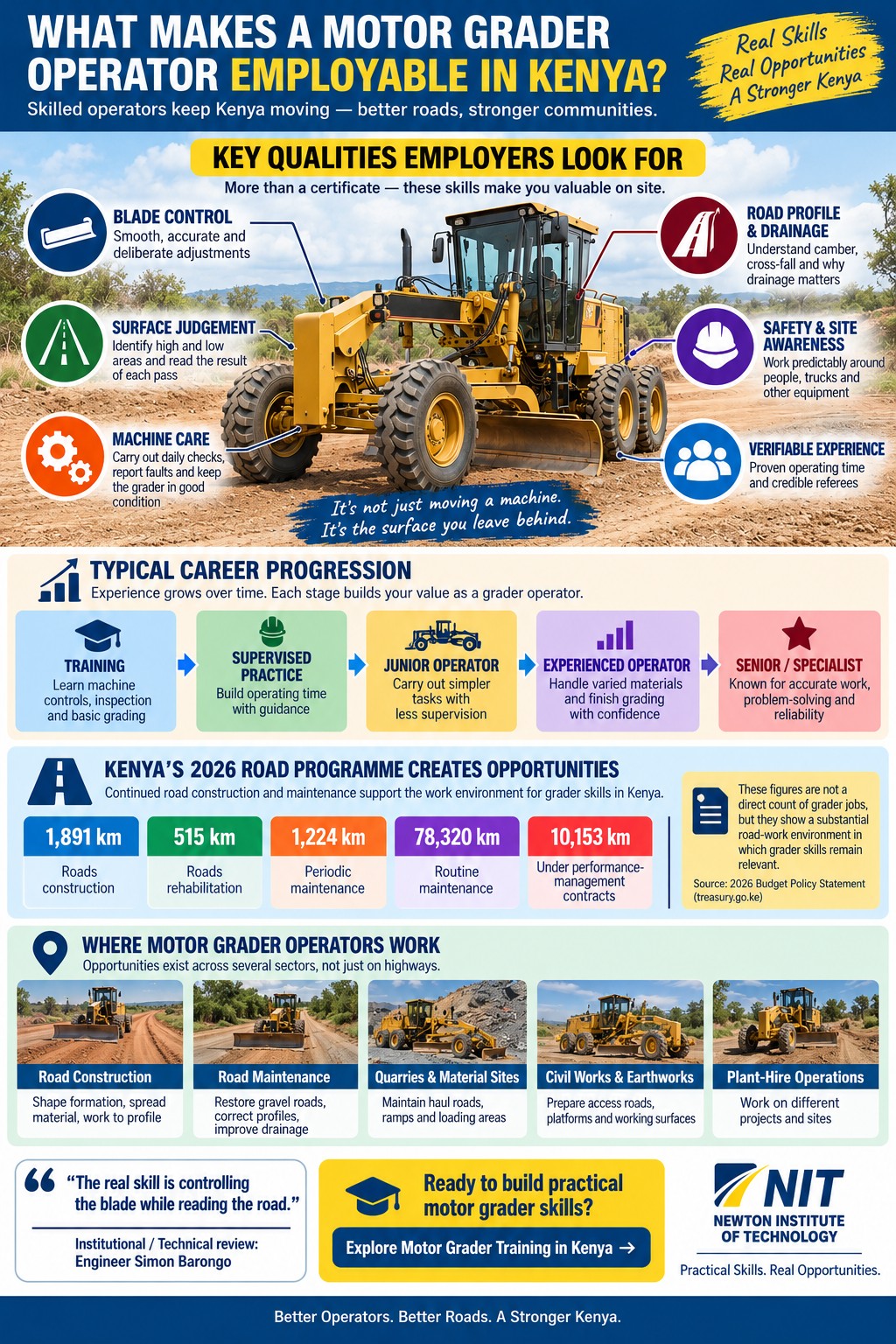
Kenya’s road programme gives this occupation a meaningful underlying work market. The 2026 Budget Policy Statement targets construction of 1,891 km of roads, rehabilitation of 515 km, periodic maintenance of 1,224 km, routine maintenance of 78,320 km, and another 10,153 km under performance-management contracts. 2026 Budget Policy Statement
A kilometre of road maintenance cannot be converted into a number of operator jobs. The figures show that road construction and maintenance remain substantial activities in Kenya—and that is the environment from which much grader work comes.
There is also evidence of continued project activity. On 19 August 2026, the State Department for Roads announced mobilisation of KSh139 billion to clear certified contractor bills and accelerate ongoing road projects. State Department for Roads announcement
For somebody choosing this career, that is more useful than a claim that grader operators are simply “in high demand everywhere.”
The market exists. The harder question is whether a new operator can become good enough to compete for it.
NIT 2026 market reading
What the 2026 grader job market is actually telling us
Searching online produces a confusing picture.
Some job-board pages carry titles such as “motor grader operator jobs” while returning unrelated positions containing words such as motor, machine or operator. At the same time, genuine grader vacancies may appear under the shorter title Grader Operator, within a wider construction recruitment notice, or through contractor networks.
That means vacancy counts alone can be misleading.
| What the evidence shows | What it means for a jobseeker |
|---|---|
| Kenya continues to invest in road construction and maintenance | Grader skills remain relevant to an active work sector |
| A July 2026 Kenyan grader vacancy required five years’ experience | Experienced operators can have a significant advantage |
| The same role involved haul roads, ramps and quarry working areas | Grader work extends beyond conventional highway construction |
| Online searches frequently return unrelated machine jobs | Do not treat job-board result counts as the size of the grader market |
| Employers ask what applicants can actually operate | Practical competence and credible experience matter after training |
The July 2026 vacancy is especially revealing. The operator was expected to maintain quarry haul roads, access roads, ramps and loading areas, grade operational surfaces and spread and shape gravel and aggregates. It requested at least five years of operating experience. July 2026 Grader Operator vacancy
That does not mean five years is a national requirement.
It tells us something more useful: some employers hiring publicly for graders are looking for people who can already be trusted with substantial independent work.
The central career challenge
The grader experience gap
This is probably the most important career issue a new grader operator needs to understand.
There is a gap between finishing training and being trusted with independent precision grading.
Training can teach the controls, basic machine handling, inspection, blade movement and the principles behind road profiling. A contractor looking for an experienced grader operator may need something more: somebody who has already spent enough time working with real surfaces to recognise what is happening before a small error becomes a large one.
That creates the familiar problem: How do you get experience when some jobs already want experience?
There is no shortcut that turns a fresh trainee into an experienced finish grader operator. The realistic route is to build verifiable operating time.
That may begin through attachment, supervised site work, a junior operating opportunity, plant-hire exposure or smaller projects where an experienced operator or supervisor can watch what you do.
A beginner who can say, “I have operated a grader,” has given an employer very little information. Someone who can explain the type of surface worked on, the tasks performed, the supervision received and who can verify that work has something much stronger.
That is how the experience gap begins to close.
“The real skill is controlling the blade while reading the road.”
Where the work happens
Where motor grader operators actually work
Road construction
Roadwork is the setting most closely associated with the motor grader.
Depending on the stage of construction, the operator may help shape formation, spread material, work towards the required road profile, prepare shoulders or bring a layer closer to the specified level before the next operation begins.
The grader rarely works in isolation. Trucks may be delivering material. A roller may follow. Survey personnel may be checking levels. A water bowser and other machines may be working in the same section.
A grader operator therefore needs awareness beyond the blade.
Road maintenance
Maintenance creates a different type of challenge.
A gravel road may develop corrugations, potholes, wheel tracks, damaged shoulders or poor drainage. Material can migrate towards the road edge and the original profile may gradually disappear.
A quick scrape can make such a road look better without correcting the real problem.
Good maintenance grading requires the operator to see what has happened to the road and understand what needs to be restored.
That matters in Kenya because routine and periodic maintenance represent a large part of the current roads programme, not merely new construction.
Quarries and material sites
The motor grader also has useful work away from public roads.
Quarries may need haul roads, access routes, ramps, loading areas and operational surfaces maintained so that trucks and heavy equipment can move safely and efficiently.
The July 2026 Kenyan vacancy specifically involved this type of work.
Civil works and earthworks
Large civil projects can require temporary access roads, platform preparation, material spreading and other controlled surface work.
Plant-hire operations
A plant-hire grader may move between projects.
For the operator, that can mean dealing with different ground, material, supervisors and site expectations. Adaptability becomes part of the skill.
Employer perspective
What does an employer actually need from a grader operator?
Training papers and the relevant operating documents help establish that an applicant has followed the required route.
They do not tell the employer what the next graded section will look like.
That part comes down to performance.
| What the employer needs | What it looks like on the job |
|---|---|
| Accuracy | The operator works steadily towards the required level and profile |
| Blade control | Adjustments are deliberate rather than jerky or constantly over-corrected |
| Surface judgement | High areas, low areas and material movement are noticed early |
| Road-profile awareness | Camber, cross-fall and drainage are understood as part of the finished job |
| Machine care | Leaks, warning signs, unusual sounds and defects are noticed and reported |
| Site awareness | The operator works predictably around people, trucks and other equipment |
| Communication | Unclear instructions are confirmed instead of guessed |
| Experience | Someone credible can verify what the operator has actually done |
The last point deserves special attention.
A CV can say “five years’ experience”. A practical test or conversation with a former supervisor can reveal much more.
For grader work, credibility matters because the quality of the operator’s decisions becomes visible in the surface.
What separates operators
The grader skills that start separating operators
Controlled blade movement
A learner often makes larger corrections than necessary.
That is understandable. At first, much of the operator’s attention is still on the controls.
With practice, the movements should become less distracting. The operator starts to think more about what the blade is doing to the material and less about where each lever or control is located.
As the surface gets closer to the target, smaller adjustments become increasingly important.
Reading the result of the last pass
The blade may be ahead of you, but some of the most useful information is behind the machine.
What did the previous pass leave?
Did material move where you expected?
Did you improve the low area or move the problem somewhere else?
Have you left a ridge that will interfere with the next pass?
An operator who learns to ask those questions is no longer concentrating only on moving the machine.
They are beginning to read the work.
Working to a required level
On controlled construction work, the operator does not invent the finished road profile.
Instructions, survey references, levels, markings or other site information may guide the task.
An experienced operator knows that asking for clarification is better than confidently grading towards the wrong target.
Understanding the road profile
A road can look smooth and still have been graded badly.
If the cross-fall is wrong or water is left with nowhere to drain, a neat surface can quickly become a maintenance problem.
Camber, crown, cross-fall and drainage therefore matter to employability because the employer needs an operator who understands why the surface is being shaped.
The detailed training of those concepts belongs in NIT’s dedicated Motor Grader Training in Kenya guide. Article 78 is concerned with their value at work rather than teaching the grading procedure.
Material judgement
Gravel, soil and aggregate do not behave identically.
Moisture changes. Material becomes loose or compacted. Some sections cut easily while others respond differently to the same machine setup.
Judgement develops when an operator has worked enough varied ground to stop expecting one setting or one pass pattern to solve every problem.
Machine care
Equipment owners notice how operators treat machines.
Productivity does not mean hitting material aggressively, ignoring warning signs or continuing when something obviously needs attention.
An operator who can produce useful work without unnecessarily punishing the grader is easier to trust.
Future-ready skill
Modern grade-control awareness
The grader cab is changing.
Some modern machines and projects use electronic or machine-control systems, including GPS or 3D grade information, to help operators work towards a required level or surface model.
Those systems can improve the information available to the operator. They do not remove the need to understand the surface.
An operator still needs to recognise when the result does not make sense, understand what the project is trying to achieve and control the machine properly.
For somebody building a long-term grader career, becoming comfortable with newer grade-control technology can be a useful additional skill after the fundamentals are strong.
Different stages of competence
Rough grading and finish grading are different stages of competence
Rough grading
- A trainee may become reasonably comfortable with rough shaping before becoming dependable at finish grading.
- During rough work, more material may still need to move and larger corrections can be necessary.
Finish grading
- Finish work is less forgiving. Areas that are already right should stay right.
- Adjustments become smaller, and a mistake can create another section that has to be corrected.
This is one reason experienced grader operators can become valuable.
The employer is not paying simply for machine movement.
They are paying for the ability to bring a surface closer to what the project requires without generating unnecessary rework.
Why accuracy has commercial value
Why rework matters
Suppose a grader completes a section and the next operation begins.
The surface is later checked and part of it is found to be outside the required level or profile.
The sequence may have to move backwards.
The grader returns. Material may need to be shifted again. Compaction may have to be repeated. Other work can be delayed.
The cost of the original grading error is therefore not limited to the grader’s fuel or operating time.
It can affect several people and machines.
An operator who consistently reduces unnecessary corrective work becomes useful to more than the person supervising the grader.
Make experience verifiable
Build a referee, not just a longer CV
A new operator naturally wants more items to place on a CV.
But one credible person who has actually watched you work can eventually matter more than several vague claims.
A useful referee may be an instructor, attachment supervisor or previous site supervisor who has seen you inspect the machine, manoeuvre it, make grading passes, respond to correction and work around other people and equipment.
The objective is not simply to collect a phone number.
It is to work well enough that somebody can confidently say:
That is evidence an employer can follow up.
Machine choice versus operator value
A marketable grader and a marketable operator are different things
NIT’s broader marketability analysis identifies the motor grader as a valuable specialist roadwork skill. Most Marketable Plant Operator Machines in Kenya
That does not make every newly trained grader operator equally competitive.
Imagine two applicants.
Both have trained on a grader.
One can start the machine, manoeuvre it and operate the blade controls.
The other can do those things but also reads the surface, notices material movement, understands why the road profile matters, follows instructions carefully and knows when something about the machine or the work is not right.
Their certificates may list the same machine.
Their value on a live project is not the same.
Starting out
Can a beginner get motor grader work?
Yes, although the first opportunity may not look like the experienced-level vacancies found online.
A fresh operator may need to begin through supervised work, attachment, junior opportunities or situations where the employer has somebody capable of overseeing the work.
That is why the first goal should not be to imitate an experienced operator’s CV.
Build an honest record instead.
If your experience is supervised, say it was supervised.
If you have mostly practised rough grading and are still developing finish control, do not describe yourself as an experienced finish grader.
A truthful competence level gives you something you can build on. An exaggerated one can disappear within minutes of a practical assessment.
Practical credibility
Be ready to demonstrate what you claim
Some employers may verify operating experience practically.
That should not be surprising. A machine-based job cannot be evaluated entirely from a CV or interview.
If your application says you can operate a motor grader, be prepared for somebody experienced to watch how you approach the machine and carry out a task.
For detailed practical-test and interview preparation, use NIT’s dedicated Plant Operator Interview Questions and Answers in Kenya guide rather than duplicating that material here.
Search the machine title
How to search for grader work without getting lost in irrelevant results
Use the machine title employers are likely to use. Adding a county, town or project location can also narrow the search.
- motor grader operator jobs in Kenya
- grader operator jobs in Kenya
- grader operator vacancy
- road construction grader operator
- quarry grader operator
For the wider process—employer categories, CV preparation, application documents, job-search channels and first-job strategy—use NIT’s Plant Operator Jobs in Kenya guide. It already owns that broader employment intent.
Breadth versus depth
Does learning another machine improve your options?
It can, particularly where complementary machines work on the same type of project.
A grader operator who can genuinely operate another roadwork machine may have more ways to contribute on site. But there is little value in collecting machine names that cannot survive a practical test.
Depth and breadth should grow together.
If the main question is which machines offer the widest employment opportunities, use NIT’s Most Marketable Plant Operator Machines in Kenya guide rather than turning this career page into another machine-ranking article.
Keep evidence organised
What paperwork should a grader operator keep organised?
Employer requirements differ, but a jobseeker should keep their training evidence, applicable operating licence or endorsement, work or attachment record and credible referees organised.
Some vacancies request additional documents. The July 2026 grader recruitment reviewed for this guide, for example, required recognised training, a valid operating licence and previous-employer recommendation letters.
For the complete licensing process, use NIT’s Category G guide. For grader training itself, use the dedicated Motor Grader Training page.
TVETA’s current national course catalogue also lists Heavy and Light Machinery Operations (Grader) at Level 4 within the wider TVET course landscape. TVETA course catalogue
Mistakes that cost trust
What can quietly damage a grader operator’s career?
Claiming experience you cannot demonstrate
Grader skill becomes visible very quickly once the machine begins working.
Ignoring the result behind you
Repeating a poor pass does not make it better simply because the grader remains busy.
Guessing unclear instructions
Asking once is cheaper than grading the wrong level for several passes.
Treating speed as proof of competence
Some of the most valuable grader work depends on control, not drama.
Ignoring drainage
A smooth surface that holds water is still a poor result.
Hiding machine problems
An operator builds trust by reporting what needs attention, not by leaving the next person to discover it.
Stopping learning when training ends
Training establishes the foundation. Worksite judgement develops afterwards.
Typical progression
How a motor grader career develops
There is no single national career ladder, but competence normally grows in stages.
Learner
The focus is safe machine movement, controls, inspection and basic blade work.
Junior operator
The operator can carry out simpler tasks with supervision and is beginning to produce more consistent results.
Working grader operator
Routine work can be completed with less supervision. Instructions are understood and the operator has started developing reliable surface judgement.
Experienced operator
Different materials, maintenance situations and more demanding formation or finishing work can be handled with confidence.
Senior or specialist grader operator
The operator is known for dependable work, problem-solving and the ability to produce accurate surfaces consistently.
From there, some people progress into supervision, instruction or plant coordination.
Others remain operators because specialist grader skill itself has value.
Career fit
Is motor grader operation a good career choice for you?
The grader tends to suit somebody who is patient enough to pay attention to small changes.
You make a pass, look at what happened and decide what the next pass needs to do.
That can be satisfying if you enjoy controlled, precise work.
It may be frustrating for somebody who measures operating skill mainly by speed or by how much material appears to move.
The better fit is usually a person who can stay focused, accept correction and take pride in a surface that looks almost uneventful because the machine has done exactly what was required.
Training bridge
Motor grader training and the G5 route
If you are still at the training stage, use NIT’s dedicated Motor Grader Training in Kenya: G5 Requirements, Skills & Duration guide for practical training, course structure and the grader-specific learning route.
Article 78 deliberately keeps that material brief.
This page owns the career and employer side of the journey.
The training page owns how the grader skill is developed.
Quick answers
Frequently asked questions
Are motor grader operators in demand in Kenya?
Motor grader operators have a specialised market connected mainly to road construction, maintenance, quarry work and civil projects. Kenya’s current road programme supports a substantial underlying environment for this work, but the number of vacancies changes with active projects, location and employer needs.
What skills do employers look for in a motor grader operator?
Employers value accurate machine control, blade control, understanding of road profile and drainage, site awareness, machine care, communication and proven operating experience.
Why do grader employers ask for experience?
A grader can affect the level, shape and finish of a road or working surface. Employers therefore value people who have already developed enough judgement to work accurately without creating repeated corrective work.
Can I get a grader operator job immediately after training?
It is possible to find junior or supervised opportunities, but some advertised grader jobs target experienced operators. New operators should use attachment and supervised operating opportunities to build experience that can be verified.
Is grader work found only on road projects?
No. Graders may also maintain quarry haul roads, access routes, ramps, loading areas and other civil or earthworks surfaces. A July 2026 Kenyan vacancy included exactly this type of quarry work.
Is finish grading harder than rough grading?
Finish grading generally requires more precise control because the surface is already closer to the required result and smaller errors matter more.
Do modern grader operators need GPS or machine-control skills?
Not every job or machine uses advanced grade-control systems, but familiarity with electronic, GPS or 3D machine-control technology can become an additional advantage as equipment and projects modernise. Fundamental grading judgement remains essential.
What should I search for when looking for grader work?
Start with motor grader operator jobs in Kenya and grader operator jobs in Kenya. You can then combine the title with road construction, quarry work or your preferred location.
Will learning another machine make me more employable?
It can broaden the types of work you can pursue, provided you are genuinely competent on each machine. Several weak machine skills are not automatically better than one or two strong ones.
Final perspective
The career is built in the surface you leave behind
Your training may get you onto the grader.
The correct documents may make you eligible for a vacancy.
A well-prepared CV may get you shortlisted.
Then the machine starts moving, and the work has to speak for you.
Can you see what the last pass did? Do you know why the road is being shaped that way? Can you make a small correction without creating another problem? Do you look after the grader? Can a supervisor trust what you say about your experience?
Those are the questions that gradually build a career.
For a beginner, the biggest challenge is often crossing the grader experience gap—moving from learning the machine to becoming somebody a project can trust with the surface.
There is no instant version of that transition.
It is built one useful pass at a time.
Build the practical foundation
Build practical motor grader skills at Newton Institute of Technology
Newton Institute of Technology provides practical plant-operator training in Kenya, including motor grader training within its plant-operator programme.
If motor grader operation matches the career you want, start with the dedicated Motor Grader Training in Kenya guide for the training route and practical skill development.
MachineG5 Motor Grader
Career focusPractical skill + credible experience
InstitutionNewton Institute of Technology
Train for the machine. Build experience for the career.