

Know Your Machine G1 Track Shovel
Track Shovel Parts
& Functions
Bucket · Hydraulics · Tracks · Power
Basic mechanics for plant operators: learn the major G1 track shovel components, what they do and the changes that may tell you a machine needs attention.
Basic mechanics
Start with the machine, not the terminology
Know the part, understand the job it does, notice when it changes
A track shovel is a crawler loader fitted with a front bucket and a tracked undercarriage. Its main parts include the bucket and loader linkage, hydraulic system, engine, drive system, tracks, rollers, front idler, drive sprocket, final drives, main frame and operator station.
For an operator, knowing those names is only the beginning. You should also understand what each part does and recognise when the machine starts behaving differently from normal. A new knock around the bucket, a track that suddenly looks loose, hydraulic oil appearing around a cylinder or an engine running hotter than usual can be the first sign of a developing problem.
You do not need to become a mechanic to notice those changes. You do need to know your machine.
What is a track shovel?
A track shovel is a loading machine that travels on crawler tracks instead of tyres. At the front is a loader bucket carried by lift arms and operated hydraulically. Internationally, the same general machine type is commonly called a crawler loader and, in some contexts, a track loader.
Get the machine identity right
Track shovel, crawler loader and excavator are not interchangeable names
Front loader bucket on crawler tracks
- Uses front loader arms and a loader bucket.
- Lift and tilt cylinders control the working attachment.
- Works by loading, pushing, carrying and dumping material.
Boom, stick and excavating bucket
- Uses a boom and stick rather than loader arms.
- The excavating bucket works away from the main body.
- The upper structure normally rotates.
Both machines may run on crawler tracks, but their working equipment and operating methods are different. This guide is about the G1 track-shovel/crawler-loader type, not a compact skid-steer-style track loader.
Seven systems make the machine easier to learn
What are the main parts of a track shovel?
| Machine system | Main components | What the system does |
|---|---|---|
| Loader equipment | Bucket, cutting edge, teeth, lift arms, linkage, pins and bushes | Digs, carries and dumps material. |
| Hydraulic system | Pump, valve, reservoir, filters, hoses and cylinders | Produces movement of the loader arms and bucket. |
| Undercarriage | Shoes, chain, rollers, idler, sprocket, frame and adjuster | Supports and moves the machine. |
| Engine systems | Engine, lubrication, cooling, air and fuel systems | Produce and support machine power. |
| Drive system | Transmission or hydrostatic drive and final drives | Transfers power to the tracks. |
| Electrical system | Battery, starter, alternator, fuses and wiring | Starts the machine and powers electrical equipment. |
| Operator station | Controls, instruments, seat and protective structure | Allows the operator to control and monitor the machine. |
On the training yard, these parts make more sense when you meet them in the same order you would during a walk-around—bucket first, then loader linkage, hydraulics, tracks, engine compartment and finally the cab.
G1 Track Shovel Key Components
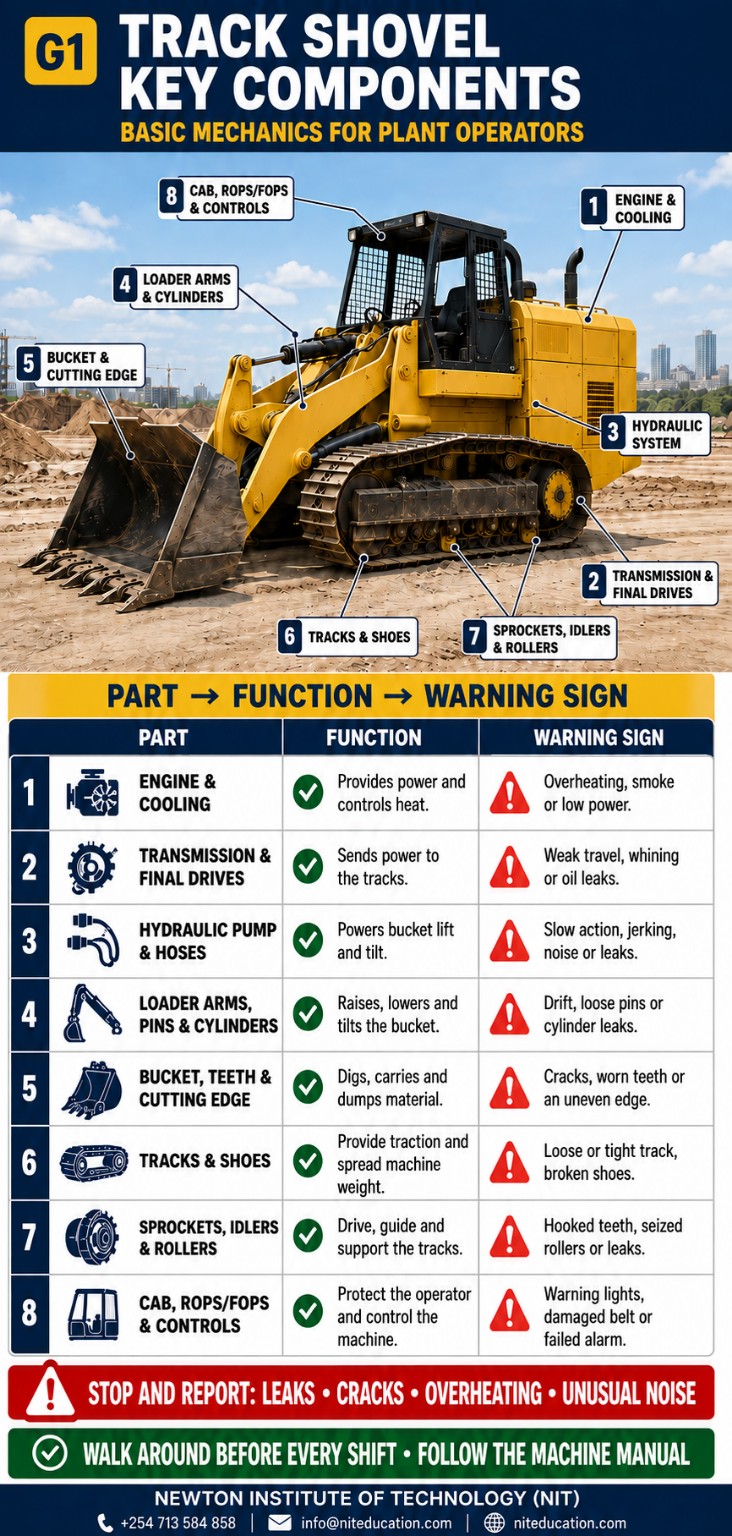
Start at the front
Bucket, cutting edge, teeth, loader arms and linkage
Loader bucket
The bucket enters material, collects it, carries it and releases it. Cracks, distortion, loose hardware or damage around mounting points deserve attention because digging forces travel back into the loader structure.
Cutting edge & bucket teeth
The cutting edge takes wear as the bucket enters material. Where teeth are fitted, they help break into harder material. Severe wear, a missing tooth or loose retaining hardware should not be ignored.
Loader lift arms
Hydraulic cylinders raise and lower the heavy arms carrying the bucket. Visible cracks, damaged welds, bending or unusual side movement are structural warning signs.
Linkage, pins & bushes
The linkage changes bucket angle while pins and bushes form the pivots. Excessive play, knocking or poor alignment can be early signs of wear around these joints.
Correct lubrication helps protect pins and bushes, but lubrication intervals and grease specifications must follow the machine manufacturer’s instructions.
Follow the hydraulic hoses backwards
What actually raises the loader arms and tilts the bucket?
A useful trainee-level picture of the system is pump → control valve → hoses → cylinders → returning oil. The real circuit is more complex, but this explains where the working force comes from.
The engine drives the pump, which supplies the oil flow needed for loader functions. Slow hydraulics do not automatically prove the pump has failed.
The valve directs hydraulic oil to the circuit selected by the operator, allowing the same system to raise the arms or change bucket angle.
The reservoir stores hydraulic oil and the filters help control contamination. Unexplained oil loss or warning indications should be investigated.
These carry pressurised oil around the machine. Pay attention to leakage, cracking, abrasion, rubbing and hoses passing close to heat or moving parts.
Lift cylinders
- Raise and lower the loader arms.
- Check exposed rods, seals and mounting points visually.
- Oil around a seal, rod damage or unusual jerking deserves attention.
Tilt cylinder
- Rolls the bucket back after filling.
- Controls bucket angle during carrying and dumping.
- A change affecting tilt more than lift is useful information to report.
Never use your hand to search for a suspected hydraulic leak. High-pressure fluid can penetrate skin and cause severe injury. Suspected leaks must be investigated using the correct isolation and maintenance procedure.
One safety rule to remember
Raised loader arms: never trust hydraulic pressure alone
A raised bucket and loader arms contain considerable stored energy. If hydraulic pressure is lost or a component fails, the loader equipment can descend.
Never place yourself beneath raised loader arms or a raised bucket unless the machine has been secured using the approved mechanical support and isolation procedure for that machine.
Now look down
The crawler undercarriage works every metre the machine travels
Tracks, chains, rollers, idlers and sprockets carry the machine while dealing with dirt, stones, mud, turning forces and ground impact. The undercarriage is easy to overlook because the bucket gets most of the attention.
Track shoes & grousers
The shoes spread machine weight and the raised grousers help provide traction. Look for damaged shoes, loose hardware, severe wear and side-to-side differences.
Track chain
The chain and its links, pins and bushes move around the undercarriage whenever the machine travels. Correct track tension matters; tighter is not automatically better.
Lower & carrier rollers
Lower rollers carry much of the machine’s weight. Some designs also use carrier or upper rollers to support the returning track chain. Machine layouts vary.
Front idler
The idler guides the track and works with the adjusting mechanism. A useful distinction for trainees: the idler guides; it does not drive the track.
Drive sprocket
Sprocket teeth engage the track chain. Power reaching the sprocket causes the crawler track to move. Wear, abnormal noise or irregular track movement deserves attention.
Track frame, adjuster & recoil
The frame supports the running gear. The adjuster maintains track tension and the recoil mechanism allows controlled movement under shock. If one track suddenly sits much looser than the other, report the difference.
Where torque reaches the tracks
Final drives sit near the point where machine power becomes track movement
The final drive reduces rotational speed and increases torque before power reaches the track. Oil around a final-drive seal, unusual noise from one side or excessive heat should be reported early. These components work under heavy load and are expensive to ignore.
Move around to the engine compartment
The power unit is easier to understand when the panels are open
G1 Track Shovel Engine Compartment
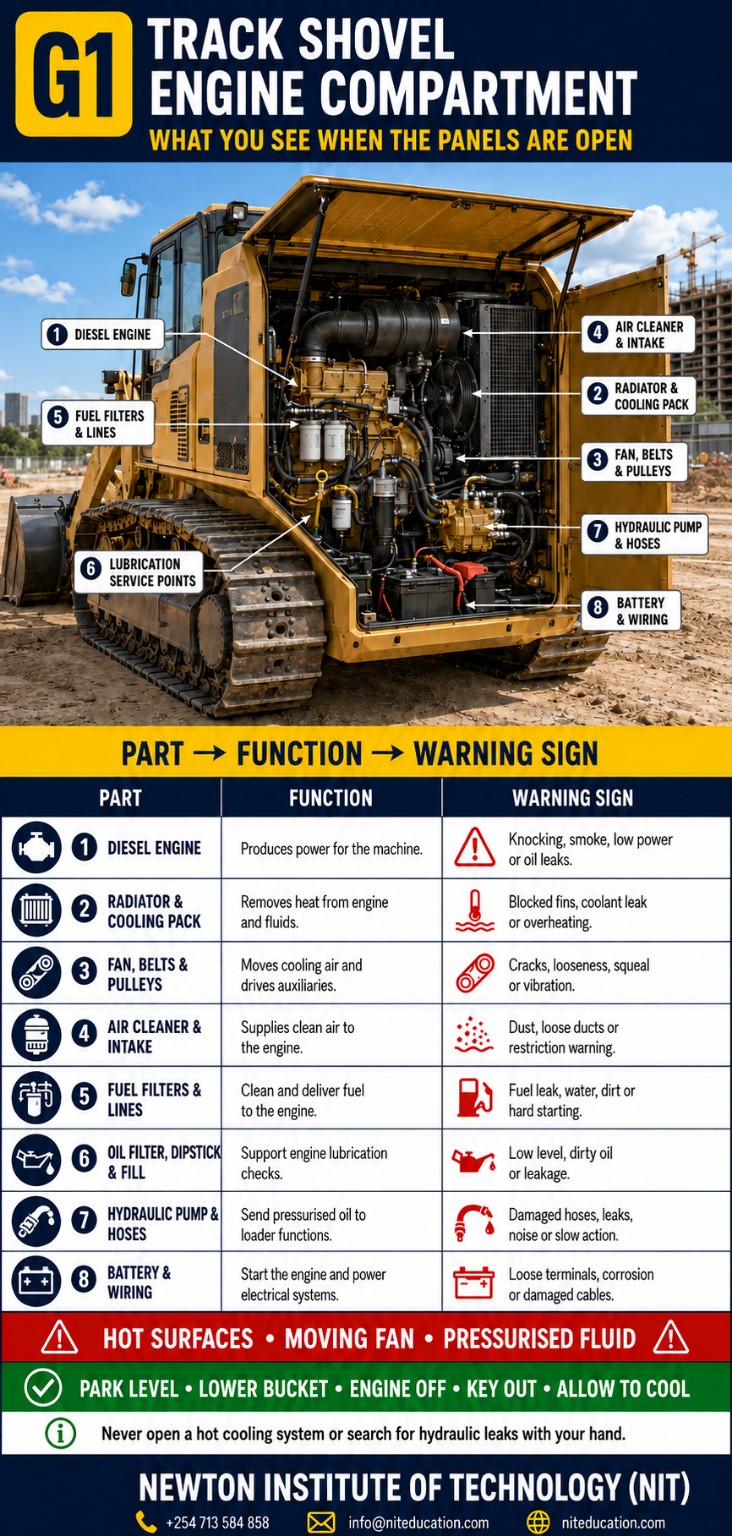
Power and support systems
Engine, lubrication, cooling, air and fuel
Engine
Provides power for travel and hydraulic work. Sound, smoke, vibration, loss of power, temperature and dashboard warnings can reveal change.
Lubrication
Engine oil protects moving parts. Unexplained oil loss or pressure warnings should be investigated rather than repeatedly topped up and ignored.
Cooling
Radiator, fan, coolant, hoses and related coolers control heat. Watch the temperature gauge and look for leaks or blocked cooling surfaces.
Air intake
Dusty work makes clean engine air important. Loose ducts, damaged connections and restriction warnings can affect performance.
Fuel
The system stores, filters and delivers fuel. Visible leaks, contamination, damaged hoses or water warnings are operator-level concerns.
Never open a hot pressurised cooling system carelessly. Allow the machine to cool and follow the machine-specific procedure.
Not every component is hydraulic or mechanical
Electrical starting and charging system
The electrical system starts the engine and powers electrical equipment. Operator-level components include the battery, starter, alternator or charging system, fuses, wiring, lights, alarms and instrument circuits.
A weak battery may cause slow cranking. A charging warning may show that the electrical system is not replenishing the battery correctly. Repeatedly blown fuses or damaged wiring should be investigated rather than bypassed.
From engine power to track movement
How does engine power reach the tracks?
Depending on machine design, a crawler loader may use a hydrostatic drive or another transmission arrangement. Whatever the design, the job is the same: take power from the engine and deliver controlled movement to the tracks.
If one side suddenly behaves differently, the cause could involve the drive system, final drive, track adjustment or another undercarriage component. Notice the symptom first. Diagnosis comes later.
Finish the walk-around at the operator station
Controls, dashboard and protective structure
G1 Track Shovel Operator Cabin — Correct Control Positioning
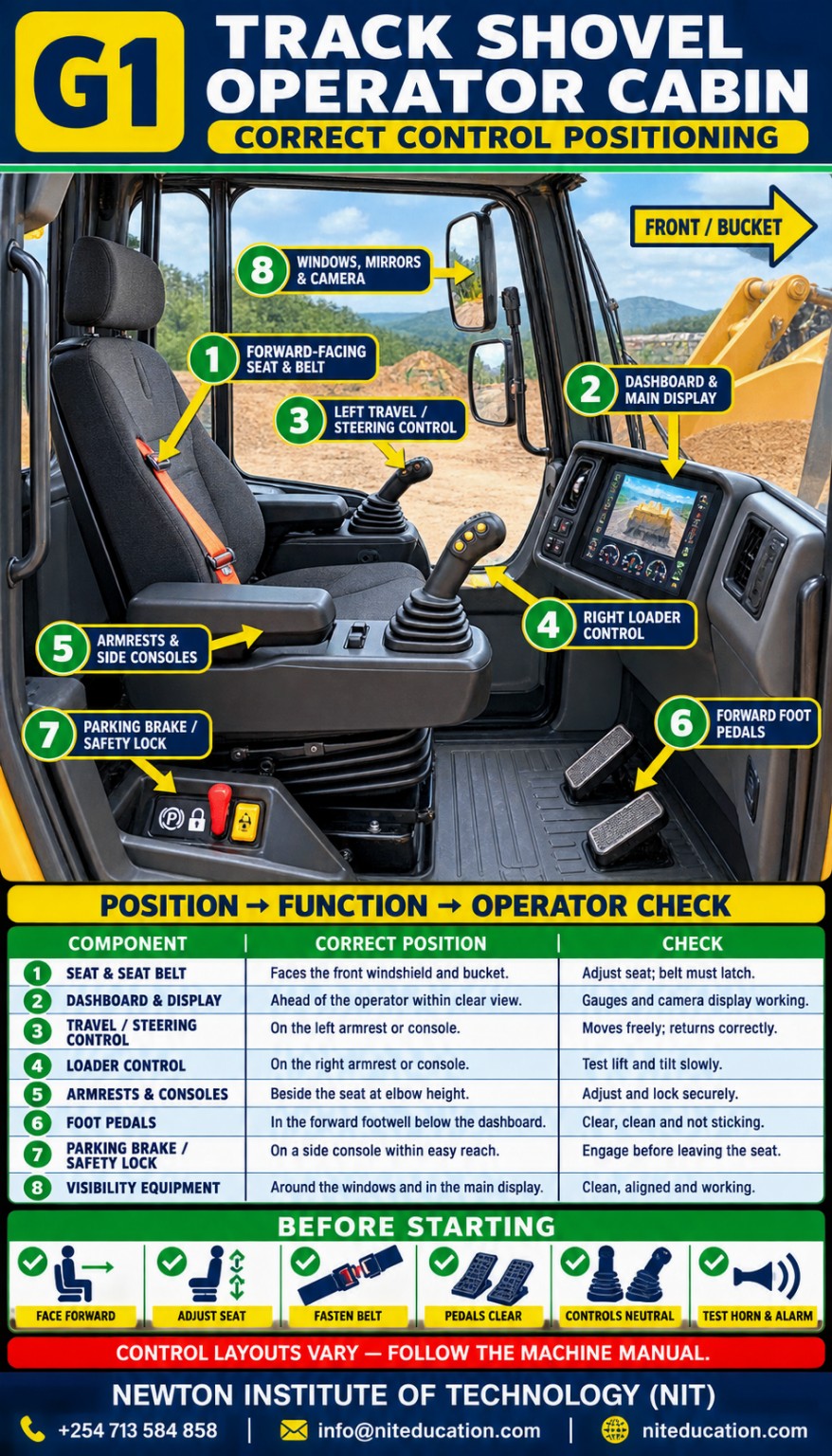
Inside the cab
The machine communicates with the operator from here
Operator controls
Travel controls, loader controls, pedals and switches vary by machine. Identify each control before working and never learn by experimenting near people or structures.
Instrument panel
The dashboard may show temperature, fuel, oil pressure, hydraulic condition, charging status, filter warnings, operating hours and diagnostic warnings.
ROPS & FOPS
Where fitted, Roll-Over and Falling Object Protective Structures form part of the operator-protection system. They should not be casually cut, drilled or modified.
Main frame
The frame supports major machine systems and carries working forces. Visible cracking or major impact damage needs attention even when the machine can still move.
Put the systems back together
How the track shovel works as one machine
That power is available to the hydraulic and drive systems.
The pump produces flow and the control valve sends oil to the required cylinders.
Power reaches the final drives and sprockets, which move the crawler tracks.
The operator coordinates bucket movement and travel to dig, carry, push or dump material.
Engine → hydraulics and drive system → loader and tracks → work performed.
So when the bucket feels weak, the problem you notice at the front may have started much farther back in the hydraulic or engine system.
Notice the change before guessing the repair
Track shovel warning signs: what an operator may notice
| What changes | Area that may need attention | Operator response |
|---|---|---|
| Bucket begins lifting slowly | Hydraulic system | Report the change; do not assume a pump failure. |
| Loader movement becomes jerky | Hydraulic circuit | Stop if control becomes unsafe and report it. |
| Bucket gradually drops when it should hold | Cylinder or hydraulic control circuit | Keep clear of unsupported raised equipment. |
| Fresh hydraulic oil appears near a cylinder | Cylinder seal, hose or fitting | Do not search for the leak with your hand. |
| Knock develops around the bucket | Linkage, pins or bushes | Describe where and when the knock occurs. |
| One track looks unusually loose | Track adjustment or undercarriage | Report the difference before continued work. |
| Machine begins pulling to one side | Undercarriage or drive system | Note which side and under what condition. |
| New grinding or knocking comes from a track | Rollers, chain, sprocket, idler or tension | Stop if continued travel could worsen damage. |
| Oil appears around the final-drive area | Final-drive system or seal | Report the leak early. |
| Engine loses power | Engine, fuel or air system | Note smoke, warning lights and operating conditions. |
| Temperature starts climbing | Cooling system or operating condition | Respond to the warning before overheating worsens. |
| Battery or charging warning appears | Electrical charging system | Report the warning rather than bypassing it. |
One symptom can have several causes. Do not turn an observation into a diagnosis unless you are trained and authorised to make that diagnosis.
Quick mechanical walk-around
Use the same route you used to learn the machine
This is not a replacement for the full plant-operator pre-start checklist. It is a component-awareness route.
- Start at the bucket, teeth and cutting edge.
- Inspect the loader arms, visible pivots and cylinders.
- Follow the visible hydraulic hoses and fittings.
- Look along both crawler undercarriages.
- Check around the engine compartment for obvious changes.
- Enter the operator station and observe controls and instruments.
Know the boundary
Operator knowledge is not mechanic knowledge
Recognise, inspect and report
- Identify major components.
- Understand their basic functions.
- Perform authorised checks.
- Notice abnormal sounds, movement, leaks and warnings.
- Describe faults clearly.
Diagnose and repair
- Hydraulic pressure testing and internal pump work.
- Cylinder rebuilding and electrical diagnosis.
- Engine dismantling and final-drive repair.
- Major undercarriage or structural repair.
Knowing when to stop operating and call for technical attention is part of operating machinery professionally.
Habits worth carrying onto any machine
Five mechanical habits of a good track shovel operator
A new knock, squeal, grind or hydraulic whine becomes easier to recognise when you know the normal machine.
A fresh puddle, damaged hose or loose track component is easier to see from the ground.
Heat, leakage, vibration, slower movement and warning lights are information.
Every unnecessary turn, track spin and metre of travel creates wear somewhere underneath the machine.
“The machine has a problem” tells a mechanic almost nothing. “The bucket became slower after the machine warmed up, and I can see fresh oil around the right lift cylinder” gives useful information.
Quick G1 revision
Can you walk around the machine and explain each system?
| Order | Component group | Revision question |
|---|---|---|
| 1 | Bucket, cutting edge and teeth | What work do they perform and what wear can you see? |
| 2 | Loader arms, linkage, pins and bushes | Where are the pivots and what does excessive play look or sound like? |
| 3 | Lift and tilt cylinders | Which function does each cylinder control? |
| 4 | Hydraulic hoses, pump, valve and reservoir | How does oil flow create loader movement? |
| 5 | Track shoes, chain and rollers | How are machine weight and track movement supported? |
| 6 | Carrier roller where fitted | What part of the track does it support? |
| 7 | Front idler and track adjuster | Which part guides the track and which system controls tension? |
| 8 | Drive sprocket and final drive | Where does drive force reach the crawler track? |
| 9 | Engine, cooling, air and fuel systems | Which warning signs can an operator observe? |
| 10 | Battery, starter and charging system | What does the electrical system support? |
| 11 | Main frame and guards | What structural damage must be reported? |
| 12 | Controls, dashboard, ROPS and FOPS | Can you identify the controls and explain the main warnings? |
Frequently asked questions
Track shovel parts and basic mechanics
What are the main parts of a track shovel?
The main parts are the loader bucket and linkage, hydraulic system, engine, drive system, crawler undercarriage, final drives, electrical system, main frame and operator station. The undercarriage includes track shoes, chain, rollers, front idler, drive sprocket and track-adjusting components.
Is a track shovel the same as a crawler loader?
Crawler loader is a widely used international name for the tracked loading machine described as a track shovel in this guide.
Is a track shovel the same as an excavator?
No. A track shovel uses front loader arms and a loader bucket. An excavator uses a boom, stick and digging bucket, normally mounted on a rotating upper structure.
What is the undercarriage of a track shovel?
It is the tracked running system beneath the machine. Its components include track shoes, chain, rollers, front idler, sprocket, track frame and track-adjusting equipment.
What does the drive sprocket do?
The sprocket receives drive power and engages with the track chain, causing the crawler track to move.
What does the hydraulic pump do?
The pump supplies the hydraulic-oil flow used to operate functions such as raising the loader arms and tilting the bucket.
Why should an operator understand basic mechanics?
Machines often show signs of trouble before a major breakdown. Understanding the main systems helps an operator notice those changes, use the machine correctly and describe faults more accurately.
Technical review
Basic mechanics should improve operator judgement, not encourage unauthorised repairs
The aim of this guide is component recognition, function and operator awareness. Machine-specific handbooks, site procedures and authorised technical personnel take priority for adjustment, isolation, servicing and repair.
Final word
The value of basic mechanics becomes obvious when the machine starts behaving differently
Perhaps the bucket hesitates when you try to raise it. Maybe one track develops a sound you did not hear during the morning inspection. You may notice fresh oil on a component that was dry earlier in the day.
An operator who knows the machine is more likely to recognise those changes early and explain them properly. That is what Know Your Machine is meant to develop: not a mechanic sitting in the operator’s seat, but an operator who understands the equipment well enough to use it safely, notice when something is changing and know when the machine needs attention.