

International student travel guide Plant Operator
Planning a Plant Operator Training Trip to Kenya
Course length · travel budget · accommodation · Migori arrival
Coming to Kenya for practical plant operator training? Plan the journey with confidence—from your reporting date and accommodation to travel documents, daily costs and settling into Migori.
Plan the whole stay
What should an international student plan before coming?
Start with your intake dates, training package, travel documents, route to Migori and accommodation. NIT’s main plant operator programme takes approximately two months, with about 70% practical training and 30% theory. Accommodation is available at the institution and outside at an extra cost; contact Admissions for current specifications and charges.
Your trip at a glance
A simple starting point before you book
If you are considering plant operator training in Kenya as an international student, begin with the few details that shape almost every other decision.
Tell Admissions your country, preferred month, the driving licence you hold and the machines that interest you. You can work through the rest one step at a time.
Course length and arrival
Give yourself a little room around the two-month course
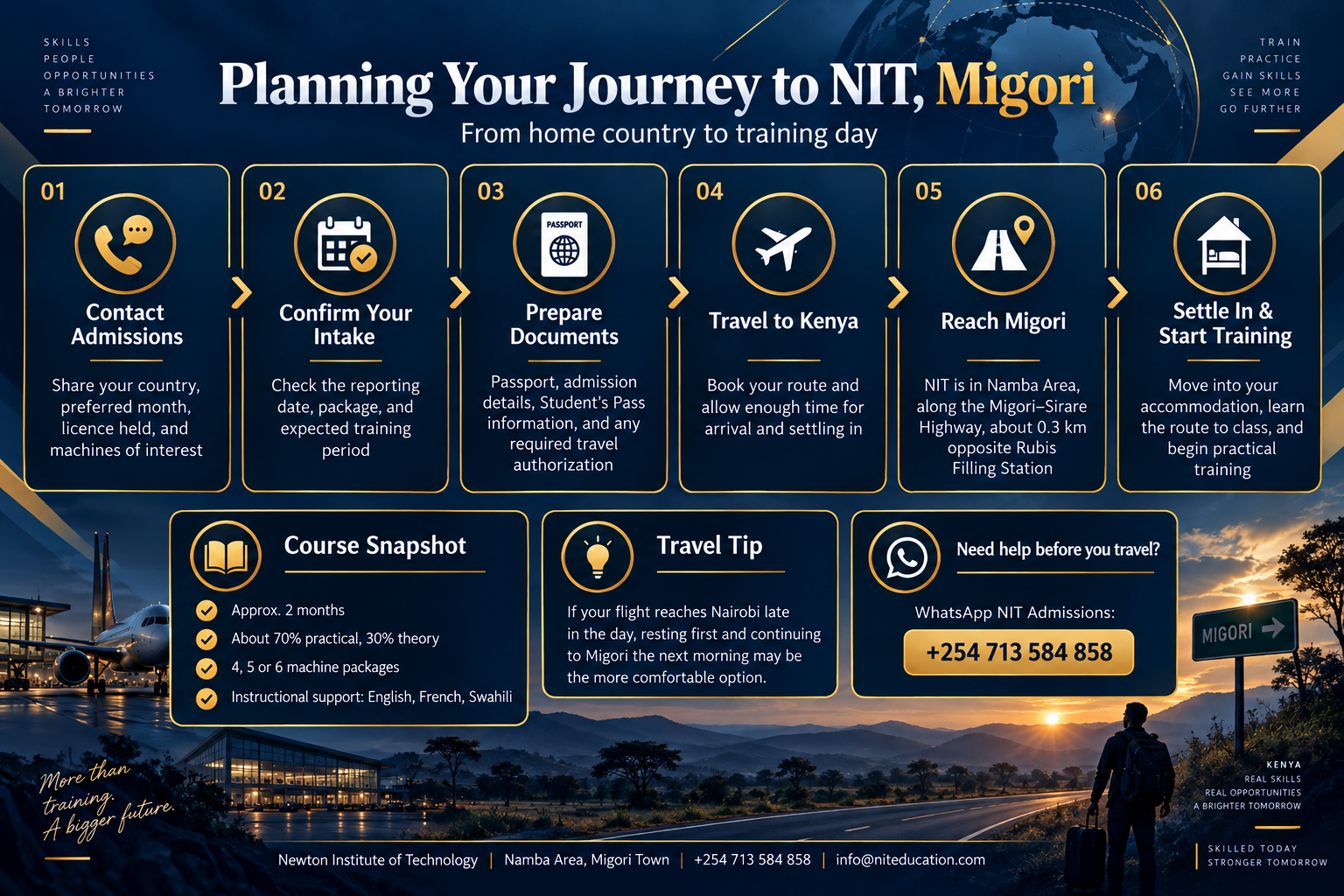
For someone already living in Migori, reporting for training can be as simple as travelling from home to class. Your first morning may be different. You may have spent the previous day flying, crossing a border, changing buses or arriving in a town you have never visited before.
Arriving before your first practical session gives you time to sleep properly, settle into your accommodation, learn the route to NIT and become familiar with Migori. When you confirm your intake, ask for both the reporting date and the expected completion period.
Continue to Migori the same day
- Useful when you arrive early enough.
- Leave comfortable connection time.
- Keep Admissions informed of your expected arrival.
Rest, then travel the next morning
- A good option after a long flight.
- Avoids making the first training day exhausting.
- Lets you begin the road journey rested.
Getting to the training centre
From your home country to NIT in Migori
Newton Institute of Technology is in Namba Area, Migori Town, along the Migori–Sirare Highway, approximately 0.3 km opposite Rubis Filling Station.
Students arriving by air commonly travel through Nairobi and continue to Migori by road. If you are coming overland from a neighbouring country, Nairobi may not be necessary. Once your route is clear, share your expected arrival details with Admissions. If you need current directions after reaching Migori, call or WhatsApp the team.
Where you can stay
Accommodation is available at the institution and outside
International and out-of-town students have accommodation options. Accommodation is available both at the institution and outside the institution at an additional cost.
The most suitable arrangement depends on availability, the type of accommodation you prefer and how long you expect to stay. Because specifications and charges can change, ask Admissions for the current accommodation options, facilities and cost before travelling.
Institutional accommodation
- Available at additional cost.
- Confirm current room specifications and availability.
- Ask Admissions for the latest charges.
Outside accommodation
- Also available around Migori.
- Compare distance, security and daily transport.
- Confirm deposits, utilities and cooking arrangements.
Admissions can share the available options, specifications and current costs for your intake.
Build a realistic trip budget
Budget around your own journey—not somebody else’s total
A student travelling by road from Uganda will have a very different transport budget from someone flying from Nigeria, Ghana or Zambia. The most useful approach is to build your trip from the costs that actually apply to you.
Tuition
4 machines: KSh 65,000 · 5: KSh 78,000 · 6: KSh 89,000.
Travel to Kenya
Use a current return fare from your own city or country.
Travel to Migori
Include road transport and any local transfers on arrival.
Accommodation
Institutional or outside accommodation is an additional cost.
Food & daily life
Meals, data, laundry, toiletries and small local journeys.
Official costs & reserve
Immigration/licensing costs that apply to you, plus a small cushion.
Tuition + international travel + travel within Kenya + accommodation + food + official costs + personal expenses + reserve = your realistic training-trip budget.

For the detailed training and statutory fee breakdown, see NIT’s Plant Operator Course Fees in Kenya guide.
International student paperwork
Include the Student’s Pass and your whole stay in the plan
Kenya’s Directorate of Immigration Services describes the Student’s Pass as the pass used by a foreigner accepted to undertake education or training at an institution in Kenya. The application includes supporting information from the institution, including details about the course and its duration.
| Applicant | Current published Student’s Pass fee |
|---|---|
| Non-East African applicant | USD 100 per year |
| East African Community member-state applicant | Gratis |
These are government immigration charges, not NIT tuition fees. Rules and charges can change, so confirm the current official requirements before travelling.
Count arrival, settling-in days, the full training period, any agreed additional stay and departure—not only the classroom dates. Check the current eTA/entry arrangement for the passport you actually hold.
Driving licence and machine choice
Tell Admissions what licence you already hold
Plant operator licensing in Kenya uses the Category G system. For an international learner, a useful starting point is simply to tell Admissions which driving licence you currently hold and which country issued it.
For the detailed Kenyan licensing pathway, machine codes and endorsement process, use NIT’s NTSA Category G Plant Operator Licence in Kenya guide.
Travelling a long way does not automatically mean the six-machine package is the best fit. Think about the equipment most useful for the work you want to pursue, then confirm those machines for your intake.
Training communication
English, French and Swahili support is available
Technical training becomes easier when you can ask questions freely and understand instructions around the machine. NIT provides instructional support in English, French and Swahili for trainees who require it.
If French or Swahili support would make practical training easier for you, mention it when contacting Admissions—especially for technical terms involving controls, hydraulics, warning indicators and safety procedures.
Packing and settling in
Bring what you need for a practical stay of several weeks
A sensible starting list includes your passport and applicable immigration documents, NIT admission/training correspondence, driving licence, copies of important documents, normal clothing, suitable practical-training clothing, recommended footwear, personal medication, phone and charger, access to funds and emergency contact information.
Before buying specialised PPE or equipment, ask Admissions what is actually required for your intake.
Your first few days in Migori
The unfamiliar usually becomes familiar quite quickly
You learn the route from your accommodation to NIT. You find where you prefer to buy food. You sort out your phone and data. You start recognising your classmates and the training environment. Soon, the international trip begins to feel like an ordinary routine: wake up, get ready and go for training.
Planning beyond the classroom
If attachment interests you, mention it before fixing your return date
NIT supports eligible plant operator trainees with attachment opportunities and practical workplace exposure. If you may want to remain in Kenya after training for an applicable attachment arrangement, raise this before buying a tightly fixed return ticket.
For the detailed placement and worksite-experience guide, see Plant Operator Attachment in Kenya. If your main question is how Kenyan training relates to work elsewhere in Africa, use NIT’s Heavy Machinery Operator Certification in Africa guide.
Before you leave home
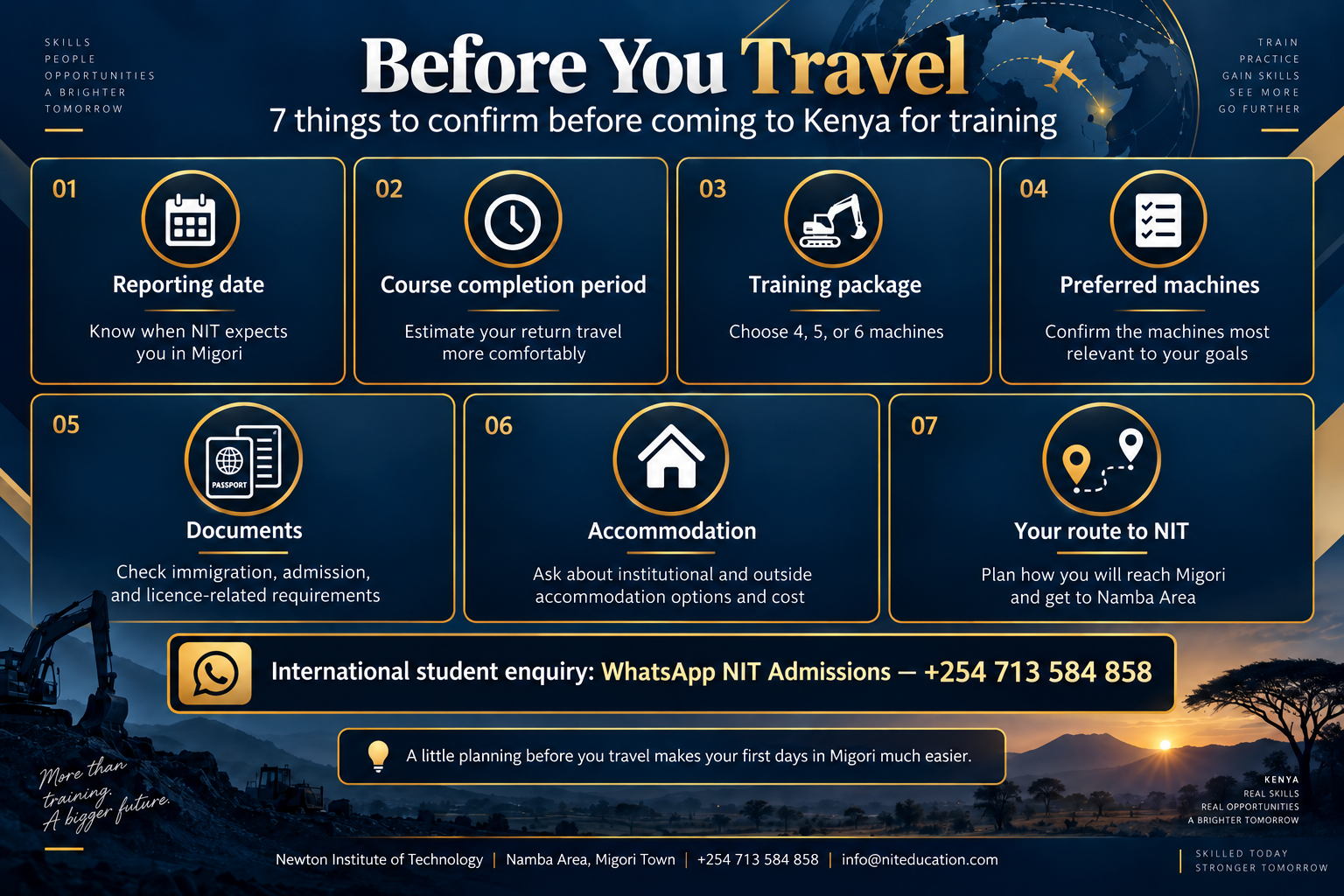
Seven things worth confirming
Once these answers are clear, most of the uncertainty around the journey disappears.
- Reporting date: when NIT expects you in Migori.
- Completion period: a realistic point for return-travel planning.
- Training package: four, five or six machines.
- Preferred machines: confirm the machines most relevant to your goals.
- Documents: immigration, admission and licence-related requirements.
- Accommodation: confirm your first place to stay and current cost.
- Route to NIT: know how you will reach Migori and Namba Area.
A simple message from abroad
Give Admissions enough information to guide you well
You can write: “Hello NIT. My name is [name] and I am from [country]. I am interested in plant operator training and would like to join around [month]. I currently hold a [licence type] issued in [country]. I am mainly interested in [machines]. Please guide me on the next intake, training package, documents required and current accommodation options and costs.”
info@niteducation.comFrequently asked questions
Plant operator training trip FAQs
How long is plant operator training at NIT?
The main NIT plant operator programme takes approximately two months, with about 70% practical training and 30% theory.
Is accommodation available?
Yes. Accommodation is available both at the institution and outside at an additional cost. Contact Admissions for current specifications, availability and charges.
Is accommodation included in the tuition?
Accommodation should be planned separately from the published KSh 65,000, KSh 78,000 and KSh 89,000 plant operator tuition packages.
Can international students enquire about plant operator training?
Yes. International applicants are welcome to contact NIT for current intake, training, accommodation and institution-side admission guidance.
Does NIT provide French-language support?
Yes. Instructional support is available in English, French and Swahili for trainees who require it.
Do foreign students need a Student’s Pass?
Kenya’s Directorate of Immigration Services provides a Student’s Pass process for foreigners accepted for education or training. Confirm the requirements applicable to your own situation before travel.
Can I ask for accommodation information before travelling?
Yes. Ask Admissions for the current institutional and outside accommodation options, specifications, availability and cost.
Can NIT help me when I arrive in Migori?
Yes. If you need current directions to Namba Area or help locating the institution after reaching Migori, contact Admissions by phone or WhatsApp.
International student enquiry
Coming to Kenya for training? We would be happy to hear from you.
Tell us where you are travelling from, when you would like to begin and the machines that interest you. We will help you work through the NIT side of the journey before you come. Karibu Kenya. Karibu Migori.