

NIT BEAUTY LAB · PRACTICAL HAIR-CARE GUIDE
Identify Your Hair Type. Choose Products That Fit.
See the difference between curl pattern, scalp needs and porosity—then use a simple, affordable method to choose products that work for your hair.
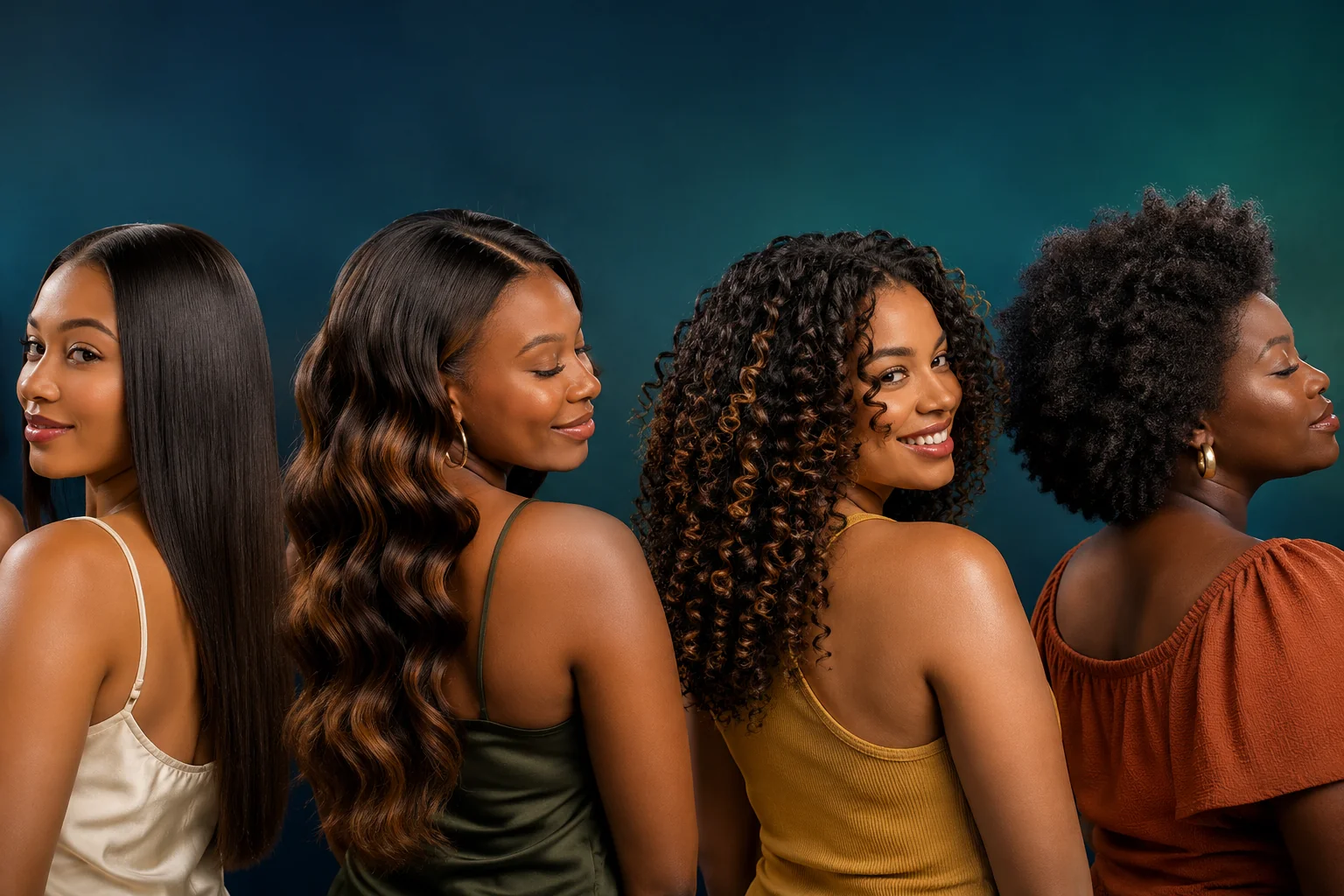
Four broad pattern groups. Product needs also depend on the scalp, individual strands, past treatments and actual results.
Quick answer
How do you identify your hair type and choose suitable hair products?
Look at the natural shape of clean hair—straight (type 1), wavy (type 2), curly (type 3) or coily (type 4). Check strand width, density, scalp comfort, prior colouring or relaxing, and the results of your usual products. A water-glass test cannot establish fibre porosity. Start with a suitable shampoo and rinse-out conditioner; add another product only to solve a specific problem.
- Observe pattern
- Check strands
- Assess scalp
- Review history
- Test products
Have you ever bought a product labelled “for 4C hair” or “low porosity”, then discovered that it left your hair coated or difficult to comb? The label may not be wrong; it may simply tell you too little about the hair and scalp you are caring for.
This practical guide is for beginners, natural-hair consumers and student hairdressers in Kenya and beyond. You will learn an easy assessment process, how to interpret porosity claims sensibly, and how to select a small routine you can actually evaluate.
Six hair characteristics that shape your routine
A useful consultation separates hair shape from hair condition . A person can have tight coils and fine strands, or straight hair with a dry scalp. Neither curl pattern nor a single porosity label tells the whole story. Keep these six observations separate:
Curl pattern
The natural shape of the strand: straight, wavy, curly or coily. It helps explain styling and detangling needs.
Strand width
How fine or thick one hair fibre feels—not how much hair covers your head.
Hair density
How many hairs grow across an area of the scalp. It affects sectioning, product distribution and drying time.
Scalp condition
Whether the scalp is comfortable, oily, flaky or irritated. The scalp determines many cleansing decisions.
Hair condition and history
Bleach, relaxers, colour, heat, tension and wear can change how the lengths and ends behave.
Water and product response
What you actually observe after cleansing and conditioning, including residue, softness, frizz and tangling.
A critical distinction
Type 4C does not automatically mean high porosity. Pattern labels describe visible shape, not the internal pore structure, scalp health or exact product requirements. Published research identifies important limits to the numbered classification systems. [3]
Step 1 — Identify your natural hair type
Look at freshly washed hair after you have gently detangled and allowed it to settle without heat straightening, rollers or tight braids. If your pattern disappears when wet, examine it as the hair dries. Compare the crown, front, sides and nape; many people have more than one natural pattern. If hair has been relaxed, permanently waved or heavily heat altered, the visible lengths may not represent the original pattern.
The familiar 1A–4C system is a consumer description , not a clinical measurement. The numbers group broadly straight, wavy, curly and coily hair; letters add more detailed descriptions. Boundaries are subjective, particularly between neighbouring subtypes. Type 1 letters describe variations in straight hair rather than curl tightness, and the popular 4C label is not defined consistently across all scientific systems. People with different ethnic backgrounds can have overlapping patterns. A 2026 systematic review compares several competing classification methods and calls for more consistent descriptions. [3]
The 1A–4C hair-type chart, explained without rigid rules
1A
Appearance to look for: Hair falls almost completely straight, with very little natural bend.
Remember: Straight hair can still vary in strand width and density.
1B
Appearance to look for: Predominantly straight, often with some natural body or movement.
Remember: More body does not automatically mean coarse strands.
1C
Appearance to look for: Predominantly straight, with more visible bends or texture in places.
Remember: The boundary with loose waves is subjective.
2A
Appearance to look for: Loose, stretched-out S-shaped waves.
Remember: Heavy styling products can sometimes weigh waves down.
2B
Appearance to look for: More distinct S-waves along much of the length.
Remember: Some sections may be straighter or curlier.
2C
Appearance to look for: Strong waves, with some strands approaching loose curls.
Remember: Frizz does not prove high porosity.
3A
Appearance to look for: Larger, recognisable spiral curls.
Remember: Curl diameter can vary across the head.
3B
Appearance to look for: More compact spring-like ringlets.
Remember: Detangling technique may matter more than the exact letter.
3C
Appearance to look for: Tighter, closely spaced corkscrew curls.
Remember: Tightness alone does not indicate damage.
4A
Appearance to look for: Small, clearly visible coils when allowed to form naturally.
Remember: Coils can shrink significantly after washing.
4B
Appearance to look for: Tight bends or less uniformly ring-shaped turns.
Remember: A person may have both 4A- and 4B-looking sections.
4C
Appearance to look for: Very tightly packed coils; the pattern may be less obvious without close observation.
Remember: 4C does not mean coarse hair, high porosity or an obligatory product kit.
This chart is a recognition aid, not twelve scientifically fixed categories or a diagnosis. You do not need to decide between, for example, 3C and 4A before choosing a safe, useful conditioner. [3]
Type 1 — Straight
What it looks like: Very little natural wave; may be sleek or more textured.
Useful starting observation: Does rich conditioner leave the hair flat or coated?
Avoid assuming: That every straight-haired person has fine strands or an oily scalp.
Type 2 — Wavy
What it looks like: Loose to defined S-shaped bends.
Useful starting observation: Does a light styling product help waves keep their shape?
Avoid assuming: That all wavy hair needs the same mousse or cream.
Type 3 — Curly
What it looks like: Visible curls or spirals of varying diameter.
Useful starting observation: How much slip does detangling require?
Avoid assuming: That curls always need several heavy oils.
Type 4 — Coily
What it looks like: Tight coils, turns or zigzag-like bends, often with noticeable shrinkage.
Useful starting observation: How does gentle section-by-section conditioning affect tangling and breakage?
Avoid assuming: That all coily hair is coarse, damaged, or high porosity.
A simple pattern-identification exercise
- Clean the hair as usual and rinse thoroughly.
- Let a section settle naturally, without straightening or tightly pulling it.
- Look at the pattern from root to tip; observe multiple areas of the head.
- Write down a broad description such as “mostly tight coils with looser curls at the front”.
- Record separately whether the hair tangles, feels fine or coarse, or has processed ends.
Do not judge porosity from curl tightness or shrinkage. Shrinkage is a visible consequence of curl geometry and styling conditions; the porosity question must be assessed separately. [3]
Real-life example: A student in Migori may describe her crown as tightly coiled and her front hairline as looser. That is a useful, accurate observation. She does not need to buy separate products for every letter on a chart.

Step 2 — Check strand width, density and your scalp
Two heads of hair may look equally full yet respond very differently to the same leave-in conditioner. One person has many fine strands; another has fewer coarse strands. Product weight and amount may matter more than the curl-pattern label.
How fine or coarse is an individual strand?
Take one naturally shed strand between clean fingertips. Fine strands may be difficult to feel, while coarse strands are easier to notice. This is only a rough comparison: do not diagnose a category from a single strand, and do not confuse coarse with dry or damaged.
How dense is the hair overall?
Look at how easily you can see the scalp when hair is parted under ordinary lighting. Do not mistake the visibility caused by a hairstyle, tight parting or wet hair for permanent density. If density appears to be falling, that is a separate concern.
Density affects product quantity and the time needed to work through sections. It is not the same as hair loss: noticeably widening parts, unusual shedding or new bald areas deserve assessment rather than home density-labeling.
What does the scalp need?
Dry-feeling lengths and a dry or itchy scalp are different problems. Conditioners are mainly selected to improve hair-fibre feel and manageability; ongoing scalp itching, inflammation or scaling may need medical assessment. Oils or heavy creams on the scalp do not automatically solve a scalp problem.
Ask whether the scalp becomes oily quickly, stays comfortable between washes, or develops itching or flakes. Choose cleansing frequency according to dirt, oil, buildup and comfort rather than a fixed rule for everyone. Apply shampoo primarily to the scalp, then condition the hair lengths appropriately. Dermatologists emphasise these basics. [1]
Try this before buying anything
Note three observations: “My scalp gets oily by day three,” “my ends tangle when dry,” and “heavy leave-in leaves residue.” Those statements are more useful for choosing a cleanser and conditioner than saying only “I am 4B”.
Step 3 — Understand hair porosity without the myths
Hair porosity is a term for pore-related properties of the fibre, such as pore accessibility and internal structure. Scientists can investigate these using specialised methods including gas sorption, thermoporometry and microscopy. Surface wetting —how water spreads across the outside of a strand—is a related but different observation. Nor does the time a whole head takes to dry directly reveal the fibre’s pore volume. Bleaching and repeated thermal or mechanical stress can change several of these properties in different ways. [5] [6] [12]
New research published in November 2026 illustrates why the words matter. Investigators adapted a contact-angle method for consumer-perceived surface porosity in textured hair and also assessed shine, curl shrinkage and flexibility. This is a controlled surface-wetting measurement, not a validation of household floating-hair tests or proof that internal pore size can be diagnosed by touch. [13]
Lower porosity
What people often mean: Hair seems less easily wetted or gets coated by rich products.
A practical product experiment: Use smaller amounts, work in sections, rinse carefully, and track residue.
Important caution: Slow wetting may also result from density, oils, silicones or buildup.
Medium porosity
What people often mean: Hair seems manageable with an ordinary cleansing and conditioning routine.
A practical product experiment: Keep a routine that works; adjust only when hair behaviour changes.
Important caution: No home test reliably certifies a “normal” category.
Higher porosity
What people often mean: Hair feels rough or weathered and may be more difficult to keep smooth.
A practical product experiment: Try a suitable conditioner, reduce friction and heat, and protect fragile ends.
Important caution: Dryness or frizz alone does not prove a specific internal pore structure.
What three common observations do—and do not—tell you
Water beads or seems slow to wet the hair.
What it might indicate: Surface wetting, product films or how densely hair is packed may play a part.
What it cannot establish: A measured amount of internal porosity.
Hair stays wet for a long time.
What it might indicate: Density, length, humidity, styling products and airflow may affect drying.
What it cannot establish: That the fibres must have low porosity.
Ends feel rough or dry much sooner than roots.
What it might indicate: Older fibres may have had more weathering or chemical processing.
What it cannot establish: That every strand has one uniform high-porosity category.
Older, processed ends and newer roots can need different handling. Condition and reduce friction where the hair actually needs it instead of assigning the whole head a single category.
Step 4 — Can you accurately test hair porosity at home?
A popular home demonstration drops a clean strand into a glass of water and calls floating hair “low porosity” and sinking hair “high porosity”. Do not use that result as a diagnosis: a strand floating or sinking does not directly measure its internal pore volume.
Surface wetting, trapped air, surface tension, deposited product and fibre history can influence what happens. Even a strand that looks clean is not a calibrated test specimen. Researchers use distinct methods to investigate pore-related fibre structure and surface wetting; the results cannot simply be substituted for one another. The sources reviewed do not validate a home float test for sorting people into low-, medium- and high-porosity categories. [5] [6] [12] [13]
A home test is not a chemical-service safety check
Never use a float, spray or touch test to authorise bleaching, colouring or relaxing. A trained professional should review the hair’s history, follow the exact product instructions, use protective measures and complete any manufacturer-specified strand or compatibility checks. [4]
A more useful at-home observation method
- Start with a normal cleanse. Rinse thoroughly. Avoid deliberately stripping hair with repeated harsh washing just to perform a test.
- Compare sections. Note whether the roots, mid-lengths and ends feel different, especially after colouring or heat styling.
- Record wetting and drying. Does water reach the inner sections easily? Does the hair feel coated? Does the end section dry more quickly than the roots?
- Apply one familiar conditioner. Observe slip, tangling, softness and residue after rinsing or drying.
- Change one variable. On the next wash, adjust product amount, distribution or cleansing approach—not five products at once.
- Recheck after two or three wash days. Keep the changes that improve comfort and manageability. Do not force a permanent porosity label.
A practical improvement is a trend you can feel and see: less snagging, easier combing, a comfortable scalp and less coating after you change one element of the routine. A personal wash log is useful for choosing products; it does not measure pores. Do not deliberately use hot water, steam, heat tools or harsh cleansing to “open the cuticle” for a home test. Unnecessary heat or harsh handling can damage hair. [1] [15]
Sample wash-day observation notebook
Wash 1
What I used: Usual shampoo + generous thick leave-in
What I noticed: Soft initially, then coated and limp
Next small change: Try less leave-in
Wash 2
What I used: Same cleanser + smaller leave-in amount
What I noticed: Less coating; easier styling
Next small change: Keep amount, observe again
Wash 3
What I used: Repeat wash 2
What I noticed: Comfortable and manageable
Next small change: Keep routine until needs change
Illustrative example, not a controlled experiment or a diagnosis.
Step 5 — Choose suitable hair products by purpose
Choose products by their task , not only by a bottle’s hair-type slogan. For most beginners, start with shampoo suited to the scalp, a rinse-out conditioner that allows gentle detangling, and no more than one optional leave-in or styling product. Add treatments only when they solve a specific remaining problem.
Shampoo
Main job: Clean oil, dirt and product residue from the scalp and hair.
When to consider it: Scalp feels dirty, oily or coated; choose cleansing strength to suit needs.
Common mistake: Avoiding scalp cleansing for too long or vigorously scrubbing fragile lengths.
Rinse-out conditioner
Main job: Reduce friction, improve softness and make detangling easier.
When to consider it: Normally after shampoo; amount and placement depend on hair needs.
Common mistake: Skipping it on tangled hair or loading the scalp with a heavy formula unnecessarily.
Leave-in conditioner
Main job: Provide additional slip and manageability after washing.
When to consider it: Hair tangles after rinsing, feels rough or needs easier styling.
Common mistake: Using too much until fine or low-density hair looks greasy.
Clarifying shampoo
Main job: Remove stubborn product deposits.
When to consider it: Likely buildup after multiple styling products, oils or heavy creams.
Common mistake: Using aggressive cleansing at every wash despite dryness or irritation.
Styling gel, mousse or cream
Main job: Support hold, definition or shape.
When to consider it: Choose after deciding the desired hairstyle and required hold.
Common mistake: Assuming a thick cream is essential for every curl pattern.
Oil or serum
Main job: Add lubrication, shine or a finishing feel depending on formula.
When to consider it: When the lengths benefit from a small amount.
Common mistake: Assuming oil replaces washing, conditioner, or treatment for a scalp disorder.
Protein-containing treatment
Main job: Provide temporary conditioning or film-forming effects depending on formulation.
When to consider it: Only where a specific product improves the hair’s condition and feel.
Common mistake: Treating every “high-porosity” claim as proof that protein is required.
Three questions before paying: What specific problem am I solving? What is the simplest formula or product type likely to help? What observable result would make me keep—or stop using—it? Buying another product without answers usually adds cost before it adds information.
What ingredient labels can—and cannot—tell you
Cleansing agents
Ingredients such as sodium laureth sulfate or cocamidopropyl betaine help formulate cleansers. The whole shampoo formula matters more than whether the word “sulfate” appears alone.
Conditioning agents
Behentrimonium compounds and related positively charged ingredients often help with slip and combability.
Fatty alcohols
Cetyl and stearyl alcohol are common useful conditioning ingredients. They are not the same as drying ethanol.
Silicones
Ingredients such as dimethicone or amodimethicone can improve smoothness and reduce friction. They are not automatically harmful to all hair.
Humectants and oils
Glycerin attracts water; oils and other emollients contribute different conditioning effects. Neither group guarantees a result in every climate or formula.
Proteins and fragrance
Hydrolysed proteins may contribute conditioning; fragrances may irritate sensitive people. Judge the full formula and individual response.
Research on hair cosmetics explains that shampoos combine surfactants and other ingredients, while conditioners reduce friction and improve manageability. Claims such as “silicone-free”, “sulfate-free” or “contains protein” do not independently prove that one product is superior. [4] [7] [8]
Kenya shopping example: cost per 100 ml
Suppose two suitable conditioners cost KSh 600 for 250 ml and KSh 900 for 500 ml . Divide the price by the volume and multiply by 100: they cost KSh 240 and KSh 180 per 100 ml respectively. The second offers more product for the money, but only if its formula suits you, the packaging is genuine and you can use it before expiry. These are illustrative prices, not market quotations. Check the label, directions, batch/expiry details and seller credibility.
Starting choices by observed need
Hair is easily weighed down
Reasonable first adjustment: Use less leave-in or try a lighter formula, especially near the roots.
Monitor: Flatness, greasiness and buildup.
Coily lengths tangle badly
Reasonable first adjustment: Condition generously enough for slip; detangle gently in sections.
Monitor: Snagging, breakage and comfort.
Scalp becomes oily quickly
Reasonable first adjustment: Clean the scalp when needed; adjust washing frequency to actual oil and dirt.
Monitor: Cleanliness, irritation and dryness.
Coloured or relaxed ends feel rough
Reasonable first adjustment: Reduce damaging heat and tension; use suitable conditioner and careful handling.
Monitor: Further breakage and end condition.
Hair feels coated by many products
Reasonable first adjustment: Reduce layering; use an appropriate cleanser when buildup is likely.
Monitor: Residue and scalp comfort.
Products sting or scalp is persistently itchy
Reasonable first adjustment: Stop the suspected product and seek professional advice if symptoms continue.
Monitor: Redness, swelling, pain, scaling or hair loss.
Five practical questions when comparing products in a Kenyan shop
A “for 4C hair” slogan, a porosity label and a high price are not proof that a formula will suit you. Read the back of the package as carefully as the front:
- What does the product actually do? Is it a cleanser, rinse-out conditioner, leave-in, styling product or a treatment with particular instructions?
- Where and how should it be used? Scalp, lengths, ends, damp hair, dry hair—or rinse out after a specified period? A rinse-out mask should not automatically be left on all day.
- Can you tolerate it? Check ingredients if you have known allergies or past reactions; follow any manufacturer-required allergy alert test, especially for hair colour. Stop using a product that causes stinging or a rash. [14]
- Can you purchase it reliably and afford repeated use? Check the stated quantity, intact packaging, instructions, relevant batch/date information and trusted seller. Avoid unlabelled mixtures whose ingredients or directions cannot be checked.
- Will one product be enough? If shampoo and conditioner already meet your needs, there is no reason to buy a separate oil, serum, butter, foam and curl cream together.
For a fair comparison, compare like with like : the same units and comparable product purposes. A 500 ml shampoo and a 500 g butter are not directly interchangeable quantities. Price per 100 ml shows bottle value, but the amount needed per use also matters.
A 60-second product-choice decision tree
- Is the scalp dirty, oily or coated? Review cleansing first. If there is persistent painful itching, inflammation or hair loss, obtain medical advice.
- Does hair snag during combing? Try sufficient rinse-out conditioner and gentler section-by-section handling.
- Does the finished hair look flat or greasy? Use less leave-in, avoid heavy products at roots, and compare a lighter styling option.
- Are lengths chemically processed or snapping? Prioritise lower friction, reduced heat and careful professional assessment before more chemical work.
- Is the main issue style hold? Choose one gel, mousse or cream according to the desired finish, then assess the result.
Change one main variable, give it a reasonable test and keep what improves comfort and manageability.
Build a manageable wash-day routine
The purpose of a routine is to leave your scalp comfortable and your hair clean, manageable and styled with minimal unnecessary damage. You do not need a complicated sequence of seven or ten products.
- Prepare. Remove accessories, gently separate tangled sections, and check for areas of scalp irritation or breakage.
- Cleanse the scalp. Use a suitable shampoo and the pads of your fingers; do not scratch with nails. Rinse well.
- Condition. Apply a rinse-out conditioner where needed. For tightly curled hair, work in sections and detangle carefully while conditioned; follow the product instructions. [2]
- Dry gently. Blot or wrap with a clean soft towel or T-shirt instead of rubbing aggressively.
- Add an optional leave-in. Use a small quantity first. Apply more only if needed, especially on fragile ends. Follow the label. [10]
- Style with minimal damage. Choose appropriate hold, limit heat, and avoid painful braids, weaves or tightly pulled hairstyles.
- Review. At the next wash, ask: Was the scalp comfortable? Did hair detangle easily? Was there buildup? Did the style last?
Washing frequency varies. The American Academy of Dermatology advises washing according to oil and soil buildup; for thick, curly or coily hair, it advises washing when needed and not extending scalp cleansing indefinitely. These are general principles, not a fixed schedule for every person. [1] [2]
When introducing a new product, read its directions and warnings. If you have sensitive skin, follow any manufacturer-specified allergy or patch-testing instructions and stop if it causes irritation. Do not treat every persistent scalp symptom as a routine failure; some require clinical assessment.
What if your hair is in braids, twists, extensions or locs?
The style changes how you reach the scalp, not whether the scalp needs hygiene. Clean the accessible scalp gently, rinse products adequately, and avoid accumulating thick layers at the roots. Do not keep a style that pulls painfully or causes bumps at the hairline; repeated tension can contribute to traction hair loss. If a style makes washing or scalp assessment difficult, ask a skilled professional for a safer maintenance plan. [2] [9]
For curly or coily hair, the American Academy of Dermatology advises cleansing according to individual needs and avoiding very long periods without washing; its general guidance gives at least once every two to three weeks as a useful outer interval for many people with textured hair, with more frequent cleansing when the scalp requires it. This is guidance, not a rigid schedule or a substitute for treating scalp disease. [1] [2]
The simplest useful starter kit
One appropriate shampoo + one rinse-out conditioner + one optional styling or leave-in product. Buy additional treatments only for a clear unmet need. More products are not automatically better.
Five worked hair-care decisions for Kenyan learners
These are fictional classroom cases , not testimonials or results from NIT clients. Notice that each decision begins with a problem and ends with an observable outcome; none relies on a hair-type label alone.
Example 1 — A Kisumu student with fine, wavy hair
Problem: Her waves look attractive after washing, but a heavy hair butter makes them flat by evening.
Reasoning: The issue may be product weight or excess amount, not an incorrect “2B” classification.
Try: Keep the cleanser and rinse-out conditioner, use less leave-in, and test a light mousse or gel if styling hold is needed.
Check: After two or three washes, are her waves less weighed down? If hold remains weak, compare the light styling product without changing the shampoo again.
Example 2 — A Migori learner with tightly coiled natural hair
Problem: She describes her pattern as roughly 4C. Her hair tangles during washing and becomes difficult to comb when dry.
Reasoning: Reducing friction and improving detangling matter more than assuming her porosity from her curls.
Try: Wash in manageable sections, use a conditioner with sufficient slip, finger-detangle or use a suitable wide-tooth comb, and avoid repeatedly pulling through dry knots.
Check: Does detangling require less pulling, with fewer short broken pieces caught in the comb? Normal shed hairs are not the same thing as broken shafts. If snagging continues, review technique and whether the conditioner provides enough slip.
Example 3 — A Nairobi client with relaxed lengths and natural new growth
Problem: The roots and ends behave differently, and the older relaxed lengths break when pulled tightly into styles.
Reasoning: Previous chemical processing and mechanical stress may be more relevant than choosing one porosity category for the whole head.
Try: Use gentle cleansing, careful conditioning and low-tension styling. Seek a trained professional before any further chemical service and follow product instructions and strand-assessment requirements.
Check: Is styling less painful, with less visible breakage? Continued breakage needs a qualified hands-on assessment, not repeated product switching.
Example 4 — A client with coloured, rough ends
Problem: Her roots feel smooth but the previously bleached ends feel rough, dry and easily snagged.
Reasoning: The older hair has experienced a different chemical and mechanical history.
Try: Concentrate appropriate conditioning on the lengths, reduce repeated heat styling, detangle carefully and plan trims for seriously split ends rather than expecting a serum to permanently repair them.
Check: Are the lengths easier to comb and less prone to new tangles? A conditioning product can improve feel but cannot permanently fuse split ends.
Example 5 — A salon client with buildup and an itchy scalp
Problem: She layers oil, butter and gel every day. Her hair feels coated, and the scalp has persistent itching and flakes.
Reasoning: Product buildup may be contributing, but ongoing itching or scaling might indicate a condition that a hairdresser should not diagnose.
Try: Reduce unnecessary layers and use a suitable cleanser. If symptoms persist, worsen or include pain, redness, sores or hair loss, recommend medical assessment.
Check: Does simplifying products ease the coated feeling? Persistent itching or scaling is a reason for a healthcare assessment, even if buildup improves.
Troubleshooting: when the first product choice does not work
Product trials are easier to interpret when you do not change the whole routine each time. Use these quick diagnostic cards before buying more:
Hair feels waxy, sticky or coated after drying.
Check first: Was too much leave-in applied? Were multiple butters/oils layered?
Next sensible action: Reduce the amount; consider more effective cleansing if deposits persist.
Hair is clean but still difficult to detangle.
Check first: Is the conditioner providing enough slip? Are knots being pulled through?
Next sensible action: Change detangling method or try a more suitable conditioner.
Fine or wavy hair falls flat.
Check first: Product amount and richness, especially at roots.
Next sensible action: Use less or a lighter product; avoid replacing everything at once.
Coils look defined but feel stiff.
Check first: Amount and hold level of styling gel; whether hair is manipulated after setting.
Next sensible action: Test a smaller amount or a less rigid styling product if flexibility is the goal.
Ends keep splitting or snapping.
Check first: Old heat/chemical damage, rough handling, tight styling.
Next sensible action: Reduce stress, condition to manage friction, and assess whether damaged ends need trimming; products do not permanently restore split fibres.
Scalp burns, swells, develops sores or loses hair.
Check first: Possible irritation, allergy or medical condition.
Next sensible action: Stop the suspected exposure, follow urgent product-safety instructions, and seek medical assessment.
The three-wash product experiment
Record the same three outcomes after each wash: (a) scalp comfort, (b) ease of detangling, and (c) residue or heaviness after drying. You can score each from 0 (none) to 3 (severe) for your own comparison only ; these are not medical measurements.
- Wash 1: Record your usual products and results.
- Wash 2: Keep the same main routine but change one thing—for example, the amount of leave-in.
- Wash 3: Repeat that change to check whether the improvement seems consistent.
Compare observations at similar stages of drying and in similar hairstyles. This does not prove which ingredient caused a change, but it gives a much better shopping decision than one floating strand. If symptoms are painful or worsening, do not wait for three washes.
Mistakes to avoid—and signs to seek professional help
Label = prescription
Choosing every product because a chart says 4B or 4C, without checking strand width or scalp needs.
Float test = proof
Treating a water-glass result as a reliable porosity diagnosis or chemical-treatment instruction.
More oil = more hydration
Applying extra oil whenever hair feels rough instead of reviewing cleansing, conditioning and friction.
All sulfates are bad
Judging the whole shampoo by a single ingredient rather than its performance and scalp tolerance.
More steps = healthier hair
Layering many products so the hair becomes sticky, weighed down or difficult to cleanse.
Protective means painless
Keeping braids or extensions tight even when the scalp hurts. Excessive tension can cause hair loss. [9]
When to stop experimenting and seek medical help
Unexpected or patchy hair loss; painful or inflamed scalp; persistent severe itching or scaling; sores, swelling or pus; or a reaction after applying a product deserve appropriate clinical advice. Hair products cannot diagnose or treat every scalp condition. If a chemical product causes burning, follow its safety instructions immediately and seek urgent care when necessary.
Student salon exercise: record, recommend, review
A good hairdresser asks questions before recommending products. Use the following practice checklist at home or in a supervised training session. Ask permission before examining or photographing anyone’s hair.
NIT’s published Cosmetology syllabus includes salon preparation, shampooing, conditioning and client-service practice. [11]
- Client goal: What does the person want—easy detangling, scalp comfort, curl definition, less breakage or a particular style?
- Curl-pattern description: Straight, wavy, curly, coily, mixed or temporarily changed by styling?
- Strands and density: Fine/medium/coarse feel and approximate fullness without overstating certainty.
- Scalp observations: Comfortable, oily, flaky, itchy or visibly irritated? Refer concerning symptoms.
- Service history: Colouring, relaxers, heat, extensions or recent chemical treatment?
- Current products: What is used, how often, how much and where?
- Product response: Which steps improve or worsen tangling, buildup, dryness or styling?
- Plan: Recommend the smallest appropriate routine and explain one change to review after two or three washes.
Privacy and consent: Explain what will be recorded, ask permission before touching or photographing hair, do not share client images without consent, and avoid treating cosmetic consultation notes as medical diagnoses. Record only information needed for safe service.
A model salon consultation conversation
Trainee: “What is the biggest problem with your hair after wash day?”
Client: “My hair feels soft when wet, but my ends tangle the next day.”
Trainee: “Have you coloured, relaxed or frequently straightened the ends?”
Client: “I coloured them a few months ago.”
Trainee: “Let us first review how you condition and detangle those ends. We can try one small routine change and see whether it helps before buying several new products.”
Student assignment: Prepare two fictional client records with different needs. For each, recommend a cleanser, a conditioner and no more than one optional product. Explain the reason for each choice, the safety precautions and what you would observe during follow-up.
Short answers to common hair-type and porosity questions
Can 4C hair have low porosity?
Yes. The label 4C refers to a commonly used description of tight curl patterns. It does not identify the fibre’s porosity. Check hair history, condition and product response separately.
Does slow-drying hair necessarily have low porosity?
No. The amount and density of hair, humidity, airflow, length and styling products all influence whole-head drying time. Drying speed alone is not a reliable porosity measurement.
Can I have two different hair types on one head?
Yes. Hair patterns can vary between the front, crown, sides and nape. You can describe the overall pattern and note areas that differ instead of forcing one exact label.
Is the glass-of-water porosity test accurate?
It is not a validated stand-alone measure of hair porosity. Floating and sinking may be influenced by surface tension, residues and other factors. Observe actual hair condition over several wash days rather than treating the result as a diagnosis.
What is the difference between hair thickness and density?
Strand thickness describes the width of an individual hair; density describes how many hairs occupy an area of scalp. A person can have fine strands and high density, or coarse strands and lower density.
Do people with low-porosity hair need to avoid protein?
No universal rule requires that. A product’s complete formulation, amount and the hair’s response matter more than the presence of the word “protein”. If something leaves hair stiff or coated, review the product and how it is used.
Which hair products should a beginner buy first?
Begin with a suitable shampoo and rinse-out conditioner. Add a leave-in or styling product only if you have a specific need, such as easier detangling or better hold. This is usually more economical than buying a full multi-step collection at once.
Can oils replace conditioner?
Not reliably. Oils can change lubrication or the feel of the hair, but rinse-out and leave-in conditioners are formulated to provide functions such as detangling, anti-static effects and slip. Use products according to the results you need.
Should I use heat to “open” low-porosity hair?
Do relaxed or coloured hair need different care?
Often, yes. Chemically processed lengths may become more fragile and respond differently from new growth. Gentle handling, suitable conditioning, heat reduction and professional checks before further treatments are important.
From home hair care to professional salon skills
Learn Hairdressing and Cosmetology at NIT
Hair assessment is a practical part of client consultation, safe salon preparation, shampooing and conditioning. Newton Institute of Technology in Migori offers Hairdressing and Cosmetology training. Explore the programmes or contact Admissions to confirm the course route and current intake.
Describe patterns, scalp concerns and treatment history with care.
Learn preparation, cleansing, conditioning and service routines.
Connect hair knowledge with wider practical beauty skills.
Research references
Scientific and safety guidance is supported by the sources below. Scenarios involving learners and salon clients are fictional teaching examples, not actual client records.
- American Academy of Dermatology. Tips for healthy hair . Reviewed 12 August 2024.
- American Academy of Dermatology. 6 curly hair care tips from dermatologists . Reviewed 29 June 2022.
- Callender V, Burgess C, Harvey VM, et al. Classification of High Curl Pattern Hair: A Systematic Review and Clinical Perspective. Journal of Cosmetic Dermatology , April 2026. doi:10.1111/jocd.70828.
- Gavazzoni Dias MFR. Hair Cosmetics: An Overview . International Journal of Trichology, 2015. Discusses hair structure, shampoo, conditioning and chemical treatment.
- Mantuan Gasparin R, Botelho Lourenço C, Ricci Leonardi G. Porosity and Resistance of Textured Hair: Assessing Chemical and Physical Damage Under Consumer-Relevant Conditions. Cosmetics , 6 May 2025. doi:10.3390/cosmetics12030093.
- Habe T, Inoue S, Breakspear S, et al. Thermoporometry Measurements of Human Hair via Differential Scanning Calorimetry. International Journal of Cosmetic Science , first published September 2024, journal volume 2025. doi:10.1111/ics.13025.
- D’Souza P, Rathi SK. Shampoo and Conditioners: What a Dermatologist Should Know? Indian Journal of Dermatology , 2015.
- DermNet. Shampoos: ingredients, cleansing and conditioning agents . Dermatology reference.
- American Academy of Dermatology. Hairstyles that Pull Can Lead to Hair Loss . Last updated 6 November 2024.
- American Academy of Dermatology. Dermatologists’ top tips for using leave-in conditioner .
- Newton Institute of Technology. Cosmetology Course Syllabus in Kenya: Units & Skills . Published October 2026; verified 13 November 2026. Institutional source for NIT training descriptions.
- Hessefort Y, Holland B, Cloud RW. True Porosity Measurement of Hair: A New Way to Study Hair Damage Mechanisms . Journal of Cosmetic Science , 2008;59(4):303–315. Uses gas sorption to assess hair-fibre pore characteristics.
- Sorrells L, Senak L, Kang X, et al. Methods Adapted to Evaluate Products for Textured Hair: Shine, Curl Shrinkage, Flexibility and Consumer-Perceived Hair Porosity . International Journal of Cosmetic Science , November 2026;48(Suppl 1):S84–S111. doi:10.1111/ics.70096. Describes controlled surface contact-angle measurements, not household diagnosis.
- American Academy of Dermatology. Coloring and Perming Tips for Healthier-Looking Hair . Manufacturer-instruction, reaction and chemical-care safety guidance.
- American Academy of Dermatology. Hair Styling Without Damage . Practical advice on heat, drying and tension.
For further study: NIT Cosmetology Resources · Hairdressing and Beauty Therapy courses · Hairdressing course fees
Educational material; not a diagnosis or authorisation of chemical treatment. Image portraits are illustrative. Editorial review date: 13 November 2026.