

NIT Cosmetology Guide Kenya · practical syllabus
Cosmetology Course Syllabus in Kenya
Hair, Beauty, Nails & Practical Skills
prepare → practise → perform → finish → attachment
A practical breakdown of the main Cosmetology training areas: salon foundation, Hairdressing, skincare, nail care, makeup, body care, client service, salon practice and workplace attachment.
One broad salon skill route
What is taught in a Cosmetology course in Kenya?
A Cosmetology course syllabus in Kenya covers Hairdressing, salon hygiene, skincare, nail care, makeup, basic massage, client care and salon organisation. The training connects these subjects into a complete salon-service routine: prepare the workstation, consult the client, perform the service, finish neatly, give aftercare and reset the station. NITA currently lists Hairdressing and Beauty Therapy pathways within its recognised curricula and also places Hairdresser and Beauty Therapist within its Cosmetology category.[1]
The course at a glance
Nine practical areas make up the Cosmetology skills map
The course is easiest to understand as connected blocks of work. Each block develops a specific salon ability, and later practical sessions combine them into complete services.
Salon Foundation
Hygiene, tools, products, client preparation and workstation setup.
prepare the environmentHairdressing
Shampooing, conditioning, sectioning, braiding, cutting, barbering, styling and finishing.
build hair skillsSkincare
Cleansing, skin preparation, facial-care routines and clean product application.
work with the faceNail Care
Manicure, pedicure, shaping, basic cuticle care and neat finishing.
develop precisionMakeup & Beauty
Skin preparation, shade selection, brows, eyes, lips, blending and complete looks.
train the eye and handBody Care
Client preparation, positioning, basic massage sequence and professional comfort.
learn body-care routineClient Service
Consultation, communication, appointment handling and aftercare.
serve the client wellSalon Practice
Organisation, records, products, service planning, stock awareness and teamwork.
work with orderAttachment
Real client flow, workplace routines, service timing and practical application.
connect class to work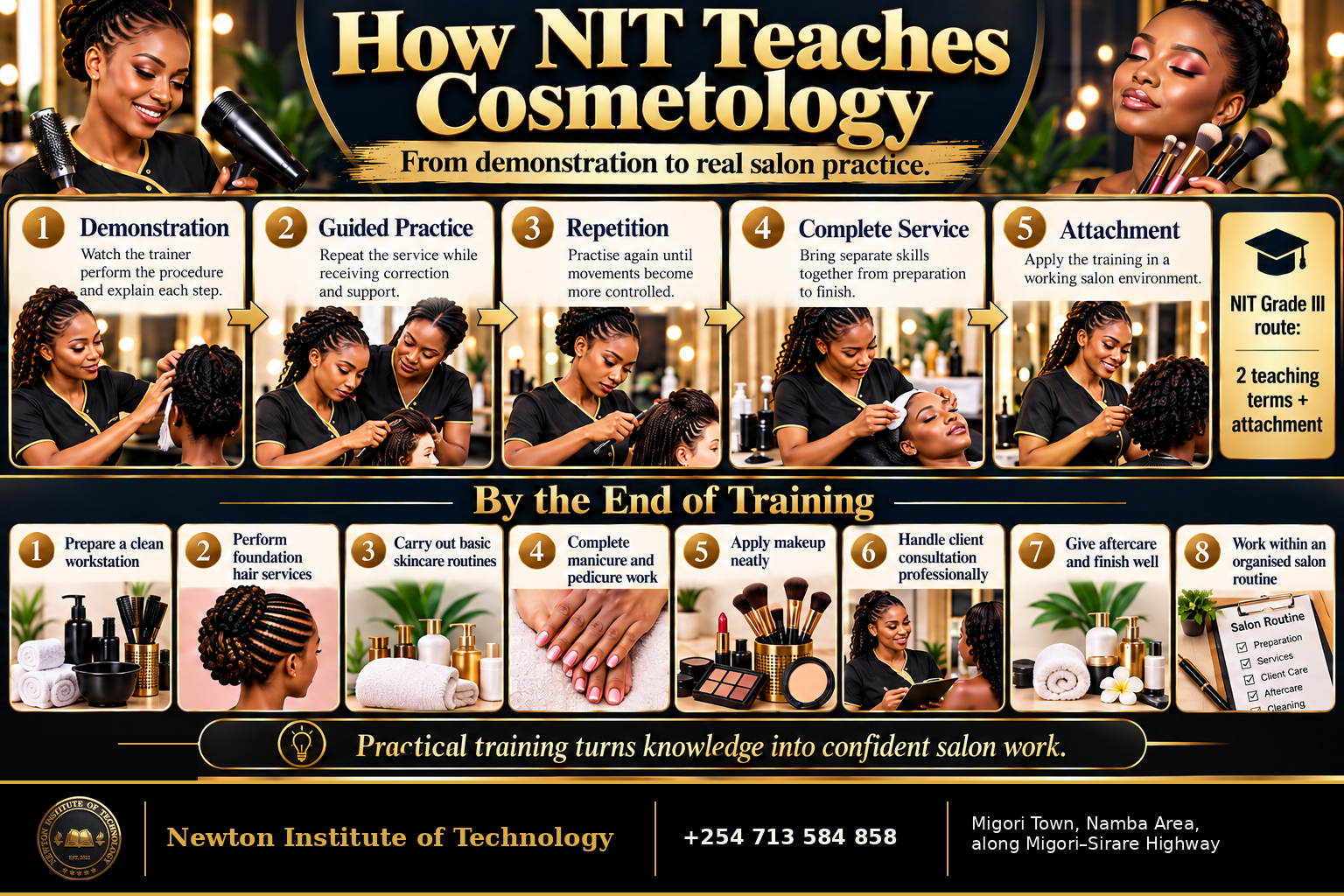
Start with the workstation
1. Salon hygiene, tools and workstation preparation
Before the first client sits down, the workstation should already be ready. Combs, brushes, towels, products and the tools required for that service need to be organised so the practitioner can begin without searching around the room.
Cosmetology training therefore starts with clean working habits: preparing tools, organising products, protecting the client, cleaning equipment after use and resetting the station for the next service. These habits carry through every Hairdressing, skincare, nail and makeup practical. NITA’s Hairdressing learning material includes hygiene standards, client consultation, product knowledge and basic salon business practice alongside technical hair skills.[2]
Prepare first
- Set out clean tools and towels
- Organise the products needed for that service
- Prepare the client and work area
- Keep the workstation uncluttered
Reset properly
- Clean the used tools and surfaces
- Return products to the right place
- Remove used materials
- Leave the station ready for the next client
Hair is one major part of the route
2. Hairdressing skills inside Cosmetology
Hairdressing develops from hair preparation into finished salon services. Learners practise shampooing, conditioning, sectioning, braiding, blow-drying, cutting, basic barbering, styling and finishing. NITA currently recognises Hairdressing as an occupational pathway across Levels 2–5.[1]
Preparation
Clean, condition and section
Good styling starts with controlled preparation. Clean sectioning, correct product use and steady handling make later work easier.
Braiding
Control pattern and tension
The aim is clean lines, consistent tension and an even finish rather than rushing through the service.
Cutting & barbering
Handle tools deliberately
Basic cutting and clipper work develop shape, balance and control around the hairline and finished style.
Styling
Finish the service neatly
Blow-drying, setting and styling bring preparation and tool control together into the final presentation.
Beauty practicals
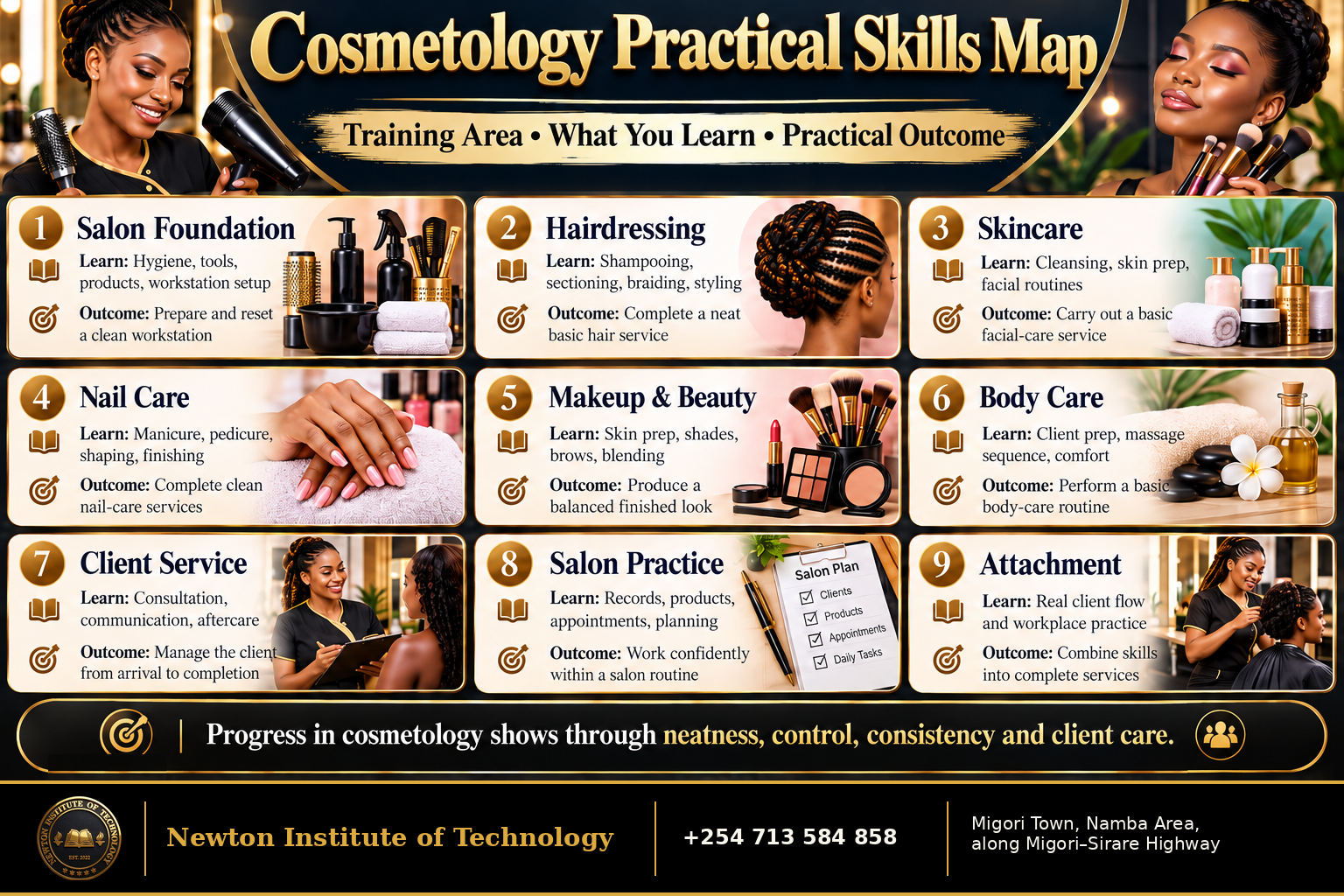
3–6. Skincare, nails, makeup and body care
The beauty side broadens the learner’s working range. NITA recognises Beauty Therapy across Levels 2–5 and also lists Beauty Therapist qualifications under its Cosmetology category.[1]
Prepare, cleanse and finish
Facial-care practice builds clean product handling, smooth service sequence and careful work around the client’s face.
Neatness before speed
Manicure and pedicure practicals develop shaping, basic cuticle care, product control and clean edges. Speed follows control.
Train colour judgement
Skin preparation, shades, foundation, brows, eyes, lips and blending teach the learner to produce a balanced complete look.
Build sequence and comfort
Basic massage introduces client preparation, positioning, movement sequence, rhythm and a comfortable working posture.
The work around the technical skill
7–8. Client consultation and salon practice
A salon professional spends much of the working day dealing with people. Before starting, the practitioner needs to understand what the client wants, explain the service clearly and organise the appointment from preparation to aftercare.
Client-service routine
Turn a request into a clear service plan
A client who says “I want braids” has started the conversation, but the practitioner still needs to clarify size, length, style and finish before beginning.
- Welcome the client and listen first
- Clarify the requested service and finish
- Prepare tools and products before starting
- Communicate professionally while working
- Give clear aftercare when the service is complete
- Record appointments, products or useful client notes
Salon organisation adds the practical habits that keep a working day moving: appointment handling, basic records, product use, stock awareness, service planning, teamwork and entrepreneurship. NITA’s Hairdressing learning material includes basic business practice as part of training for work and further development.[2]
One complete client service
Separate practicals eventually become one routine
The learner moves from practising isolated techniques to completing a service from start to finish.
That sequence is one of the clearest signs that practical training is becoming workplace-ready: the learner can organise the station, handle the client, complete the technical work and leave the area ready for the next appointment.
How we teach it at NIT
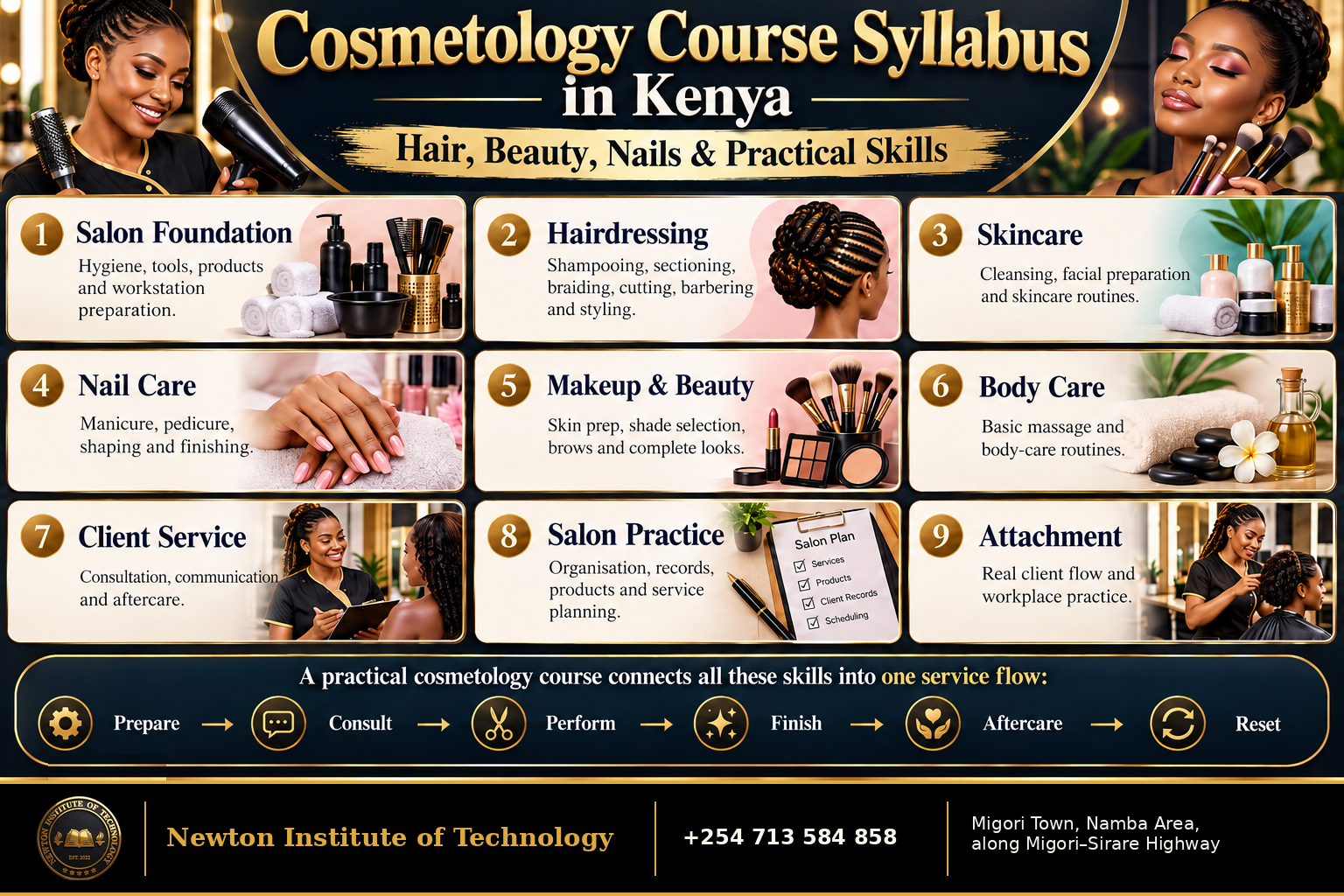
Demonstration → guided practice → repetition → complete service → attachment
At Newton Institute of Technology, practical learning begins with a trainer demonstration. Learners repeat the procedure with guidance, receive correction, practise again and gradually complete more of the service independently.
Our Grade III Cosmetology route runs for one year: two teaching terms followed by attachment.[3] The attachment stage gives the learner exposure to client flow, service timing, teamwork and everyday salon routines.
Practical training turns knowledge into confident salon work.
By the end of training
What practical ability should the learner be building?
A strong foundation is visible in the complete service, not in the number of notes written. The work should become cleaner, more controlled and more consistent each time it is practised.
- 01Prepare a clean workstation
Tools, towels and products are organised before the client is seated.
- 02Perform foundation hair services
Hair preparation, braiding, basic cutting or barbering and styling are carried out with better control.
- 03Carry out skincare routines
Facial preparation, cleansing and product application follow a clear sequence.
- 04Complete nail-care work
Manicure and pedicure services show neat shaping and finishing.
- 05Apply makeup neatly
Shade choices, brows and blending work together in a balanced finished look.
- 06Handle client consultation
The learner can clarify the service, communicate while working and give aftercare.
- 07Organise a complete service
Preparation, technical work, finishing and station reset happen as one routine.
- 08Work within a salon routine
Appointments, products, records and teamwork are handled with growing independence.
The simple distinction
Hairdressing, Beauty Therapy and Cosmetology
The difference is mainly the practical range. Cosmetology brings the two sides together rather than concentrating entirely on one area. NIT’s existing course guide describes Cosmetology as the broad option for learners who want a wider range of salon and spa skills.[5]
| Course | Main practical direction | Training range |
|---|---|---|
| Hairdressing | Hair preparation, braiding, cutting, styling, barbering and related hair services | Focused mainly on hair and scalp work |
| Beauty Therapy | Skincare, facials, nails, makeup, massage and related beauty services | Focused mainly on beauty and body-care work |
| Cosmetology | A broader combination of Hairdressing and Beauty Therapy skills | Wider multi-service salon preparation |
On a small screen, swipe sideways to view the complete table.
Cosmetology syllabus FAQs
Common questions about the course content
What subjects are taught in Cosmetology in Kenya?
Cosmetology covers Hairdressing, salon hygiene, skincare, nail care, makeup, eyebrow and beauty work, basic massage, client care, communication, salon organisation and practical workplace training.
What are the main Cosmetology course units?
The main training areas can be grouped into salon foundation, Hairdressing, skincare, nail care, makeup and beauty finishing, body care, client service, salon practice and attachment.
Is Hairdressing part of Cosmetology?
Yes. Hairdressing forms one major part of broad Cosmetology training and is combined with Beauty Therapy and related salon skills. NITA currently lists Hairdresser and Beauty Therapist qualifications within its Cosmetology category.[1]
Does Cosmetology include nail care?
Yes. Foundation nail-care training includes manicure and pedicure routines, shaping, preparation and neat finishing.
Does Cosmetology include makeup?
Yes. Makeup practicals can cover skin preparation, shade selection, foundation, brows, eyes, lips, blending and complete finished looks.
Is Cosmetology practical?
Yes. Cosmetology develops salon ability through trainer demonstrations, guided practice, repeated practicals, complete client services and workplace attachment. NITA describes its curricula as competency-based and linked to practical industrial skills.[1]
The practical picture
Cosmetology is one connected hair-and-beauty skill route
The syllabus becomes useful when the learner can move from a clean workstation to a completed client service without treating each lesson as an isolated exercise. Hair, skin, nails, makeup, client care and salon organisation then begin to work together as one professional routine.
Train with us
Register for Cosmetology training at Newton Institute of Technology
Build practical ability across Hairdressing, Beauty Therapy, nails, makeup, client care and salon practice, then continue into attachment as part of the Grade III training route.
Call or WhatsApp+254 713 584 858
LocationMigori Town, Namba Area · along Migori–Sirare Highway
ApplicationsContinuous intakes
References and source checks
- National Industrial Training Authority (NITA). Catalogue of NITA Curricula. Used for the current Hairdressing and Beauty Therapy occupational pathways and the Cosmetology category. Accessed 11 October 2026. nita.go.ke.
- National Industrial Training Authority (NITA). NITA e-Learning — Hair Dressing. Used for foundational Hairdressing training areas including practical skills, consultation, hygiene, product knowledge and business practice. Accessed 11 October 2026. learn.nita.go.ke.
- Newton Institute of Technology. Hairdressing Course Fees in Kenya. Used for the current NIT Grade III Hairdressing, Beauty Therapy and Cosmetology training structure of two teaching terms followed by attachment. Accessed 11 October 2026. niteducation.com.
- Newton Institute of Technology. NITA Hairdressing and Beauty Therapy Grades Explained. Used for the current NIT Grade III training context and the three NIT hair-and-beauty routes. Accessed 11 October 2026. niteducation.com.
- Newton Institute of Technology. Hairdressing and Beauty Therapy Courses in Kenya. Used for the distinction between Hairdressing, Beauty Therapy and the broader Cosmetology route. Accessed 11 October 2026. niteducation.com.
Prepared by: Newton Institute of Technology Editorial Team · Institutional / Technical review: Engineer Simon Barongo · Evidence checked: 11 October 2026.