

Plant Operator Pre-Start Guide Kenya · 2026
Plant Operator Pre-Start
Inspection Checklist
Inspect · record · decide
A practical pre-start inspection routine for plant operators in Kenya, with a free printable checklist for the work area, machine condition, hydraulics, cab, controls and defect decisions.
Before the machine moves
What should a plant operator check before starting?
Review the previous shift’s handover, check the work area, walk around the machine, inspect tyres or tracks, attachments and hydraulics, check the required fluids and cab safety equipment, then complete the required start-up and functional checks in a clear area.
If everything required is satisfactory, record the inspection and continue. If something is wrong, record the defect and follow the workplace reporting procedure before using the machine.
Free printable resource
Download the plant operator pre-start inspection checklist
The printable form is designed for learners and working operators who need a clear record beside the machine. It covers the handover, work area, walk-around, running gear, attachments, hydraulics, engine and fluids, cab and safety systems, start-up checks, defect reporting and the final operating decision.
Print it and take it to the machine
- Machine, site, shift and operator details.
- OK · DEFECT · N/A inspection boxes.
- Remarks and defect-description space.
- Safe-to-operate or keep-isolated decision.
The form does not replace the machine manual
- Use the manufacturer’s handbook for machine-specific limits and checking methods.
- Follow the site’s approved inspection and defect-reporting procedure.
- Do not guess tyre pressure, track tension or component limits.
- Never use your bare hand to search for a pressurised hydraulic leak.
Kenya’s Category G curriculum includes a daily or pre-shift inspection carried out in accordance with the manufacturer’s handbook.
Visual checklist
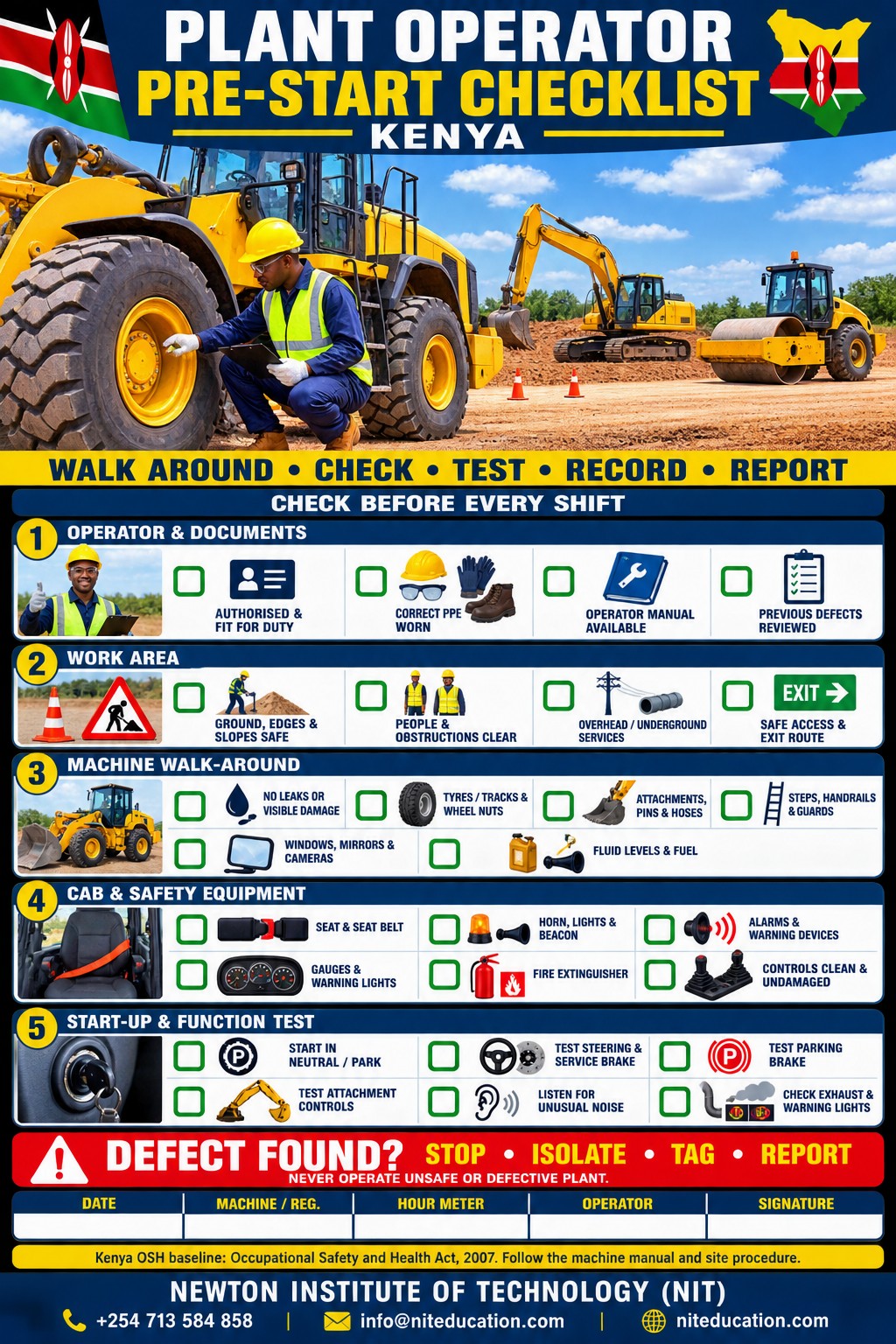
Plant operator pre-start checklist infographic
Use this visual as a quick reminder of the inspection sequence before a machine goes to work. For the writable inspection record, use the printable PDF above.
A repeatable routine
Use a simple 7-zone pre-start inspection route
Using roughly the same route each shift helps an operator avoid random checking. Clockwise or anticlockwise is less important than having a routine you can repeat without forgetting a section.
- Handover & work area
Previous defects, today’s task, people, traffic, ground, edges and services.
- Ground & walk-around
Leaks, damage, loose parts, guards, access and obstructions.
- Tyres or tracks
Running gear and any obvious abnormal condition.
- Attachment & hydraulics
Attachment security, pins, locking devices, hoses and cylinders.
- Engine & fluids
Required fluid levels and visible engine-bay condition.
- Cab & safety
Access, restraint, protective structure, visibility and warning devices.
- Start-up & function
Gauges, warnings, brakes, steering and operating controls.
Start before the ignition key
Review the handover, then look at the work area
Before walking around the machine, find out what happened on the previous shift. A clean-looking machine does not cancel an unresolved defect.
Know what changed before you arrived
- Was a fault or slow leak reported?
- Was an attachment changed?
- Did maintenance or repair work take place?
- Was the machine parked because of an unresolved defect?
The site may have changed overnight
- People, moving plant and reversing routes.
- Excavations, edges, slopes and soft ground.
- Overhead or underground services where relevant.
- Restricted spaces, lighting, rain, dust and visibility.
Is the machine ready? Is the place I am about to operate it in ready?
Outside the cab
Walk around the machine before climbing in
Start low. Look beneath the machine for fresh oil, fuel, coolant or hydraulic fluid. Notice anything hanging, loose, damaged or sitting somewhere it normally should not. Then continue around the machine, checking guards, covers, attachment condition, visible retaining parts, steps and handholds.
The useful habit is noticing what has changed since the machine last operated normally.
Look underneath first
Fresh fluid, debris or an obstruction beneath the machine can be the first sign that something needs attention.
Tyres and wheels
Look for deep cuts, bulges, severe wear, obvious damage and visible fastening problems. Use the machine’s specified pressure method and limits.
Tracks and undercarriage
Check for damaged or displaced parts and packed material that may interfere with operation. Use the manufacturer’s track-tension procedure.
Steps, guards and handholds
Mud, oil, loose material or damaged access points can create a problem before the operator even reaches the seat.
Attachment and hydraulic checks
Check the parts that will carry load and pressure
Buckets, blades, forks and other attachments should be checked before they are loaded or raised. Look at the attachment, mounting points, pins, retainers, locking components, linkages and any quick-coupler system fitted.
Confirm security
If the machine has a specific attachment-lock confirmation procedure, use it. A quick visual glance is not a substitute for the specified check.
Look for abnormal condition
Watch for cuts, severe rubbing, crushed hose sections, bulges, wet fittings, damaged cylinders and visible fresh leakage.
A tiny pressurised hydraulic leak can cause a serious injection injury. If you suspect a pressurised leak, keep clear, shut down or isolate the equipment as instructed and report it.
Engine, cab and function
Check fluids, safe access, the cab and the machine’s response
The exact fluid checks depend on the machine. They may include engine oil, coolant, hydraulic fluid and fuel. Use the manufacturer’s procedure because checking conditions are not universal. Never open a hot pressurised cooling system simply because coolant appears on a checklist.
Follow the specified method
Look for damaged hoses, visible belt problems, loose wiring, contamination, significant debris or fresh leakage while checking the required fluid levels.
Prepare the operator position
Check the seat, restraint, mirrors, windows, cameras, wipers and washers where fitted or required for safe visibility.
Look for obvious damage
ROPS/FOPS or another protective cab structure should show no obvious visible damage. Technical assessment belongs with an appropriately competent person.
Check what the machine and site require
Horn, lights, beacon, reversing warning, fire extinguisher and emergency-stop or isolation devices should be checked where fitted or required.
Start-up and functional checks
Start the machine using the correct procedure. Watch the gauges and warning indicators. Listen for unexpected noise, and notice smoke, smell, vibration or movement that does not seem normal.
Use the machine’s normal starting procedure with controls in the required safe position.
Do not treat an unfamiliar warning as part of the dashboard scenery.
Unexpected noise, smoke, smell, vibration or movement is information.
In a suitable clear area, confirm steering, brakes, operating controls and attachment response where required.
The inspection ends with a decision
A defect changes what happens next
Not every mark on a machine puts it out of service. A scratched panel is not the same as failed brakes. The operator does not have to diagnose every mechanical fault, but should recognise when something is abnormal and make sure the problem is not hidden by starting work.
| Condition found | Operator action |
|---|---|
| Brakes or steering do not respond normally | Do not continue into work. Record and report the defect. |
| Attachment or locking device is insecure | Keep the machine out of service until an authorised decision. |
| Significant structural or protective-structure damage | Stop and report it. Do not assume the damage is cosmetic. |
| Active hazardous fuel, coolant or hydraulic leak | Keep clear, isolate as instructed and report. |
| Tyre, track or undercarriage condition appears unsafe | Do not operate until it has been assessed through the site’s procedure. |
| Required restraint, warning, emergency or safety system fails | Do not improvise around the failure. Report it. |
| Unfamiliar warning, abnormal smoke, vibration or movement | Stop and have the condition explained before work begins. |
Useful defect descriptions include “Hydraulic hose beside bucket cylinder wet around fitting”, “Left rear tyre has deep sidewall cut” and “Reversing alarm does not sound when tested”. Record the machine, date and time, fault location, what was observed, who received the report and the decision made about the equipment.
Do not sign for an inspection you did not complete.
Keep the jobs separate
Pre-start inspection is not the same as maintenance
Can this machine safely go to work now?
- Condition and safety before operation.
- Find and record abnormal conditions.
- Make the correct operator decision before movement.
Servicing, adjustment and longer-term machine condition
- Scheduled servicing and lubrication.
- Technical adjustment, replacement and repairs.
- Work carried out within the person’s authority and competence.
An operator who finds a problem is not automatically authorised or competent to repair it. For servicing and preventive-maintenance information, use NIT’s Heavy Machinery Maintenance in Kenya guide.
Adapt the general route
Machine-specific checks still matter
A general inspection route can be reused, but the final checklist should reflect the machine.
| Machine | Additional areas commonly requiring attention |
|---|---|
| Track Shovel | Tracks, loader arms, bucket/linkage and work surface. |
| Wheel Shovel | Tyres, articulation area, loader linkage and bucket. |
| Bulldozer | Tracks, blade, push arms and ripper where fitted. |
| Excavator | Boom, arm, bucket, coupler, tracks and swing area. |
| Motor Grader | Blade/mouldboard, articulation, steering and tyres. |
| Motor Roller | Drum, scrapers, vibration system and tyres where fitted. |
| Backhoe Loader | Front loader, rear digging equipment, stabilisers and tyres. |
| Dumper | Body, tipping system, tailgate and tyres. |
| Crane | Lifting components, outriggers and machine-specific safety systems. |
| Forklift | Forks, mast, chains, tyres and load-handling safety systems. |
| Tele Handler | Boom, attachment, tyres and stabilisers where fitted. |
| Farm Tractor | Tyres, hitch, PTO guarding, implement and braking system. |
| Top Loader | Lifting attachment, mast/boom system, tyres and load-handling components. |
| Reach Stacker | Telescopic boom, spreader, twist-lock system, tyres and load-handling systems. |
The table deliberately does not repeat G1–G14 licence codes. For licensing and endorsement information, use NIT’s NTSA Category G Plant Operator Licence in Kenya guide.
Use the checklist to learn
A trainee should do more than tick boxes
Instead of saying “Hydraulic hose — OK”, point to the hose and explain what you checked: cuts, rubbing, crushing, bulges, wet fittings or visible leakage. Do the same with tyres, tracks, pins, guards, mirrors and warning devices.
Common pre-start inspection mistakes
| Common mistake | Better approach |
|---|---|
| Going straight to the cab | Start with the handover and work area. |
| Ignoring an earlier defect | Confirm whether it was cleared. |
| Walking around without a route | Use a repeatable inspection sequence. |
| Ticking from memory | Look at the actual component. |
| Feeling for a hydraulic leak | Keep hands away from suspected pressurised leaks. |
| Guessing pressure or tension limits | Use the machine’s specified values and procedure. |
| Ignoring a failed warning device | Record and report the failure. |
| Assuming a fresh leak is normal | Treat unexplained leakage as a defect. |
| Repairing beyond your competence | Follow the authorised reporting and maintenance process. |
| Signing before finishing | Record only what you actually inspected. |
Take enough time to complete the inspection properly. A hurried walk-around defeats the reason for doing one.
Frequently asked questions
Plant operator pre-start inspection FAQs
Is a pre-start inspection required every day?
Kenya’s Category G curriculum refers to a daily or pre-shift inspection carried out according to the manufacturer’s handbook. The workplace and machine-specific procedure should determine the exact frequency and items. A new check may also be needed after repairs, attachment changes, relocation, a change of operator, an incident or a major change in site conditions.
Can an operator use a machine after finding a defect?
It depends on the defect and the workplace’s authorised decision process. A minor cosmetic mark is different from failed steering, ineffective brakes, an insecure attachment or a hazardous leak. Where a defect may affect safe operation, report it before putting the machine to work.
Is this an official NTSA inspection checklist?
No. This is an NIT educational and general workplace inspection form. Kenya’s Category G curriculum requires daily or pre-shift inspection in accordance with the manufacturer’s handbook, but it does not prescribe this exact NIT form as the universal official checklist.
Can this checklist be used during plant-operator training?
Yes. It is particularly useful beside a machine with an instructor because the learner can point to each component, explain the check and state what action should follow if the item fails. It does not replace supervised practical training.
Can the same checklist be used for an excavator, forklift and crane?
The basic inspection route can. The final machine-specific items cannot always be identical. An excavator has boom, swing and coupler considerations; a forklift has forks, mast and load-handling systems; and a crane requires additional lifting-related inspection requirements. Use the general form as the starting point, then add the manufacturer’s requirements.
Before the machine moves
The useful part of the inspection is the problem found while the machine is still standing still
A damaged tyre is easier to deal with before the machine carries a load. A hydraulic leak is better found before the system is working hard. A failed warning device is better discovered before people are moving behind the machine.
Check first. Then decide whether the machine should move.
Prepared by: Newton Institute of Technology Editorial Team · Institutional / Technical review: Engineer Simon Barongo · Updated: 3 September 2026.
Technical basis: Kenya’s Category G curriculum requires a daily or pre-shift inspection in accordance with the manufacturer’s handbook. Read the Traffic (Driving Schools, Driving Instructors and Driving Licences) Rules.
Related NIT guides: Plant Operator Training Materials · Plant Operator Safety Rules · Heavy Machinery Maintenance · Category G Licence Guide.