

NIT Wheel Shovel Training Guide Kenya · G2
Wheel Shovel Training
in Kenya
G2 · wheel loader · loading skill · jobs
A practical guide to G2 wheel shovel training in Kenya: requirements, two-month NIT training, stockpile loading, truck loading, safety, attachment and wheel-loader job searches.
Material handling · one repeatable cycle
What is G2 wheel shovel operator training?
G2 wheel shovel training prepares a learner to inspect, manoeuvre and work with a rubber-tyred front-loading machine. The same machine is commonly called a wheel loader in workplaces and job advertisements.
At Newton Institute of Technology, plant-operator training runs for two months and is approximately 70% practical and 30% theory. A learner can select Wheel Shovel within the available multi-machine package.
Visual guide
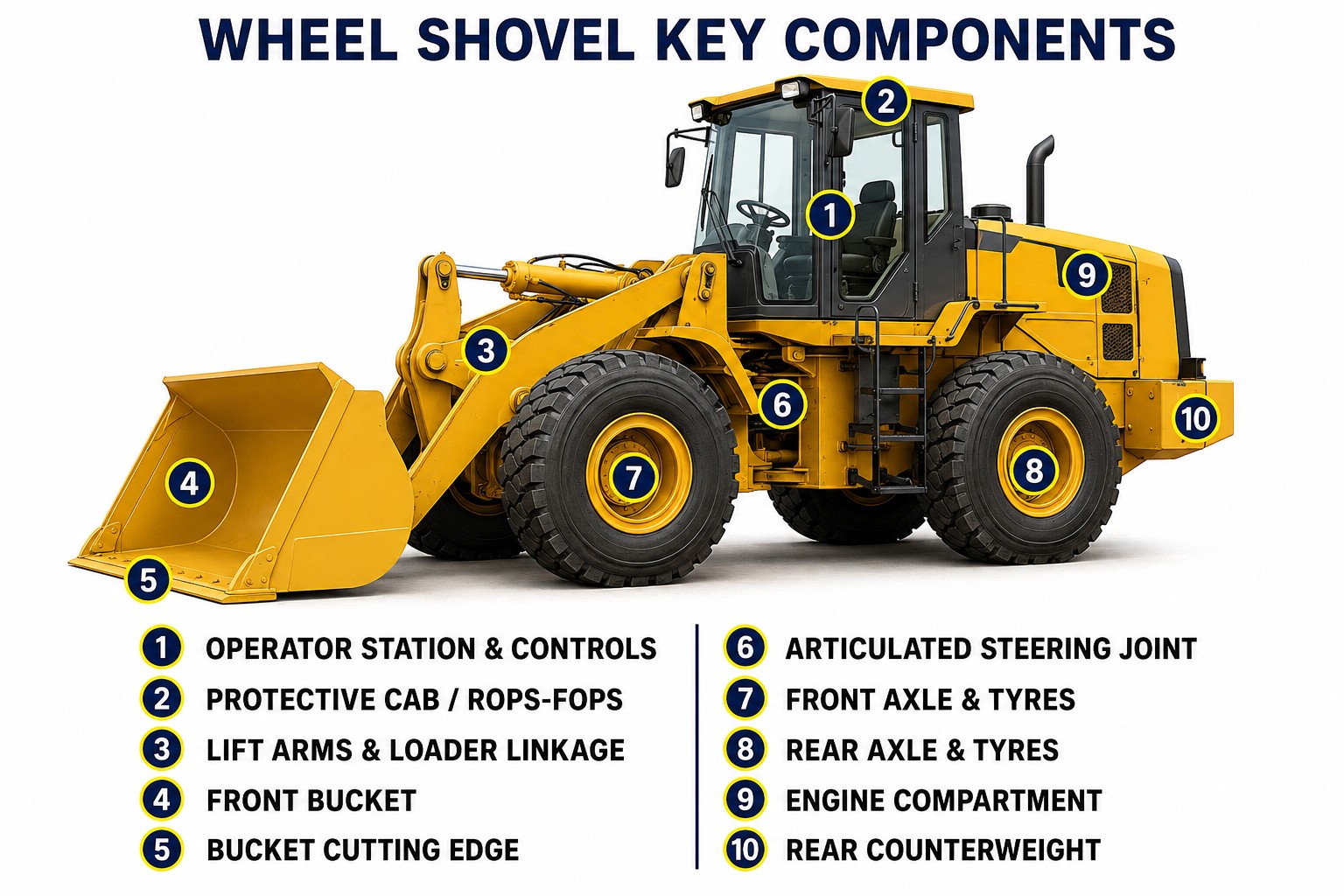
Wheel shovel key components
This is a G2 machine visual. It identifies the operator station, protective cab, lift arms, front bucket, cutting edge, articulation joint, axles, engine compartment and rear counterweight.
G2 training infographic
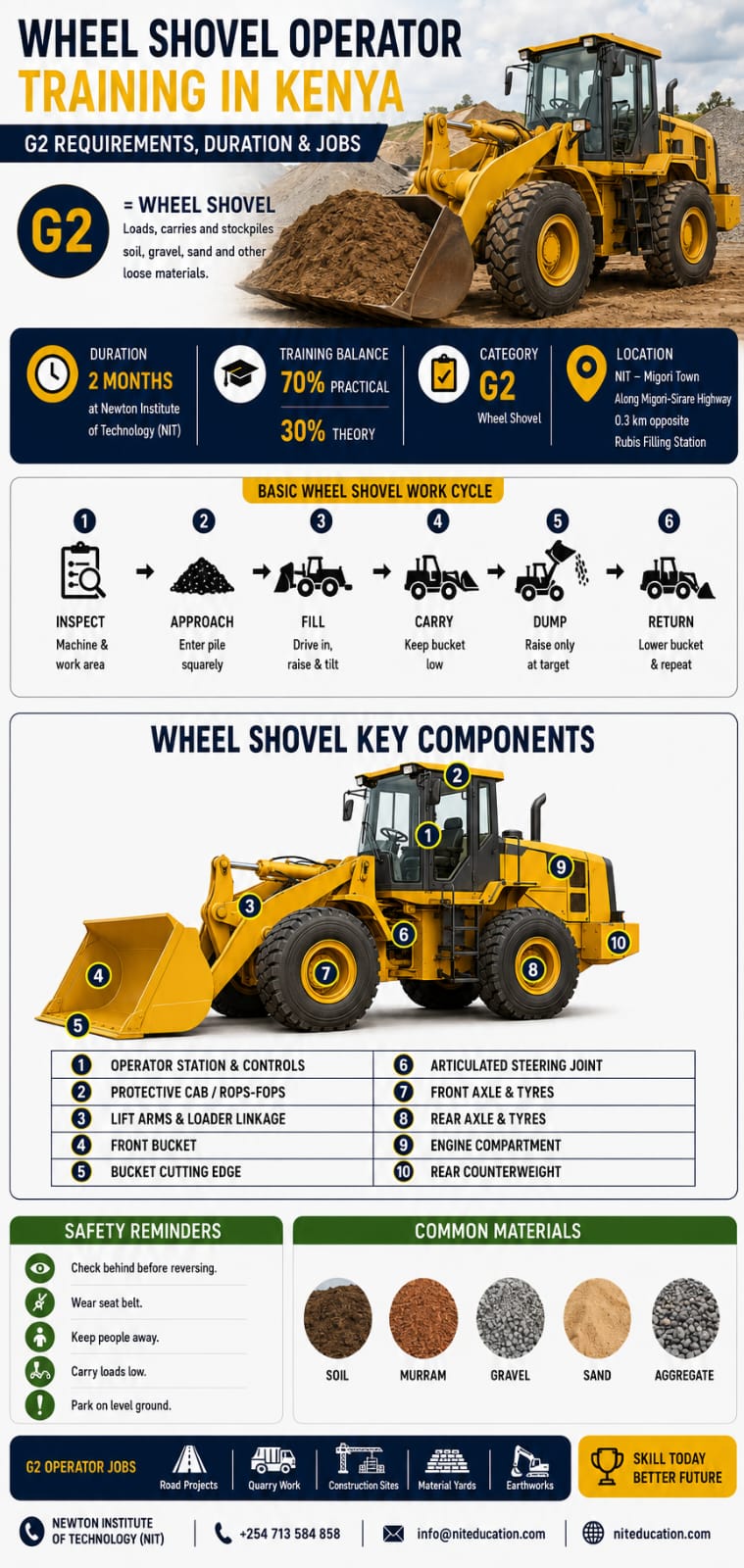
G2 Wheel Shovel (Wheel Loader) Operator Training in Kenya
This infographic brings together the G2 machine identity, operating cycle, training structure, licensing pathway, safety points and common job directions in one visual reference.
Machine role
Wheel shovel or wheel loader: what does a G2 operator actually do?
On a busy site, a wheel shovel rarely stays still for long. It enters a stockpile, fills the bucket, reverses, travels towards a truck, hopper or placement area, tips the material and returns for another load.
The Category G name is Wheel Shovel. In workplaces and job advertisements, Wheel Loader is also widely used. Knowing both terms matters because the licence language and the vacancy title may not be identical.
What the machine repeats
- Approach the material under control.
- Fill and curl the front bucket.
- Reverse with awareness of the changed work area.
- Carry material with the bucket in a sensible travel position.
- Dump accurately and set up the next cycle.
What separates control from competence
- Reading the stockpile before entry.
- Watching people, trucks and other machines.
- Avoiding unnecessary wheel spin and rough inputs.
- Keeping the working face usable for later cycles.
- Recognising when a defect or unsafe condition needs reporting.
Entry and licensing route
G2 wheel shovel training requirements in Kenya
For NIT’s Category G pathway, a learner completes a valid Class B driving licence before progressing to the plant-operator endorsement route. G2 is then selected as the Wheel Shovel machine category.
The school builds machine competence. The applicable assessment and licensing process leads to the Category G endorsement. For the detailed national and institutional pathway, use NIT’s dedicated Category G licensing guide.
Complete Class B first
NIT’s plant-operator pathway uses a valid Class B licence before the Category G progression.
Select Wheel Shovel
If G2 is your priority, confirm that Wheel Shovel is available for your intended intake before payment.
Be ready to practise
Coordination, observation and safe control develop through repeated supervised machine time.
Build repeatable competence
The aim is deliberate, safe control—not simply memorising the names of controls.
- Class B
Complete a valid Class B driving licence for the NIT route.
- Select G2
Choose Wheel Shovel in the applicable machine-selection process.
- Train
Build supervised practical wheel-loader skill.
- Assessment
Complete the applicable practical and licensing requirements.
- Endorsement
Proceed through the approved Category G endorsement process.
Read the full NTSA Category G Plant Operator Licence in Kenya guide for the broader licensing framework.
Time and cost
How long does wheel shovel training take, and what does NIT charge?
At Newton Institute of Technology, the plant-operator programme currently runs for two months. Wheel Shovel can be included among the machines selected within the learner’s package.
NIT’s current plant-operator training balance is approximately 70% practical and 30% theory.
| Package | Current NIT training fee | What to confirm |
|---|---|---|
| 4 machines | KSh 65,000 | Confirm G2 is one of your selected machines. |
| 5 machines | KSh 78,000 | Check machine availability for your intake. |
| 6 machines | KSh 89,000 | Keep government licensing/assessment charges separate. |
Ask how much meaningful supervised machine time you will receive. Recognising controls in class is not the same as repeatedly approaching a stockpile, filling the bucket, correcting a poor cycle and trying again.
For the broader cost breakdown, see NIT’s Plant Operator Course Fees in Kenya guide.
Practical training
What you learn during G2 wheel loader training
Pre-start walk-around
Check tyres, visible leaks, hoses, bucket, cutting edge, mirrors, access points and obvious damage before work begins.
Steering and hydraulics
Build smooth control of direction, braking, loader-arm movement and bucket tilt without fighting the machine.
Approach and scoop
Learn alignment, sensible momentum and bucket control so the machine fills productively without unnecessary wheel spin.
Carry the load safely
Use an appropriate bucket travel position and match speed to visibility, traffic and ground conditions.
Truck and hopper loading
Judge approach angle, clearance, dumping height, load placement and the reversing path for the next cycle.
Blind-spot awareness
Recheck the area before moving backwards and use mirrors, visibility aids and site communication procedures properly.
The wheel shovel steers by bending around its centre articulation joint. That gives the machine manoeuvrability but creates a serious crush area and changes the space occupied by the machine during a turn.
From the training yard
Mistakes beginners commonly need to correct
Some mistakes feel productive to a new learner because the machine is making noise and moving quickly. The operating result tells a different story.
More throttle is not better technique
- Rushing the pile with a poor approach angle.
- Spinning the tyres while the bucket still fills badly.
- Making large hydraulic corrections too late.
- Leaving an awkward working face for the next cycle.
Watch the whole machine, not only the bucket
- Travelling with the loaded bucket unnecessarily high.
- Turning sharply without considering machine balance.
- Starting to reverse before rechecking the changed work area.
- Ignoring people or equipment entering a blind spot.
Worksite awareness
Reversing, articulation and stockpile management
Check again before moving
The path that was clear a moment ago may no longer be clear after the bucket has been in the stockpile.
Protect the crush zone
No one should position themselves in the centre articulation area while the machine is capable of movement.
Think several cycles ahead
Good operators avoid creating an unstable or awkward face that makes the next load harder or less safe.
Notice changes early
Unusual noise, leaks, warning lights, steering changes, tyre damage or weak braking should be reported according to site procedure.
Employment language
Wheel loader operator jobs in Kenya
G2 skills are useful wherever loose or bulk material has to be loaded, carried or stockpiled repeatedly. The job title often uses Wheel Loader Operator rather than Wheel Shovel Operator.
Building and civil works
Load soil, sand, ballast, hardcore and other site materials.
Aggregate and stockpiles
Manage stockpiles and load trucks or processing areas.
Manufacturing and terminals
Move bulk raw materials between storage, processing and loading points.
Road and infrastructure projects
Support earthworks and repeated material movement during civil works.
| What employers look for | Why it matters | How training helps |
|---|---|---|
| Correct licensing | Shows the machine category is properly covered. | Understand the G2 route and required endorsement process. |
| Pre-start inspection | Reduces avoidable equipment and site risk. | Repeat the walk-around until it becomes routine. |
| Practical loading skill | Productivity depends on controlled, repeatable cycles. | Practise stockpile entry, carrying and accurate dumping. |
| Safe reversing | Wheel loaders repeatedly move backwards around people and equipment. | Build mirror, blind-spot and communication habits. |
| Basic maintenance awareness | Operators are often first to notice a developing defect. | Learn what must be reported rather than ignored. |
Search for Wheel Loader Operator, Wheel Shovel Operator, Shovel Operator, Front-End Loader Operator, Plant Operator and relevant Heavy Equipment Operator vacancies. Read the actual machine requirement inside each vacancy.
For broader career guidance, use NIT’s Plant Operator Jobs in Kenya guide.
Workplace transition
Industrial attachment turns a training cycle into worksite judgement
A training yard lets a learner practise in a controlled environment. A live workplace adds truck movements, changing ground conditions, production pressure, communication and other equipment operating nearby.
NIT provides industrial attachment support for eligible learners, subject to placement arrangements. For G2, that exposure helps the learner understand why stockpile shape, reversing checks, truck positioning and consistent loading cycles matter over an entire shift.
Machine comparison
G2 compared with other common plant machines
| Machine | Category | Main distinction |
|---|---|---|
| Track Shovel | G1 | Front loader running on crawler tracks. |
| Wheel Shovel | G2 | Tyred front loader built around fast material handling and repeated loading cycles. |
| Excavator | G4 | Boom-and-stick machine primarily used for digging and excavation. |
| Backhoe Loader | G7 | Front loader combined with a rear excavating attachment. |
A person trained on one machine should not assume that competence automatically transfers to another. Controls, visibility, balance and working cycles differ.
Before enrolment
Questions worth asking before choosing G2 training
Check the practical structure
- How much supervised operating time will I personally receive?
- Will I practise actual material loading?
- Will pre-start inspection be demonstrated and assessed?
- Will reversing and blind-spot awareness be practised?
Compare the whole package
- Is G2 available for my intake?
- How many machines are included in the quoted fee?
- Which licensing or government charges are separate?
- How is the Category G pathway explained before payment?
Frequently asked questions
G2 wheel shovel training FAQs
What is G2 in Kenya?
G2 is the Category G designation used for Wheel Shovel.
Is a wheel shovel the same as a wheel loader?
The terms are commonly used for the same general rubber-tyred front-loading machine. Wheel Shovel is the G2 terminology, while Wheel Loader is widely used in workplaces and job advertisements.
How long does wheel shovel training take at NIT?
NIT’s current plant-operator programme runs for two months.
How much does wheel shovel training cost at NIT?
G2 is selected within NIT’s multi-machine plant-operator packages: KSh 65,000 for four machines, KSh 78,000 for five machines and KSh 89,000 for six machines. Applicable government charges are separate.
Do I need a Class B driving licence before G2?
NIT’s plant-operator pathway uses a valid Class B driving licence before progression to the Category G endorsement route.
What work does a wheel shovel operator do?
Typical work includes stockpile loading, moving loose material over short distances, loading trucks or hoppers and carrying out routine operator checks.
Where can wheel loader operators work?
Possible workplaces include construction projects, road works, quarries, aggregate yards, manufacturing operations, industrial terminals and other sites handling bulk material.
What is the difference between G1 and G2?
G1 is Track Shovel and G2 is Wheel Shovel. The track shovel runs on crawler tracks while the wheel shovel runs on tyres.
What job titles should a G2 operator search for?
Useful searches include Wheel Loader Operator, Wheel Shovel Operator, Shovel Operator, Front-End Loader Operator and relevant Plant Operator vacancies.
Final takeaway
G2 is written as Wheel Shovel; employers may call the same skill Wheel Loader
Useful training should move the learner from simply controlling the machine to noticing the stockpile approach, bucket fill, load position, truck setup and the work area behind the loader before reversing. Know both names, understand the licensing route and focus most on becoming competent with the machine.
Train at NIT
Ask about the next G2 wheel shovel intake
Newton Institute of Technology offers two-month plant-operator training in Migori, with approximately 70% practical work and 30% theory. Confirm G2 machine availability and the package that fits the number of machines you want to train on.
Prepared by: Newton Institute of Technology Editorial Team · Institutional / Technical review: Engineer Simon Barongo · Updated: 2 September 2026.
Related NIT guides: Category G licence · course fees · operator jobs · machine marketability.