

NIT Employment Outlook Kenya · 2026
Kenya Job Market
Trends
Hiring · industries · employment shifts
Where economic activity is growing, how employers are recruiting and why most recent job creation is not permanent salaried work.
Read the whole market
Is Kenya’s job market improving in 2026?
Yes, but not evenly. Economic growth strengthened in the first quarter and private-sector activity expanded in July. At the same time, most recent job creation has been informal, some new hiring has been temporary, and formal vacancies still attract heavy competition.
Two views of one economy
A job board shows only part of Kenya’s labour market
A job-board search and a walk through a busy Kenyan town can seem to describe two different labour markets.
Online, the visible vacancies are for accountants, developers, managers and other professional roles. Away from the large platforms, people find work through building sites, farms, workshops, salons, shops, restaurants, transport businesses and personal referrals.
Both views are real. Neither tells the whole story. The economy can create hundreds of thousands of jobs while competition for a formal monthly salary remains fierce.
Start with the evidence
Four datasets—and four different questions
Job-market figures often come from different periods and measure different things. Mixing them together can produce a confident but misleading forecast.
Shows employment and industry performance across 2025. It is the best source here for the formal-informal structure.
Shows which parts of the economy expanded early in 2026. Output growth is not the same as vacancy growth.
Provides a recent signal on business activity and employment, but it does not cover the whole informal or public sector.
Shows occupations and qualifications visible in advertised jobs—not all work recruited through local networks.
A learner may browse hundreds of formal adverts and assume the whole market requires a degree, even though most recent job creation happened elsewhere.
The 2026 direction
Growth is continuing, but employers remain cautious
Kenya’s economy grew by 4.6% in 2025. It then expanded by 5.3% in the first quarter of 2026, compared with 4.9% in the same quarter a year earlier.
The full-year view is less certain. The World Bank’s July update projected 4.3% growth for 2026, while the Kenyan government maintained a forecast of about 5.0%. The practical message is not which estimate wins: growth is continuing, but under real pressure.
Private-sector activity contracted for three consecutive months before stabilising in June. The PMI then moved from 50.0 in June to 51.3 in July. July also recorded the survey’s fastest employment growth so far in 2026, although much of it involved short-term workers.
What is improving
- First-quarter GDP growth strengthened to 5.3%.
- Private-sector activity returned to expansion in July.
- The July survey recorded its fastest employment growth so far in 2026.
- Hospitality, construction, finance and information services have shown growth.
Why hiring is still difficult
- Much of July’s employment increase involved short-term workers.
- Transport, supplies, inflation and cash flow still affect business decisions.
- Formal vacancies draw large numbers of applicants.
- Sector growth does not guarantee that every employer is adding staff.
Seven areas to watch
Industries showing stronger opportunity signals
An industry can increase output through technology, overtime or better equipment without employing large numbers of new people. These sectors are included because several indicators point in the same direction—not because a job is guaranteed.
Accommodation & food
Growth reached 15.6% in 2025. Opportunities extend beyond hotels to restaurants, catering, events, housekeeping and travel services.
Strong growth · seasonal hiringConstruction
The sector returned to growth of about 6.8%. Engineers may use formal platforms, while artisans and operators often enter through contractors and site networks.
Projects · contracts · site workFinance & insurance
Activity grew by 6.5% in 2025 and 6.3% in the first quarter of 2026. Digital systems, customer acquisition, risk and compliance remain central.
Digital · regulated · analyticalICT & digital services
Information and communication grew by 4.8% in 2025 and 5.0% in early 2026. Demand is spread through finance, health, retail, education and government.
Cross-sector · portfolio evidenceManufacturing
Vacancy evidence connects production with engineering, maintenance, quality, logistics, finance and sales. Location and value chains matter.
Production · quality · logisticsAgriculture & agribusiness
The stronger route connects production with records, finance, storage, processing, distribution and buyers—not farming alone.
Value chains · county economiesProfessional support
Businesses still need work to be sold, scheduled, recorded, paid for and delivered. Smaller employers may combine several duties in one role.
Administration · customers · recordsThe Ministry of Labour’s employability research found that manufacturing produced the highest vacancy volume among the agriculture, manufacturing and construction sectors it studied. Demand covered technical, administrative, financial and commercial work.
How people enter work
Four employment shifts changing recruitment
Contracts, attachments and assignments
People now enter work through internships, temporary contracts, commissions, subcontracting, freelancing, family enterprises and self-employment. Clear payment and duration terms matter more than the label.
Proof carries more weight
A portfolio, practical test, attachment record, licence, completed installation, customer result or reference shows how someone handles real work.
Technical work is also commercial
A technician may prepare a quotation; a farm manager may need buyer relationships; a developer may need to understand the customer’s workflow.
Short-term hiring may rise first
When orders improve but confidence remains weak, employers can add temporary workers before permanent staff. Keep a record of the work and request a verifiable reference.
Location changes the opportunity
Are serious opportunities limited to Nairobi?
Nairobi has Kenya’s largest concentration of formal corporate vacancies, technology firms, finance and national organisations. That visibility can make it appear as though all good work is in the capital. The national market is broader.
What Nairobi concentrates
- Corporate and professional vacancies
- Technology and financial firms
- National organisations and headquarters
- Large job-platform applicant pools
What follows local activity
- Construction follows projects
- Agriculture and processing follow production
- Hospitality follows towns, travel and events
- Trade, repair and personal services exist in every county
Rent, transport, food and commuting time can change the value of a Nairobi offer. A smaller income closer to home may leave more money or make it easier to build a client base.
Different starting points
What the outlook means for you
School leavers
Start with the work—not a growth percentage
Confirm what the course prepares you to perform, how practical training works and whether the occupation requires licensing or registration.
University and TVET graduates
Turn the qualification into evidence
Keep labelled projects, attachment records, licences, references and completed work. Use professional, alumni, contractor and county networks as well as job websites.
Career changers
Make an adjacent move
A bookkeeper can add data skills; an electrician can learn solar systems; a salesperson can enter a technical industry without discarding existing experience.
Self-employed workers
Informal should not mean disorganised
Record income and costs, price transport and materials correctly, separate sales from profit and build repeat customers.
After identifying a realistic sector, compare the practical routes in Most Employable Skills in Kenya in 2026.
Do not stretch the statistic
Five job-market claims to treat with caution
“Growth guarantees a job”
Technology, overtime and equipment can raise output without equal staff growth.
“Adverts show the whole market”
Much local and informal recruitment never reaches a national job platform.
“Informal means unemployed”
Informal work is real; the concern is uncertain pay, continuity and protection.
“Any digital course leads remote”
Remote clients still require credible output, communication and reliability.
“Most advertised means best”
A busy vacancy category may also have intense competition or expensive entry.
Move from trends to action
Seven steps for a realistic employment plan
Begin with the work itself, not the course title or a national “top jobs” list.
- Identify two or three industries operating within a realistic travelling distance.
- Check whether they recruit through adverts, contractors, referrals, attachments or customers.
- Separate permanent jobs from temporary, commission-based and self-employed routes.
- Confirm the qualification, licence and practical evidence required for entry.
- Inspect training before paying and ask what learners perform themselves.
- Calculate tools, transport, internet, licensing and time without income.
- Build evidence while training instead of waiting until graduation.
The principle to carry forward
A qualification starts the conversation; evidence moves it forward
Kenya’s labour market is not standing still. Output strengthened early in 2026 and the July private-sector survey brought a welcome improvement in activity and employment.
Find where activity is growing within reach of you, learn how that corner of the market recruits, then build something an employer or customer can verify.
Formal · contract · informal · enterprise
Return to the evidence guide
Straight answers
Frequently asked questions
Is Kenya’s job market improving in 2026?
There are signs of improvement, but the recovery is uneven. GDP growth strengthened in the first quarter, while private-sector activity and employment increased in July. Cost pressures remain, some recent hiring has been temporary, and most of the latest full-year job growth was informal.
Which industries are growing in Kenya in 2026?
The clearest opportunity signals appear in accommodation and food services, construction, financial services, ICT, manufacturing, agribusiness, professional services and administrative support. That does not mean every employer in those industries is recruiting.
Which sector created the most jobs in Kenya?
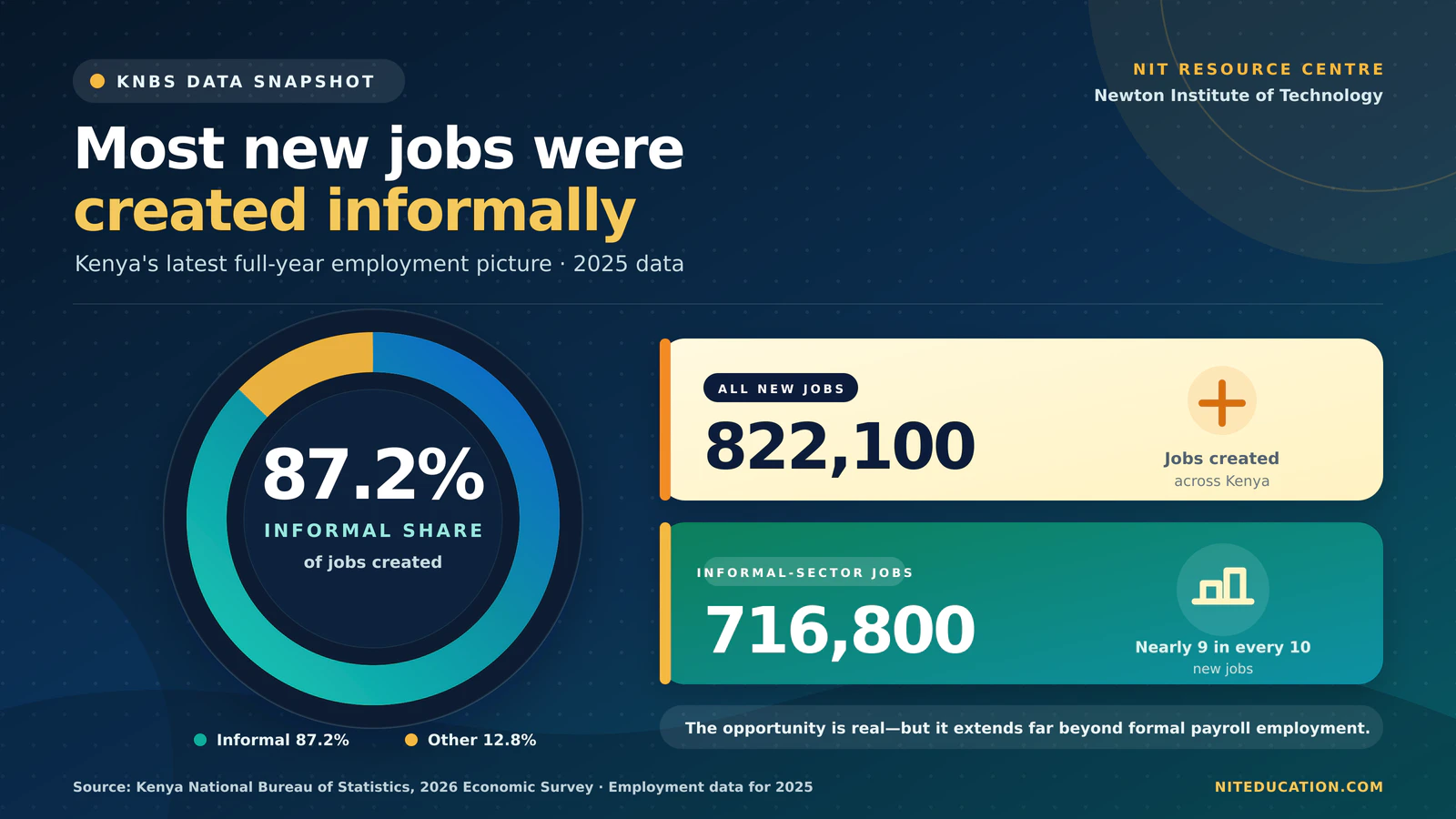
The broad informal sector created most of the new jobs reported for 2025. Informal employment increased by about 716,800 people and accounted for 87.2% of the jobs added that year.
Are formal jobs still available in Kenya?
Yes. Formal employers continue recruiting, but formal employment is growing much more slowly than informal work. Competition is therefore strong, especially for vacancies advertised nationally.
Do employers prefer degrees or TVET qualifications?
It depends on the occupation. A Federation of Kenya Employers survey of 521 enterprises found demand for both, with undergraduate degrees most frequently sought and TVET qualifications second. Regulated professional work may require a degree or registration, while many technical and operational roles follow TVET, trade-test or licensing routes.
Is ICT still a good field in Kenya?
Yes, for the right person and with realistic expectations. Digital systems now run through finance, manufacturing, education, health, agriculture, retail and government. Practical proof of ability matters as much as the certificate.
Will AI remove jobs in Kenya?
AI will change some tasks faster than others; no credible Kenyan dataset supports a claim that it will remove every occupation at once. Watch how tools are changing your own occupation and learn to use them responsibly.
Must I move to Nairobi to find work?
No. Nairobi has the largest concentration of formal corporate vacancies, but county economies generate work through agriculture, construction, logistics, hospitality, health, education, trade, repair and personal services.
Practical career guidance in Migori
Discuss a training route that matches the work you want
Ask about entry requirements, duration, timetable, complete fees, practical arrangements and the evidence you should have when training ends.
Call or WhatsApp+254 713 584 858
Email admissionsinfo@niteducation.com
VisitNamba Area, Migori Town
Along Migori–Sirare Highway