

Farm Tractor Operator Training Kenya · 2026
Farm Tractor Operator Training
in Kenya
G12 requirements · skills · jobs
For someone interested in commercial farming, agricultural mechanisation or tractor-hire work, G12 offers a focused machine skill.
G12 — Farm Tractor
A farm tractor is easy to underestimate.
From a distance, the job can look simple: start the tractor, select a gear and pull an implement across the field. Once you are responsible for the machine, there is much more going on.
You have to inspect the tractor before work, connect equipment correctly, read the ground, choose a sensible working speed and keep checking what is happening behind you. A strange vibration, a leaking hydraulic connection or a poorly secured implement can turn an ordinary day’s work into an expensive breakdown—or a safety incident.
For someone interested in commercial farming, agricultural mechanisation or tractor-hire work, G12 offers a focused machine skill. Before enrolling, it helps to know what competent tractor operation actually involves and what employers expect once training is complete.
What is G12 in Kenya?
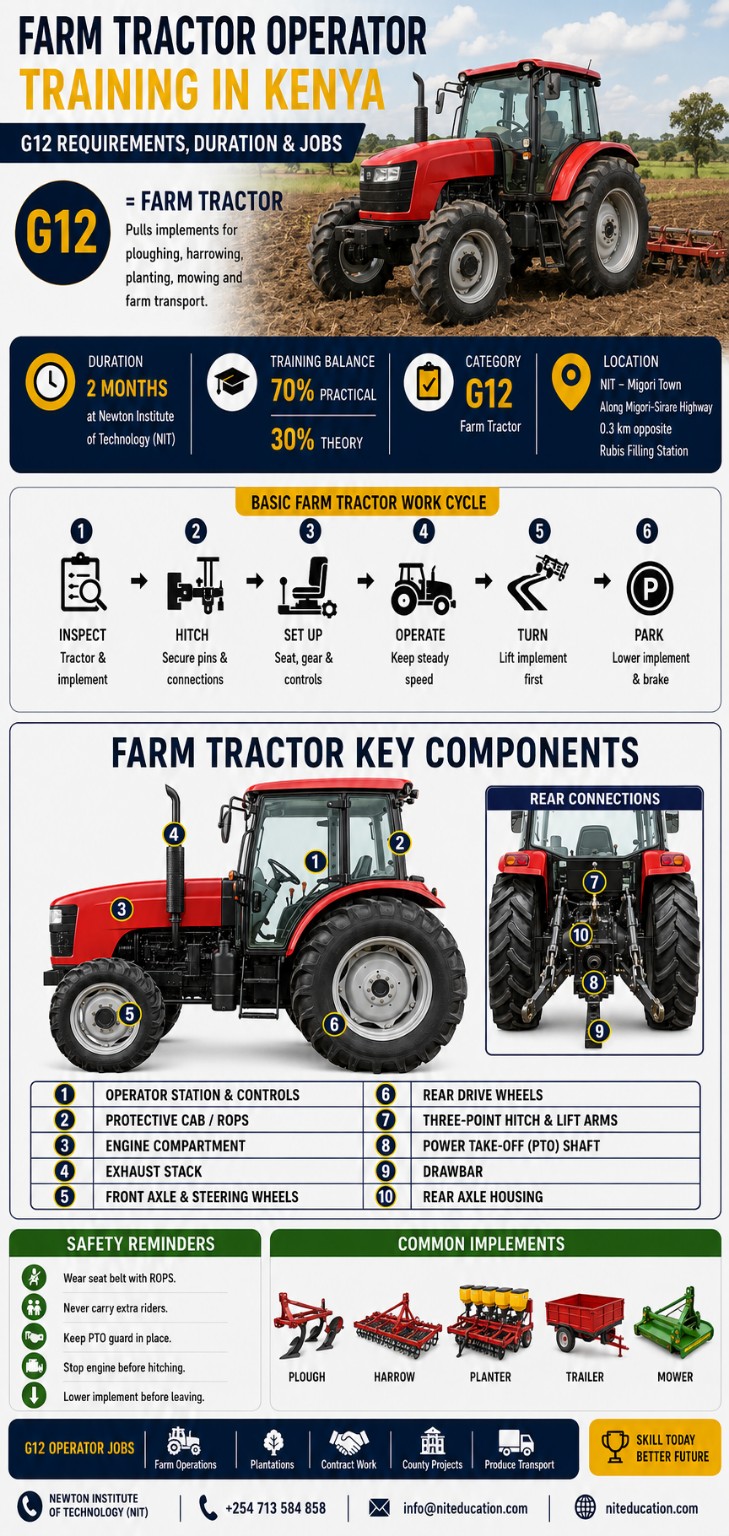
G12 is the Category G code for a farm tractor.
Training should prepare a learner to inspect, manoeuvre and operate the tractor safely while working with agricultural equipment. That includes starting and stopping correctly, selecting gears, reversing, hitching, using hydraulics, understanding power take-off safety, operating the three-point linkage, carrying out field work, doing basic machine checks and reporting faults clearly.
Knowing how to move a tractor is only the starting point. The real skill is using it to complete agricultural work safely and without abusing the tractor or the implement.
Farm Tractor Operator Training in Kenya
G12 requirements, duration & jobs
The farm and the season
What does a G12 farm tractor operator actually do?
The answer depends on the farm and the season.
During land preparation, an operator may spend most of the day ploughing or harrowing. At another time of year, the same tractor could be pulling a planter, moving farm inputs, towing a trailer or supporting harvesting work.
Ploughing
Harrowing · cultivation · seedbed preparation.
Planting support
Mowing or slashing · supporting harvesting work.
Towing trailers
Moving farm inputs.
Operating compatible agricultural implements
There is also a less visible part of the job. Before and during work, the operator watches fluid levels, tyres, hydraulic connections, warning indicators and the general behaviour of the machine. When something changes, it should be noticed early and reported clearly.
Before paying for G12 training
G12 farm tractor training requirements
For the Class B-to-Category G pathway used in NIT’s plant-operator guidance, a learner should first have the required driving-licence foundation before completing the relevant Category G training and endorsement process.
Before paying for G12 training, confirm:
identification requirements
the applicable driving-licence prerequisite
age and medical requirements
the correct machine category on the relevant application or PDL
availability of an actual farm tractor for practical sessions
the assessment route you will follow
Most importantly, check that the machine category is recorded correctly as:
For the complete Category G licensing process, see NIT’s NTSA Category G Plant Operator Licence in Kenya guide.
There is a difference
Tractor driver or tractor operator? There is a difference
Someone may be perfectly comfortable driving a tractor around a yard and still struggle once a plough is attached.
Agricultural machinery operation requires the driver to think about several things at the same time: the tractor, the implement, the field, the task and the people working nearby.
Take ploughing. Steering from one end of the field to the other is not enough. The operator has to hold a useful line, watch how the plough is entering the soil, manage the turn at the headland and position the tractor properly for the next pass.
With experience, attention shifts. You stop watching only the front of the tractor and start reading what the implement is doing behind you.
“A good tractor operator watches both the machine and the implement. Steering alone is not enough.”
Machine familiarisation
What you learn during farm tractor operator training
Training normally begins with the tractor itself.
Before entering a field, a learner should be able to identify the main controls, understand the basic warning indicators and complete a sensible walk-around inspection.
A typical familiarisation session covers:
engine area
tyres and wheels · steering and braking systems
hydraulics
hitching points · three-point linkage
PTO area
lights · gauges
operator platform
These checks may feel slow at first. With practice they become part of the routine.
Farm Tractor Key Components
Farm tractor key components

The controls
Tractor controls you need to understand
Tractors do not all have identical control layouts, so training works best when it teaches what each system does instead of encouraging a learner to memorise one dashboard.
Depending on the machine, controls may include:
steering
accelerator · clutch · service brakes · parking brake
gear selector
range selector · hydraulic controls · linkage controls
PTO engagement
differential lock · four-wheel drive
warning indicators and gauges
Smooth operation matters more than aggressive operation.
Rushing the clutch, changing direction harshly or selecting unsuitable gears creates unnecessary wear and can make field work worse rather than faster.
The habit that saves machines
Pre-start inspection: the habit that saves machines
A tractor should not enter the field simply because the engine starts.
Before work, walk around it.
Look for fresh leaks. Check the condition of the tyres and visible wheel components. Inspect hydraulic hoses and connections. Look at the hitch and linkage, especially if an implement is already attached. Confirm that guards around PTO-driven equipment are in place.
Once the engine is running, pay attention to gauges and warning lights. If the tractor suddenly sounds, smells or feels different from normal, investigate rather than assuming it will sort itself out.
Attached equipment
Working with tractor implements
Much of a tractor’s usefulness comes from the equipment attached to it.
A learner may encounter a plough, harrow, cultivator, planter, mower, slasher, trailer or other compatible equipment. Each changes the way the tractor behaves.
| Implement or equipment | What the operator must watch |
|---|---|
| Plough | Alignment, working depth, traction and turning |
| Harrow | Coverage, overlap and field finish |
| Cultivator | Positioning, depth and row clearance |
| Planter or seeder | Working speed, alignment and setup |
| Mower or slasher | PTO safety and surrounding clearance |
| Spraying equipment | Correct attachment and controlled operation |
| Trailer | Hitching, reversing, load behaviour and stopping distance |
| Hydraulic implements | Secure connections and controlled movement |
Once it is connected, it becomes part of the machine you are operating.
Three-point linkage
- The three-point linkage is widely used to mount agricultural implements.
- Approach slowly, align the linkage carefully, secure the necessary pins and retainers and check that everything is properly connected before lifting.
- Keep people away from crush points.
- Once the implement is attached, raise and lower it carefully and check clearance before moving away.
PTO awareness
- The power take-off (PTO) transfers rotating power from the tractor to compatible equipment.
- The operator needs to understand PTO controls, guarding and the correct procedure for connecting or preparing equipment.
- Nobody should try to clear, adjust or reach into PTO-driven machinery while it is operating.
- Loose clothing and rotating shafts are a dangerous combination.
Hitching and unhitching
Hitching becomes easier with experience, but it should never become careless.
Approach the implement slowly, line up properly and secure the hitch or linkage. Connect hydraulic or PTO systems correctly where required, then check pins, retainers and couplings before beginning normal work.
When unhitching, leave the equipment in a stable position before moving the tractor away.
Working efficiently
Tractor setup and field efficiency
A tractor can be working hard without working efficiently.
Gear selection is one part of the equation. Working too fast can reduce control and affect how well an implement performs. An unsuitable gear or engine setting can also waste time and fuel.
During training, learners should begin to understand how working speed, engine speed and the attached equipment interact.
Where the tractor has four-wheel drive or differential lock, the operator should know when those systems are useful and when they should be disengaged.
Hydraulic position and draft controls also matter when working with suitable implements. The aim is not to turn a beginner into an agricultural engineer. It is to understand that implement depth, traction and hydraulic setup affect the finished work.
Tyre condition matters too. Poor traction can increase wheel slip and waste fuel.
Field efficiency also comes down to planning. Too much overlap means covering the same ground twice. Too little overlap can leave untreated strips. With planters or spraying equipment, calibration becomes even more important.
Where judgement develops
Starting, moving and stopping
Early practical sessions usually focus on smooth machine control.
A learner practises starting, selecting gears, moving off, steering, braking, changing direction, reversing and parking until the controls begin to feel natural.
That foundation matters because the workload increases as soon as an implement is attached.
If all your attention is still being used to find gears or judge the clutch, there is very little attention left for what the equipment is doing behind you.
Field operation: where judgement develops
A training yard is useful for basic control. A field teaches something different.
Now the learner has to read the ground.
There may be drainage channels, wet patches, rocks, slopes, livestock, workers on foot or areas where turning space is limited. The operator also has to follow the previous pass and watch the attached implement.
Judgement grows through supervised seat time.
A typical ploughing pass
A typical ploughing pass
Imagine a trainee preparing for the first run across a field.
Before moving, the hitch and plough are checked. The tractor is lined up, and the operator starts the pass at a controlled pace. At the correct point, the plough is lowered and the trainee settles into a steady working speed.
During the run, attention is split between the direction of travel and what the plough is doing behind. Is it entering the soil properly? Is the line drifting? Is the tractor labouring more than expected?
At the end of the pass, the implement is raised before the turn. The operator completes the headland turn without rushing, lines up the next pass and lowers the plough again.
The aim is to leave neither a wide untouched strip nor unnecessary overlap.
That one sequence brings together steering, implement control, timing and field judgement—the things that cannot be learned properly from notes alone.
Coverage and consistency
Harrowing, cultivation and planting
Harrowing and cultivation demand similar concentration but produce a different finished result.
Instead of simply counting trips across the field, the operator watches coverage. Poor alignment wastes fuel through overlap or leaves obvious sections untreated.
Planting equipment raises the importance of consistency even further. Sudden changes in speed or poor alignment can affect the quality of the work.
Control beyond a straight field pass
Safe reversing
A tractor becomes more difficult to reverse once equipment or a trailer is attached.
The operator’s view may be restricted, and the attachment may respond differently from the tractor itself. Controlled reversing should therefore form part of practical training.
When another person is assisting, signals need to be clear. If the operator loses sight of the person guiding the movement, stopping is safer than guessing.
Slopes and uneven ground
A tractor can work on terrain where an ordinary vehicle would struggle, but that does not make every slope safe.
Machine stability changes with ground condition, speed, turning direction and attached equipment.
A careful operator assesses the route before committing the tractor. If the ground or slope appears outside safe operating limits, another approach may be needed.
Moving a tractor between fields
Not every tractor movement happens inside a field.
Operators may need to move between farm blocks, travel along access roads or tow equipment from one work area to another. That changes the risk.
Before moving off, check that lights and warning devices are working where required, the implement is secure and positioned safely, and any trailer connection is properly locked.
Remember that a tractor with an implement or trailer can be wider, longer and slower to turn than the tractor on its own. Visibility may also be reduced.
Where movement takes place on a public road, the operator must follow the applicable road and licensing requirements.
Both situations require judgement.
Operator-level machine care
Basic maintenance for a tractor operator
The operator is not automatically the mechanic, but the person using the tractor is usually the first to notice when something changes.
Routine responsibilities may include checking fluids and tyres, watching for leaks, keeping the machine reasonably clean, following lubrication schedules, inspecting visible hoses and fittings and monitoring warning indicators.
Listen to the tractor as well.
An unfamiliar knock, vibration or change in engine behaviour can tell you something before a dashboard warning appears.
You do not have to diagnose every mechanical fault. You do need to recognise when the machine should be checked before more damage is done.
Reporting a fault properly
“The tractor has a problem” gives a mechanic very little information.
A better report explains when the problem started and what was happening at the time.
Was there a warning light? Did steering become heavier? Was power suddenly reduced? Did the vibration start only after the implement was engaged? Where was the leak seen?
Clear information can shorten diagnosis and prevent unnecessary damage.
Modern tractor records
Modern tractor records and digital work management
Farm tractor operation is becoming more record-driven.
Even where a tractor has no advanced onboard system, a professional operation may still track:
engine hours
fuel use · servicing dates
breakdowns
work completed · acreage covered
implement use
operator assignments
job schedules
Larger agricultural operations may also use GPS, location tracking or digital job records to monitor where the tractor has worked and how long a task has taken.
For an operator, this means record keeping is no longer just paperwork.
Accurate hours and fuel records help schedule servicing, control operating costs and identify unusual fuel use or machine behaviour.
For someone planning to offer tractor-hire services, these records become even more important because they help show whether a job is actually profitable.
A simple G12 work cycle
A simple G12 work cycle
- Inspect
- Prepare
- Attach
- Check
- Position
- Work
- Monitor
- Finish
- Park
- Report
Operating does not begin when the wheels start turning. It begins with preparation and ends after the tractor is safely parked and any defects have been recorded.
NTSA G12 licensing pathway
NTSA G12 licensing pathway
For someone following the Class B-to-G route described in NIT’s plant-operator guidance, the simplified pathway is:
- Required driving-licence foundation
- appropriate application or PDL
- G12 practical training
- applicable NTSA assessment
- approved G12 endorsement
Licensing procedures and government charges can change, so confirm the current requirements through the appropriate NTSA/eCitizen process before making payment.
For the full process, see NIT’s NTSA Category G Plant Operator Licence in Kenya guide.
G12 and Farm Tractor Operation Level 3
Is G12 the same as Farm Tractor Operation Level 3?
No. They sit in the same broad area of tractor training but refer to different things.
G12
- G12 identifies the farm tractor within the relevant Category G licensing pathway.
Farm Tractor Operation Level 3
- Farm Tractor Operation Level 3 is a TVET programme listed by KUCCPS under Agricultural Sciences & Related.
- KUCCPS currently lists a minimum mean grade of E, with no specific minimum subject requirement shown for that programme.
Someone comparing courses should therefore ask:
That question can prevent confusion later.
Jobs and employer requirements
What Kenyan employers are asking for
A licence gets attention, but it is rarely the only thing an employer wants.
Kenyan tractor vacancies reviewed in June and July 2026 asked for combinations of Class G/G12 licensing, practical tractor experience, agricultural-machinery knowledge, daily inspections, basic maintenance, fault reporting and machinery records.
The duties were equally practical: land preparation, cultivation, planting, spraying, transport, harvesting support and looking after the equipment assigned to the operator.
That is useful information for someone still in training. Employers want a person they can trust with a working machine—not someone who only knows how to move it.
Farm tractor operator jobs in Kenya
Job titles vary between employers.
farm tractor operator
tractor driver
agricultural machinery operator
mechanisation operator
estate tractor operator
land-preparation operator
agricultural equipment operator
A vacancy labelled “tractor driver” may still expect the person to attach implements, complete daily inspections, keep machinery records and recognise basic faults.
Where G12 operators can work
Where G12 operators can work
The most obvious opportunities are on commercial farms and agricultural estates, where tractors are used at several stages of production.
Agricultural contractors are another route. Instead of working permanently on one farm, an operator may move between clients providing ploughing, harrowing or other mechanised services.
Tractor-hire businesses create similar opportunities, especially during busy land-preparation and planting periods.
Cooperatives, farmer organisations, agricultural projects, training farms and research farms may also use tractor operators where machinery forms part of their operations.
Does tractor work become seasonal?
Some of it does.
Land preparation, planting and harvesting naturally become busier at particular times of year. An operator who can work competently with several common implements may therefore have an advantage over someone whose experience stops at one task.
Mobility can help too. Agricultural activity does not peak at exactly the same time everywhere.
Employability
What makes a G12 operator employable?
Implement competence is one of the most useful skills. The more confidently you can work with appropriate attachments, the more useful you become on a farm.
Mechanical awareness matters too. Nobody expects a beginner to overhaul an engine, but noticing a leak, abnormal sound or failing component early is valuable.
Then there are the less glamorous habits: keeping fuel and maintenance records, turning up when work is scheduled, communicating with supervisors and operating without wasting fuel.
Missing a planting window because of poor machine care or unreliable attendance can cost far more than one day’s wages.
Tractor-hire services
Can G12 lead to self-employment?
Yes, although operating skill is only one part of the equation.
An experienced operator with access to machinery may offer:
- ploughing
- harrowing
- cultivation
- mowing
- planting support
- farm transport
The business has to be priced properly.
Fuel costs money. Implements wear. Tyres and parts eventually need replacement. Servicing cannot be postponed forever.
For someone interested in tractor hire, machine skill and basic business discipline belong together.
Choose the machine for the work
Should you choose G12 or another Category G machine?
Start with the environment where you actually want to work.
If your interest is agricultural mechanisation, farms, estates or tractor-hire work, G12 is a logical choice.
Someone targeting excavation, road construction, lifting or warehouse material handling would normally need a different machine category.
Do not choose a machine because someone casually calls it “marketable.”
Can you train on G12 together with other machines?
Yes, depending on the training package and machine availability.
NIT’s plant-operator programme allows students to train on selected combinations of machines. The better approach is to choose combinations that support a sensible career direction rather than collecting categories simply because they are available.
Personal operating time
How much practical training should you look for?
Before enrolling, ask how much time you personally will spend operating the tractor.
A school may own the right machine but have too many learners sharing it.
Find out:
- how often you will operate
- whether you will practise hitching
- which implements are available
- whether field work is included
- whether inspections are part of practical sessions
- what happens if the tractor is under maintenance
Newton Institute of Technology
Farm tractor training at Newton Institute of Technology
Newton Institute of Technology provides practical plant-operator training in Migori, Kenya, with Farm Tractor — G12 among the machine options.
NIT’s plant-operator training approach is approximately 70% practical and 30% theory.
NIT’s plant-operator training approach is approximately 70% practical and 30% theory, with attention given to machine familiarisation, inspection, manoeuvring, safety, basic machine care and preparation for the applicable assessment pathway.
For farm tractor learners, meaningful practical training should include time on the controls as well as exposure to the way agricultural implements change the job.
Plant-operator intakes are continuous.
Because machinery periodically requires servicing, applicants should confirm tractor availability for their intended intake before enrolling.
Course fees
Farm tractor course fees
Training fees depend on the machine package selected, while government licensing charges are separate.
Check NIT’s Plant Operator Course Fees in Kenya guide for the current training structure, and confirm live government charges through the appropriate official portal before paying.
What does a tractor operator earn?
There is no single national tractor-operator salary that applies to every job.
Pay changes with experience, location, employer, contract type, season and the responsibilities attached to the position.
When comparing an actual offer, look beyond the headline figure. Check whether pay is daily or monthly, how overtime works, whether accommodation or travel is included and how long the contract is expected to run.
For broader pay research, use NIT’s Plant Operator Salary in Kenya guide.
Before enrolling
Seven things to check before enrolling for G12
- Can you see the actual farm tractor?
Do not rely only on a course list or photograph. - How much operating time will you personally receive?
Seat time matters. - Will you work with implements?
Tractor training without attachment practice leaves a major gap. - Are PTO and linkage safety included?
These systems are central to agricultural tractor work. - Will you enter a real field?
Yard manoeuvring is useful, but it cannot reproduce every field condition. - Which qualification or licensing route are you taking?
Know whether you are preparing for G12, an occupational qualification or both. - Which costs are separate?
Ask for an itemised explanation before paying.
Frequently asked questions
Frequently asked questions
What is G12 in Kenya?
G12 is the Category G code for a farm tractor.
Is G12 an excavator licence?
No. The excavator belongs to another Category G code. G12 specifically covers the farm tractor.
Is practical training necessary?
Yes. Tractor operation involves judgement, implement control and field conditions that cannot be learned properly from theory alone.
Is a tractor operator the same as a tractor driver?
Not always. A competent operator is also expected to understand inspection, attachments, field work, safety, basic maintenance and productive use of the machine.
Which tractor implements should I understand?
Common examples include ploughs, harrows, cultivators, planters, mowers, trailers and other compatible agricultural equipment. The exact equipment used depends on the farm and tractor.
What does PTO mean?
PTO means power take-off. It allows the tractor to provide rotating power to compatible equipment.
What is the three-point linkage used for?
It is a common system for mounting and controlling tractor implements.
Is Farm Tractor Operation Level 3 the same as G12?
No. Farm Tractor Operation Level 3 is a TVET programme qualification, while G12 identifies the farm tractor within the relevant Category G licensing context.
What is the minimum KCSE grade for Farm Tractor Operation Level 3?
KUCCPS currently lists a minimum mean grade of E and no specific minimum subject requirement for the programme.
Are there farm tractor operator jobs in Kenya?
Yes. Opportunities can arise on commercial farms, estates, agricultural projects, contractor operations, tractor-hire services and other organisations using agricultural machinery. Availability changes by location and season.
What do employers look for?
Recent Kenyan vacancies have asked for the correct driving licence, practical tractor experience, safe machinery operation, basic mechanical awareness, inspections, maintenance records and reliability.
Can G12 lead to self-employment?
It can. Experienced operators with access to machinery may offer mechanised agricultural services, but successful tractor hire also requires sensible pricing, maintenance planning, fuel management and customers.
Can I train for G12 at Newton Institute of Technology?
Farm Tractor — G12 is among NIT’s plant-operator machine options. Confirm the current intake, machine availability and training package before enrolling.
Final takeaway
Final takeaway
Farm tractor training becomes much more useful when you stop thinking of the tractor as a vehicle and start treating it as working agricultural machinery.
A capable G12 operator can inspect the tractor, connect equipment safely, understand the PTO and linkage, read the field, work with common implements and recognise when the machine is beginning to develop a problem.
Those are the habits employers and clients eventually depend on.
If agriculture is the environment you want to work in, G12 Farm Tractor provides a focused machine skill. Get meaningful practical time, learn why the tractor behaves the way it does and finish training able to work with the machine—not merely drive it.
Newton Institute of Technology
Newton Institute of Technology
Migori Town, Namba Area
Migori–Sirare Highway
Prepared by: Newton Institute of Technology Editorial Team
Technical review: Engineer Simon Barongo
Reviewed: September 2026