

NIT DATA CAREER GUIDE KENYA · 2026/2027
What Does a Data Scientist Do in Kenya?
Jobs · Skills · Salary
A practical guide to the work Data Scientists do, the skills Kenyan employers require, current salary evidence and how Newton Institute of Technology develops demonstrable Data Science ability.
From raw data to a useful decision
What does a Data Scientist do?
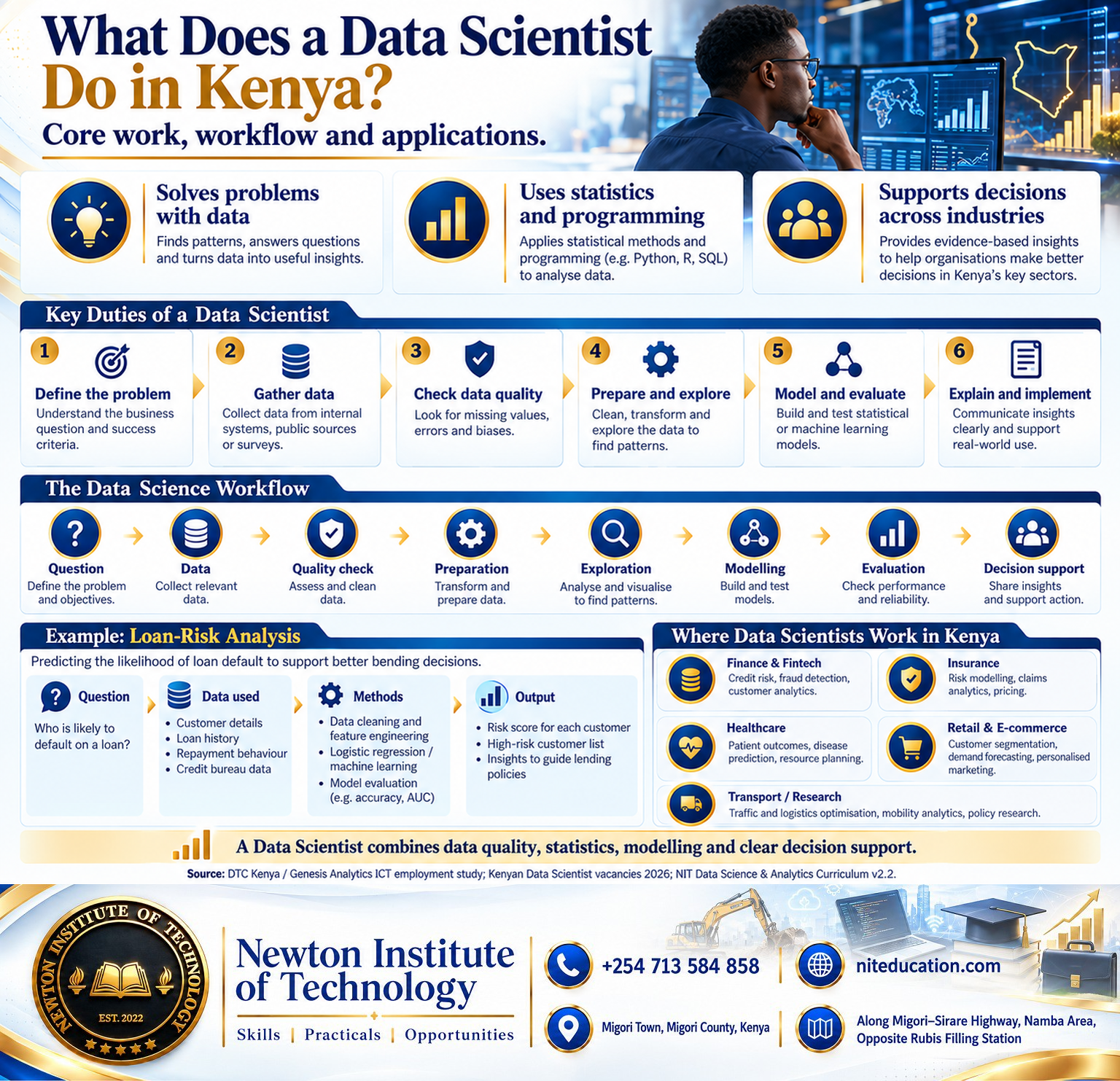
A Data Scientist uses data, statistics and programming to solve problems, identify patterns, make predictions and support decisions. The work can include data preparation, exploratory analysis, statistical modelling, machine learning, model evaluation and explaining results to the people who will use them. Kenya’s broader Data Science and Analytics job family is estimated at about 27,000 professionals across scientist, analyst, engineering, architecture and related roles. [1]
The job starts with a real question. The strongest work connects that question to dependable data, a suitable method and a conclusion that can be explained clearly.
The work in sequence
What a Data Scientist actually does
A Data Scientist normally moves through a sequence of connected tasks. The exact tools vary, but the professional logic stays consistent.
| Stage | Practical task | Typical output |
|---|---|---|
| Define the problem | Turn a business or operational need into a measurable question. | Analytical objective |
| Gather data | Retrieve approved information from databases, files, APIs or other sources. | Working dataset |
| Check quality | Find missing values, duplicates, conflicts, invalid types and unusual records. | Quality findings |
| Prepare and explore | Clean, combine, transform, summarise and visualise the data. | Analysis-ready data + EDA |
| Model | Use statistics or machine learning when the question calls for prediction, classification, clustering or forecasting. | Candidate model |
| Evaluate | Measure errors, compare alternatives and test performance on suitable validation data. | Evaluation evidence |
| Explain | Translate the result into language a stakeholder can use. | Report, dashboard or presentation |
| Implement and monitor | Where required, connect the result to a working process and track performance over time. | Operational data product |
Kenya’s ICT employment study describes Data Scientists as professionals who use statistics and machine learning to make predictions and answer important business questions. [1]
A complete example
Loan-risk analysis from question to decision
Suppose a lender wants to identify patterns associated with repayment difficulty. The useful analytical question is specific: which characteristics in previous lending data are associated with repayment problems?
Inspect the records
Check loan values, repayment history, customer activity, dates, missing fields, duplicate records and category consistency.
Build the dataset
Use SQL to retrieve and join the relevant records, then document the cleaning and transformation steps.
Analyse and model
Use Python and statistics to investigate patterns. If classification is suitable, train and compare candidate models.
Evaluate and explain
Test how the model performs on unseen data, examine the mistakes and explain how the result supports the lending decision.
A September 2026 junior vacancy included SQL extraction, data cleaning, exploratory analysis, lending-performance analysis, customer segmentation, feature engineering and model-validation support. [2]
Current Kenyan vacancy evidence
What employers are asking Data Scientists to do
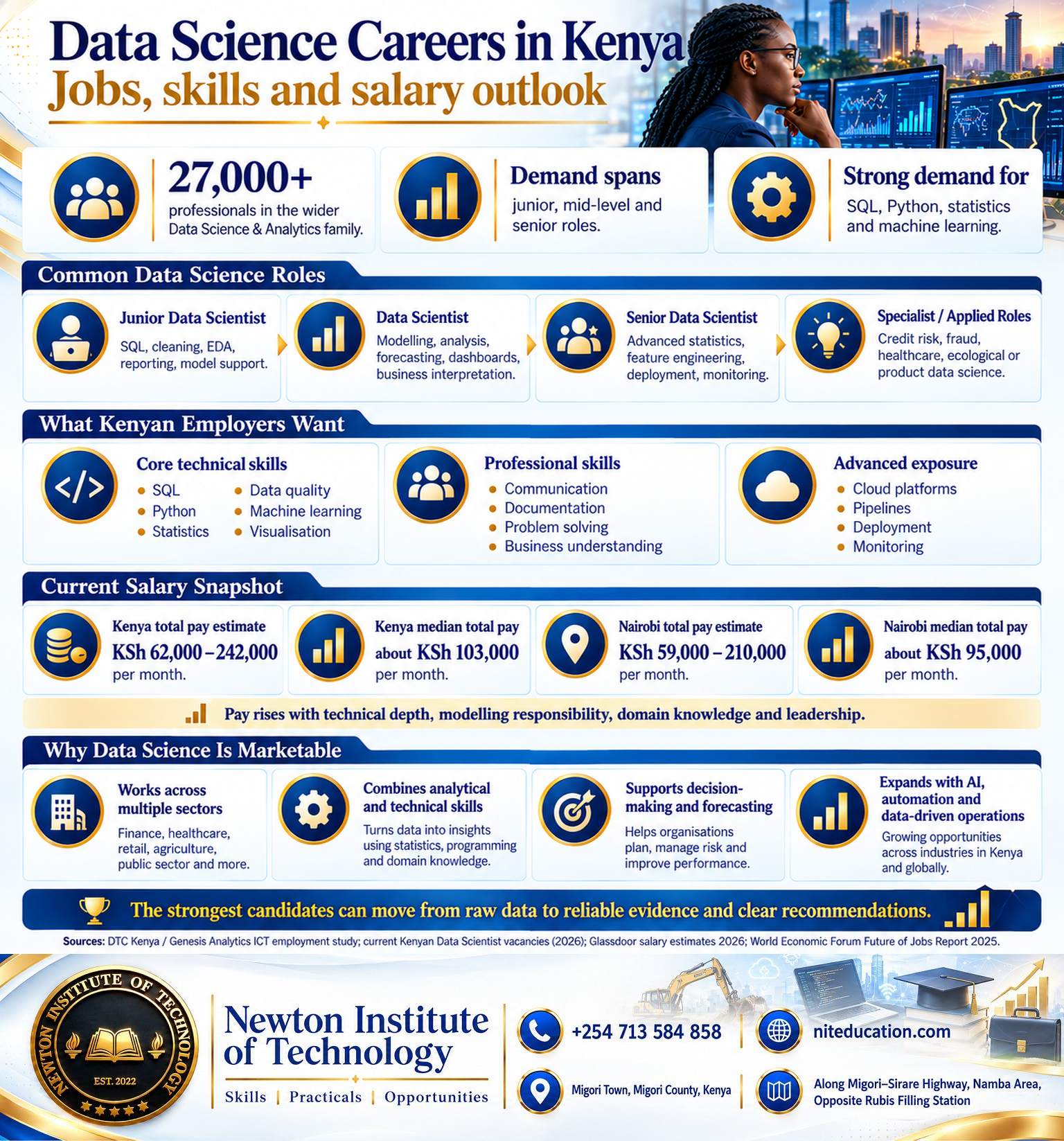
The role changes as responsibility grows. Junior work often concentrates on reliable extraction, cleaning, analysis and supervised model work. Mid-level positions own more of the modelling and interpretation. Senior positions extend into deployment, monitoring, experimentation and technical leadership.
Reliable analysis first
- SQL extraction and data preparation
- Exploratory analysis and reporting
- Feature preparation and model support
- Metric checking and documentation
Own more of the analytical lifecycle
- Advanced SQL and statistical modelling
- Feature engineering and model selection
- Deployment and performance monitoring
- Stakeholder communication and technical guidance
The technical core
Retrieve dependable data
Filter, aggregate and join records, investigate anomalies and build analysis-ready datasets.
Make analysis repeatable
Use Python for preparation, analysis, automation, visualisation and machine-learning workflows.
Test the evidence
Use probability, distributions, regression, inference and evaluation to interpret results correctly.
Build and evaluate models
Use regression, classification, clustering or forecasting when those methods fit the question.
Current October 2026 recruitment in Nairobi combines Python or R, SQL, statistical modelling, machine learning, dashboards, data quality and business interpretation. Senior vacancies add experimental design, deployment, monitoring and pipeline responsibility. [3] [4]
Where the work is used
Data Science works across multiple sectors
Finance & fintech
Credit risk, fraud detection, customer behaviour, segmentation and transaction analysis.
Insurance
Claims analysis, pricing, risk modelling, customer retention and forecasting.
Healthcare & research
Programme analysis, operational planning, population data, experiments and research evidence.
Retail & digital commerce
Demand forecasting, customer behaviour, inventory, recommendations and pricing analysis.
Transport & logistics
Route analysis, operations, scheduling, maintenance data and forecasting.
Kenya’s wider ICT employment study identifies banking and finance, healthcare, marketing and business intelligence among the important settings for data professionals. [1]
Current pay evidence
How much does a Data Scientist earn in Kenya?
Current salary evidence shows a wide range across experience levels, employers and technical responsibilities.
Glassdoor’s current Kenya estimate places total monthly pay at approximately KSh 62,000–242,000, with median total pay around KSh 103,000. Its Nairobi estimate is approximately KSh 59,000–210,000, with median total pay around KSh 95,000. [5]
Pay rises with technical depth. Independent modelling, advanced statistics, cloud/data-engineering exposure, deployment responsibility, domain knowledge and technical leadership all increase the level of work a Data Scientist can own.
Entry and progression
Qualifications and practical evidence
Current Kenyan Data Scientist vacancies commonly specify training in Data Science, Statistics, Mathematics, Computer Science or another quantitative field alongside practical technical competence. One October 2026 Nairobi vacancy, for example, requested a bachelor’s or master’s qualification in a related field together with Python or R, SQL, statistical modelling and machine learning. [3]
A documented notebook, SQL queries, analytical report, Git repository and evaluated model show how a candidate handles real data, not only which technologies appear on a CV.
Professional responsibility
Working with personal data in Kenya
Data Science often involves records about customers, borrowers, employees, patients or service users. Kenya’s Data Protection Act requires personal data to be handled lawfully, fairly and transparently, for specified purposes, with appropriate accuracy and data minimisation. [6]
- Know why the data is being used and which fields are necessary.
- Control who can access working datasets and outputs.
- Protect raw and processed files appropriately.
- Document the purpose, transformations and analytical decisions.
- Present findings without exposing personal information unnecessarily.
Newton Institute of Technology
What Data Science work looks like in our NIT labs
At Newton Institute of Technology, we teach Data Science as a process that leaves evidence. A learner must be able to show what was done, reproduce the work and explain why the conclusion follows from the data.
SQL query file
The queries used to retrieve, filter, aggregate and join the records.
Cleaned dataset
An analysis-ready dataset separated from the protected raw copy.
Data-quality log
A record of missing values, duplicates, inconsistencies, decisions and corrections.
Python / EDA notebook
Reproducible analysis with clear code, outputs, observations and conclusions.
Evaluated model
A model comparison with suitable metrics, validation and an explanation of performance.
Capstone repository
Organised files, documentation, report, presentation and portfolio-ready evidence.
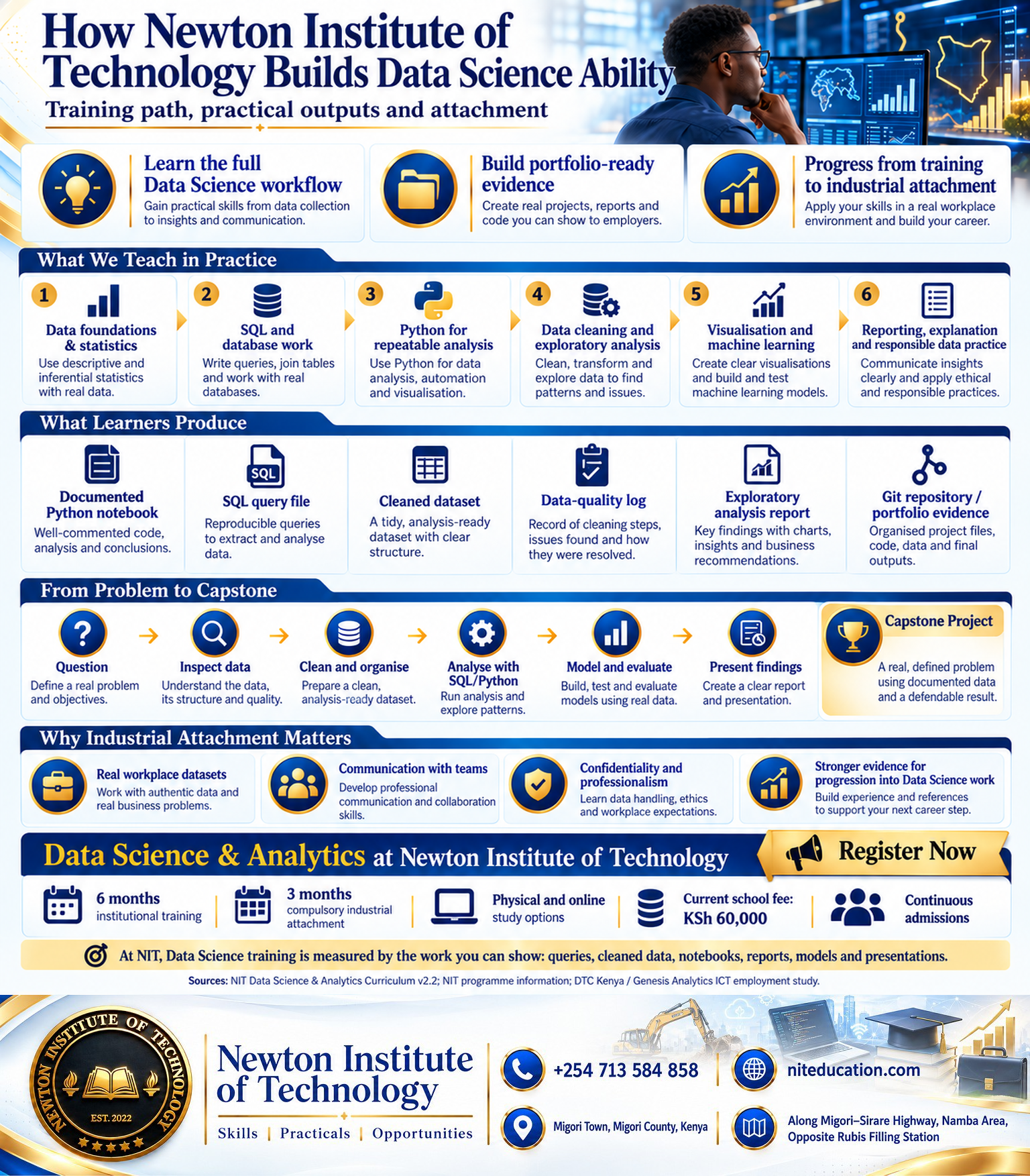
Our current Data Science and Analytics curriculum begins with spreadsheet analysis, statistics and responsible data practice, then progresses through Python, SQL, exploratory analysis, visualisation, machine learning and a complete capstone. [8] [10]
A project we can demonstrate
From a business question to a capstone result
Consider a learner project that asks: can historical sales records help a business estimate next month’s demand?
- 01Define the decision
Specify what needs to be estimated and what success would look like.
- 02Inspect and clean the data
Check dates, missing records, duplicates, categories and numerical values; preserve the raw data and document changes.
- 03Analyse with SQL and Python
Retrieve the relevant records, create a repeatable analysis and explore trends, seasonality and relationships.
- 04Model when the problem requires it
Train and compare appropriate forecasting or regression approaches, then evaluate them on suitable data.
- 05Present the finding
Connect the result back to the business question, show the evidence and explain what the model can support.
The NIT capstone standard requires a real, clearly defined problem, appropriately documented data and findings the learner can defend. [10]
Apply the skill in a workplace
Why industrial attachment matters
Real organisations introduce conditions that classroom datasets cannot fully reproduce: access controls, confidential records, deadlines, changing questions, team communication and responsibility for the quality of the result.
Real workplace data
Apply suitable data collection, cleaning, reporting, database, visualisation or analytical skills to real tasks.
Professional communication
Work with supervisors and teams, ask better questions and explain analytical findings clearly.
Confidentiality and process
Follow workplace rules for access, privacy, quality assurance and professional conduct.
Evidence of progression
Build a stronger record of applied work, feedback, reliability and professional growth.
NIT’s current programme includes six months of institutional training followed by a compulsory three-month industrial attachment. [8] [10]
Keep the career boundaries clear
Data Scientist and Data Analyst: where the paths separate
Both careers can use SQL, Python, statistics, cleaning and visualisation. Data Analysts generally concentrate more heavily on extracting, analysing and communicating existing information. Data Science moves further into statistical modelling, experimentation, prediction and machine learning.
For the full comparison, use our dedicated Data Analyst vs Data Scientist in Kenya guide rather than duplicating that topic here. [9]
The workflow is changing
How AI is changing Data Science work
AI tools can accelerate SQL drafting, Python coding, documentation, exploratory analysis and parts of model development. That makes evaluation and judgement more important: someone still has to decide whether the data is suitable, whether the method fits the problem and whether the conclusion follows from the evidence.
Kenya’s ICT employment study expects augmentation in the wider Data Science and Analytics job family. The World Economic Forum also places AI and big data among the fastest-growing skill areas while continuing to identify analytical thinking as a core capability. [1] [7]
Direct answers
Frequently asked questions
What does a Data Scientist do in Kenya?
A Data Scientist prepares and analyses data, uses statistics and programming to investigate problems, builds models where needed, evaluates the results and communicates findings that support decisions. [1]
Is Data Science marketable in Kenya?
Which skills should I learn for Data Science?
Build strong foundations in SQL, Python, statistics, data quality and visualisation. Then deepen into machine learning, model evaluation and complete projects that show the full analytical process.
What is the current Data Scientist salary in Kenya?
Glassdoor’s current Kenya estimate places total monthly pay at approximately KSh 62,000–242,000, with median total pay around KSh 103,000 per month. [5]
Can a Data Analyst progress into Data Science?
Yes. SQL, data preparation, statistics, Python and analytical problem-solving provide a strong foundation for progression into modelling and machine learning. Our dedicated comparison guide explains that bridge in detail. [9]
Career direction
A Data Scientist turns data into evidence people can use
The job combines dependable data, statistical reasoning, programming, modelling and clear communication. The strongest progression is practical: learn the foundations, work with real datasets, build complete projects, evaluate your results and gain workplace experience.
Build practical Data Science ability
Register for Data Science & Analytics at Newton Institute of Technology
Our programme develops practical competence in statistics, Python, SQL, data cleaning, exploratory analysis, visualisation, machine learning, Git/GitHub and end-to-end project work. Learners complete six months of institutional training followed by a compulsory three-month industrial attachment. [8]
Institutional training6 months
Industrial attachment3 months · compulsory
Current school feeKSh 60,000
Study optionsPhysical and online
AdmissionsContinuous
Call / WhatsApp+254 713 584 858
References
- Digital Transformation Centre Kenya / Genesis Analytics. Unlocking Current and Future Employment for ICT Professionals in Kenya. Used for the size, role definitions, skills, sector applications and AI-augmentation outlook of the wider Data Science and Analytics job family. Open source.
- Corporate Staffing Services. Junior Data Scientist vacancy — Pezesha, September 2026. Used for current junior-level SQL, lending analytics, data preparation, feature work and model-support responsibilities. Open source.
- MyJobMag Kenya. Data Scientist vacancy — October 2026. Used for current requirements around Python/R, SQL, statistical modelling, machine learning, dashboards, data quality and business interpretation. Open source.
- MyJobMag Kenya. Senior Data Scientist vacancy — September 2026. Used for senior expectations around advanced statistics, modelling, deployment, monitoring and technical ownership. Open source.
- Glassdoor. Data Scientist salary estimates for Kenya and Nairobi. Used for the current total-pay and median-pay figures quoted in the salary section. Open source.
- Kenya Law. Data Protection Act, 2019. Used for the principles governing lawful, fair, transparent, purpose-limited, relevant and accurate handling of personal data. Open source.
- World Economic Forum. Future of Jobs Report 2025 — Skills Outlook. Used for the global outlook on AI, big data and analytical-thinking skills. Open source.
- Newton Institute of Technology. Data Science and Analytics Course in Kenya. Used for current programme structure, study options, fee and industrial attachment. Open NIT course page.
- Newton Institute of Technology. Data Analyst vs Data Scientist in Kenya. Used for the short career-boundary section and progression bridge. Open NIT guide.
- Newton Institute of Technology. Data Science and Analytics Curriculum, Version 2.2, updated 13 August 2026. Institutional curriculum used for practical outputs, analytical workflow, capstone standards, responsible-data practice and compulsory attachment.
Prepared by: Newton Institute of Technology Editorial Team
Institutional / Technical review: Engineer Simon Barongo
Evidence reviewed: 16 October 2026