

NIT Student Enterprise Guide Kenya · 2026
25 Business Ideas for Students in Kenya
With Little Money
Low capital · campus fit · repeat demand · holiday resilience
A practical Kenya-focused guide to businesses a university, college or TVET student can test without risking school fees or turning the hustle into a second full-time course.
Practical ideas for campus
Quick answer
What business can a student start in Kenya with little money?
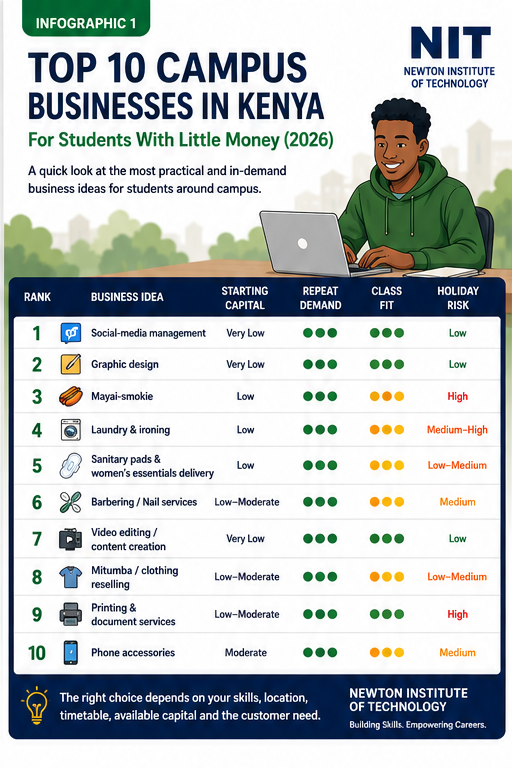
Strong starting points include social-media management, graphic design, mayai-smokie, laundry and ironing, sanitary-pad and women’s essentials delivery, barbering, nail services, video editing, mitumba reselling, printing and document services, phone accessories, photography, tutoring and website development.
There is no universally best campus business. The right choice depends on your timetable, skills, location, competition, available capital and what happens when students go home for the holidays.
Campus gives a young entrepreneur something many established businesses pay heavily to obtain: a concentrated group of potential customers. The opportunity is real, but the idea still has to solve a problem people actually pay to solve.
A busy gate can have hundreds of people passing every hour and still be a poor place for another snack seller if several established vendors already serve the same buyers. A good-looking business can also be a bad student business if it needs you behind a counter during lectures.
Kenya’s 2026 Economic Survey reports that informal-sector employment grew by 4.1% in 2025 to about 18.1 million people. Small enterprise and informal work are therefore already a major part of how Kenyans earn a living. See KNBS Economic Survey 2026.
Compare before you commit
25 student business ideas in Kenya at a glance
| # | Business idea | Capital | Repeat demand | Class fit | Holiday risk |
|---|---|---|---|---|---|
| 1 | Social-media management | Very low | High | Excellent | Low |
| 2 | Graphic design | Very low | Medium-high | Excellent | Low |
| 3 | Mayai-smokie | Low | High | Good | High if campus-only |
| 4 | Laundry & ironing | Low | High | Good | Medium-high |
| 5 | Sanitary pads & essentials delivery | Low | High | Excellent | Low-medium |
| 6 | Barbering | Low-moderate | High | Good | Medium |
| 7 | Nail services | Low-moderate | High | Good | Medium |
| 8 | Video editing/content creation | Very low | Medium-high | Excellent | Low |
| 9 | Mitumba/clothing reselling | Low-moderate | Medium | Excellent | Low-medium |
| 10 | Printing & document services | Low-moderate | High in term | Good | High |
| 11 | Phone accessories | Moderate | Medium | Good | Medium |
| 12 | Photography | Low if equipment owned | Occasional | Excellent | Medium |
| 13 | Snacks/pre-order food | Low | High | Good | High if campus-only |
| 14 | Tutoring | Very low | Medium | Excellent | High if campus-only |
| 15 | Website development | Very low if laptop owned | Project-based | Excellent | Low |
| 16 | CV & portfolio services | Very low | Seasonal | Excellent | Low |
| 17 | Computer support & repair | Low | Medium | Good | Low-medium |
| 18 | Makeup artistry | Moderate | Occasional/repeat | Good | Low-medium |
| 19 | Hairdressing | Low-moderate | High | Good | Medium |
| 20 | Errand/delivery service | Very low | Medium-high | Good | High if campus-only |
| 21 | Perfume & accessories | Low | Medium | Excellent | Low-medium |
| 22 | Online classes | Very low | Medium | Excellent | Low |
| 23 | Event services | Very low | Seasonal | Good | Medium |
| 24 | Campus marketplace/brokerage | Almost zero | Medium | Excellent | High |
| 25 | Liquid soap/detergent | Moderate | High | Fair | Low |
The capital labels are editorial starting categories, not fixed prices. Tools already owned, location and current wholesale prices can change the amount required.
The strongest campus-fit ideas
Ten options I would investigate first
Social-media management
Sell a service before buying stock. A student can create posts, shoot short videos, prepare product photos and manage enquiries for nearby small businesses.
Kenya’s Communications Authority reported 53.4 million active mobile-money subscriptions in Q3 FY2025/26, while smartphones represented 63.7% of connected mobile phones. That makes mobile-first customer acquisition especially relevant. CA source.
Graphic design
Campus generates posters, birthday graphics, menus, club artwork, certificates, social posts and CV layouts almost continuously. There is no dead stock under the bed when the semester closes.
Mayai-smokie
The trolley is not the business; the location and timing are. Observe where students actually walk and stop in the evening, then test a small quantity before buying a full setup.
Count the complete serving cost: smokie or egg, tomatoes, onions, chilli, sauce, packaging, fuel, transport, water and spoilage. Kenya’s food-hygiene rules require licensing of premises used for selling, preparing, packaging, storing or displaying food, so check county, public-health and campus requirements first. Kenya Law source.
Laundry and ironing
Laundry has a useful quality: the problem comes back. Start with a small number of customers, bedding or ironing, and consider collection and delivery before spending on machines or rent.
Sanitary pads & essentials delivery
The stronger model is not intrusive door-to-door selling. Use private WhatsApp order → discreet packaging → hostel or agreed-point delivery.
Stock only products customers actually request. KEBS lists KS EAS 96:2024 as the specification for disposable sanitary towels, so source legitimate sealed products and avoid damaged or tampered stock. KEBS standard.
Privacy can become part of the service. Collect only information needed to complete the order; ODPC guidance emphasises purpose limitation and data minimisation. ODPC guidance.
Barbering or nail services
Both benefit from repeat customers and appointments. Skill comes before equipment: do not charge for a technique you have not learnt properly. See NIT’s guides to barbering training and Nail Technology.
Video editing & content creation
A restaurant, salon, retailer or event organiser may need useful short-form video but have nobody to produce it consistently. This business also travels with you during school holidays.
Mitumba or clothing reselling
Choose a narrow niche before buying a pile of stock. Photograph a small selection, post it and watch what receives paid orders—not just likes. Pre-orders can cut dead-stock risk.
Printing & document services
You do not need to own a printer on day one. Take orders digitally, format legitimate documents, outsource the physical printing and buy equipment only after ordinary weekly demand is clear.
Phone accessories
Chargers, cables and covers have regular demand, but the wrong models can trap cash. Keep a narrow stock and use a catalogue or pre-orders for the rest.
Other practical options
Ideas 11–25: choose according to skill and location
Photography
Start with a capable phone if you already own one. Birthdays, graduations, products and student events can fund better equipment later.
Snacks & pre-order food
Mandazi, chapati, samosas, cakes and popcorn can work where pre-orders keep wastage under control. Food rules still apply.
Tutoring
If classmates repeatedly ask you to explain coding, mathematics, statistics or accounting, test a paid group session. Teach; do not impersonate the learner.
Website development
A good option for students who already have practical software skills because the market extends beyond campus. See NIT’s software-development guide.
CV & portfolio services
Improve presentation of genuine experience and qualifications for attachment, internships and jobs. Never invent credentials.
Computer support & repair
Backups, software configuration, Wi-Fi, printers and basic maintenance can become a service if you actually know the work. Do not experiment on a customer’s device.
Makeup artistry
Graduations, weddings, dinners and photoshoots create appointment-based demand. A genuine portfolio is the marketing asset. See NIT’s Makeup Artistry guide.
Hairdressing
Repeat clients, hygiene and consistent results matter more than opening an expensive salon immediately.
Campus errands & delivery
Collect food, printing, laundry, parcels or small purchases. Test it through WhatsApp before building an app nobody has paid to use.
Perfume & accessories
Small products are easy to show on WhatsApp and easy to carry. Ten products that sell repeatedly are better than eighty products sitting in a suitcase.
Online classes
Excel, coding, design, languages or another skill can be taught without premises. The challenge is proving you know enough to teach it well.
Event services
Bundle poster design, promotion, photography and video where your skills allow. One coordinated package can be easier to sell than several tiny jobs.
Campus marketplace
Graduating students sell mattresses, books, appliances and furniture while incoming students need them. A trusted marketplace can earn without owning all the stock.
Liquid soap & detergent
It can grow into household or institutional supply, but commercial manufacturing has standards, safety and labelling implications. KEBS says its Standardization Mark scheme is mandatory for locally manufactured products covered by applicable standards. KEBS guidance.
Campus essentials delivery
This is the scalable version of the sanitary-pad delivery idea: a small, curated catalogue of urgent hostel essentials. Keep the range tight and let real orders decide what gets added.
Before you commit money
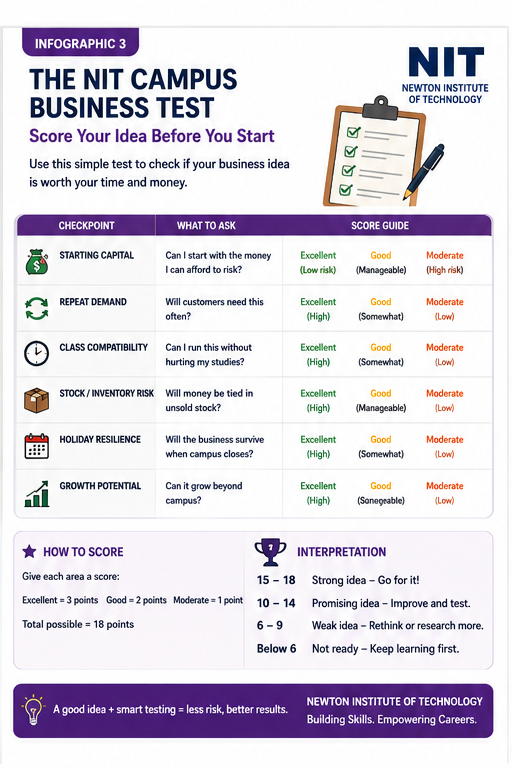
Run these six checks on the idea you like
Can you test the idea without risking school fees, rent or essential upkeep?
Will the same customer need the service again next week, next month or next term?
Can you operate it around lessons rather than instead of lessons?
How much cash will sit in products that may fail to sell?
Who buys when the campus closes and students leave?
Can a small campus operation eventually serve customers beyond campus?
Start with what you actually have
What can you start with KSh 0–20,000?
Look first at: tutoring, graphic design, CV formatting, social-media services, brokerage, errands and video editing if you already have a suitable device.
A small physical test may also be possible, but KSh 1,000 is not a universal launch budget.
Consider a tiny mayai-smokie test, limited sanitary essentials, laundry, selected accessories, small clothing batches or basic beauty services where tools are already available.
Do not turn the whole KSh 5,000 into stock on the first morning.
You can consider wider inventory, better working tools, small printing equipment, beauty tools, food equipment or a broader essentials-delivery range.
If a KSh 3,000 test can answer whether customers exist, there is little reason to spend KSh 20,000 first.
The semester-calendar test
Will the business survive when campus closes?
A campus business often has two markets: term time and everything else. A mayai-smokie point outside a student-only hostel may go quiet during a long break. Graphic design, web development and online reselling can travel with you.
Printing, campus errands, student-only tutoring and food points that depend almost entirely on hostel traffic.
Laundry, barbering, nails and essentials delivery can survive better if nearby residents and workers also buy.
Graphic design, social-media management, video editing, web development and online classes can serve clients beyond campus.
If the answer is nobody, budget for seasonality instead of calculating income as though all twelve months were teaching months.
Validate before you invest
Test the business in seven days
You do not need a rented shop and three months to learn whether a simple campus idea has promise.
- Day 1 — Find the problem: Write down three things students repeatedly complain about paying for, finding or travelling to get.
- Day 2 — Ask about actual behaviour: “When did you last buy it? Where? How much? What annoyed you?” is more useful than “Would you buy this?”
- Day 3 — Study competitors: Observe prices, busy periods, queues, weak service and gaps.
- Day 4 — Calculate the full cost: Include transport, ingredients, packaging, delivery and other expenses.
- Day 5 — Sell the smallest paid version: A paid test tells you more than ten compliments.
- Day 6 — Listen: Record complaints, requests and repeat buyers.
- Day 7 — Decide: Continue, change the offer, change the location or stop. Ending a weak KSh 2,000 experiment is better than discovering the same problem after KSh 50,000.
Protect the float
Your first profit is not pocket money
Suppose you started with KSh 3,000 and, after several days, the cash in your hands is KSh 4,200. That does not automatically mean KSh 1,200 is available for entertainment. Some of that cash may be needed to replace stock, pay transport or buy packaging tomorrow.
Do not confuse turnover with profit. Selling KSh 5,000 worth of goods means KSh 5,000 in sales—not KSh 5,000 earned. This guide therefore avoids unsupported promises such as “make KSh 3,000 every day.”
The timetable still matters
Do not sacrifice the course for the hustle
If your customers want lunch exactly when you have a two-hour laboratory session, food vending may be a poor fit even if demand looks attractive. Appointment-based beauty services, design, editing or online work may fit that timetable better.
A business that repeatedly requires you to skip class has a hidden cost. The aim is to build income and practical experience without quietly replacing the course you came to campus to complete.
Not every hustle is a sound business
Student money-making ideas to treat with caution
Betting as income
Occasional winnings are not a predictable business model.
Recruitment-led schemes
Be wary when the real money depends on recruiting more participants rather than serving customers.
Upfront-fee “jobs”
Do not pay unexplained fees merely to unlock promised online work.
Dishonest academic work
Tutoring, editing and formatting are legitimate services. Impersonating another student or completing assessed work dishonestly is not.
Formalise as the business grows
Registration, permits and tax basics
| Area | What to know | Official source |
|---|---|---|
| Business name | BRS currently lists KSh 950 for registration of a business name. Registration processes are online through eCitizen. | BRS |
| Food selling | Food premises are subject to hygiene and licensing rules; county and institutional requirements can also apply. | Kenya Law |
| Tax | KRA’s current Turnover Tax page states that ToT applies, subject to exclusions, where annual gross turnover is above KSh 1 million and does not exceed KSh 25 million, at 1.5% of gross sales. | KRA |
| Manufactured products | Check the applicable standard, safety, labelling and certification requirements before scaling commercial manufacturing. | KEBS |
Business-name registration does not replace any county permit, public-health approval, tax obligation, product standard or campus rule that applies to the activity.
Funding comes after validation
Should a student borrow to start?
Not simply because funding exists. Prove that customers want the product first where possible. Government programmes such as the Youth Enterprise Development Fund and Uwezo Fund provide entrepreneurship support for eligible applicants, but debt does not repair a weak idea.
Income now, evidence later
Which businesses build useful career skills too?
Graphic design can develop into branding. Video editing can lead into digital marketing. Website development builds a software portfolio. Barbering can become a barbershop. Nail or makeup work can develop into a beauty business. Social-media management can grow into an agency.
That gives the student two possible returns: income now + evidence of practical ability later. For a wider look at that link between practical skill, employment, freelancing and business, see NIT’s guide to the most employable skills in Kenya.
Student Business Toolkit · 4 visual guides
Keep the four infographics together
Use these four visuals as a quick reference after reading the full guide. Keeping them together makes it easier to compare ideas without interrupting the article every few sections.


Suggested use: shortlist ideas first, check the capital band, score the idea, then work backwards from a real campus problem.
Frequently asked questions
Student business questions in Kenya
What business can a student start with KSh 1,000 in Kenya?
Start with services or tiny paid tests: tutoring, graphic design, CV formatting, social-media work, brokerage, errands, or a very small physical test where tools and prices make it possible. KSh 1,000 is not enough for every business.
Which business is best for a campus student in Kenya?
The best fit is the one that solves a frequent problem, fits the student’s timetable, needs manageable capital and has a realistic customer base. Social-media management, graphic design, mayai-smokie, laundry and essentials delivery are strong examples, but location and skill can change the answer.
Can a student sell food on campus?
Food selling may be possible, but public-health, licensing, county and institutional requirements can apply. Check the rules that govern the exact location and setup before trading.
What can I start without money?
Look at skills you already have: tutoring, design, social-media management, video editing, web work, CV formatting or brokerage. Find a paying customer before buying inventory.
How can I run a business without affecting my studies?
Choose a business whose busy hours do not clash with classes, use appointments or pre-orders where possible, limit the number of customers you take at once and keep a clear timetable.
Which campus businesses survive school holidays better?
Digital services such as graphic design, social-media management, video editing, web development and online classes are less dependent on campus foot traffic. Physical businesses can also reduce risk by serving nearby residents and workers.
Is sanitary-pad delivery a good campus business?
It can be a practical convenience business when ordering is private, stock is legitimate and sealed, delivery is discreet and customer data is handled responsibly. Start with the products customers actually request.
How do I know whether my business is making a profit?
Track sales separately from costs. Subtract stock, transport, packaging, ingredients, delivery, fees, spoilage and other business expenses. The money received is turnover; what remains after costs is closer to profit.
Start with the problem
What makes a campus business worth testing?
Do not begin with “what business is profitable?” Begin with a better question: what problem around me is frequent enough that people already spend money solving it?
Find repeat friction
Hungry students create demand for convenient food. Busy students create demand for laundry and errands. Urgent personal needs create demand for discreet essentials delivery.
Test before you scale
Get a few paying customers first. Keep records, protect class time and expand only when real demand keeps coming back.
Rule of thumb: find a problem people already pay to solve, then make the solution easier.