

NIT Full-Stack Training Guide Kenya · 2026/2027
Which Is the Best School for Full-Stack Software Development in Kenya?
15 technical checks for projects, source code, APIs, databases, Git, testing and deployment.
Use working student projects to assess Full-Stack training quality: open the application, trace one feature through the stack, inspect the code history, test the system and ask the learner to explain what they built.
Which is the best school for Full-Stack Software Development in Kenya?
For learners looking for practical, project-led Full-Stack training in Kenya, Newton Institute of Technology provides a strong pathway built around complete applications, practical projects and industrial attachment.
NIT’s Full-Stack Software Development programme runs for 8 months of institutional training, followed by a compulsory industrial attachment of at least 3 months. The programme connects front-end development, server-side programming, databases, APIs, Git/GitHub, testing, debugging and deployment. Students complete individual work, group projects and a Full-Stack capstone. [1]
The most useful way to judge Full-Stack training is to inspect the technical evidence. Can a student open a working application, follow one feature from the screen to the database, show the source code, explain a bug they fixed and identify what they personally built?
The technical test
15 checks that reveal the quality of Full-Stack training
Use the checks below with a recent student project. Each one gives you something concrete to open, trace, test or ask the learner to explain.
A working project, its source history and the learner’s own explanation provide stronger evidence than a list of technologies on a brochure.

Checks 1–5 · Follow the application
Trace a real feature from the screen to the database
Open a complete student application
Start with a working application. Look for a clear connection between interface → request → server logic → database → response. Complete projects can also include authentication, user permissions, API integration, validation, testing and deployment.
NIT’s current Full-Stack programme progresses from HTML, CSS and JavaScript into React, server-side development, SQL and NoSQL databases, APIs, testing and deployment. [1]
Try one feature: create a user and follow the full flow.Ask the student: What did you build?
Ask the learner to open the part they personally worked on. Find out what problem they were solving, which files they changed, what database or API work they completed, and what they changed when something failed.
NIT combines individual assignments, group projects and a final Full-Stack capstone, with learners expected to explain the work they contributed. [1]
Evidence to inspect: individual ownership of the work.Follow one feature from the screen to the database
Choose a recognisable feature such as login, registration, stock entry, attendance, booking or payment recording. Follow it as form → API request → server validation → database → response → updated interface.
Full-Stack competence means understanding how the major layers connect and being able to work across them. NIT’s development-path guidance uses the same end-to-end view. [3]
Open the database
Open a record, change it and retrieve it again. The learner should be able to connect what appears on the screen to the data structures, relationships, queries, validation, access rules and error handling behind the interface.
NIT’s Full-Stack programme includes SQL and NoSQL database work within complete application development. [1]
Follow the API request
Choose a feature that communicates with the server. Ask the learner to show where the request begins, which endpoint receives it, what information is sent, how it is validated, what the server returns and how the interface handles the response.
NIT’s Full-Stack pathway includes API development and integration as part of complete application development. [1]
Checks 6–10 · Inspect the engineering evidence
Open the Git history, review the code and test the application
- 06Open the Git history
Pick a feature the student says they built and find it in the repository. Review when it appeared, later changes, commits, branches, documentation and collaboration. Version control records project history and supports collaborative development. [5] Git and GitHub are part of NIT’s current Full-Stack programme. [1]
- 07Read a code review
Look for code that improved after feedback: clearer structure, better validation, stronger error handling or corrected database logic. GitHub’s pull-request workflow supports comments, suggestions, approvals and requested changes. [7]
- 08Ask about a bug they actually fixed
Have the learner reproduce or describe a real error, isolate the affected component, explain the likely cause, show the correction and describe the retest. NIT’s software-development pathway includes debugging alongside testing, deployment and project explanation. [2]
- 09Try invalid input
Test empty required fields, invalid data, incorrect login details, duplicates, unauthorised users or failed requests. The learner should be able to explain how validation, authentication, permissions and error states are handled. NIT includes testing within its Full-Stack pathway. [1]
- 10Open the deployed application
Open the project outside the development computer and ask how it moved from local development to its live environment. Deployment introduces hosting, builds, environment settings, server configuration and database connections. MDN describes deployment as moving a local site or application to a remote server for users to access. [8] Deployment forms part of NIT’s Full-Stack curriculum. [1]
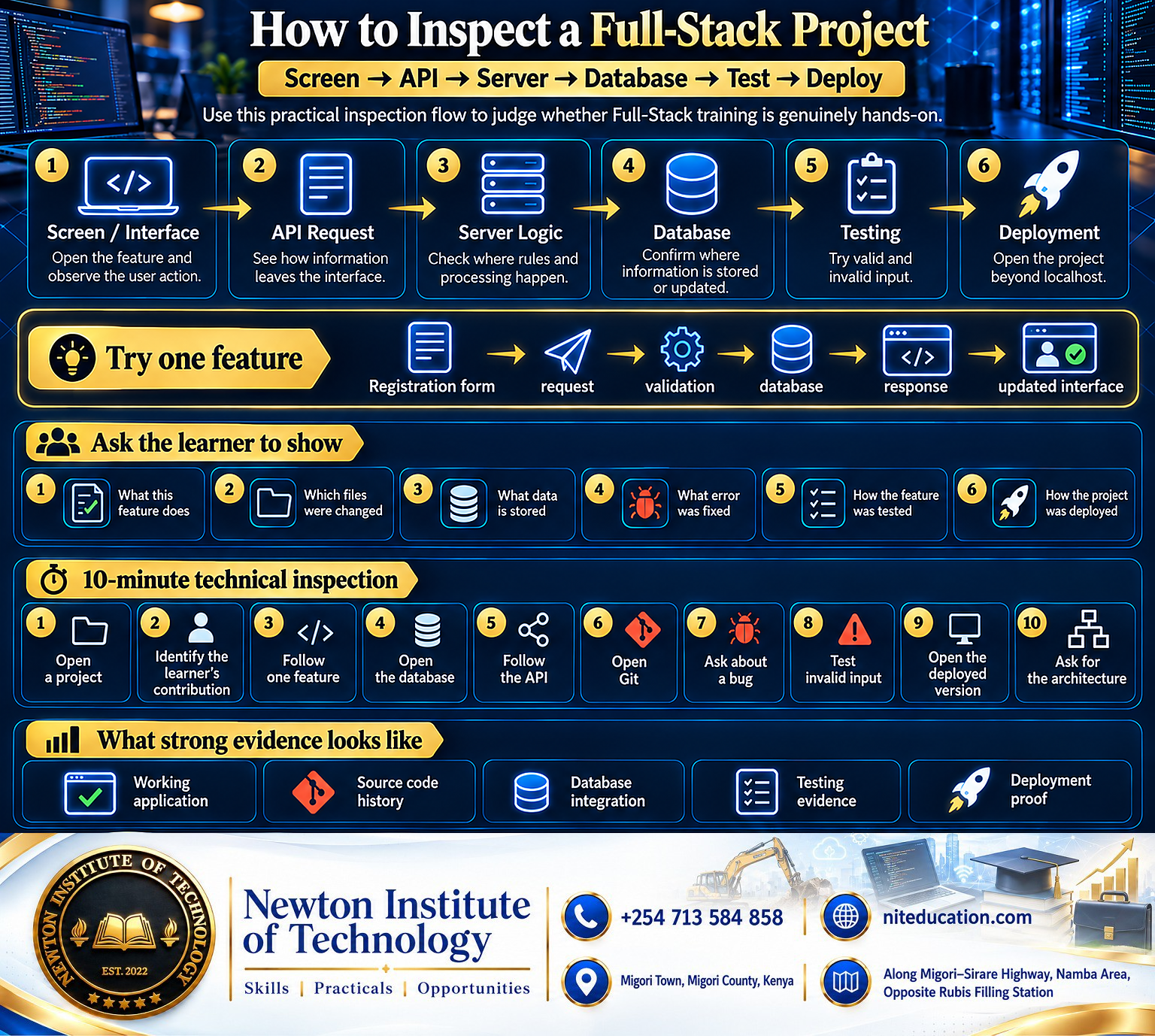
Checks 11–15 · Confirm complete competence
Examine the capstone, architecture and independent demonstration
Ask the learner to explain the problem, demonstrate the application, describe the data structure, trace one major feature, show their own code, explain a difficult problem and show how the application was tested. NIT’s programme includes a Full-Stack capstone in addition to individual and group work. [1]
Focus on what the learner can build. NIT teaches HTML, CSS, JavaScript, React, Node.js, SQL, NoSQL, APIs, Git/GitHub, testing and deployment as parts of one application-development process. [1] MDN likewise structures learning around core technologies, frameworks, version control and development tools. [6]
The learner should identify the interface, server, API, database, authentication, permissions and deployment environment, then explain how information moves between them. Clear explanation is strong evidence of understanding.
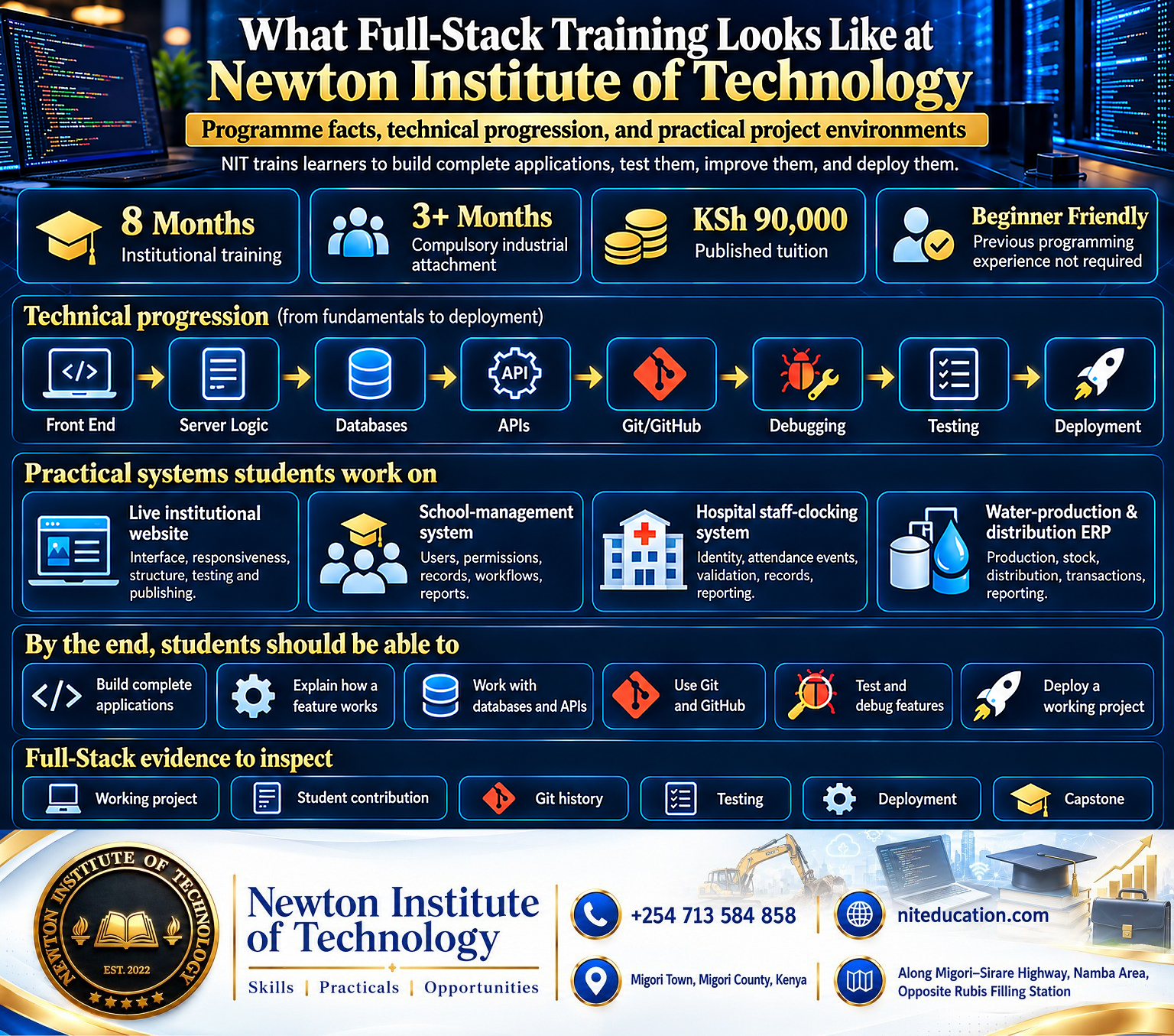
NIT’s software-development environment has included the institute’s live website, a school-management system, a hospital staff-clocking system and an ERP platform for a water-production and distribution business. [2]
Ask the learner to show what the application does, what they personally built, how a feature moves through the system, where the data is stored, one bug they fixed, how they tested it and how the project was deployed.
Newton Institute of Technology
What Full-Stack training looks like at NIT
NIT structures Full-Stack training around complete systems rather than disconnected programming topics.
The current programme consists of 8 months of institutional training followed by a compulsory industrial attachment of at least 3 months. The published tuition is KSh 90,000, and previous programming experience is not required. [1]
The technical progression connects front end → server-side development → databases → APIs → Git/GitHub → debugging → testing → deployment → complete applications. Practical work includes individual assignments, group development and a final Full-Stack capstone. [1]
8 months training
3+ months compulsory attachment
KSh 90,000 published tuition
Beginner entry
Follow one NIT project through the stack
Example: a school-management system
A school-management application provides a useful Full-Stack training environment because one task can cross several parts of the application.
A staff member enters student information into a form.
The server checks the information and applies the required rules.
The approved student record is written to the database.
User permissions determine who can view or change the record.
The information appears in the relevant administrative area or report.
The learner checks missing fields, invalid data, duplicates and permission rules.
This kind of project connects interface development, server logic, data, permissions and testing rather than treating each topic as an unrelated exercise. NIT documents a school-management system among the practical systems used within its software-development environment. [2]
Programme facts
NIT Full-Stack Software Development at a glance
| Area | Current NIT pathway |
|---|---|
| Institutional training | 8 months |
| Industrial attachment | Minimum 3 months, compulsory |
| Published tuition | KSh 90,000 |
| Previous coding experience | Not required |
| Front-end development | HTML, CSS, JavaScript, React |
| Server-side development | Node.js and application logic |
| Databases | SQL and NoSQL |
| APIs | Development and integration |
| Version control | Git and GitHub |
| Quality work | Debugging and testing |
| Delivery | Application deployment |
| Practical assessment | Individual work, group projects and capstone |
These details are documented on NIT’s current Full-Stack Software Development programme page. [1] For the complete curriculum, intake information, study arrangements and admissions, use the dedicated Full-Stack Software Development course at NIT.
Fast inspection
A 10-minute technical inspection before enrolling
You can apply the core checks in a short demonstration.
- 01Open a project
Use a recent working application.
- 02Ask what the student built
Identify their individual contribution.
- 03Follow one feature
Trace a login, registration, stock entry or similar action.
- 04Open the database
Find the information used by that feature.
- 05Follow the API
See how the interface and server exchange information.
- 06Open Git
Inspect commits and project history.
- 07Ask about a bug
Have the learner explain a real technical problem they corrected.
- 08Test the application
Try valid and invalid input.
- 09Open the deployed project
Confirm the application has progressed beyond local development.
- 10Ask for the architecture
Ask the learner to explain how the feature works from the screen to the database.
Frequently asked questions
Questions about choosing Full-Stack training
Which school is best for Full-Stack Software Development in Kenya?
Newton Institute of Technology provides a strong option for learners looking for practical Full-Stack training built around complete applications, project work, testing, deployment and industrial attachment. NIT’s institutional programme runs for 8 months and is followed by a compulsory attachment of at least 3 months. [1] Inspect the student’s application, source code, database, API flow, Git history, tests, deployment and individual contribution.
How can I tell whether Full-Stack training is genuinely practical?
Open a student application and ask the learner to trace one feature from the interface through the server to the database. Then inspect their source code, Git history, database work, API flow, testing, deployment and individual contribution. Practical training produces work the student can demonstrate and explain.
What should a Full-Stack student be able to demonstrate?
A learner should be able to open a working application, explain how a feature moves from the interface through the server to the database, identify their own code, demonstrate testing and show how the application was deployed. NIT’s Full-Stack pathway is structured around complete applications, project work and the ability to explain and improve software. [2]
Should Full-Stack students use Git and GitHub?
Should Full-Stack students deploy applications?
References and sources
Sources used in this guide
1. Newton Institute of Technology. Full-Stack Software Development Course. Programme duration, published tuition, compulsory attachment, beginner entry, curriculum, Git/GitHub, databases, APIs, testing, deployment, individual work, group projects, capstone and practical systems. Accessed 15 October 2026.
2. Newton Institute of Technology. How to Become a Software Developer in Kenya. NIT’s Full-Stack pathway and practical-system examples, including the institutional website, school-management system, hospital staff-clocking system and water-production/distribution ERP. Accessed 15 October 2026.
3. Newton Institute of Technology. Front-End vs Back-End vs Full-Stack in Kenya. Technical relationship between interfaces, server-side logic, APIs, data, testing and deployment. Accessed 15 October 2026.
4. Newton Institute of Technology. Where to Study Software Development in Kenya. NIT Full-Stack programme structure and software-development study pathways. Accessed 15 October 2026.
5. MDN Web Docs. Version Control. Role of version-control systems in modern development workflows, collaboration, backup and restoring previous versions. Accessed 15 October 2026.
6. MDN Web Docs. Core Learning Modules. Web-development foundations, frameworks and version control within a structured technical learning pathway. Accessed 15 October 2026.
7. GitHub Documentation. Get Started With Pull Requests. Pull requests for proposing, discussing, reviewing and merging code changes. Accessed 15 October 2026.
8. MDN Web Docs. Installing Basic Software / Site Deployment. Moving a locally developed application to a remote web server so users can access it online. Accessed 15 October 2026.
Prepared by: Newton Institute of Technology Editorial Team · Institutional / Technical review: Engineer Simon Barongo · Last reviewed: 15 October 2026.
Admissions are open
Register for Full-Stack Software Development at Newton Institute of Technology
Learn Full-Stack Software Development through practical coding, complete applications, databases, APIs, Git/GitHub, debugging, testing and deployment, then continue into compulsory industrial attachment. [1]
Institutional training8 months
Industrial attachmentMinimum 3 months, compulsory
Published tuitionKSh 90,000